
Blockchain Certificate Verification in 2026: Combating AI-Generated Credential Fraud
Published on April 4, 2026

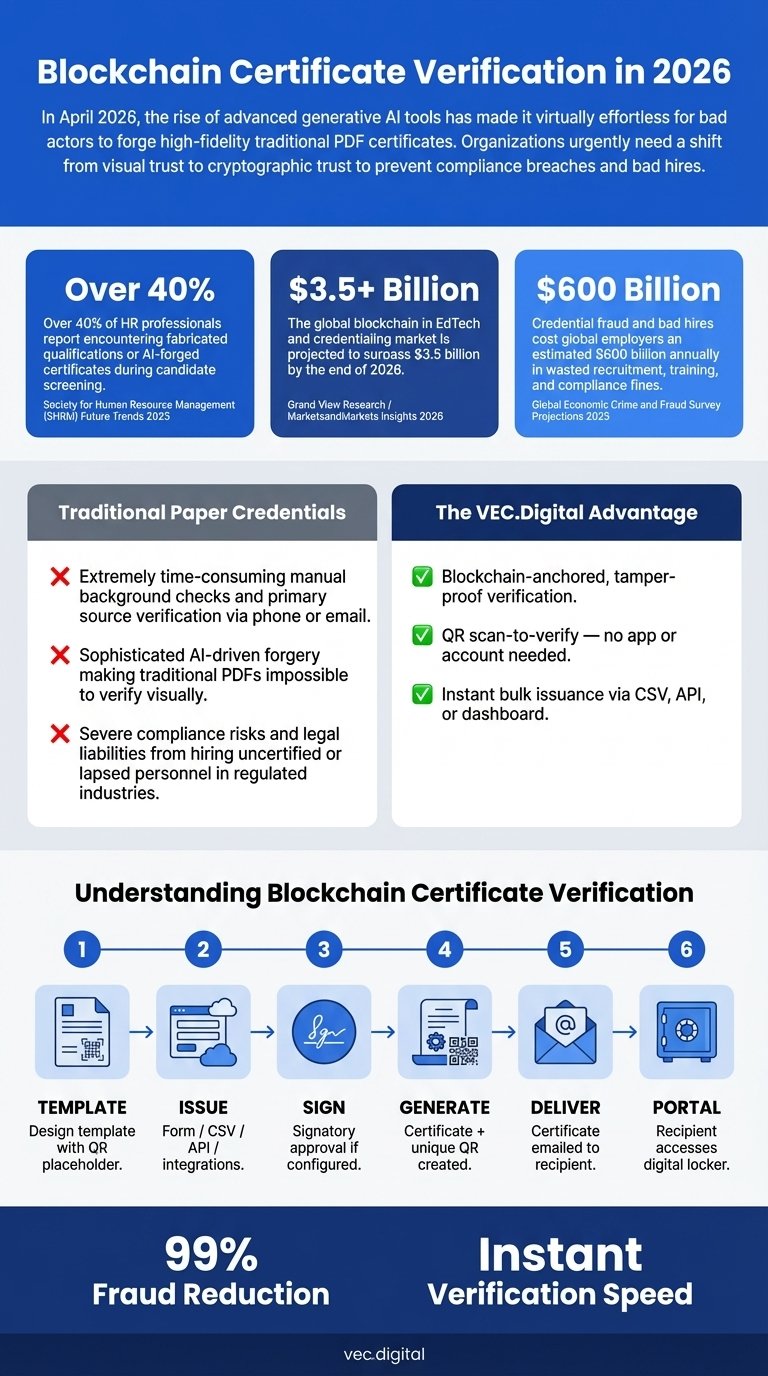
Credential fraud and bad hires cost global employers an estimated $600 billion annually in wasted recruitment, training, and compliance fines, according to the 2025 Global Economic Crime and Fraud Survey Projections. As advanced generative AI tools make it virtually effortless to forge high-fidelity traditional PDFs, relying on visual authenticity is no longer a viable strategy for HR managers and university registrars. Implementing robust blockchain certificate verification is now the essential defense mechanism for protecting institutional reputation and ensuring regulatory compliance globally.
In this comprehensive guide, our team at VEC.Digital shares our deep expertise in blockchain-powered digital credentialing to help your organization transition from vulnerable visual trust to irrefutable cryptographic trust. You will learn how to effectively eliminate credential fraud using seamless QR code scan-to-verify workflows, how to issue bulk, tamper-proof certificates in minutes, and how to provide learners with globally accessible, permanently verifiable credentials. By the end of this article, you will have a clear roadmap for modernizing your issuance pipeline while significantly reducing manual background check processing times.
Key Takeaways
- AI-Driven Forgery is rendering traditional PDF certificates obsolete, requiring an urgent shift to cryptographic verification mechanisms.
- Blockchain Certificate Verification provides immutable, instant proof of authenticity without requiring deep technical expertise from HR administrators.
- QR Code Workflows allow employers to instantly verify digital credentials globally, bypassing slow and expensive manual background checks.
- Automated Issuance Pipelines enable organizations to securely issue credentials at scale via dashboard, CSV upload, REST API, or third-party integrations.
- Sustainable Credentialing eliminates paper waste, supports global UN sustainability goals, and drastically reduces operational printing costs.
The Rise of AI Forgery and the Death of Visual Trust
The landscape of professional credentialing has undergone a seismic shift. For decades, organizations relied on the visual inspection of physical diplomas, watermarks, and embossed seals. Even as the world transitioned to digital formats, the standard remained the PDF document. However, the proliferation of sophisticated digital tools has fundamentally compromised this model. Today, implementing blockchain certificate verification is not merely a technological upgrade; it is a fundamental requirement for maintaining institutional integrity.
How Generative AI is Fueling Digital Credential Fraud
In April 2026, the rise of advanced generative AI tools has made it virtually effortless for bad actors to forge high-fidelity traditional PDF certificates. What once required specialized graphic design skills can now be accomplished in seconds with a simple text prompt. AI systems can perfectly replicate university letterheads, clone authorized signatures, and generate flawless typography that easily passes a visual inspection.
This technological democratization of forgery has created a massive headache for hiring managers worldwide. According to the Society for Human Resource Management (SHRM) Future Trends report for 2025, over 40% of HR professionals report encountering fabricated qualifications or AI-forged certificates during candidate screening. When a forged document looks identical to a genuine one, visual trust is effectively dead. Organizations urgently need a shift from visual trust to cryptographic trust to prevent compliance breaches and bad hires.
The Hidden Costs of Manual Background Checks
Faced with an influx of potentially fraudulent applications, HR departments and university registrars are often forced to fall back on extremely time-consuming manual background checks. This involves primary source verification via phone calls, emails to university administration offices, and waiting days or even weeks for confirmation. This archaic process creates severe bottlenecks in the recruitment pipeline.
The financial and operational toll of these delays is staggering. However, technology provides a clear solution. The Gartner HR Tech Innovations report for 2026 highlights that organizations leveraging automated verification workflows reduce background check processing times by up to 70%. By transitioning to cryptographic verification, organizations can eliminate the administrative burden of manual follow-ups, allowing HR teams to focus on strategic talent acquisition rather than acting as document sleuths.
Global Compliance Risks in the Digital Age
Beyond the operational inefficiencies, the failure to properly verify credentials carries severe compliance risks and legal liabilities, particularly in regulated industries such as healthcare, finance, and aviation. Hiring uncertified or lapsed personnel can lead to devastating consequences, including massive fines, loss of operating licenses, and severe reputational damage.
Global privacy and compliance regulations are pushing organizations away from insecure data practices. Frameworks such as GDPR in Europe, HIPAA in US healthcare, and the Dubai Paperless Strategy in the UAE mandate stringent data protection and privacy standards. Sending unencrypted PDF certificates via email is increasingly viewed as a liability. Secure, privacy-preserving verifiable credentials give data ownership back to the recipient while ensuring institutional compliance and protecting sensitive personal information.
Understanding Blockchain Certificate Verification
Despite the growing necessity for secure digital credentials, there remains a significant knowledge gap. Existing industry literature often focuses heavily on the complex cryptography behind Web3, alienating business leaders who simply need a reliable solution. At VEC.Digital, we believe in shifting the conversation from theoretical concepts to practical B2B utility. Understanding blockchain certificate verification is about understanding how to achieve instant, irrefutable proof without requiring technical expertise from your staff.
How Does Blockchain Certificate Verification Actually Work?
One of the most common questions we receive is: How does blockchain certificate verification actually work? The process is elegantly simple for the user, while highly secure on the backend. When your organization issues a certificate through VEC.Digital, the platform generates a unique cryptographic "hash"—a digital fingerprint of that specific document. This hash is then anchored onto an immutable blockchain ledger.
The blockchain does not store the recipient's personal data or the certificate itself, ensuring complete compliance with global privacy laws like GDPR. Instead, it only stores the cryptographic proof of issuance. When a third party, such as a hiring manager, attempts to verify the certificate, the system recalculates the hash of the presented document and compares it to the hash stored on the blockchain. If they match, the document is mathematically proven to be authentic and unaltered. If even a single pixel or letter has been changed by AI forgery, the hashes will not match, and the verification will instantly fail.
Can a Blockchain Verifiable Credential Be Faked or Hacked?
Another critical question from administrators is: Can a blockchain verifiable credential be faked or hacked? The short answer is no. Because the verification relies on decentralized, immutable ledger technology, altering the record of a certificate after it has been issued is computationally impossible.
Traditional databases can be breached, and records can be altered by malicious internal or external actors. However, once a certificate's hash is anchored to the blockchain, it becomes a permanent, tamper-proof record. Even if a bad actor manages to create a perfect visual replica of a certificate using generative AI, they cannot alter the blockchain ledger to validate their forgery. The cryptographic proof serves as an absolute source of truth.
Standard Digital Badges vs. Verifiable Credentials
To fully grasp the modern credentialing landscape, it is important to understand: What is the difference between a standard digital badge and a verifiable credential? A standard digital badge is often just an image file (like a PNG) with some metadata attached. While visually appealing, they are relatively easy to copy, manipulate, or falsely claim.
A verifiable credential, on the other hand, is built on robust cryptographic standards—such as those outlined by the W3C Verifiable Credentials Data Model. It contains mathematically provable assertions about the issuer, the recipient, and the achievement. While a standard badge relies on the viewer trusting the image, a verifiable credential relies on mathematical certainty, making it the only viable choice for high-stakes professional and academic credentialing.
The Mechanics of Instant Trust: QR Codes and Digital Lockers
The true power of blockchain certificate verification lies in its accessibility. Security protocols are only effective if they are easy for end-users to adopt. VEC.Digital has engineered an issuance and verification pipeline that prioritizes seamless user experiences, ensuring that anyone, anywhere, can verify a credential in seconds.
Why Are QR Codes Used on Secure Digital Certificates?
A frequent inquiry from our enterprise clients is: Why are QR codes used on secure digital certificates? The answer comes down to bridging the physical and digital worlds seamlessly. Every certificate issued through VEC.Digital features a unique, dynamically generated QR code. This code links directly to a dedicated verification URL (e.g., /certificate/[uuid]).
This QR code scan-to-verify workflow empowers instant, irrefutable proof. If a certificate is printed on physical paper for a graduation ceremony or a corporate office wall, an observer can simply scan the QR code with their standard smartphone camera. There is no need to download a proprietary app, create an account, or log into a portal. The scan instantly queries the blockchain and provides a definitive "Pass/Fail" result.
How Do Employers Check if a Digital Certificate is Genuine?
When an employer receives a digital certificate from a candidate, they need a frictionless way to validate it. How do employers check if a digital certificate is genuine? With VEC.Digital, the process is entirely frictionless. The employer simply clicks the verification link provided by the candidate or scans the QR code.
They are immediately directed to a public certificate verification page. If the credential is authentic, the page clearly displays a prominent "blockchain verified" badge, alongside the recipient's details, the issuer's verified identity, and the exact timestamp of issuance. This simple, intuitive interface completely eliminates the need for phone calls to university registrars or emails to previous employers, providing instant peace of mind.
Empowering Learners with Recipient Digital Lockers
Modern credentialing is not just about the issuer; it is equally about empowering the recipient. Professionals today are highly mobile, often moving between countries and industries. They require permanent, secure access to their qualifications.
VEC.Digital provides every recipient with a secure digital locker. This portal gives learners permanent access to all their earned certificates in one centralized location. They can view, download, or share their credentials via a simple link to their LinkedIn profile or directly with prospective employers. This global accessibility ensures that their hard-earned qualifications are always at their fingertips, anywhere in the world, at any time.
How Universities and Enterprises Can Prevent Forgery
For large-scale issuers, the challenge is not just issuing a single secure document, but managing thousands of credentials efficiently while maintaining strict security protocols. Implementing blockchain certificate verification at scale requires a platform designed for organizational workflows.
Protecting Institutional Reputation at Scale
University administrators frequently ask: How can universities prevent certificate forgery? The stakes are incredibly high. Brand dilution and reputational damage occur rapidly when fake certificates bearing an institution's name circulate in the job market. If employers lose trust in a university's diplomas, the value of that institution's education plummets.
This is why 85% of university administrators consider immutable digital credentialing a top priority for protecting their institutional reputation, according to the 2026 Educause Higher Ed Trend Report. By adopting VEC.Digital, universities ensure that every diploma issued is cryptographically sealed. This not only protects the institution's legacy but also protects the investment made by legitimate alumni, ensuring their genuine credentials retain their high value in the marketplace. You can learn more about our tailored approaches on our Higher Education Solutions page.
Streamlining the Issuance Pipeline
Transitioning to secure credentialing should not create administrative nightmares. VEC.Digital offers four distinct issuance methods to accommodate any organizational size or technical capability. Administrators can issue certificates one-by-one via an intuitive dashboard form, utilize CSV uploads for bulk issuance to hundreds of graduates simultaneously, or leverage our REST API and third-party integrations for fully programmatic, automated issuance.
Furthermore, VEC.Digital features a robust multi-signatory workflow. Organizations can assign up to two signatories per certificate template. The certificate is held securely in a pending state until all signatories have independently reviewed and signed off, ensuring strict internal governance. Designing these certificates is equally effortless, utilizing our template editor which boasts over 1,400 Google Fonts, drag-and-drop functionality, support for A2 through A5 sizes in both portrait and landscape, and seamless Canva integration for stunning background designs.
Certificate Revocation and Lifecycle Management
Credential management does not end at issuance. In corporate training, compliance certifications, and professional licensing, credentials often expire or may need to be revoked due to ethical violations or updated regulatory requirements. A major content gap in the industry is explaining how easily institutions can manage this lifecycle.
With VEC.Digital, administrators have complete control over certificate revocation and lifecycle management. If a credential must be invalidated, the issuer can revoke it directly from their dashboard. Because the verification page queries the live blockchain status, anyone scanning the QR code or clicking the link subsequently will instantly see that the certificate has been revoked or has expired. This ensures that only currently valid, compliant certifications are recognized in the field.
Driving Sustainability and Global Market Adoption
The transition to blockchain certificate verification is driven not only by security needs but also by global economic and environmental imperatives. Organizations worldwide are recognizing the multi-faceted benefits of digitizing their credentialing workflows.
The Environmental Impact of Digital Credentials
Traditional paper-based credentialing is highly resource-intensive. The global printing, packaging, and international shipping of physical diplomas contribute significantly to organizational carbon footprints and operational costs. At VEC.Digital, we are deeply committed to sustainability and actively support UN sustainability goals.
By transitioning to digital certificates, organizations completely eliminate paper waste, reduce the consumption of toxic printing inks, and eradicate the carbon emissions associated with physical delivery logistics. This eco-friendly approach not only aligns with global corporate social responsibility (CSR) initiatives but also drastically reduces the hard costs associated with credential management, allowing educational institutions and corporations to reallocate those funds toward actual learning and development.
Projected Growth of the Verifiable Credentials Market
The global shift toward secure digital credentialing is accelerating rapidly. According to insights from Grand View Research and MarketsandMarkets for 2026, the global blockchain in EdTech and credentialing market is projected to surpass $3.5 billion by the end of the year.
This explosive growth underscores a fundamental market realization: cryptographic trust is the new baseline. Organizations that fail to adopt verifiable credentials risk falling behind global compliance standards and losing the trust of their stakeholders. Leading HR organizations and educational bodies globally are actively pushing for these standards to become the universal norm for professional verification.
Securing Your Organization's Future with VEC.Digital
As AI-generated forgery continues to undermine traditional document security, the need for robust, immutable proof of achievement has never been greater. Blockchain certificate verification is the definitive solution to credential fraud, offering instant, cryptographically secure verification that protects your organization's reputation while drastically reducing administrative overhead.
VEC.Digital is engineered to make this transition seamless. From our intuitive template editor and multi-signatory workflows to our seamless QR code verification and recipient digital lockers, we provide a comprehensive, end-to-end credentialing platform trusted globally. Whether you are a university registrar managing thousands of graduates or a corporate compliance officer ensuring workforce readiness, our platform delivers the security and efficiency you require.
We believe that high-grade security should be accessible to all organizations. That is why VEC.Digital offers a completely free plan to help you start issuing secure credentials immediately—with no credit card required and no setup fees. As your needs grow, our paid organizational plans start at just $29.99/month, and individuals can verify single certificates for just $1.00 each. Explore our organization pricing to find the perfect fit for your institution.
Ready to eliminate credential fraud and modernize your issuance pipeline? Start your journey today and experience the power of effortless, trustworthy digital credential issuance.
Contact our team to learn more:
Website: vec.digital
Email: support@vec.digital
WhatsApp: +971521373078