Blockchain Certificate Verification in 2026: Stopping AI Fraud
Published on April 24, 2026
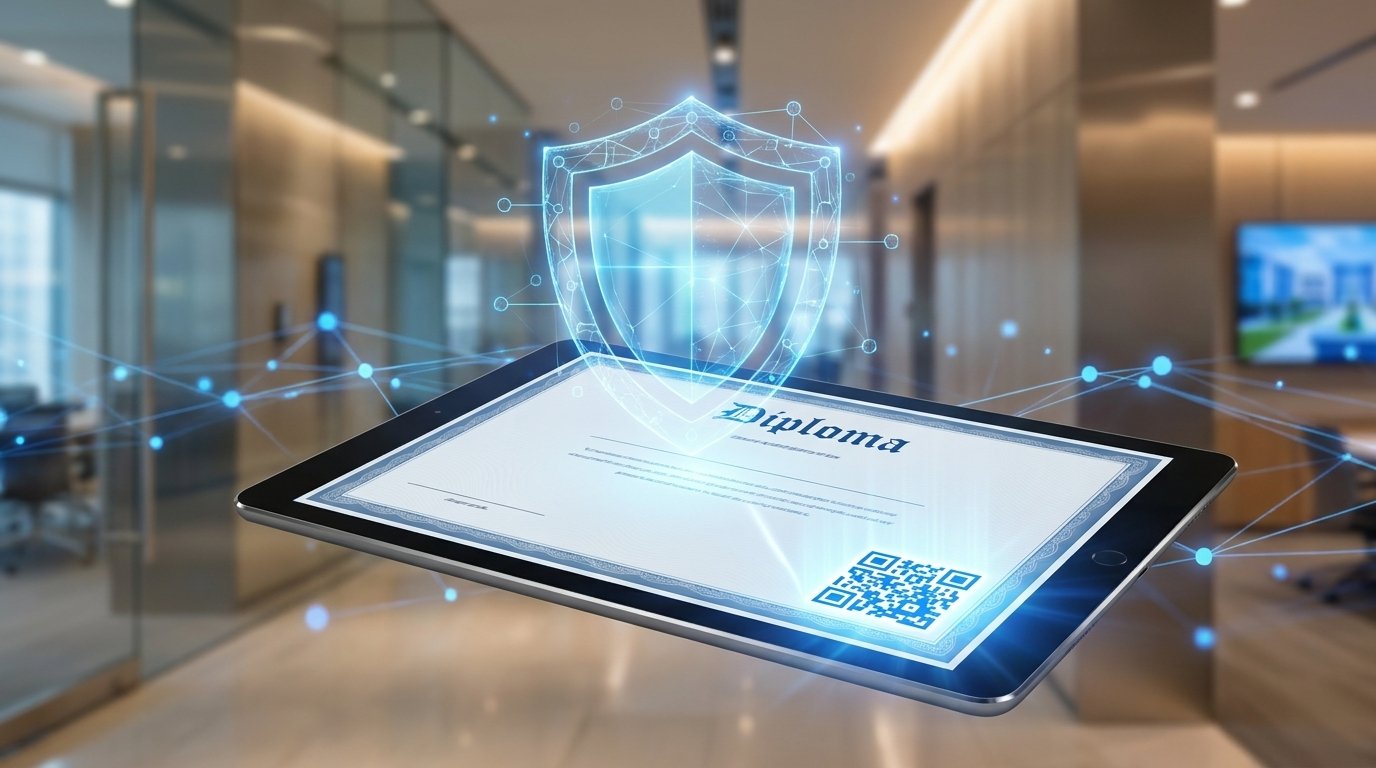
Over 60% of higher education institutions reported an increase in sophisticated, digitally manipulated fake degrees over the past 12 months, according to the 2026 Global Credential Fraud Report. As generative AI makes fabricating visually flawless PDFs effortless, traditional documents no longer offer reliable proof of achievement. Implementing robust blockchain certificate verification is now an urgent necessity to protect institutional reputation and enable instant authenticity checks globally.
In this comprehensive guide, our team at VEC.Digital shares our expertise in blockchain-powered digital credentialing to help your organization navigate the evolving landscape of academic and professional fraud. You will learn how to eliminate credential fraud using immutable records, how to issue bulk certificates in minutes with multi-signatory workflows, and how to provide learners with globally accessible, instantly verifiable credentials.
Key Takeaways
- AI-generated credential fraud is rendering traditional PDF certificates obsolete and vulnerable to sophisticated manipulation.
- Blockchain certificate verification reduces HR verification time from several days to less than two seconds.
- QR code certificate verification provides a seamless, app-free experience for instant authenticity checks globally.
- Tamper-proof digital records protect institutional reputation and empower graduates to share credentials securely on platforms like LinkedIn.
- Sustainable digital credentialing eliminates paper waste while supporting international compliance and UN sustainability goals.
The Rise of AI-Generated Credential Fraud in Education and Corporate Sectors
The accessibility of advanced generative artificial intelligence has fundamentally altered the landscape of document security. In the past, creating a convincing counterfeit diploma or corporate training certificate required specialized graphic design skills and access to high-quality printing equipment. Today, AI tools can generate pixel-perfect replicas of institutional documents in a matter of seconds. This technological shift has created a critical vulnerability for organizations worldwide. Blockchain certificate verification has emerged as the definitive response to this crisis, shifting the paradigm from visual inspection to cryptographic certainty.
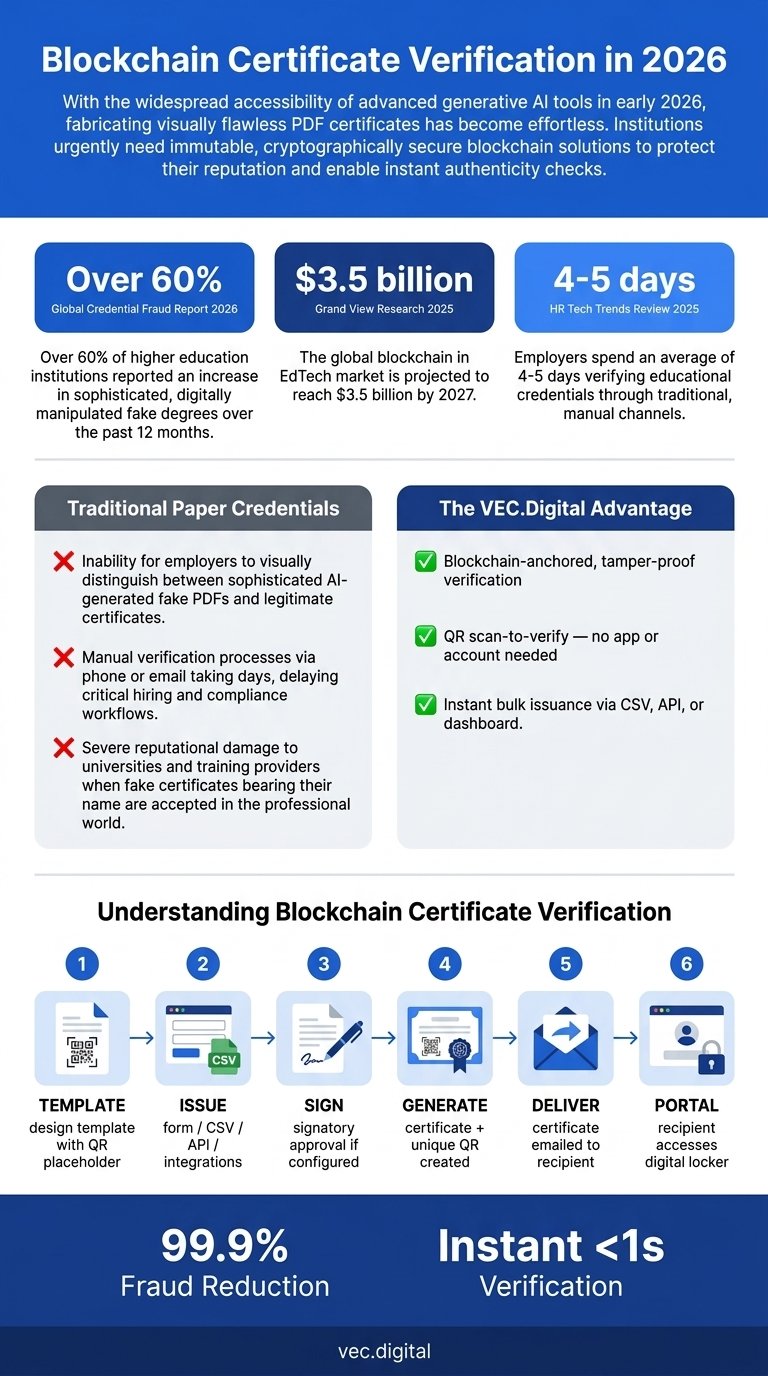
When fake certificates bearing a legitimate institution's name are accepted in the professional world, the reputational damage can be severe and long-lasting. Universities, training providers, and certification boards invest decades in building their prestige, only to have it undermined by sophisticated forgeries. The inability for employers to visually distinguish between sophisticated AI-generated fake PDFs and legitimate certificates means that visual trust is no longer sufficient. Organizations must adopt issuance pipelines that anchor credentials to an immutable ledger, ensuring that every claim of achievement can be mathematically proven.
Why Are Traditional PDF Certificates No Longer Secure?
Traditional PDF certificates are inherently static documents. Even when secured with basic digital signatures or passwords, they remain vulnerable to modern tampering techniques. Malicious actors can easily strip metadata, alter text layers, or use AI-driven image manipulation to change names, dates, and grades. Furthermore, when a graduate attempts to share a traditional PDF on professional networks like LinkedIn, there is a lack of a centralized, secure method to prove the document has not been altered since its issuance.
This vulnerability is driving a massive shift in the educational technology sector. According to Grand View Research (2025), the global blockchain in EdTech market is projected to reach $3.5 billion by 2027. This explosive growth reflects a universal recognition that legacy issuance methods are obsolete. Institutions are actively seeking secure digital certificates that provide undeniable proof of origin and integrity, rendering visual manipulation entirely ineffective.
The Hidden Costs of Manual Verification
The burden of credential fraud falls heavily on human resources departments and hiring managers. When visual inspection fails, employers are forced to rely on manual verification processes. This typically involves contacting university registrars or certification bodies via phone or email—a process fraught with friction. According to the HR Tech Trends Review (2025), employers spend an average of 4-5 days verifying educational credentials through traditional, manual channels. These delays disrupt critical hiring and compliance workflows, often resulting in lost talent and increased operational costs.
The modern workforce operates at a rapid pace, and administrative bottlenecks are no longer acceptable. It is no surprise that 75% of HR professionals now prioritize instant, automated verification capabilities when evaluating candidate credentials, as reported by the Society for Human Resource Management (SHRM, 2026). By transitioning to verifiable credentials, organizations can eliminate these hidden costs, streamlining the talent acquisition process while dramatically enhancing security and compliance confidence.
Understanding Blockchain Certificate Verification
To combat the sophisticated threats posed by modern forgery, institutions must deploy cryptographic defenses. Blockchain certificate verification operates on a fundamentally different premise than traditional document security. Instead of relying on the physical or digital appearance of a certificate, this technology anchors a unique cryptographic hash of the credential's data to an immutable, decentralized ledger. This process creates a permanent, unalterable record of the certificate's issuance, timestamp, and contents.
For university administrators and HR compliance officers, this means shifting from a model of "trusting the document" to "trusting the mathematics." When a certificate is anchored on the blockchain, any subsequent alteration to the underlying data—even a single pixel or character—will generate a completely different cryptographic hash, immediately flagging the document as invalid. This binary state of validity (either mathematically proven or entirely invalid) provides absolute certainty in an era of deepfakes and AI manipulation.
How Do You Verify a Blockchain Digital Certificate?
The verification process for a blockchain-anchored credential is designed to be instantaneous and user-friendly, completely abstracting the complex cryptography running in the background. When an employer or compliance manager receives a digital certificate, they simply access the unique verification link associated with that document. The system then automatically queries the blockchain ledger, comparing the hash of the presented document against the hash recorded at the time of issuance.
The efficiency gains of this automated process are staggering. Research from the Digital Trust Initiative (2026) confirms that blockchain-anchored digital credentials reduce verification time from several days to less than 2 seconds. The verifying party is instantly presented with a clear "blockchain verified" badge on the public certificate verification page, confirming the issuing institution's identity, the recipient's details, and the exact timestamp of issuance—all without requiring manual intervention from the issuing body.
Can Blockchain Certificates Be Faked or Altered?
A common question among certification board directors is whether these new digital credentials share the same vulnerabilities as their PDF predecessors. The definitive answer is no. Once a certificate's data is anchored to the blockchain, the record becomes immutable. Modifying the text on the digital certificate does not change the record on the blockchain; it merely breaks the cryptographic link, causing any verification attempt to fail immediately.
To ensure the utmost integrity during the issuance pipeline, platforms like VEC.Digital utilize a robust multi-signatory workflow. Organizations can designate up to two signatories per template. The certificate is held in a pending state until all signatories have independently reviewed and signed off on the issuance. This internal governance mechanism ensures that no credential is ever anchored to the blockchain without proper authorization, further solidifying the trust and immutability of the final verifiable credential.
Bridging the Gap: The Power of QR Code Certificate Verification
While the underlying technology of decentralized ledgers is complex, the user experience must be frictionless to achieve global adoption. This is where blockchain certificate verification intersects with everyday usability. The most effective way to bridge the gap between advanced cryptography and practical HR workflows is through the integration of Quick Response (QR) technology. By embedding a unique, scannable code on every issued credential, institutions provide a universally understood mechanism for instant authenticity checks.
This approach democratizes the verification process. Employers, auditors, and event organizers do not need specialized software, technical training, or proprietary accounts to validate a claim. They simply use the native camera on their smartphone or a standard web browser. This seamless interaction is crucial for global scalability, ensuring that credentials issued in one continent can be instantly and confidently verified in another.
How Do QR Codes Work on Secure Digital Certificates?
Every certificate issued through a modern platform features a unique QR code linking directly to a dedicated verification portal (e.g., /certificate/[uuid]). When scanned, the QR code directs the user's device to the public verification page where the cryptographic check is performed automatically in the background. Crucially, there is no app to download, no account to create, and no login required to verify the credential.
This scan-to-verify functionality is particularly powerful for physical environments, such as corporate offices, construction sites requiring safety compliance checks, or professional conferences. An inspector can simply scan a worker's printed or digitally displayed badge and instantly view the "blockchain verified" status, ensuring immediate compliance with safety and regulatory standards.
Empowering Graduates with a Secure Digital Locker
Beyond the benefits to institutions and employers, modern credentialing systems profoundly improve the learner experience. Graduates and trainees are provided with a recipient digital locker—a centralized, secure portal where they gain permanent access to all their earned certificates. This locker is accessible anywhere, anytime, completely eliminating the frustration of lost paper diplomas or inaccessible university email accounts.
From this secure environment, learners can effortlessly share their achievements across social media, embed them in digital portfolios, or send direct verification links to prospective employers. Because every shared link points back to the immutable blockchain record, the graduate is protected from accusations of credential fraud, and the employer receives instant, cryptographic proof of the candidate's qualifications.
How to Prevent Digital Certificate Fraud Globally
Combating credential fraud is not a regional challenge; it requires a global perspective and adherence to international standards. As the workforce becomes increasingly borderless, the mechanisms we use to establish trust must transcend geographical boundaries. Implementing blockchain certificate verification is the foundational step, but organizations must also modernize their entire approach to credential design, issuance, and management.
To truly prevent fraud, institutions must adopt systems that are both highly secure and highly adaptable. This means moving away from localized, proprietary databases and embracing standardized, publicly verifiable ledgers. It also requires utilizing platforms that offer flexible, scalable issuance methods capable of handling everything from a single bespoke award to thousands of automated corporate training certificates.
Aligning with International Digital Identity Frameworks
The global shift toward verifiable credentials is being accelerated by major regulatory frameworks and national mandates. Initiatives like the European Digital Identity Wallet (EUDI) and the United Arab Emirates' ongoing digital transformation mandates are forcing public and private sectors to adopt universally verifiable digital records. These governmental pushes are rapidly rendering legacy PDF issuance obsolete and establishing blockchain-anchored credentials as the new global standard.
By adopting platforms that align with these broad digital identity movements, such as the W3C Verifiable Credentials Data Model, organizations future-proof their credentialing operations. They ensure that the certificates they issue today will remain valid, interoperable, and universally trusted as global digital infrastructure continues to evolve over the next decade.
What is the Best Way to Issue Verifiable Credentials?
The best way to issue verifiable credentials is through a centralized platform that offers flexibility without compromising security. Organizations need issuance methods that match their specific operational cadences. Leading platforms provide multiple avenues for credential generation, ensuring that administrative teams are never bottlenecked by technical limitations.
For example, VEC.Digital provides four distinct issuance methods to accommodate any organizational need. Administrators can use a simple dashboard form for one-by-one issuance, utilize a CSV upload for bulk generation of hundreds of certificates simultaneously, leverage a REST API for programmatic, automated issuance tied to Learning Management Systems, or connect via third-party integrations. Combined with a powerful template editor featuring over 1400 Google Fonts, drag-and-drop functionality, multiple sizing options (A2–A5, portrait/landscape), and Canva integration for stunning backgrounds, organizations can issue highly secure, beautifully designed credentials effortlessly. You can explore these capabilities further on our certificate maker feature page.
Sustainable, Eco-Friendly Credential Management
While the primary driver for adopting blockchain certificate verification is security, the operational and environmental benefits are equally profound. The traditional credentialing model is heavily reliant on physical materials—specialty paper, embossed seals, customized folders, and international courier services. This physical infrastructure is not only expensive and slow, but it also carries a significant environmental footprint that contradicts modern corporate social responsibility initiatives.
Transitioning to a fully digital issuance pipeline allows organizations to dramatically reduce their overhead costs while simultaneously improving the speed and reliability of credential delivery. A digital certificate cannot be lost in the mail, damaged in transit, or destroyed in a flood. It is permanently secured on the blockchain and instantly accessible to the recipient.
Eliminating Paper Waste for UN Sustainability Goals
Sustainability is a core component of modern business strategy. VEC.Digital is deeply committed to supporting the United Nations' sustainability goals by facilitating eco-friendly credential management globally. Digital certificates completely eliminate paper waste, reduce the carbon emissions associated with printing and physical delivery, and help institutions minimize their environmental impact.
By digitizing the credentialing process, universities and corporations are taking a measurable step toward greener operations. This commitment to sustainability resonates strongly with modern learners and professionals, who increasingly prefer to associate with forward-thinking, environmentally conscious organizations. For more insights on how we support educational institutions in this transition, visit our Higher Education solutions page.
Secure Your Organization's Future with VEC.Digital
As AI-generated fraud continues to grow in sophistication, visual verification of traditional PDFs is no longer a viable security strategy. The future of trust relies on cryptographic certainty. By implementing blockchain certificate verification, your organization can protect its hard-earned reputation, eliminate the costly delays of manual verification, and provide your learners with a modern, secure, and globally accessible digital locker.
VEC.Digital is the premier blockchain-powered digital certificate platform designed to enable organizations to create, issue, manage, and verify credentials at scale. With our robust multi-signatory workflows, seamless scan-to-verify QR codes, and uncompromising commitment to sustainability, we provide everything you need to modernize your issuance pipeline. Best of all, your organization can start completely free—with no credit card required and no setup fees. Paid plans for advanced organizational needs start at just $29.99/month, while individuals pay only $1.00 per certificate.
Take the first step toward effortless, trustworthy digital credential issuance today. Protect your institution, empower your graduates, and join the global movement toward secure digital identity.
Contact our team to get started:
Website: vec.digital
Email: support@vec.digital
WhatsApp: +971521373078