
Centralizing Continuing Education: Why Your University Needs a Modern Digital Certificate Maker
Published on June 26, 2026

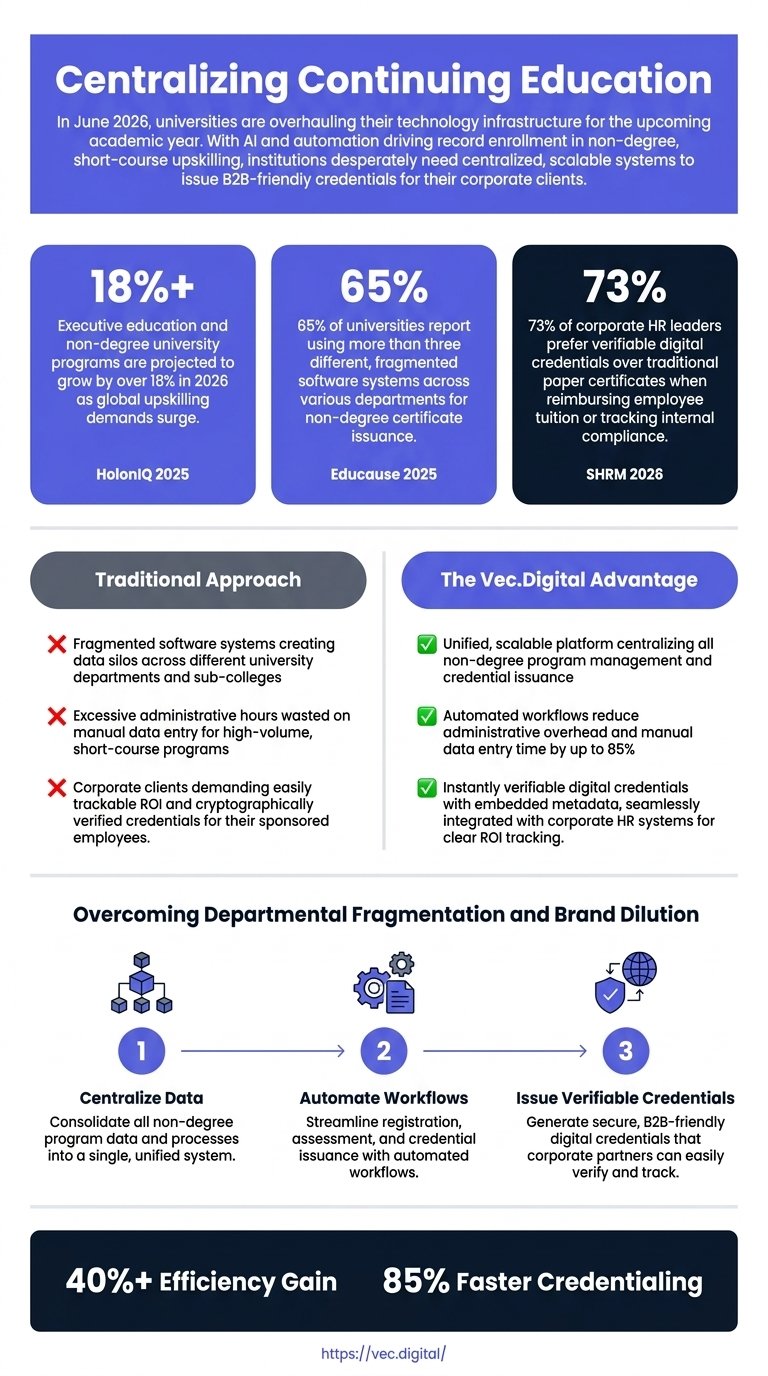
Executive education and non-degree university programs are projected to grow by over 18% in 2026 as global upskilling demands surge, creating an unprecedented administrative burden for institutions. To handle this influx while satisfying corporate partners, higher education leaders require a robust digital certificate maker capable of scaling operations seamlessly. Without a centralized system, universities risk drowning in fragmented data silos and manual issuance processes that frustrate both staff and corporate clients.
In this comprehensive guide, we leverage our deep expertise in educational technology and credentialing security to show you how modernizing your issuance engine can transform your institution's B2B partnerships. You will learn how to automate high-volume credential generation, eliminate departmental fragmentation, and implement globally recognized, verifiable digital credentials that corporate HR teams inherently trust.
Key Takeaways
- Consolidating fragmented software systems into a single automated credential system eliminates data silos across university departments.
- Implementing a bulk certificate generator saves institutions an average of 40 administrative hours per 1,000 credentials issued.
- Corporate partners increasingly demand verifiable digital credentials to accurately track employee training ROI and compliance.
- Utilizing blockchain certificate verification completely eradicates the risk of credential fraud and enhances institutional reputation.
- Adopting QR code certificates allows global employers to instantly authenticate achievements without requiring proprietary apps or accounts.
The Shifting Landscape of University Credentials
The Rise of Executive Education and Global Upskilling
The global economy is undergoing a massive transformation, driven by rapid technological advancements and the urgent need for continuous professional development. According to HolonIQ (2025), executive education and non-degree university programs are projected to grow by over 18% in 2026 as global upskilling demands surge. This explosive growth is largely fueled by international initiatives, such as the European Year of Skills, and the increasing recognition that traditional four-year degrees must be supplemented with targeted, lifelong learning. As a result, universities are seeing record enrollments in short-course upskilling programs, bootcamps, and specialized corporate training cohorts.
However, this shift brings a critical question to the forefront: what is the difference between an academic diploma and a continuing education credential? While traditional academic diplomas represent the culmination of multi-year degree programs and are typically issued once a year during massive commencement ceremonies, continuing education credentials are issued continuously, year-round, at high volumes. They represent specific skill acquisitions, compliance training completions, or executive leadership milestones. Because these non-degree credentials are often sponsored by employers, they require a fundamentally different approach to issuance, tracking, and verification than traditional undergraduate degrees.
The Administrative Bottleneck in Short-Course Programs
As universities expand their non-degree offerings, they quickly encounter severe administrative bottlenecks. Many institutions still rely on legacy processes designed for annual graduation cycles. When applied to short courses that conclude every few weeks, these manual processes break down. Administrators find themselves bogged down in endless data entry, manually typing recipient names, course details, and dates into outdated templates. This inefficiency is not just an inconvenience; it represents a massive drain on university resources and budgets.
So, how do universities issue digital certificates for short courses efficiently? The answer lies in technological modernization. Research from EdTech Digest (2026) reveals that universities implementing automated bulk generation save an average of 40 administrative hours per 1,000 credentials issued. By utilizing a modern digital certificate maker, continuing education departments can bypass manual data entry entirely. Through CSV uploads or direct API integrations with Learning Management Systems (LMS), thousands of personalized credentials can be generated, signed, and distributed globally in a matter of minutes, freeing up administrative staff to focus on strategic program development rather than tedious paperwork.
Overcoming Departmental Fragmentation and Brand Dilution
The Hidden Cost of Fragmented Software Systems
One of the most pervasive challenges facing modern universities is the decentralization of technology. Over the years, individual departments, sub-colleges, and specialized institutes within the same university have often procured their own disjointed software solutions. A recent study by Educause (2025) found that 65% of universities report using more than three different, fragmented software systems across various departments for non-degree certificate issuance. This fragmentation creates severe data silos, making it nearly impossible for university leadership to gain a holistic view of their continuing education impact or to maintain a unified alumni database.
How can multiple university departments share one certificate system effectively? The solution requires deploying a centralized platform equipped with unified team management capabilities. A sophisticated system allows the central IT or Registrar's office to act as the primary administrator, creating distinct workspaces or role-based access profiles for different departments (e.g., the School of Business, the College of Engineering, or the Executive Education Hub). This ensures that while each department retains the autonomy to issue credentials for their specific programs, all data flows into a single, secure, and easily auditable central repository. This consolidation not only reduces software licensing costs but also hardens the institution's cybersecurity posture.
Enforcing Strict Institutional Brand Consistency
Beyond operational inefficiencies, fragmented systems lead to a severe lack of brand consistency. When individual professors, adjunct instructors, or department heads issue their own basic non-degree certificates using generic word processors or consumer-grade design tools, the university's prestigious brand is diluted. A certificate representing a top-tier academic institution should look, feel, and function like a premium, highly secure document, regardless of whether it is for a two-day seminar or a six-month executive bootcamp.
By implementing a centralized platform, universities can lock in approved, professionally designed templates. The central administration can upload official university seals, exact brand color codes, and authorized digital signatures from Deans or the University President. When a department needs to issue an award, they simply select from the pre-approved library of templates. This guarantees that every credential entering the global marketplace—whether shared on LinkedIn or submitted to an employer—perfectly reflects the institution's heritage and rigorous academic standards, thereby protecting the university's visual identity and global reputation.
Meeting Corporate Demands with Verifiable Digital Credentials
Why HR Leaders Demand Cryptographic Verification
The primary consumers of continuing education credentials are not just the learners themselves, but the corporate employers who sponsor them. Corporate clients are increasingly demanding easily trackable return on investment (ROI) and cryptographically verified credentials for their sponsored employees. According to the Society for Human Resource Management (SHRM, 2026), 73% of corporate HR leaders prefer verifiable digital credentials over traditional paper certificates when reimbursing employee tuition or tracking internal compliance. Paper certificates are easily forged, easily lost, and require time-consuming manual background checks that slow down hiring and promotion cycles.
Are digital certificates acceptable for corporate tuition reimbursement? Absolutely, provided they meet modern verification standards. When an employee submits a credential to their HR department for reimbursement, the HR manager needs instant proof that the document is authentic, was issued by the claimed university, and has not been altered. An advanced HR employee certification platform bridges the gap between academic issuers and corporate consumers by providing credentials that are intrinsically secure and instantly auditable, satisfying the rigorous compliance requirements of modern enterprise organizations.
Embracing Global Standards and Interoperability
The demand for secure credentials is driving massive market growth. Grand View Research (2025) projects that the global digital credential market in higher education is expected to surpass $2.5 billion by 2027. This growth is heavily influenced by the adoption of international frameworks, such as the W3C Verifiable Credentials Data Model. This standard ensures that digital records are universally recognized, interoperable across different platforms, and cryptographically secure.
Universities that align their continuing education programs with these global standards position themselves as forward-thinking leaders in educational technology (EdTech). By issuing credentials that conform to international verification protocols, institutions ensure that their international alumni can effortlessly prove their qualifications to employers anywhere in the world, from Dubai to London to Tokyo. This global interoperability is a massive selling point when universities are pitching customized executive training programs to multinational corporations.
How to Automate Certificate Issuance for Continuing Education
Transitioning to an Automated Credential System
For universities ready to modernize, understanding how to automate certificate issuance for continuing education programs is the first crucial step. The process begins by moving away from manual data entry and embracing dynamic data mapping. A modern bulk certificate generator allows administrators to design a master template with dynamic fields—such as [Recipient_Name], [Course_Title], and [Completion_Date]. Instead of typing these details one by one, the administrator simply uploads a CSV file containing the cohort's data, or relies on an API connection to automatically pull this data from the university's LMS upon course completion.
Once the data is mapped, the system’s automated engine takes over. It generates individualized certificates for every student in the cohort, applies the necessary digital signatures, anchors the records for security, and dispatches customized emails containing secure links to the learners' digital lockers. What previously took a team of administrators weeks to accomplish can now be executed flawlessly in under five minutes. This level of automation is essential for scaling operations without exponentially increasing administrative headcount.
Best Practices for High-Volume Generation
When evaluating what is the best digital certificate maker for higher education, universities must look for platforms that offer a comprehensive, end-to-end automated process. It is not enough to merely generate a PDF; the system must handle the entire lifecycle of the credential. Best practices dictate that the chosen platform should feature built-in signatory approval chains. For example, before a batch of 500 executive leadership certificates is published, the system should automatically route a notification to the Dean of Executive Education, requiring their secure digital sign-off.
Furthermore, institutions must prioritize platforms that offer robust analytics. After issuance, universities need to track engagement metrics: how many learners opened their credential, how many shared it on professional networks like LinkedIn, and how many unique employers verified it. These data points are invaluable for marketing departments looking to demonstrate the real-world impact and visibility of the university's continuing education programs.
Maximizing ROI Through Strategic B2B Partnerships
Positioning Your University as a Corporate Training Leader
In the highly competitive landscape of higher education, continuing studies departments operate much like B2B enterprises. Their goal is to secure lucrative, long-term training contracts with major corporations. To win these contracts, universities must offer more than just excellent curriculum; they must offer a seamless, modern administrative experience. When a university can promise a corporate client that their employees will receive instantly verifiable, highly secure digital badges upon completion, it significantly elevates the institution's value proposition.
By utilizing QR code certificates, universities provide a tangible, immediate benefit to both the learner and the employer. Every credential features a unique QR code that, when scanned by any smartphone camera, instantly routes the user to a dedicated, university-branded public verification page. This page displays the issuer's details, the recipient's achievements, and the irrefutable proof of authenticity. No proprietary apps, account registrations, or manual phone calls to the registrar are required. This frictionless verification process is exactly what modern HR departments demand.
The Future of Continuing Education Credentials
The ultimate layer of trust in modern credentialing is immutability. This is where blockchain certificate verification becomes a strategic imperative. By anchoring issued certificates to an immutable, publicly verifiable blockchain, universities make credential fraud mathematically impossible. The blockchain acts as a decentralized, tamper-proof ledger; once a credential is recorded, it cannot be altered, backdated, or forged by malicious actors.
For high-stakes executive education—where corporate sponsorships can run into the tens of thousands of dollars per employee—this level of cryptographic security is non-negotiable. When the verification page displays a "blockchain verified" badge, it signals to global employers that the university employs the highest possible standards of digital security. This not only protects the university's prestige but also ensures that the continuing education department remains a highly profitable, highly respected pillar of the institution for decades to come.
Secure Your Institution’s Future with Vec.Digital
The future of higher education relies on agility, security, and the ability to meet the rigorous demands of the global corporate sector. As upskilling and executive education continue to drive institutional growth, relying on fragmented, manual processes is no longer viable. Your university needs a centralized, automated engine that issues credentials with absolute authority and seamless efficiency.
At Vec.Digital, we provide a comprehensive suite of tools designed specifically to create, manage, publish, and authenticate online certificates at scale. Our platform combines an intuitive drag-and-drop design editor with powerful bulk issuance capabilities, instant QR code authentication, and immutable blockchain security. With a 99.98% uptime SLA and a commitment to global sustainability, we empower institutions to eradicate credential fraud while saving countless administrative hours.
Stop letting manual data entry and fragmented systems hold your continuing education programs back. Transform your credentialing process, attract top-tier corporate partnerships, and give your learners the verifiable digital proof they deserve.
Ready to modernize your university's credentialing system? Visit us at https://vec.digital/ to explore our platform, or contact our enterprise team directly at support@vec.digital to schedule a tailored demonstration for your institution.