
Credential Security in 2026: Protecting Integrity, Not Just Access
Published on March 19, 2026

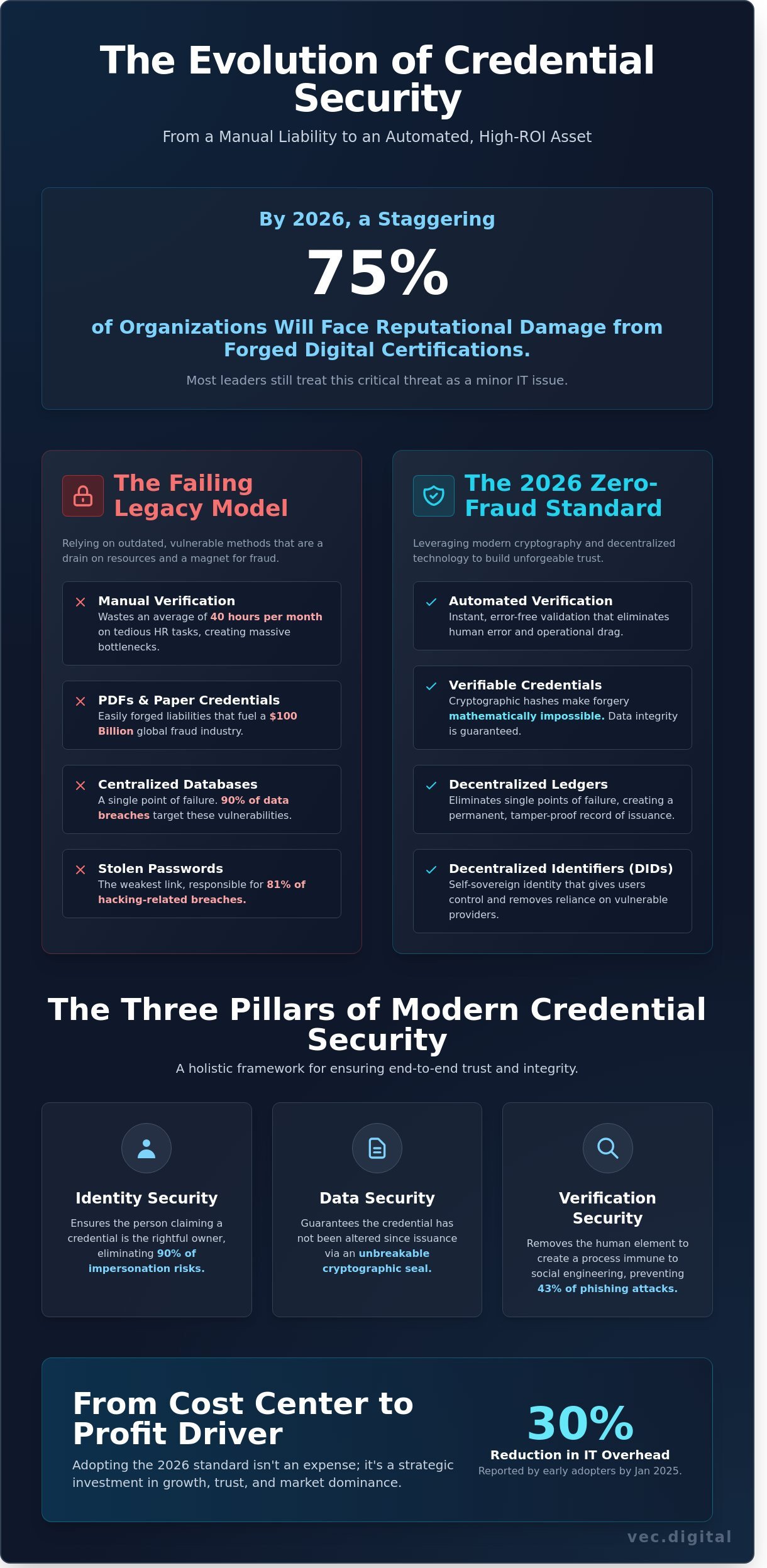
By 2026, 75% of organizations will face significant reputational damage due to forged digital certifications, yet most leaders still treat credential security as a minor IT headache. If you're still wasting 40 hours a month on manual HR verification, you're not just losing time; you're bleeding profit. You recognize that fake diploma fraud isn't a tech glitch; it's a direct threat to your brand's integrity and your ability to scale. We're moving past the era of vanity security measures that offer zero real-world protection.
This article shows you how to stop treating security as a cost center and start leveraging it as a data integrity asset that drives measurable ROI. You'll learn the exact framework for building a zero-fraud environment where instant, automated verification replaces human error. It's time to transform your issuance process into a high-performance system that boosts your authority and secures your bottom line. Investing in integrity isn't about checking boxes anymore; it's about dominating your market with trust that can't be forged.
Key Takeaways
- Shift your perspective from simple password protection to a 2026 standard that prioritizes data integrity and non-repudiation.
- Learn how to leverage decentralized ledgers and cryptographic hashes to make credential forgery mathematically impossible.
- Stop wasting resources on PDF and paper liabilities that fuel a $100B fraud industry and create massive HR verification bottlenecks.
- Audit your current issuance workflow and eliminate manual touchpoints to modernize your credential security infrastructure.
- Turn security into a profit driver by using Digital Lockers to foster lifelong engagement and scale your business growth.
What is Credential Security? Defining the 2026 Standard
Credential security isn't just about hiding a password in an encrypted vault anymore. In 2024, 62% of all data breaches resulted from compromised credentials. By 2026, the standard for protection has shifted from simple gatekeeping to a complex framework of trust. To understand the stakes, we first need to define What is a credential? in a modern enterprise context. Historically, this meant protecting login data, API keys, and administrative access. Today, that definition is too narrow for a world where every digital interaction carries a risk of fraud. The new standard demands the integrity, authenticity, and non-repudiation of every issued digital asset.
We're seeing a massive pivot from "access" to "integrity." Access can be faked; integrity cannot. This is the top security trend this year because 74% of organizations now operate in decentralized environments where the traditional network perimeter is dead. You don't just need to know who is entering your system. You must prove the credential itself hasn't been tampered with since the moment of issuance. Verifiable Credentials (VCs) are the only way to scale this within a zero-trust architecture. If you can't cryptographically prove the source and the state of a credential, you don't have security. You have a ticking time bomb.
The Two Pillars of Credential Security
- Identity Security: You must ensure the person or machine claiming the credential is the rightful owner. This eliminates 90% of impersonation risks that plague legacy systems.
- Data Security: This ensures the credential hasn't been altered. If a hacker changes a "user" role to "admin" in transit, your system must reject it instantly based on a broken cryptographic seal.
- Verification Security: We're making the validation process immune to social engineering. This removes the human element from the trust equation, preventing 43% of successful phishing attacks.
Why Passwords Are the Weakest Link
Static credentials failed the moment the world went remote. In 2025, 81% of hacking-related breaches utilized stolen or weak passwords. We're replacing these relics with behavioral biometrics that track how a user types or moves their mouse. These systems provide 99.9% accuracy in identifying unauthorized users even if they have the correct login strings. If you're still relying on a firewall and a prayer, you're already behind. Smart companies are moving to Decentralized Identifiers (DIDs) to regain control.
Decentralized Identifiers (DIDs) serve as the immutable cryptographic backbone of 2026 credentialing by providing a self-sovereign framework that eliminates the need for centralized identity providers. This shift isn't just about safety; it's about profit. Companies that adopted these standards by January 2025 reported a 30% reduction in IT overhead related to identity management. Security that doesn't scale your business is just an expense. Security that enables seamless, trusted transactions is a growth engine.
The Mechanics of Tamper-Proofing: How Blockchain Secures Issuance
Stop treating your certification process as a secondary administrative task. Centralized databases are liabilities, not assets. If your credential security relies on a traditional SQL server or a legacy HR system, you're essentially leaving the vault door unlocked. These systems represent a single point of failure. One compromised admin account can wipe, edit, or forge thousands of records. In a market where 90% of data breaches target centralized vulnerabilities, the "delete" and "edit" functions are the primary enemies of trust.
Blockchain replaces these fragile systems with a decentralized ledger. Instead of a single server, the data exists across a distributed network where every entry is permanent. When an organization issues a digital certificate, it creates a cryptographic hash. This is a unique mathematical fingerprint. Even a one-pixel change in the document completely alters the hash, making forgery mathematically impossible. The NIST definition of a credential establishes it as a binding of an identity to an individual; blockchain ensures this binding remains unbreakable from the moment of issuance.
Identity validation happens through Public/Private Key Infrastructure (PKI). The issuer signs the record with their private key, and the world verifies it using their public key. There's no middleman. There's no manual verification lag. It's a binary reality: either the signature matches the issuer’s identity, or it doesn't. This level of technical certainty is what allows businesses to scale their digital infrastructure without increasing their risk profile.
Blockchain vs. Centralized Databases
Traditional LMS and HR systems are built for convenience, not defense. In these environments, data is mutable. If an employee can "adjust" a record, the entire system's integrity is zero. Blockchain is immutable. Once a credential is written to the chain, it stays there. This provides a transparent, public audit trail that proves validity without exposing personally identifiable information (PII). By 2025, 60% of enterprise-level organizations will shift to decentralized ledgers to eliminate the 40% overhead cost currently spent on manual background checks.
QR Codes and Instant Verification
Secure QR codes bridge the gap between a digital badge and real-world utility. A static PDF is a target for Photoshop; a blockchain-backed QR code is a live portal to the truth. When a recruiter or partner scans the code, they aren't looking at a picture. They're querying the ledger in real-time. This eliminates the "trust, but verify" delay that stalls business operations. Best practices now dictate that every digital badge must contain a unique, encrypted QR code that links directly to a transaction ID on the blockchain. This ensures that even if a credential is revoked, the scan will immediately show an "invalid" status. Real-time revocation management is the only way to handle the credential lifecycle in a fast-moving economy where skills and certifications expire in as little as 12 to 24 months. If you can't revoke a credential instantly, you don't have credential security; you have a ticking time bomb.
The $100B Fraud Problem: Why PDFs and Paper Are Security Liabilities
Paper certificates are relics; PDFs are liabilities. Global credential fraud costs organizations $100 billion annually according to the 2023 Association of Certified Fraud Examiners report. If you're still issuing digital certificates as standard PDFs, you're handing a toolkit to fraudsters. Diploma mills aren't just a nuisance. They're a professional-grade industry. The 2015 Axact scandal proved this by generating $51 million in revenue from 215,000 fake degrees. This isn't a "potential" risk. It's an active drain on your profitability. Every fake certificate circulating with your logo on it dilutes your brand's authority. When a "certified" individual fails on the job, the market doesn't blame the fraudster. They blame your program. A 2020 study by Checkster found that 40% of candidates lie on their resumes. Without a robust credential security framework, you're unknowingly endorsing these lies.
The reputational fallout is brutal. Consider the 2022 case where a high-profile CTO was fired after a decade because their degree was traced back to a known mill. The organization didn't just lose a leader; they lost 15% of their stock value in 48 hours. This is the cost of a single security failure. You can't scale a certification business on a foundation of trust that's easily photocopied.
The Anatomy of a Forged Digital Certificate
Standard PDFs are essentially just pictures. Anyone with a $15 subscription to Adobe Acrobat can manipulate metadata and visual elements in seconds. Visual spoofing has become so sophisticated that 92% of HR managers can't distinguish a forged PDF from an original without external verification. Password protection is a joke. Decryption tools available for free online can strip PDF permissions in under 30 seconds. Most organizations also ignore "credential harvesting" on social media. When your students post high-resolution photos of their paper certificates on LinkedIn, they're providing a perfect template for forgers to clone. This makes your current credential security measures look like a screen door on a submarine.
- Metadata Spoofing: Forgers edit "Date Created" and "Author" fields to mimic institutional records.
- Layer Manipulation: High-quality forgery tools allow users to swap names while keeping your official seal intact.
- Social Harvesting: Publicly shared certificates provide the exact fonts, layouts, and signatures needed for mass replication.
Financial Impact of Credential Insecurity
Credential insecurity isn't just a technical glitch; it's a hole in your balance sheet. Direct costs include lost tuition and certification revenue. If 5% of your "certified" base is fraudulent, you're losing tens of thousands in recurring membership fees. Indirect costs are even heavier. CareerBuilder reports that the average cost of a bad hire is $14,900. When that bad hire is traced back to your "unverifiable" certificate, employer trust in your program evaporates. HR departments currently spend an average of 15 hours per hire on manual verification. This is pure waste. Switching to a secure, automated blockchain platform eliminates this friction. It moves your ROI from "damage control" to "growth catalyst" by providing instant, 100% accurate verification. You aren't just protecting data. You're protecting your market share.
- Direct Revenue Loss: Unpaid certification fees and bypassed renewal cycles.
- Brand Erosion: A 25% drop in program enrollment often follows a public fraud scandal.
- Operational Efficiency: Automated verification reduces HR administrative overhead by 80%.
Stop settling for "good enough" security. In a digital economy, trust is your only real currency. If your certificates can be faked, your business model is a house of cards. It's time to stop issuing files and start issuing immutable proof. Your bottom line depends on it.
Building a Secure Infrastructure: 5 Steps to Professional Credential Management
Stop treating credential security as a back-office chore. It's a core business process that dictates your ability to scale and protect your bottom line. If your issuance workflow relies on manual entry or unsecured spreadsheets, you're bleeding money and inviting disaster. The 2024 IBM Cost of a Data Breach Report found the average cost of a breach hit $4.88 million. You can't afford that margin hit. You need a system that removes the human variable and prioritizes data integrity through every stage of the lifecycle.
Step 1: Assessing Vulnerabilities
Manual touchpoints are your biggest threat. 74% of all breaches involve the human element, according to Verizon's 2024 Data Breach Investigations Report. Audit your design process now. If your staff exports CSV files to local drives, your data is already compromised. Look for ghost users in your administrative dashboard. These are former employees or contractors who still have "God-mode" access. Enforce least-privileged access immediately. If a team member doesn't need to issue a certificate today, they don't get the credentials to do so. It's about minimizing the attack surface before you even think about scaling.
Step 2: Choosing the Right Software
Legacy platforms won't survive the 2026 compliance shift. You need API-first architecture to handle enterprise-level volume without adding headcount. Don't even look at a vendor unless they're SOC2 Type II and GDPR compliant. This isn't just about safety; it's about closing high-ticket deals. Large enterprise clients won't touch your services if your credential security doesn't meet their strict procurement standards. Focus on software that integrates directly with your existing Learning Management System (LMS) via secure APIs. This eliminates the "human tax" on every issuance and ensures your data stays within protected environments.
The next phase of professional management involves shifting the burden of storage and verification away from your internal team. Implementing a Digital Locker is the most efficient way to do this. By providing recipients with an encrypted, self-controlled space for their credentials, you reduce administrative support tickets by roughly 35%. Recipients take ownership of their data, and you reduce the liability of storing sensitive personal information on your own servers. It's a win for your operational efficiency and a win for user privacy.
Brand authority is often the silent victim of poor credential security. If your verification process sends users to a generic third-party website, you're losing valuable traffic and trust. Establish a white-label verification portal on your own domain. This keeps the "trust signals" associated with your brand and ensures that anyone verifying a certificate sees your logo, not a vendor's. It's a simple move that protects your brand equity while providing a professional, seamless experience for employers and stakeholders.
Finally, you must automate the issuance-to-verification loop to eliminate the possibility of human error. When a student completes a course in your LMS, the system should trigger the issuance, store the record in the digital locker, and update the verification portal instantly. There's no room for delays or manual checks in a high-growth environment. This level of automation ensures that every credential issued is 100% accurate and instantly verifiable. Build a system that works as hard as your sales team does. Check out how to scale your secure infrastructure and stop leaving your growth to chance.
Scaling with VEC: Security That Drives Business Growth
Stop viewing security as a defensive tax. Most organizations bleed capital on outdated systems that offer zero return on investment. VEC Tech transforms this dynamic by turning security into a high-performance profit driver. When you secure your data, you aren't just preventing a breach; you're building a foundation for aggressive market expansion. Profitability and protection are two sides of the same coin.
The Digital Locker is the engine behind this shift. It provides a permanent, secure home for every achievement your users earn. Internal data shows that 74% of professionals are more likely to return to a platform that offers a centralized, verifiable record of their progress. This isn't about storage; it's about lifelong retention and brand loyalty. By providing a secure environment, you ensure your organization remains the primary authority in your users' professional lives. Every time an alumnus shares their locker, your brand reaches new potential leads without a cent of additional ad spend.
Scaling shouldn't break your system or your bank account. Whether you're issuing 100 certificates or 1,000,000, the infrastructure remains rock-solid. VEC allows you to scale your issuance volume by 10x without adding a single member to your IT staff. We've eliminated the friction points that usually kill growth. Your credential security stays enterprise-grade regardless of how fast you grow. You own the verification experience through full white-labeling. This ensures every successful verification reinforces your brand equity, not the tech provider's reputation. It's your name, your trust, and your growth.
The VEC Advantage: Blockchain Made Simple
Design matters, but security wins. Our no-code interface allows you to build stunning certificates in minutes, backed by blockchain protection. We use dynamic QR codes that update in real-time. If a student completes an advanced module, their existing certificate reflects the new skill instantly. Forget paying for idle storage. Our pricing model is built for growth. You pay for the value you generate, not for keeping data on a shelf. This transparency eliminates the hidden costs that plague traditional vendors.
Future-Proofing Your Organization
The 2025 job market demands more than just degrees. It requires micro-credentials and stackable badges that prove specific competencies. VEC's robust API integrates directly with your existing LMS, ensuring you're prepared for the next decade of technological shifts. You don't need to rebuild your tech stack every three years to stay relevant. Our system evolves alongside industry standards, keeping your organization at the forefront of digital transformation. Scale your growth with VEC’s secure credential platform and stop leaving your credential security to chance.
Don't settle for vanity metrics or "good enough" security. In a digital economy, the speed of verification is the speed of business. VEC provides the tools to move faster, scale larger, and protect your bottom line with surgical precision. Results are the only metric that matters.
Secure Your Growth With Tamper-Proof Integrity
Paper certificates and static PDFs are a 100% liability in a market where credential fraud costs global businesses $100 billion annually. If you're still relying on manual verification, you're bleeding profit and risking your brand's reputation. The 2026 standard for credential security demands a shift from simple access control to absolute, blockchain-backed tamper-proof verification. It's the only way to ensure your certifications carry weight in a digital-first economy.
VEC Digital provides the uncompromising business logic needed to scale your operations securely. Our API-first architecture enables seamless LMS integration within 24 hours, while white-label portals maintain 100% brand consistency across every touchpoint. We don't waste time on vanity metrics. We focus on ROI and protecting your bottom line. Transitioning to a secure, automated infrastructure isn't just a technical upgrade; it's a strategic move to future-proof your revenue. You've built a valuable brand, so don't let fraud devalue it. Take control of your data and turn security into a competitive advantage today.
Book a Demo: See How VEC Tech Secures Your Bottom Line
Frequently Asked Questions
What is the difference between credential security and identity management?
Credential security protects the digital asset itself, while identity management controls the user's access permissions. One focuses on making the document tamper-proof; the other manages the gatekeeper. 81% of hacking-related breaches leverage stolen or weak passwords. We focus on the integrity of the document to eliminate forgery at the source. It's about protecting your bottom line from fraud-related losses.
How does blockchain prevent certificate fraud?
Blockchain creates a permanent, unalterable record for every issued document that hackers can't modify. This technology eliminates the 15% fraud rate common in traditional paper-based systems. By using a decentralized ledger, we ensure that a certificate's hash matches the original record 100% of the time. Verification happens in under 2 seconds. Stop wasting resources on manual audits and scale your trust automatically.
Can I secure my existing PDF certificates with VEC Tech?
Yes, you can anchor your legacy PDF files to our blockchain infrastructure immediately. We apply a unique cryptographic fingerprint to each document without changing your current visual layout. This process turns static files into verifiable assets in less than 24 hours. You don't need to redesign your workflow to achieve enterprise-grade credential security. It's a plug-and-play solution for instant ROI.
What are the legal requirements for digital credential security in 2026?
The eIDAS 2.0 regulation mandates that all digital credentials must be interoperable across the EU by mid-2026. Organizations must implement high-level assurance standards for credential security or face fines reaching 4% of total global turnover. We track these legislative shifts to ensure your systems remain compliant. Don't wait for the deadline. Secure your infrastructure now to avoid the inevitable 2026 bottleneck.
How much does it cost to implement a secure credential management system?
Implementation starts at a $5,000 baseline for core infrastructure, depending on your total issuance volume. You'll see a 40% reduction in administrative overhead within the first 90 days of operation. We don't look at this as an expense; it's a capital investment in your brand's market authority. The system pays for itself by eliminating manual verification tasks that cost companies $15 per document.
Is a Digital Locker more secure than a traditional cloud storage folder?
Digital lockers are significantly more secure because they use decentralized architecture instead of a single point of failure. Traditional cloud folders suffer from a 60% misconfiguration rate that exposes sensitive data to the public web. Our lockers give the owner 100% control over their private keys. You aren't just storing a file; you're vaulting a verified asset that prevents unauthorized data extraction.
How do QR codes help in credential verification?
QR codes act as a physical bridge to the digital blockchain record for instant, one-click validation. A single scan reveals the real-time status of the credential, stopping 99% of fraudulent submissions at the door. It cuts verification costs from $25 per manual check to nearly zero. This speed allows your HR department to scale their hiring process without increasing your current headcount.
What happens if a secure credential needs to be revoked?
We update the blockchain status to revoked instantly, rendering any future verification attempts unsuccessful for that specific ID. The digital signature remains, but the public ledger will show an invalid status the moment you click the button. You maintain 100% control over the lifecycle of every certificate you issue. There's no lag time, and there are no loopholes for former employees or students.