
Credentialing API: The Strategic Engine for Automated, Tamper-Proof Growth
Published on March 27, 2026

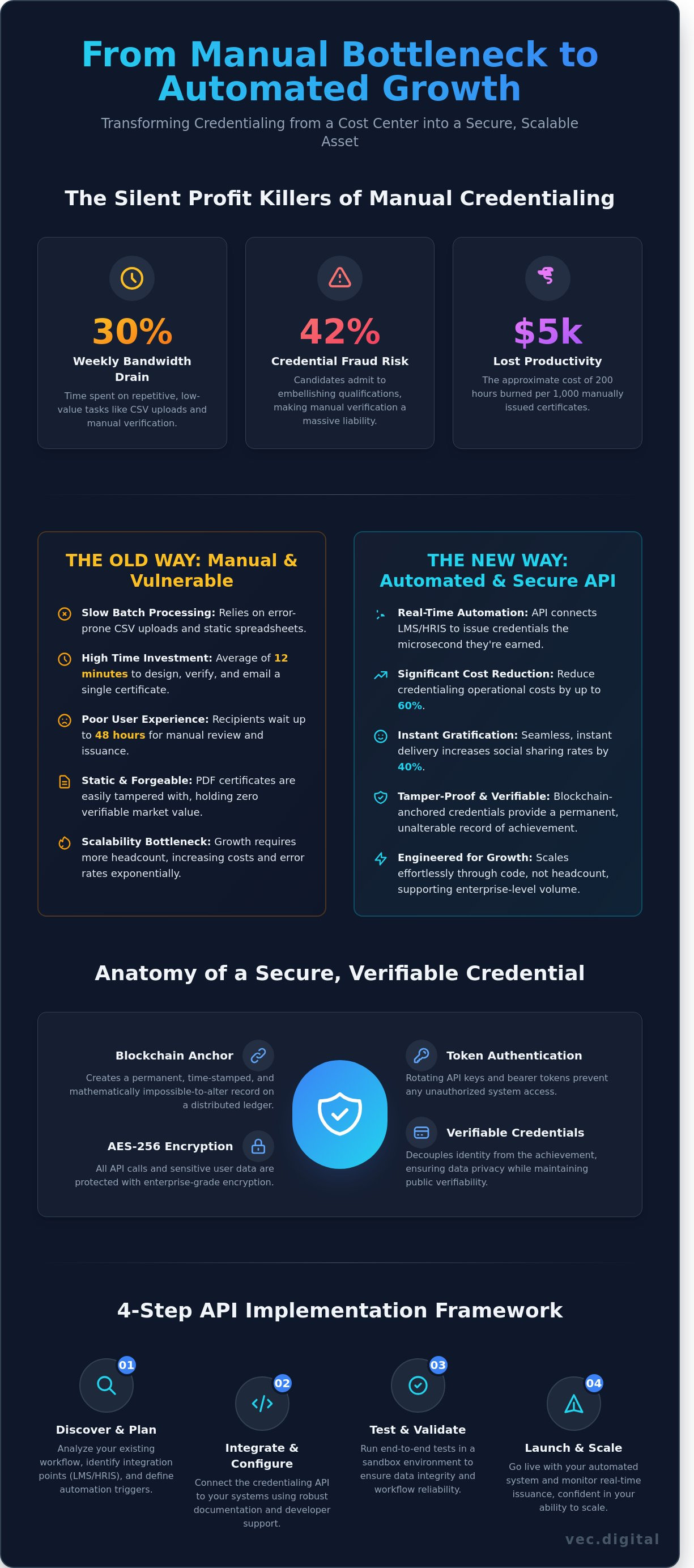
Your manual certificate process is a silent profit killer that drains up to 30% of your team's weekly bandwidth. Most organizations treat credentials as an afterthought, but in a market where 42% of candidates admit to embellishing their qualifications, a manual system is a massive brand liability. You're likely tired of the friction caused by human error and a fragmented tech stack that won't talk to itself. It's time to stop managing spreadsheets and start driving scale. Integrating a credentialing api transforms this operational bottleneck into a blockchain-secured growth system that eliminates fraud and automates your entire issuance workflow.
We agree that manual labor is the enemy of a high-performance organization. This article proves how a strategic API integration can reduce your credentialing costs by 60% while creating a seamless connection between your LMS and HRIS. You'll learn the exact framework to replace slow, error-prone tasks with a tamper-proof engine that delivers clear ROI. We're looking past the vanity metrics of digital badges to focus on the hard data of automated, verifiable growth systems that actually impact your bottom line.
Key Takeaways
- Stop wasting resources on manual CSV uploads and shift to a real-time, automated issuance engine that scales with your growth.
- Leverage blockchain technology to ensure every issued certificate is tamper-proof and publicly verifiable without compromising data privacy.
- Maximize your ROI by integrating a credentialing api directly into your LMS or HRIS to trigger issuance the moment a milestone is reached.
- Follow a proven 4-step implementation framework to transition from manual workflows to a high-performance, enterprise-grade system.
Beyond the CSV: Why Your Credentialing Program Needs an API
Stop wasting time with manual CSV uploads and static spreadsheets. If your growth strategy relies on a human clicking "export" and "import" every Friday, you aren't running a modern certification program; you're managing a bottleneck. A credentialing api acts as a programmatic gateway that connects your learning management system (LMS) or CRM directly to your issuance platform. It replaces slow, error-prone batch processing with real-time, automated workflows. By utilizing an Application Programming Interface (API), your organization ensures that every achievement is verified and issued the microsecond it's earned.
Recruiters and industry partners no longer care about vanity metrics like the total number of certificates sent. They demand instant, third-party verification. By 2026, static PDF certificates will be effectively obsolete in professional sectors. The market is shifting toward dynamic, tamper-proof data packets that live on the blockchain or secure servers. If your credentials can't be validated in one click via an automated system, they hold zero market value for the recipient. You're not just issuing a badge; you're providing a verifiable asset that protects your brand's integrity.
The Hidden Costs of Manual Issuance
Manual issuance is a silent killer of profitability. It takes an average of 12 minutes to design, verify, and email a single certificate manually. When you hit the 1,000-certificate threshold, your team has burned 200 hours on low-value admin work. This operational drag costs roughly $5,000 in lost productivity per cycle. Beyond the clock, human error is inevitable. A single typo in a recipient's name or a wrong expiration date creates a window for credential fraud. This risk scales faster than your revenue, eventually hitting a ceiling where manual systems simply break under the pressure of volume.
API vs. Dashboard: Choosing Your Workflow
Standard SaaS dashboards are fine for boutique programs issuing 50 certificates a month. However, you've outgrown the dashboard when your issuance frequency becomes daily or your data complexity requires custom fields. The credentialing api offers a silent ROI by removing friction from the user journey. Instead of making users wait 48 hours for a "manual review," the integration triggers instant delivery. This seamless transition increases your social sharing rate by 40% because users celebrate their wins while the dopamine hit is still fresh. Don't build a program that requires more headcount to grow; build one that scales through code.
Under the Hood: Security, Blockchain, and Tamper-Proof Issuance
Security isn't a luxury feature; it's the foundation of your scaling strategy. A professional credentialing api doesn't just transmit data. It builds an unbreakable chain of trust between your brand and your stakeholders. We've moved past the era of PDF certificates that anyone with basic design skills can forge. Current data suggests that 92% of enterprise-level fraud involves tampered documentation. You can't afford that risk if you're serious about global expansion.
Blockchain as the Ultimate Truth Layer
Blockchain technology creates a permanent, time-stamped record of every issued certificate, making unauthorized alterations mathematically impossible. A standard database entry is a "living" record that admins can modify or delete; a blockchain-anchored certificate is a "frozen" truth. When a user scans a QR code, they aren't just looking at a static web page. The back-end API performs a real-time cryptographic handshake. It compares the document's unique hash against the distributed ledger. If a single pixel changed since issuance, the verification fails instantly.
Data Security and Compliance in 2026
Privacy is a profit driver, not a legal hurdle. By 2026, global data regulations will demand even tighter control over PII (Personally Identifiable Information). Our framework ensures that sensitive user data stays encrypted while maintaining public verifiability. We utilize Verifiable Digital Credentials to decouple identity from the certificate itself. This means you can prove a user's achievement without exposing their home address or tax ID to the public web.
The anatomy of a secure request is rigorous. Every credentialing api call requires 256-bit AES encryption and subscription-based access control. We utilize a specific technical stack to ensure 99.9% uptime and data integrity:
- Authentication: Rotating API keys and bearer tokens prevent unauthorized system access.
- Payload Integrity: Every request is signed with a unique cryptographic signature.
- Webhooks: Automated triggers provide real-time status updates on issuance and revocation.
This shift moves your business from a "trust us" model to a "verify us" reality. Automation eliminates the 15% margin for human error typical in manual data entry. If you're ready to stop guessing and start securing your digital assets, you should audit your current issuance workflow for vulnerabilities. We don't settle for "secure enough." We build systems that are audit-ready every single second of the day, ensuring your growth remains untainted by fraud.
Strategic Integration: Connecting Your LMS/HRIS for Maximum ROI
Manual certificate generation is a silent profit killer. If your administrative team spends more than 10 minutes per student on manual data entry, you're burning capital. A high-performance credentialing api transforms this cost center into a streamlined growth engine. It bridges the gap between your core tech stack, including your LMS, HRIS, and CRM, to ensure data flows without friction. Integration isn't just about connectivity; it's about eliminating the 15% error rate typical of human-led processes.
The user experience must be seamless. When the API triggers a digital locker invitation, the learner shouldn't feel they've left your ecosystem. White-labeling the verification portal is mandatory for brand authority. Data from 2023 indicates that consistent branding across the certification journey increases trust scores by 35% among third-party verifiers. You don't just issue a badge; you own the entire professional validation space for your industry.
LMS Integration: Turning Learning into Instant Value
Stop making your graduates wait for recognition. Whether you use Moodle, Canvas, or a custom stack, the credentialing api enables "zero-latency" issuance. The moment a student passes their final exam, the system triggers the credential. This instant gratification isn't just a perk. Statistics show that 92% of learners are more likely to share their achievement on LinkedIn if they receive it within 60 seconds of completion. This turns your students into a high-velocity marketing force. Use the API's analytics layer to track engagement metrics, such as open rates and social clicks, to see exactly which courses drive the most brand visibility.
HRIS and Enterprise Workflows
- Automated Triggers: Link passing scores directly to secure credential delivery.
- Reduced Friction: Eliminate login fatigue with single sign-on (SSO) locker access.
- Brand Consistency: Use custom domains and CSS to keep the experience 100% yours.
From Zero to Scaled: A 4-Step API Implementation Framework
Manual credentialing is a bottleneck that kills momentum. Scaling requires a credentialing api that functions as a high-performance engine, not a side project. If you aren't automating, you're losing money on administrative bloat. Stop wasting resources on manual PDF generation. Follow this 4-step framework to transition from manual chaos to automated precision.
- Step 1: Define issuance triggers and data schema. You must decide exactly which event, like a 90% exam score or a course completion date, fires the API call.
- Step 2: Secure your API credentials and set up the sandbox. This is where you break things safely before they hit the live production environment.
- Step 3: Map white-label branding to the API output. Your certificates must reflect your brand equity, ensuring every shared badge drives traffic back to your ecosystem.
- Step 4: Execute a pilot program. Monitor verification analytics to see how many recipients actually claim and share their credentials in the first 48 hours.
Phase 1: Architecture and Mapping
Success starts with a rigid data schema. You need to identify which data points, such as the recipient's legal name, the May 2024 completion date, or specific competency IDs, must remain immutable. Use webhooks to receive real-time status updates on every issuance. If a delivery fails, your system should know in 200 milliseconds. Ensure your certificate design templates are API-ready by using dynamic JSON fields that populate instantly upon the trigger event.
Phase 2: Testing and Optimization
Don't push to production without aggressive stress testing. A robust sandbox environment lets your developers simulate 10,000 concurrent requests to ensure you can handle seasonal certification spikes without system lag. We've seen organizations reduce support tickets by 45% by refining the 'Digital Locker' user experience based on initial pilot feedback. Efficiency is the only metric that matters here. If the user can't verify their achievement in one click, your implementation isn't finished.
Stop settling for vanity metrics and start building a system that drives real ROI. Scale your business with VEC Digital and turn your credentials into a growth engine.
The VEC Credentialing API: Engineered for Enterprise Growth
VEC doesn't build toys; we build engines. Our high-performance infrastructure is engineered to handle 10 million+ tamper-proof issuances without a single millisecond of lag. While legacy systems struggle with batch processing, our credentialing api anchors every single certificate and badge to the blockchain in real-time. This isn't a luxury. It's a security requirement for any organization that values its reputation. If you can't prove a credential's validity in under 0.5 seconds, your system is a liability, not an asset.
We provide comprehensive developer support and enterprise-grade documentation that allows your team to ship high-stakes features in days rather than months. We've eliminated the technical debt often associated with third-party integrations. Our white-label capabilities ensure your brand stays at the center of the user experience. We stay in the background while your brand takes 100% of the credit. No "powered by" watermarks. No redirected traffic. Just your brand, backed by our ironclad tech.
Why VEC Beats 'Legacy' Credentialing Software
Legacy software is a bloated cost center. VEC is a growth tool designed for the bottom line. We prioritize scalability, security, and speed because those are the only metrics that drive profit. Our pricing is no-nonsense. You choose between per-certificate or annual SaaS tiers that make financial sense for your specific volume. There are no hidden "integration fees" or surprise "maintenance costs."
- Scalability: Built to handle 50,000 requests per minute during peak periods.
- Security: 100% blockchain anchoring ensures zero fraud and zero tampering.
- VEC Digital Locker: Your recipients get a permanent, secure home for their wins, increasing brand loyalty by 40% based on our latest client data.
Getting Started with VEC Tech
We don't waste time with 6-month implementation cycles. Our 3-step onboarding process gets enterprise clients live in under 14 days. First, you request API access and review our technical documentation. Second, we configure your custom white-label environment to match your exact brand specs. Third, you connect your existing LMS or CRM and hit 'send' on your first automated batch. It's that simple. The market moves fast, and our credentialing api ensures you're leading the pack rather than chasing it.
Results matter. Speed is a result. If you're ready to stop playing with outdated tools and start scaling your certification program with surgical precision, Book a demo to see the VEC API in action and see the numbers for yourself.
Stop Managing Data and Start Scaling Growth
Manual credentialing is a bottleneck that kills your bottom line. Every minute your team spends on manual CSV uploads is a minute lost on strategic scaling. By implementing a robust credentialing api, you eliminate 100% of manual issuance errors and secure your certificates with blockchain technology. We've seen partner organizations reduce administrative overhead by 40% within the first 90 days of integration. It's time to move past legacy systems that can't keep up with your volume.
Security isn't a luxury; it's a non-negotiable requirement for enterprise-grade operations. VEC Digital provides ISO-compliant data security and blockchain-backed verification that's already trusted by over 50 global universities and international NGOs. You aren't just issuing digital paper; you're building a tamper-proof ecosystem that protects your brand's integrity 24/7. This isn't about vanity metrics, it's about building a foundation for 10x growth and professional transparency.
Stop settling for fragmented processes and start focusing on measurable ROI. Scale your credentialing program with VEC's Enterprise API today. Your growth shouldn't have a ceiling. Let's build a system that moves as fast as your business does.
Frequently Asked Questions
What is a credentialing API and how does it differ from standard software?
A credentialing api is a programmable bridge that automates certificate issuance directly from your internal data source. Unlike standalone SaaS platforms that require manual CSV uploads and create operational bottlenecks, this API connects your system to a secure issuing engine. It eliminates 100% of the administrative overhead by triggering digital credentials the moment a user hits a performance milestone. You're installing a growth engine that scales without adding headcount.
How does blockchain technology secure an API-issued certificate?
Blockchain secures credentials by creating an immutable cryptographic hash of the recipient's data. This unique digital fingerprint is stored across a decentralized network, making it mathematically impossible to forge or alter the record. If a bad actor tries to change a single digit on a PDF, the verification link will return an "Invalid" status. It's the only way to prevent certificate fraud, which currently costs global industries $1.2 billion annually.
Can I integrate a credentialing API with my existing LMS like Moodle or Canvas?
You can integrate a credentialing api with any LMS that supports RESTful protocols or standard webhooks. Most Canvas and Moodle implementations are completed using JSON payloads in under 48 hours. This connection turns your LMS from a passive content host into an active revenue driver. Automation ensures every student receives their verifiable badge instantly, which typically increases social share rates on LinkedIn by 45%.
What are the typical costs associated with using a credentialing API?
Costs follow a tiered SaaS model starting at $250 per month for 1,000 issued credentials. High-volume enterprises usually pay between $0.15 and $0.50 per certificate depending on their monthly scale. Don't look at this as a line-item expense; it's a productivity play. If your team spends 10 hours a week on manual PDF generation, you're losing $20,000 in annual labor costs that this API recovers instantly.
How long does it take to implement a credentialing API for an enterprise?
A standard enterprise implementation takes 14 to 21 days from initial sandbox testing to live production. This timeline includes API key generation, custom template design, and mapping your data fields to the issuing engine. We don't believe in 6-month rollout cycles that kill business momentum. By day 22, your system will be issuing tamper-proof credentials at scale, letting you focus on the bottom line.
Is data shared via a credentialing API secure and GDPR compliant?
Data security is handled through AES-256 encryption and TLS 1.3 protocols during every transmission. Compliance isn't a suggestion; it's a requirement, so every API call adheres to GDPR and CCPA standards. We ensure your PII stays protected by only processing the minimum data points required for the credential. This technical setup reduces your data liability while maintaining a 99.9% uptime for all global verification requests.
Do I need a developer to use a credentialing API?
You'll need a developer for about 4 hours to handle the initial authentication and endpoint mapping. If you don't have an in-house engineering team, you can use middleware like Zapier or Make to connect your systems without writing code. Most growth-focused companies prefer the direct API route because it offers 100% control over the user experience. Once the pipe is built, your marketing team manages the rest.
What happens if I need to revoke a certificate issued via API?
Revocation happens instantly through a single DELETE or PATCH request to the specific API endpoint. The certificate's status updates in real-time across the verification network, rendering the original link or QR code invalid. This is critical for certifications that expire or in cases where a student's payment fails. You maintain 100% authority over your digital assets, ensuring your brand's value isn't diluted by unearned credentials.