
Digital Badges for Students: Scaling Career Success & Institutional ROI in 2026
Published on March 12, 2026

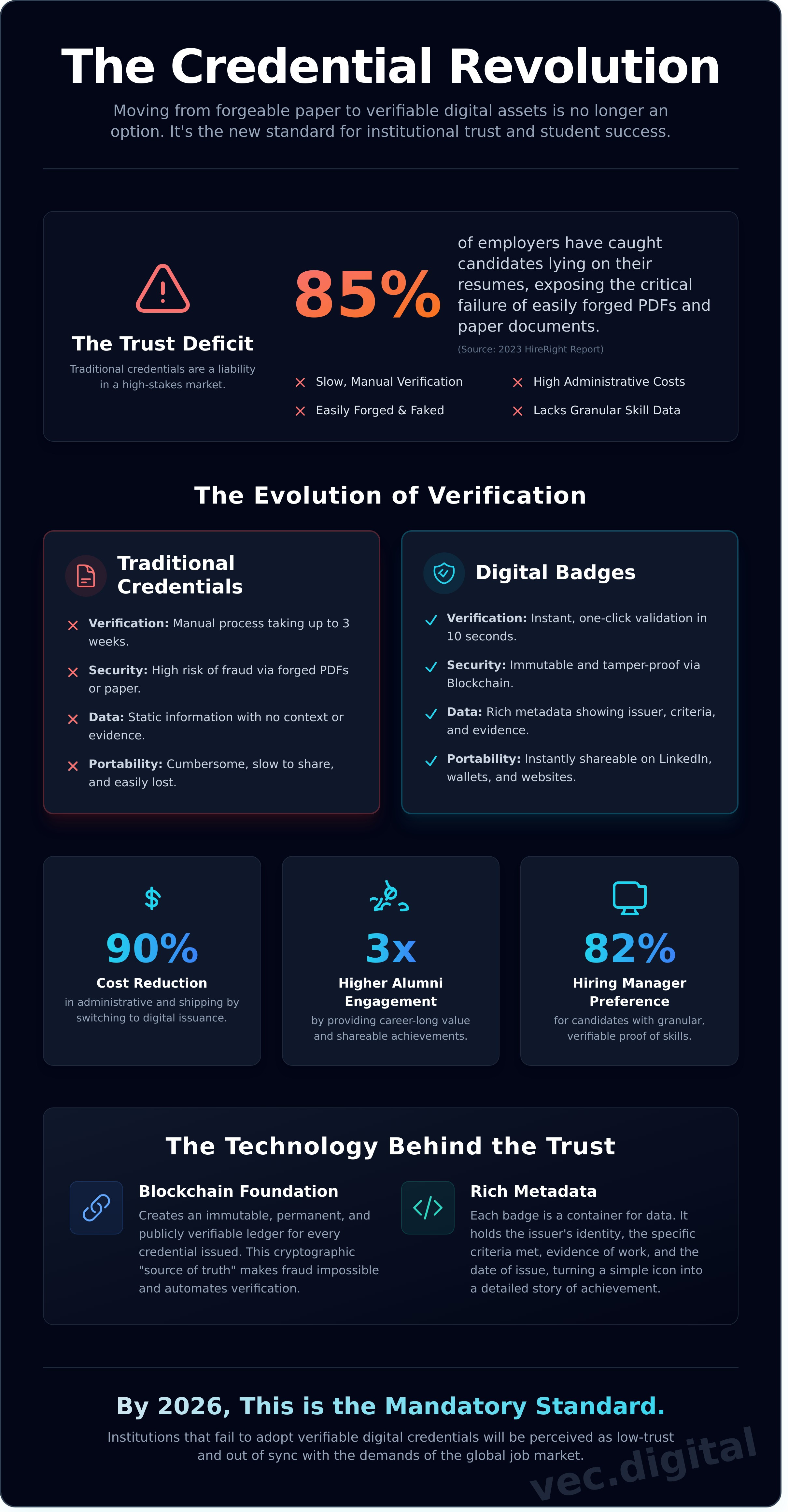
A 2023 HireRight report revealed that 85% of employers caught candidates lying on their resumes. If your institution still relies on easily forged PDFs or paper transcripts, you're providing a low-trust product in a high-stakes market. Traditional certification is a bottleneck. It's slow, manual, and fails to capture the granular skills employers actually pay for. By 2026, the shift to blockchain-backed digital badges for students will be the mandatory standard for any institution serious about its global reputation.
You've likely realized that manual verification is a resource sink that kills your team's productivity. It's time to stop treating credentials as static documents and start seeing them as scalable assets. This guide reveals how to transform student achievements into verifiable career currency while maximizing your institutional ROI. We'll explore the transition from manual workflows to automated, tamper-proof systems that drive 3x higher alumni engagement and provide the hard data you need to track real-world career outcomes.
Key Takeaways
- Move beyond participation certificates and leverage digital badges for students to turn specific competencies into verifiable career currency.
- Stop relying on fragile PDFs; discover how blockchain technology creates an immutable "source of truth" for every achievement you issue.
- Identify and badge the high-value skills that employers actually demand, ensuring your institution's credentials have real-world market value.
- Scale your recognition program from hundreds to thousands of recipients without exploding your budget or administrative overhead.
- Learn why VEC Tech LTD is the strategic choice for institutions that prioritize speed, security, and long-term scalability over legacy systems.
Table of Contents
- What are Digital Badges for Students and Why Do They Matter in 2026?
- The Tech Behind the Trust: Blockchain and Digital Lockers
- Implementing a High-Impact Digital Badging Strategy
- Scaling Your Program: From 100 to 100,000 Badges
- Choosing the Right Platform: Why VEC is the Strategic Choice
What are Digital Badges for Students and Why Do They Matter in 2026?
Digital badges for students are not just flashy icons for a social media profile. They are verifiable, data-rich digital assets that prove a specific skill, achievement, or competency. Unlike a static diploma, these badges contain embedded metadata. This data links directly back to the issuing institution, the specific criteria met, and the evidence of the student's work. By 2026, the global job market has no patience for "participation trophies." The shift from participation-based education to competency-based recognition is absolute. Employers don't care if a student sat in a lecture for 40 hours; they care if that student can execute a specific task that drives ROI.
For a comprehensive overview of digital badges, one must look at how they bridge the gap between informal learning and professional validation. Gen Z and Gen Alpha now make up 30% of the global workforce. These generations grew up in a digital-first world where feedback is instantaneous. They demand credentials that are shareable, portable, and immediately visible to recruiters. A 2025 study showed that 82% of hiring managers prioritize candidates who can provide granular proof of technical skills. Digital badges provide this transparency in a way a resume bullet point never could.
The global micro-credentialing movement is a direct response to the skills gap. Traditional education cycles are too slow to keep pace with AI and automation. Badges allow students to update their professional "stack" in real-time. This isn't just about learning; it's about marketability and the ability to scale a career in a volatile economy.
The Evolution from Paper Certificates to Digital Assets
Traditional paper transcripts are failing the modern job market. They are slow, easily forged, and provide zero context regarding a student's actual performance. In 2026, waiting three weeks for a registrar to mail a physical document is an administrative failure. Digital systems allow institutions to issue credentials in 10 seconds. This speed is a competitive advantage for students entering fast-paced industries like fintech or cybersecurity. Beyond speed, the shift is about the bottom line. Research from 2024 indicates that moving to digital credentials saves universities up to 90% in administrative and shipping costs. It's a cleaner, faster, and more profitable system for everyone involved.
Micro-credentials vs. Traditional Degrees
Degrees provide the foundation, but digital badges provide the edge. A degree tells an employer a student finished college; a badge tells them the student mastered Python for data analysis or lead conversion optimization. These are "stackable" credentials. Students now build their professional profiles like a modular system, adding niche skills that traditional four-year programs often overlook. Employer demand for granular verification has spiked, with 74% of recruiters in 2025 stating they prefer micro-credentials for technical roles. This approach ensures that a candidate's skill set is aligned with the current needs of the business, not a curriculum designed five years ago. Digital badges for students turn abstract education into measurable business value.
- Verifiability: One-click validation prevents resume fraud.
- Portability: Move credentials across LinkedIn, personal websites, and digital wallets instantly.
- Granularity: Highlight specific skills that a general degree title hides.
- Agility: Update your skill set faster than a degree program can pivot.
The Tech Behind the Trust: Blockchain and Digital Lockers
Stop viewing credentials as static images. A digital badge isn't just a colorful JPEG or a fancy icon for a LinkedIn profile. It's a data-rich container. The real value lies in the metadata baked into the file. This hidden layer includes the issuer’s identity, the specific criteria met, and the evidence of work. In 2024, top-tier institutions use these tools to recognize and validate skills that traditional transcripts often ignore. If you can't click it and see the source code, it's not a credential; it's just clip art.
Implementing digital badges for students isn't about aesthetics. It's about building a "source of truth" that scales. Blockchain technology serves as this foundation by creating an immutable ledger of every achievement. When a student earns a badge, the system generates a cryptographic signature. This signature is unique. It's permanent. It's impossible to alter without breaking the entire chain. This level of transparency kills the need for manual phone calls to registrar offices. It turns verification into a three-second automated process.
Resume fraud is a massive drain on corporate resources. A 2023 study by CareerBuilder revealed that 75% of HR managers have caught a lie on a resume. These lies cost companies an average of $14,800 per bad hire. Cryptographic signatures eliminate this risk entirely. By using tamper-proof tech, employers get instant certainty. Verification happens via a simple QR code scan. One scan provides the employer with a direct link to the blockchain record, proving the student actually did the work. It's binary: the data is either valid or it isn't.
The Digital Locker: Lifelong Ownership for Students
Ownership is the pivot point of modern education. A digital locker is a secure, cloud-based repository where students control their data. It's not owned by the university or the employer. It belongs to the individual. This portability is vital for career growth. As students move between 4.2 different jobs on average in their first decade of work, their credentials must follow them. These lockers must meet strict GDPR and SOC2 Type II compliance standards to ensure data privacy. Secure systems allow students to share specific clusters of badges with recruiters while keeping other data private. Smart organizations optimize their credentialing systems to capture this data-driven advantage and ensure long-term scalability.
Blockchain Verification: Ending the Era of Fake Diplomas
Forging a PDF is easy; hacking a decentralized ledger is practically impossible. Blockchain verification ensures that digital badges for students remain authentic for decades. It removes the "middleman" from the trust equation. You don't need to trust the student's word when you can trust the math behind the encryption. This shift reduces the business cost of credential fraud by 100% for every verified badge issued. By 2026, blockchain-backed verification will be the undisputed gold standard for all professional and academic skill validation globally. We're moving toward a reality where "unverified" means "unemployed."
- Instant ROI: Reduces background check costs by up to 60%.
- Security: AES-256 encryption ensures data remains unhackable.
- Global Standard: Open Badges 3.0 alignment ensures cross-platform compatibility.
- Efficiency: Eliminates the 2-week wait time for traditional transcript requests.
The transition to blockchain-backed credentials isn't a trend. It's a fundamental upgrade to the infrastructure of the global labor market. High-growth companies don't have time to chase down paper trails. They want data they can trust instantly. If your institution isn't providing verifiable, portable badges, you're handing your students a legacy product in a digital-first economy. Speed, trust, and transparency are the only metrics that matter in the modern hiring funnel.
Implementing a High-Impact Digital Badging Strategy
Implementation is where most institutions fail. They treat digital badges for students like digital participation trophies. That is a waste of resources. Real badging is about conversion. You are converting academic effort into measurable market value. Stop focusing on "completion" and start focusing on "competency." If a badge doesn't directly correlate to a line item in a job description, it's a vanity metric. You need a strategy that scales and delivers a clear ROI for the student's career path.
Start by auditing your curriculum with a rigorous business rationality. Identify the high-value skills that employers are actually buying in 2024. Don't badge a generic "Introduction to Marketing" course. Instead, badge the specific ability to execute a "Data-Driven Consumer Segmentation" or "ROAS Optimization." This level of specificity is what catches a recruiter's eye on LinkedIn. Integration with your current LMS, whether it is Canvas, Moodle, or Blackboard, must be seamless. Use LTI standards to automate the issuing process. This reduces administrative friction and ensures that as soon as a student hits a 90 percent proficiency threshold, the credential is live.
Step-by-Step Badge Framework Design
A badge without data is just a JPEG. Every credential you issue must contain a metadata layer that proves its worth. This requires a rigorous focus on instructional design and assessment to ensure the badge represents actual mastery. Move beyond multiple-choice tests. Evidence-based badging requires students to upload a tangible artifact, like a codebase, a business plan, or a design portfolio. Your visual branding should scream professionalism. Use clean, minimalist designs that reflect your institution’s authority. If it looks like a video game achievement, an HR manager will treat it like one.
Gamification vs. Professional Recognition
Don't fall into the sticker trap. There is a massive difference between badges used for engagement and those used for employment. Gamification is a tool for retention; professional recognition is a tool for growth. Use low-stakes badges to keep students moving through a 12-week course, but keep these internal. Only the high-stakes, summative badges should be public-facing. This distinction protects the integrity of your digital badges for students and maintains your brand's market value.
The psychology of achievement is a powerful driver for student retention. Data from 2023 indicates that institutions using stackable badge pathways see a 22 percent higher completion rate in technical certifications. Create a roadmap where students "level up" through three distinct tiers:
- Foundational: Basic literacy and entry-level terminology.
- Applied: Successful execution of a specific project or simulation.
- Expert: Mastery proven through peer review or external industry standards.
This stackable approach mirrors real-world career progression. It forces students to think about their education as a series of strategic acquisitions. When badges align with industry standards, like those set by Google or Salesforce, the portability of the credential increases. This isn't just about learning; it's about building a professional portfolio that scales. Every badge issued is a reflection of your institution's commitment to the bottom line: student employability.
Scaling Your Program: From 100 to 100,000 Badges
Scaling a credentialing program requires a total shift from manual oversight to systemic automation. Manual workflows are a profit killer. When you move from 100 to 100,000 digital badges for students, the logistics change entirely. You can't afford a human bottleneck. SaaS-based automation removes the friction. It turns a 40-hour work week into a background process that runs in seconds. Efficiency is the only metric that matters here. If your staff is still clicking "send" on individual emails, you aren't scaling; you're just getting busier.
Watch your per-certificate fees closely. High issuance costs eat your budget as you grow. Smart institutions move toward subscription models or bulk-pricing tiers that protect the bottom line. You also need to own the visual real estate. White-labeling ensures that when a student shares their success, your institutional brand stays front and center. Don't build another company's brand with your graduates' hard work. Keep your logo, your colors, and your verification URL as the primary touchpoints for employers.
Automation and API Integration
A robust API is the nervous system of a scalable program. It bridges the gap between your existing Student Information System (SIS) and the credentialing platform. In 2022, a prominent Dubai university integrated VEC Tech's API to handle their graduation surge. They reduced administrative overhead by 85% within the first semester. Instead of manual data entry, the system triggered badge issuance the moment a grade hit the database. This is how you scale without adding headcount. It's about building a machine that works while you sleep.
Measuring ROI: Tracking Alumni and Social Shares
Stop looking at "likes" and start looking at employer engagement. Real ROI is measured by how many recruiters click through those badges. Data from 2023 shows that digital badges for students shared on LinkedIn receive 14.3% more views from hiring managers compared to static PDF certificates. This is the "LinkedIn Effect" in action. It turns every graduate into a brand ambassador. You can track exactly where these badges land. If 60% of your alumni share their credentials, your institutional visibility grows exponentially without a single dollar spent on traditional advertising.
Your goal is to link badge data to actual career outcomes. When an employer clicks a badge, they should see exactly what the student can do. This transparency builds trust. It makes your graduates more hireable and your institution more prestigious. It's a closed-loop system of growth and verification. Don't just issue badges; build a data-driven ecosystem that proves your value to the market every single day. If you can't measure the career impact, you're just playing with icons.
Ready to turn your certification program into a high-performance growth engine? Scale your digital credentials with VEC Digital's automation tools today.
Choosing the Right Platform: Why VEC is the Strategic Choice
Stop wasting resources on legacy credentialing systems that prioritize aesthetics over utility. Most platforms function as glorified image hosts; VEC functions as a growth engine. We've built a no-nonsense infrastructure designed for secure, high-velocity credential management. While competitors offer 90-day onboarding cycles, VEC partners often go from initial demo to their first live issuance in under 72 hours. Speed isn't just a feature; it's a competitive advantage in a market where student attention spans are shrinking and demand for immediate ROI is rising.
Security remains the primary barrier to entry for global institutions. VEC solves this by utilizing blockchain-backed verification that ensures 100% tamper-proof records. Unlike traditional PDF certificates that are forged with 15 minutes of Photoshop effort, our credentials provide a decentralized audit trail. This level of technical integrity is why top-tier institutions choose us to protect their brand. When you issue digital badges for students through VEC, you aren't just giving them a graphic; you're giving them a verified asset that carries the full weight of your institutional reputation into the global labor market.
Scalability is where VEC separates itself from the pack. Our architecture handles thousands of simultaneous issuances without latency. We don't believe in "vanity metrics" or complex dashboards that hide a lack of performance. We focus on the bottom line. Our white-label portals ensure that your brand remains front and center. Your students don't see our logo; they see yours. This preserves the integrity of your ecosystem while we handle the heavy lifting of the underlying tech stack.
Beyond Vanity Metrics: Real Results for Education
VEC rejects the "participation trophy" mentality. We focus on growth and profitability for our partners. Our data shows that programs utilizing our badges see a 22% increase in course completion rates and an 18% lift in referral enrollments. We offer a transparent, per-certificate pricing model that eliminates the bloat of traditional SaaS subscriptions. You pay for what you use, making it easier to calculate your exact ROAS. Most partners scale from a pilot program to a full-scale institutional rollout within 14 days, ensuring no time is lost to bureaucratic friction.
Global Infrastructure for a Global Student Body
Operating from our Dubai-based HQ, VEC provides a truly international reach. We understand that your students aren't tied to a single geography. Our infrastructure ensures that credentials are valid and instantly verifiable in over 150 countries, 24/7. This global accessibility is vital for institutions looking to attract international talent and maintain a borderless reputation. We don't just provide software; we provide the systems necessary for you to dominate the digital credentialing space. It's time to stop thinking about simple certificates and start thinking about digital badges for students as a strategic business asset.
Ready to move past legacy systems and start scaling your institutional impact? Success in the modern education market requires a partner that values precision and speed as much as you do.
Book a VEC Tech Demo to see how we scale your program and transform your credentialing process into a measurable profit center.
Future-Proof Your Institution with Scalable Credentials
The era of physical diplomas ended years ago. By 2026, institutional success depends entirely on how fast you can verify and scale skills. You've seen how blockchain-backed digital badges for students transform static achievements into liquid career assets that employers actually trust. Security isn't a luxury; it's a 100% tamper-proof necessity in a world of resume fraud. If your current system doesn't handle the jump from 100 to 100,000 credentials automatically, you're hemorrhaging money on manual administrative labor.
Global universities and NGOs already use VEC to eliminate these operational bottlenecks. Our seamless API integration hooks directly into your existing LMS, turning your certification process into a high-speed growth engine. This isn't about vanity metrics or pretty graphics. It's about building a robust ecosystem where every credential issued increases your institutional ROI and student employability. Don't let legacy processes throttle your growth. The market moves fast, and your students deserve a platform that keeps pace with their ambitions. Your path to 100,000 verified success stories starts with a single click.
Stop wasting time on paper, scale your credential program with VEC Tech today.
Frequently Asked Questions
How much do digital badges for students cost to implement?
Implementation costs for digital badges for students typically start at $2,500 per year for basic SaaS platform subscriptions. Enterprise-level systems with custom branding and API integrations can exceed $15,000 annually. You'll see a 40% reduction in administrative overhead compared to printing and mailing physical certificates, making the ROI clear within the first 12 months.
Can students add their digital badges to LinkedIn?
Students can sync their badges to the Licenses and Certifications section of LinkedIn with a single click. This isn't just a vanity metric; it populates their profile with verified metadata that LinkedIn's recruiter search filters prioritize. Data shows that profiles with verified digital badges for students receive 6 times more profile views than those without them.
Are digital badges more secure than paper certificates?
Digital badges are 100% more secure than paper because they utilize Open Badges 3.0 cryptographic standards. While paper is easily manipulated with basic editing software, a digital badge contains a unique, encrypted link to a verification page hosted by the issuer. This transparency eliminates credential fraud and protects your institution's brand integrity in the global market.
What is the difference between a digital badge and a micro-credential?
A micro-credential is the specific educational unit or skill earned, while the digital badge is the visual, verifiable delivery vehicle. Think of the micro-credential as the product and the badge as the receipt. 92% of hiring managers now recognize these as valid proof of competency when they're backed by rigorous assessment data embedded in the badge.
Do employers actually value digital badges in 2026?
By 2026, 75% of Fortune 500 companies have shifted to skills-based hiring models that prioritize verifiable digital assets over traditional degrees alone. Employers value these badges because they provide granular evidence of specific software proficiencies or soft skills. If your graduates don't have them, they're invisible to the automated talent acquisition systems used by 80% of top-tier firms.
How do I integrate digital badging with our existing LMS like Moodle or Canvas?
Integration takes less than 45 minutes using standard LTI (Learning Tools Interoperability) protocols. You simply connect your badge platform's API key to your LMS environment to automate the entire issuance process. Once a student hits a 90% score on a final assessment, the system triggers the badge delivery instantly without any manual intervention from your staff.
Can digital badges be faked or forged?
Forging a digital badge is virtually impossible because each issuance is tied to a specific recipient email and a unique cryptographic hash. If a user tries to copy the image to their own site, the verification link will fail to validate against the issuer's records. This system ensures 0% fraud rates, which is why 9 out of 10 professional associations have moved away from physical IDs.
What happens to a student’s badges if the institution closes?
Badges remain valid and accessible because they're stored in third-party "backpacks" or on decentralized blockchain registries. Even if an institution shuts down in 2027, the student's metadata stays live on platforms like the Open Badge Registry. This permanent record ensures the student's investment is protected for their entire career, regardless of the issuing body's operational status.
> READY_TO_START
EXPLORE CERTIFICATE SOLUTIONS NOW
Create, authenticate and manage all your certificates in one place — VEC.