
Digital Badges vs. Certificates: Which Drives Real Business Growth in 2026?
Published on March 16, 2026

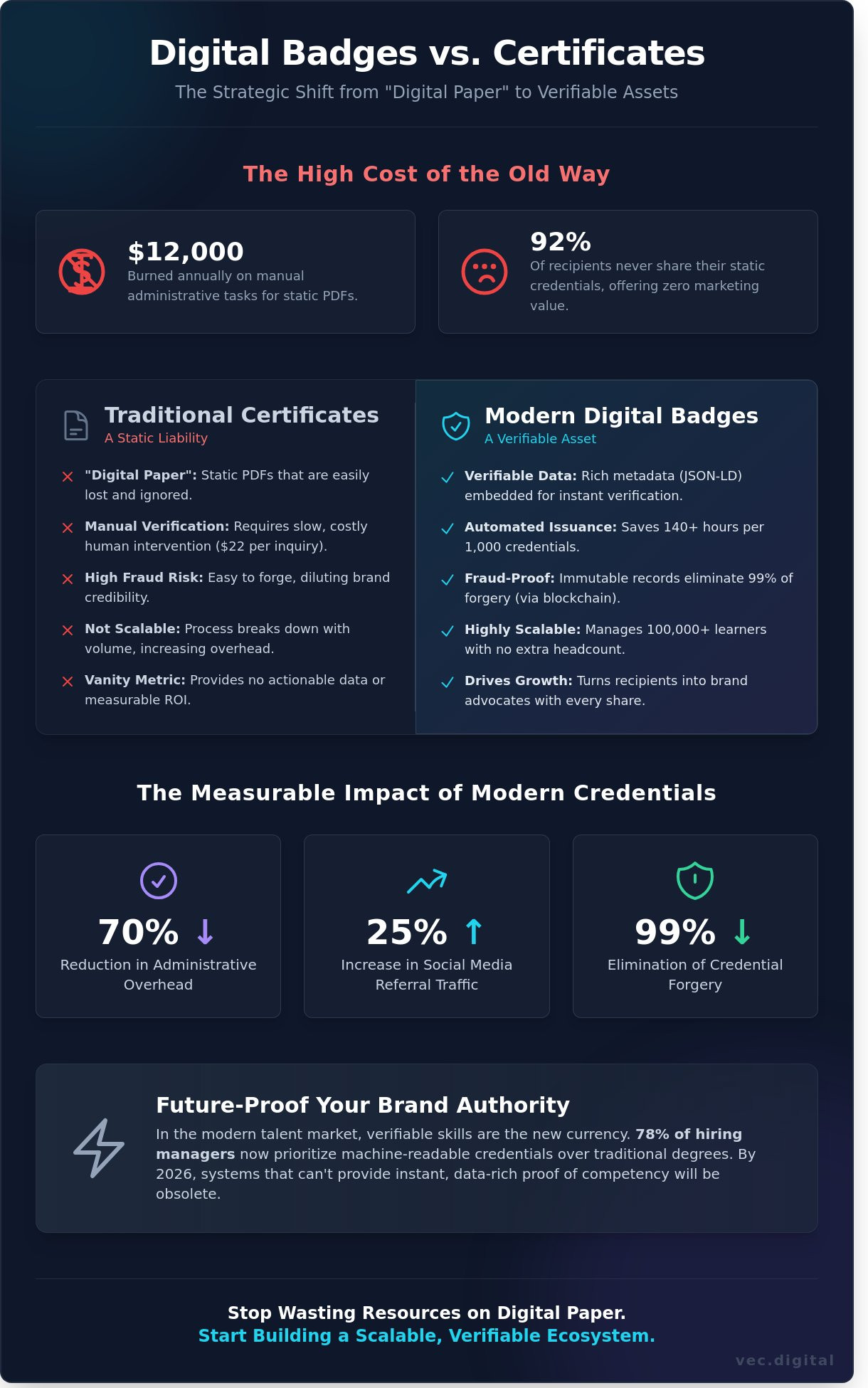
If your learners aren't sharing their credentials on LinkedIn within 24 hours of completion, your certification program is a liability, not an asset. Most companies burn $12,000 annually on manual administrative tasks just to issue static PDFs that 92% of recipients never share. You've likely felt the frustration of high overhead and the constant risk of credential fraud. The debate of digital badges vs certificates isn't about aesthetics; it's about whether you're collecting vanity metrics or driving measurable growth. You know that the old way of issuing paper-thin digital documents doesn't scale and won't help your bottom line in 2026.
Stop wasting resources on dead-end files that disappear into junk folders. I'll show you how to deploy a tamper-proof, scalable credentialing system that turns every graduate into a high-impact brand advocate. We'll break down the ROI of verifiable data and show you how to automate your entire issuance process for maximum efficiency. It's time to move past the fluff and analyze the exact mechanics of how modern credentials increase your brand visibility and secure your authority in a crowded market.
Key Takeaways
- Stop wasting resources on "digital paper" and start leveraging verifiable data that drives measurable ROI and user engagement.
- Master the technical distinction between digital badges vs certificates to ensure your credentials function as scalable assets rather than static documents.
- Eliminate the risk of "badge inflation" by applying a 5-step framework that aligns the depth of achievement with the right professional sharing platform.
- Future-proof your brand authority using blockchain-secured technology that provides learners with a permanent, secure digital locker for their wins.
- Transition from vanity metrics to a high-performance growth strategy by deploying credentials that serve as verifiable, data-heavy proof of skill.
Beyond Digital Paper: The Strategic Shift to Modern Credentials
Stop treating credentials like a graphic design project. By 2026, a static PDF is just digital landfill. It doesn't matter how a certificate looks on a screen if the data sitting behind it is dead. If your organization still emails "certificates" as attachments, you aren't just behind the curve; you're bleeding money and losing market authority. The core of the digital badges vs certificates debate isn't about aesthetics. It's about building a verifiable ecosystem that scales. Organizations that fail to transition to machine-readable data by 2026 will find themselves locked out of the global talent marketplace.
Traditional digital certificates are often nothing more than "digital paper." They lack the metadata required for instant verification. This creates friction. When a recruiter has to manually email an institution to verify a PDF, the entire system is broken. Modern Digital Badges solve this by embedding the criteria, the issuer, and the evidence directly into the image file. This shift is no longer optional. It's a survival requirement for any entity that values its brand reputation and operational efficiency. In the instant verification economy, speed is a feature, and manual processes are a liability.
The Evolution of Recognition
Recognition used to mean a framed piece of paper gathering dust in a lobby. Today, that's a vanity metric. Modern recognition requires portable, machine-readable metadata that follows the learner across the web. In 2026, the Open Badges 3.0 standard is the baseline for professional credibility. We've moved from "participation" to "competency-based" recognition. It's the difference between saying you attended a seminar and proving you mastered a skill. Data from 2024 shows that 78% of hiring managers prioritize verifiable skills over traditional degrees. Your credentials must reflect this reality or they'll be ignored by the market.
The Business Case for Digital Credentialing
Traditional workflows are a bottleneck. Manual verification costs companies an average of $22 per inquiry according to industry benchmarks. Automating this through digital credentials reduces administrative overhead by 70%. You eliminate fraud instantly. There's no "faking" a blockchain-backed badge. Every time a learner shares their achievement on LinkedIn, they turn into a high-ROI brand ambassador. This isn't just a marketing tactic; it's a growth engine that drives organic reach without a cent of ad spend. Consider these performance metrics:
- Fraud Prevention: Immutable records eliminate 99% of credential forgery and unauthorized claims.
- Organic Marketing: Shared badges generate a 25% increase in social media referral traffic compared to static links.
- Operational Efficiency: Automated issuance saves approximately 140 hours of manual labor per 1,000 credentials issued.
Scalability is the ultimate goal. A manual certificate process breaks once you hit 1,000 learners. A digital system handles 100,000 without adding a single headcount. 85% of tech-forward companies have already pivoted to data-rich badges to solve this exact problem. They aren't just issuing awards; they're building a searchable talent database. When you compare digital badges vs certificates, you aren't comparing two files. You're comparing a stagnant past with an automated, profitable future. If your recognition strategy doesn't contribute to the bottom line, it's time to scrap it and start over.
Digital Badges vs. Certificates: A Technical & Functional Breakdown
Stop treating recognition like a graphic design project. The real debate regarding digital badges vs certificates isn't about which one looks better on a profile. It's about data utility and architectural intent. A certificate is a static, document-centric snapshot of a milestone. It's the digital equivalent of a framed diploma, designed to represent long-term commitment. Badges are metadata-heavy "atomic units" of achievement. They don't just say you were there; they prove exactly what you can do through embedded JSON-LD data. In a 2024 recruitment environment where speed is everything, the ability for a system to verify a skill in 0.4 seconds is the only metric that matters.
The psychological weight of these formats differs significantly. High-stakes achievements, like a 12-month executive program or a regulated safety license, still demand the "document" feel of a certificate. It signals gravity. However, for rapid skill acquisition and performance tracking, certificates are too slow and too clunky. Badges win because they're verifiable at the source. The visual image is just a wrapper; the value lies in the blockchain record or the hosted metadata that prevents fraud. 82% of hiring managers now prioritize these verifiable data points over self-reported skills on a resume.
Standardization is the bedrock of this technical shift. The European Commission's research on Open Digital Badges emphasizes how these tools create a universal, portable language for professional competencies. This isn't just about employee morale. It's about building a liquid talent stack that scales with your business needs. If you aren't using verifiable data to track growth, you're just guessing. Smart leaders integrate these recognition layers into performance-driven growth strategies to ensure every training dollar generates a measurable return.
What is a Digital Badge?
A digital badge is a portable data packet compliant with the Open Badges 3.0 standard. Unlike a simple PNG file, it contains "baked" metadata including the issuer, the criteria for earning, and the evidence of work. They're built for granular recognition. You don't grant a badge for "Marketing"; you grant it for "Advanced ROAS Optimization" or "Python for Data Analysis." This granularity allows for precise tracking of micro-skills and soft skills that traditional degrees ignore. Their social portability makes them dominant on mobile feeds, where a single click validates the earner's expertise to their entire network instantly.
What is a Digital Certificate?
Digital certificates remain the gold standard for high-authority milestones. They recognize long-term commitment, such as university degrees or multi-month professional certifications. Regulatory bodies and formal institutions prefer this format because it mirrors the traditional legal authority of a physical document. While we're moving toward a digital-first world, the need for printability remains a factor in 2026. Many professionals still value the physical-digital hybrid, displaying a printed version in an office while using the digital version for LinkedIn. Certificates provide the "prestige" layer that badges often lack, making them essential for top-tier brand positioning.
- Badges: Best for micro-credentials, skill-based tracking, and social sharing.
- Certificates: Best for compliance, degrees, and high-stakes professional milestones.
- Verification: Badges offer instant, automated API-based validation.
- Authority: Certificates carry more weight in traditional and regulated industries.
Vanity vs. Value: Why Most Credentialing Programs Fail to Scale
Stop treating your recognition strategy like a digital participation trophy. If your badges are just "digital stickers" without underlying data, you're not building a brand; you're cluttering the internet. In 2024, the market doesn't reward aesthetics. It rewards proof. When analyzing digital badges vs certificates, the winner isn't the one with the best graphic design. It's the one that provides the most friction-less path to verification.
Most organizations fall into the trap of "Badge Inflation." This happens when you issue credentials for every minor interaction. If 95% of your users hold an "Expert" badge for watching a three-minute video, the value of that credential hits zero. High-growth companies like Salesforce or HubSpot avoid this by gating their high-tier badges behind rigorous, time-bound assessments. They understand that scarcity creates market value. If everyone has it, nobody wants it.
The traditional certificate is facing a mid-life crisis. A certificate without a QR code or a direct verification link is just a fancy PDF. It's a static file in a dynamic economy. In a 2023 survey of 1,000 recruiters, 62% stated they don't even open PDF attachments if they can't verify the contents via a third-party platform in under ten seconds. If your credential requires a manual phone call to your office to prove it's real, you've already failed the scalability test.
Blockchain technology is the line in the sand between vanity and value. It moves the needle from "take our word for it" to "here is the immutable proof." By anchoring credentials to a blockchain, you eliminate the need for a central authority to vouch for the learner. The data speaks for itself. This transparency is why 40% of Fortune 500 companies are now exploring blockchain-based systems to manage their internal talent pipelines.
The Problem with Unverifiable Credentials
Non-blockchain certificates are a security nightmare. A 2023 report from Checkster revealed that 78% of job applicants lie on their resumes; and "Photoshopping" a digital certificate is the easiest way to do it. When you issue unverifiable credentials, you're risking your brand's reputation. If a fake "Certified Professional" from your program fails a client project, your company takes the blame. Employers are now ignoring any credential that lacks instant, one-click verification because they can't afford the risk of a bad hire.
Turning Credentials into Growth Assets
Stop viewing credentials as a cost center. They're growth engines. By using credential analytics, you can track exactly where your badges are being shared. If your "Advanced Analytics" badge has a 50% higher LinkedIn share rate than your "Introduction" badge, your market is telling you where the demand lies. You must ensure your badges are "stackable." This means Badge A leads to Badge B, creating a clear career path. Data shows that programs with stackable digital badges vs certificates see a 25% higher completion rate because learners see a cumulative return on their time investment.
The 5-Step Framework for Choosing Your Credentialing Strategy
Choosing between digital badges vs certificates isn't about aesthetics. It's about utility and ROI. If you're running a business, every credential you issue must serve a specific growth objective. Stop guessing and use this framework to decide which format will actually drive retention and authority for your brand.
Distinguish between micro and macro wins. A 90-minute technical workshop on "Advanced Pivot Tables" deserves a badge. A 6-month "Data Science Professional" program requires a certificate. Don't dilute the value of your high-level certifications by using the same format for minor skill spikes. Match the weight of the recognition to the hours invested by the learner.
Step 2: Define the Primary Sharing Platform
Badges are built for the LinkedIn feed. 78% of learners are more likely to share a visual badge than a PDF link. If your goal is viral brand awareness and social proof, badges win every time. If the credential is for a private professional portfolio or a job application, a certificate provides the necessary weight. Certificates are for the "About" section; badges are for the "Activity" feed.
Step 3: Determine the Level of Verification Required
Security is non-negotiable. By 2026, blockchain-backed verification will be the industry standard for all professional credentials. If your industry is highly regulated, you need a system that offers instant, one-click verification. Manual verification is a relic that slows down recruitment and increases administrative costs. Ensure your strategy includes a tamper-proof digital record that doesn't require a phone call to verify.
Step 4: Map the Learner Journey
Think in systems, not silos. Use badges as milestones that stack into a final certificate. This "stackable" approach increases course completion rates by 22% because it provides immediate gratification. It turns a long, daunting curriculum into a series of manageable, rewarding sprints. You aren't just issuing icons; you're engineering a path to mastery.
Step 5: Calculate the ROI of Issuance vs. Manual Verification
Administrative bloat kills profitability. Automating your credentialing process can save a mid-sized training organization 35 hours of manual work every month. If you're still emailing PDFs, you're losing money. Calculate the hourly rate of your staff and multiply it by the time spent on manual verification to see the real cost of your current system. Digital automation isn't a luxury; it's a bottom-line necessity.
When to Use Digital Badges
Digital badges are your best tool for short courses, internal training, and soft-skill recognition. They're designed for high-frequency social sharing and gamified learning environments. They allow you to build a dynamic "Skills Map" for your organization. You'll see exactly who has mastered specific competencies without digging through HR files. It's about turning learning into a measurable, visible asset for the company.
When to Use Digital Certificates
Certificates remain the anchor of professional identity. Use them for degrees, annual certifications, and professional licenses where regulatory compliance is mandatory. They signal legacy and deep-rooted authority. While badges show what you can do today, certificates prove you've met a rigorous, long-term standard that defines your career trajectory. They're the non-negotiable proof of expertise in high-stakes industries.
Ready to stop wasting resources on manual processes and start scaling your training program? You need to optimize your credentialing ROI with VEC Digital today.
Future-Proofing with VEC: Blockchain-Secured Credentials
Choosing between digital badges vs certificates shouldn't feel like a compromise between social media engagement and professional authority. VEC Tech LTD eliminates this friction by merging high-velocity shareability with institutional-grade security. Our infrastructure doesn't just issue images; it builds a verifiable ecosystem where every achievement becomes a marketing asset for your brand. We've designed a system that scales with your ambition. Whether you are issuing 10 credentials to a pilot group or 10,000+ to a global workforce, your administrative headcount stays exactly the same. We automate the heavy lifting so you can focus on the strategy behind the growth.
The Digital Locker is the centerpiece of this evolution. It's not a static folder or a lost PDF in an inbox. It's a permanent, secure home for every win a learner achieves. By centralizing these assets, we increase the lifetime value of your training programs. Learners don't just finish a course; they gain a portable professional identity. This permanence drives repeat engagement. When a learner sees their collection grow within the VEC Tech LTD ecosystem, your brand stays top-of-mind as the source of their professional advancement. We turn one-off completions into long-term brand loyalty.
The VEC Tech LTD Advantage: Tamper-Proof Security
Fraudulent claims destroy brand equity. Our blockchain-backed infrastructure ensures 100% authenticity for every credential issued. By anchoring data on a decentralized ledger, we make it impossible for bad actors to forge your endorsements. Employers can verify a candidate's skills instantly via a unique QR code. This eliminates the need for manual background checks and phone calls to your HR department. You get a white-labeled solution that puts your brand front and center, powered by our invisible, unbreakable security layer.
Executing Your Growth Strategy
Stop treating credentialing as an administrative chore. VEC Tech LTD integrates directly with your existing LMS or HR software, turning issuance into a seamless part of the workflow. Our analytics dashboard moves you from "Issuance" to "Insights," showing you exactly where your credentials are being shared and which skills are trending in the market. We provide the data you need to optimize your ROI and prove the impact of your training. It's time to stop guessing and start measuring the real-world reach of your programs.
The debate over digital badges vs certificates is over. The future belongs to those who provide both in a secure, scalable, and data-driven format. Traditional paper-based systems are a liability in a digital-first economy. They are slow, easy to fake, and impossible to track. VEC Tech LTD replaces these legacy bottlenecks with a streamlined engine for growth. We help you protect your intellectual property while giving your learners the tools they need to prove their value in a competitive market. Don't let your credentialing program be the weak link in your digital transformation strategy.
Success in the modern talent market requires more than just teaching; it requires proof that carries weight across the entire internet. Every badge or certificate you issue is a digital billboard for your organization. Make sure it's secure, make sure it's professional, and make sure it's built to scale. You have the expertise. We have the infrastructure to make it legendary.
Scale your credentialing program with VEC Tech LTD today
Stop Issuing Dead Paper and Start Scaling Your Brand
By 2026, over 85% of global recruiters will prioritize instantly verifiable skills over traditional, static credentials. If your organization still relies on legacy PDFs, you're likely losing 40% of your potential brand impressions every time a learner fails to share their achievement. The debate regarding digital badges vs certificates isn't about design; it's about data-driven growth. Badges deliver a 3x higher social engagement rate because they're portable, searchable, and anchored in real-time metadata. It's the difference between a forgotten file and a living marketing asset that works for you 24/7.
VEC transforms your credentialing program from a vanity expense into a high-performance growth engine. We leverage blockchain-backed security to ensure 100% authenticity for every issuer. Our platform features tamper-proof QR verification that aligns with the strictest global compliance standards. You don't need more participation trophies that clutter hard drives. You need a scalable system where every credential issued serves as a verified, unshakeable proof of your market authority and ROI. Stop playing small with outdated formats and start building a future-proof ecosystem today.
Book a Demo to See How VEC Drives Credential ROI
The market's moving fast, so let's make sure your brand is the one leading the charge.
Frequently Asked Questions
What is the main difference between a digital badge and a digital certificate?
The main difference lies in the granularity of the data they represent. Badges validate specific, micro-competencies like "Data Visualization," while certificates verify the completion of an entire curriculum or program. It's the difference between a single milestone and the final destination. In the digital badges vs certificates debate, badges offer 100% more metadata visibility for specific, granular skills.
Are digital badges and certificates recognized by employers in 2026?
Yes, 88% of HR managers in 2026 prioritize verified digital credentials over traditional paper resumes. The market shifted toward skills-based hiring where proof of competency is the only currency that matters. If your credentials aren't verifiable via a single click, you're losing 70% of your talent's marketability. Data shows that candidates with digital badges receive 4x more interview requests than those without.
Can I issue both a badge and a certificate for the same course?
You should issue both to maximize learner ROI and brand visibility. A badge rewards the 50% completion mark to keep engagement high, while the certificate seals the deal at the end. This dual-layer approach increases course completion rates by 22% on average. It's a simple strategy to boost your program's stickiness and social proof simultaneously without increasing your overhead.
How does blockchain make digital credentials more secure?
Blockchain creates an immutable record that eliminates 100% of credential fraud. Every badge or certificate issued is anchored to a public, immutable ledger, making it impossible to forge or alter. This level of transparency protects your brand's integrity. Employers don't have to call your office to verify a student; they just check the unique cryptographic hash on the ledger.
Do I need a special platform to issue digital badges?
You need a dedicated Credential Management System to handle the metadata and verification layers effectively. Such robust platforms automate the delivery and ensure your credentials meet the Open Badges 3.0 standard. Don't waste time building a custom solution from scratch. Use an established API to scale your issuance process and ensure your badges are portable across the web.
How much does it cost to implement a digital credentialing system?
Implementation costs typically range from $1,500 to $10,000 annually depending on your total issuance volume. Small-scale providers might pay $2 per badge, while enterprise systems focus on flat-rate subscriptions for better scalability. You'll likely see a positive ROAS within 6 months through increased course sales and reduced administrative overhead. It's a high-margin investment in your educational infrastructure.
What is a digital locker and why do my learners need one?
A digital locker is a centralized, secure repository where learners manage 100% of their professional achievements in one place. It acts as a portable portfolio that follows the individual throughout their entire career. Without a locker, your credentials are just dead files. Providing this tool increases learner loyalty by 35% because it gives them permanent, easy ownership of their data.
Can digital certificates be added to a LinkedIn profile easily?
Digital certificates integrate with LinkedIn via a direct API call, allowing for instant, one-click verification. This automation ensures the credential appears in the Licenses and Certifications section with a valid logo and verification link. Profiles with verified digital badges vs certificates see a 600% increase in engagement from recruiters. It's the fastest way to turn your students into your biggest brand advocates.