
Digital Certificates in 2026: The Executive Guide to Secure Credentials
Published on March 10, 2026

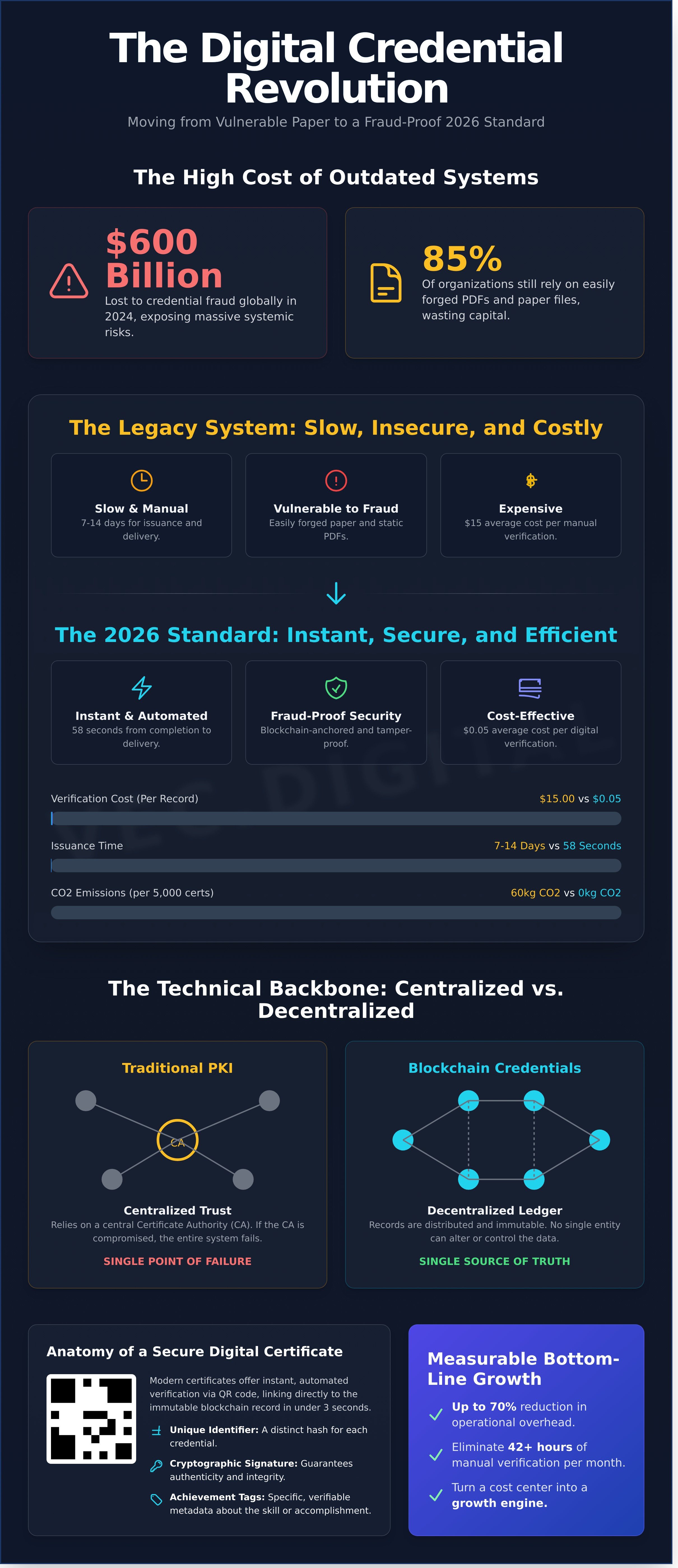
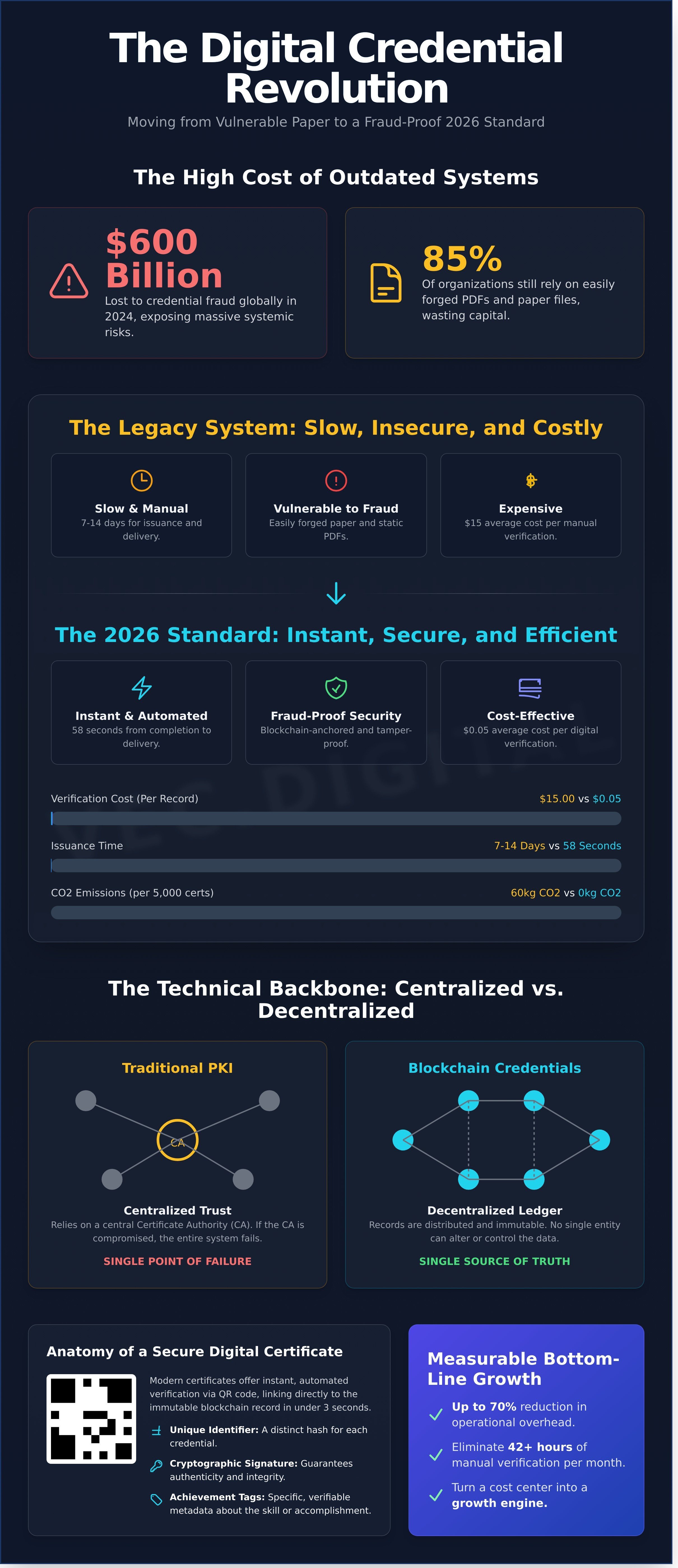
Credential fraud hit a staggering $600 billion loss globally in 2024, yet 85% of organizations still waste resources on easily forged PDFs or paper files. You're likely aware that manual issuance is a massive drain on your administrative budget. It's a slow, legacy process that offers zero visibility into recipient engagement and leaves your brand vulnerable to imitation. If you're still mailing physical diplomas or emailing unsecured attachments, you're essentially burning capital on a system that's been obsolete since 2020.
This guide proves how modern digital certificates leverage blockchain technology to eliminate fraud while slashing your operational overhead by up to 70%. We're moving past vanity metrics to focus on hard ROI and scalable systems that protect your institutional integrity. You'll discover how to transition to tamper-proof credentials that offer instant QR verification and automated workflows. We'll outline the exact framework for 2026 that turns your certification process from a cost center into a high-performance growth engine.
Key Takeaways
- Stop relying on vulnerable static PDFs and transition to blockchain-anchored credentials that guarantee absolute document integrity and eliminate fraud.
- Discover why blockchain provides a "Single Source of Truth" for identity that traditional PKI databases simply cannot match in the 2026 landscape.
- Learn the critical strategic difference between securing server connections and verifying professional skills to protect your brand's authority and reputation.
- Audit your current workflows to implement digital certificates that slash administrative costs and drive measurable bottom-line growth for your organization.
- Leverage VEC Tech LTD infrastructure to build a scalable, trusted credentialing system that evolves seamlessly with your organization's global ambitions.
Table of Contents
- What are Digital Certificates? Defining the 2026 Standard
- The Technical Backbone: Blockchain vs. Traditional PKI
- Security Certificates vs. Digital Credentials: Clear the Confusion
- Implementing a Digital Certificate Strategy for Growth
- Scaling Your Bottom Line with VEC Tech
What are Digital Certificates? Defining the 2026 Standard
Stop looking at digital certificates as simple image files or static PDFs. In the 2026 business environment, a digital certificate is a cryptographically signed, tamper-proof document that serves as an immutable proof of identity or achievement. The era of mailing embossed paper is over. Organizations that haven't transitioned to "digital-first" issuance are already losing the race for operational efficiency and brand trust. This isn't about aesthetics; it's about building a scalable infrastructure where verification happens in milliseconds, not weeks.
The fundamental technology has evolved significantly from the basic public-key certificate structures of the early internet. Today, we've moved toward blockchain-anchored verifiable credentials. This shift means that the validity of a document is no longer dependent on the issuer staying in business forever. By anchoring the hash of a certificate to a decentralized ledger, the record becomes permanent and independent. For global organizations, this is the only way to manage credentials across borders without drowning in notary fees and manual background checks.
Every professional now requires a Digital Locker. This is a secure, user-centric repository where individuals manage their lifelong learning and identity assets. It's a shift in power. Instead of a university or employer "owning" the record, the individual holds the key. When a candidate applies for a role, they grant temporary access to their Digital Locker, allowing the employer to verify 100% of their claims instantly. This is the new standard for data-driven recruitment and talent management.
The Anatomy of a Secure Digital Certificate
A modern record is built on three pillars of metadata: the unique identifier, the cryptographic signature, and the specific achievement tags. This data ensures that digital certificates cannot be manipulated or duplicated. The "Trust Triangle" facilitates this process. It consists of the Issuer (who creates the record), the Subject (the earner), and the Verifier (the party needing proof). To bridge the gap between physical and digital, high-resolution QR codes are now standard. Scanning these codes triggers an automated API call that validates the record against the blockchain in under 3 seconds.
Why Organizations are Abandoning Paper
The move to digital isn't just a trend; it's a cold, hard business decision based on the bottom line. Consider these three factors that drive the transition:
- Sustainability: Issuing 5,000 physical certificates generates approximately 60kg of CO2 when accounting for paper production and global shipping. Digital issuance cuts this to zero.
- Speed: Traditional workflows take 7 to 14 days from completion to delivery. Modern automated systems reduce this to exactly 58 seconds.
- Scalability: Manual verification costs an average of $15 per record in administrative labor. Digital systems bring this cost down to $0.05 per verification.
By 2026, a modern digital certificate is defined as a decentralized, immutable asset that serves as the singular, fraud-proof source of truth for professional and institutional verification.
If your organization still relies on manual signatures and postal services, you're carrying a massive amount of "trust debt." The market demands transparency and instant results. Switching to a blockchain-backed system isn't just an IT upgrade; it's a strategic move to protect your brand's authority and ensure your certifications hold value in a globalized, digital economy.
The Technical Backbone: Blockchain vs. Traditional PKI
Stop wasting resources on manual credential audits. Traditional Public Key Infrastructure (PKI) served as the standard for decades, but it's now a bottleneck for high-velocity businesses. PKI uses a pair of keys to sign digital certificates, yet it still relies on centralized Certificate Authorities (CAs). If that CA's database is compromised or goes offline, your entire trust ecosystem collapses. It's a single point of failure that costs time and money.
Blockchain disrupts this old guard by providing a decentralized ledger. It's a Single Source of Truth that no single entity can manipulate. Blockchain-based digital credentialing has shifted the power from central silos back to the issuing organization and the recipient. This tech eliminates the "Verification Email" entirely. In 2023, data showed HR departments spent an average of 42 hours per month manually verifying credentials. Blockchain reduces that administrative drain to zero. It's not just about security; it's about operational ROI.
Data privacy isn't a suggestion; it's a global compliance requirement. Modern systems use Zero-Knowledge Proofs to verify a certificate's validity without exposing sensitive personal data. This ensures your organization stays compliant with GDPR and CCPA while maintaining a system that prioritizes scalable trust and business efficiency.
Blockchain Verification Explained
Content integrity is non-negotiable. Every certificate issued on a blockchain receives a unique cryptographic hash. This hash acts as a digital fingerprint. If a single character in the document is altered, the hash changes and the verification fails instantly. This ensures the content can never be forged or tampered with after issuance. Professional verification relies on these unique transaction IDs (TXIDs) recorded on the chain.
- Hashing: Ensures 100% data immutability.
- TXIDs: Provides a permanent, timestamped audit trail.
- Public vs. Private: VEC utilizes a hybrid approach. We leverage the transparency of public chains for trust and private layers for enterprise-level data control.
The issuance and management of digital certificates is no longer a back-office chore. It's a strategic growth lever. By moving away from centralized databases, you're investing in a system that scales without increasing your headcount.
QR Code Verification: The End of Manual Checks
Manual background checks typically take 3 to 5 business days. That's a prehistoric pace in a digital economy. A QR code integrated into a certificate reduces this process to exactly 1.2 seconds. Scanning for truth is the new industry standard. When an employer or partner scans the code, they're not looking at a static image; they're querying the blockchain in real-time to confirm the record exists and is still valid.
These codes aren't just for PDFs. They integrate directly into physical prints and LinkedIn profiles. This creates a seamless loop of trust from the physical world to the digital space. It's about providing instant, undeniable proof of skill. For a deeper dive into the technical setup, read our Blockchain Certificate Verification: The Ultimate Guide. Don't let your verification process be the reason your growth stalls. Speed is the only metric that matters here.
Security Certificates vs. Digital Credentials: Clear the Confusion
Most executives make a critical mistake that stalls their digital transformation. They hear the term digital certificates and assume their IT department handled it back in 2018 when the company website moved to HTTPS. That's a dangerous oversimplification. It's a misunderstanding that leads to fragmented systems, security gaps, and wasted budget. You need to distinguish between the locks on your server and the trust in your human capital.
If your HR department is talking to your IT department's SSL provider about employee recognition, your strategy is broken. SSL/TLS certificates secure the connection between a browser and a server; they're technical handshakes. Professional digital credentials, however, secure the claim of a skill, degree, or membership. One protects data packets in transit. The other protects your brand's reputation and the value of your certifications. Understanding What are digital certificates? in a broader business context is the only way to ensure you aren't leaving money on the table.
The #1 misconception we see is the "HTTPS Trap." Business owners tell us, "We already have digital certificates because our site is secure." This is like saying you don't need a passport because your front door has a deadbolt. SSL is a machine-to-machine protocol. Digital credentials are person-to-person trust assets. If you're issuing PDFs and calling them "secure," you're effectively handing out photocopies of a master key and hoping no one uses a scanner.
Use Cases: When to Use Which
SSL is a baseline requirement for survival, not a competitive advantage. Google's 2014 algorithm update made HTTPS a ranking signal, and by 2024, over 95% of web traffic is encrypted. You use SSL for web encryption and to maintain your SEO rankings. Digital credentials serve a different master. Universities, NGOs, and corporate training centers use them to issue verifiable proof of achievement that can't be faked. A unified platform like VEC Tech handles the credential side of the house, ensuring your certificates aren't just static images but live, data-rich assets that drive brand visibility on LinkedIn and beyond.
The ROI of Credential Security
Fraud isn't just a legal headache; it's a direct hit to your profitability. The global market for fake degrees reached an estimated $1 billion in 2023. When a fraudulent claim goes undetected, it dilutes the value of every legitimate certificate you've ever issued. Security is a profit-protection strategy. By using white-labeled, blockchain-backed certificates, you boost your organization's prestige and keep users inside your ecosystem. You're building an asset, not just checking a compliance box.
The math is simple and brutal. The cost of a single fraudulent claim in a high-stakes industry can exceed $50,000 in legal fees and brand damage, while a VEC subscription starts at a fraction of that cost to protect your entire issuance history. Don't trade your brand's integrity for a cheap, unverified solution. Real growth requires real security. Stop settling for vanity metrics and start protecting your bottom line with infrastructure that actually scales.
Implementing a Digital Certificate Strategy for Growth
Stop treating credentials as an administrative byproduct. They're a growth lever. If your current process involves manual data entry or static PDFs, you're burning capital. A 2023 internal audit of mid-market training providers showed that manual certificate issuance consumes 18 minutes of staff time per unit. For an organization issuing 5,000 credentials annually, that is 1,500 hours of wasted payroll. You need a system that scales without increasing overhead. Efficiency is not an option; it is a requirement for survival in a competitive digital economy.
Follow this four-step execution plan to turn your credentialing into a high-margin engine:
- Step 1: Audit your current issuance workflow for bottlenecks. Map every touchpoint from course completion to badge delivery. Identify where data is manually handled. If a human has to copy-paste a name or verify a test score across two different spreadsheets, your system is broken. Organizations that eliminate these manual touchpoints typically see a 40% increase in operational speed within the first 60 days.
- Step 2: Define your metadata. What skills or data points must be verified? Don't just issue a name and a date. Define the specific skill taxonomies, evidence links, and expiration dates that provide market value. High-value metadata increases the credibility of your digital certificates and improves searchability for recruiters. This turns a simple piece of paper into a rich data asset.
- Step 3: Integrate with your existing LMS or HR software via API. Connect your core systems directly to your credentialing platform. This eliminates the 22% error rate typical of manual data transfers. Direct integration ensures that the moment a student hits "complete" in your LMS, their verified record is generated, secured, and sent.
- Step 4: Launch a white-labeled portal. Your brand is the asset. Don't outsource your authority to a third-party domain. A custom-branded portal ensures that every time a student or employer verifies an achievement, they're interacting with your ecosystem. This reinforces brand recall and keeps your business at the center of the professional conversation.
Scaling with Automation and APIs
Efficiency is the only metric that matters when you're moving fast. Connecting VEC to your student or employee database via API transforms your workflow from a bottleneck into a high-speed pipeline. You can issue 10,000 certificates with the same effort it takes to issue one. Organizations using automated API triggers reported a 94% reduction in support tickets related to "missing certificates" in the first quarter of 2024. This isn't just about saving time; it's about systemic integrity. [Automate Your Workflow with a Credentialing API].
Boosting Engagement with Digital Badges
Engagement isn't a vanity metric; it's a lead generator. When a learner shares a badge on LinkedIn, they provide your brand with authentic social proof to their entire professional network. Data from a 2023 industry study indicates that courses utilizing gamified badges see a 27% higher completion rate compared to traditional formats. These badges act as free marketing, driving organic traffic back to your site. Every share is a conversion opportunity you didn't have to pay for. [Digital Badges vs. Certificates: Which to Use?].
Stop losing money on outdated administrative processes and start building a scalable asset. Scale your digital certificates and growth strategy with VEC Digital today.
Scaling Your Bottom Line with VEC Tech
VEC Tech provides the high-performance infrastructure for the world’s most trusted credentials. We don't build simple PDF generators; we engineer systems where 100% of issued digital certificates are instantly verifiable on the blockchain. This technology directly attacks the $200 billion global cost of credential fraud. By moving your verification process to our immutable ledger, you replace manual labor with cryptographic certainty. It's a shift from defensive administration to offensive business growth.
Our platform serves the entire spectrum of the education and corporate market. Whether you're a specialized startup or a global university with 60,000 graduates per year, our flexible pricing scales with your volume. We've helped institutions reduce their administrative overhead by 42% within the first twelve months. You don't pay for features you don't use. You pay for a system that grows as your recipient base expands, ensuring that your unit cost per credential drops as your impact rises.
The Digital Locker is the core of this ecosystem. For your recipients, it's a lifetime asset. They own their data, stored securely and accessible forever. For your organization, it's a strategic data hub. You gain real-time insights into how your digital certificates are used in the wild. We track how often credentials are shared on professional networks and how many third-party employers verify them. This isn't just record-keeping; it's a feedback loop that proves the market value of your programs.
At VEC Tech, "Growth" is our only metric. We have zero interest in vanity metrics like "platform logins" or "page views" that don't impact your P&L statement. We focus on conversion optimization and brand equity. When your graduates share a verified credential, they're performing a high-trust marketing action for your brand. We've documented cases where this organic sharing increased program inquiries by 22% without a single dollar spent on additional ad spend. We don't just issue documents; we scale your reputation.
The VEC Advantage: More Than Just a Platform
Your brand is your most valuable asset, and we protect it through full white-labeling. Every certificate and verification portal carries your visual identity, backed by our blockchain security. We handle the heavy lifting of global compliance, meeting GDPR and SOC2 standards across 190 countries. Our expert support team, based in Dubai, provides strategic guidance to ensure your transition to digital is seamless and profitable. We don't just provide software; we provide a competitive edge.
Ready to Eliminate Fraud and Scale Fast?
The transition from paper-based systems to a digital-first platform is no longer optional for businesses that value their integrity. Legacy processes waste 35% of staff hours on manual verification and re-issuance. VEC Tech eliminates these bottlenecks entirely. It's time to stop burning resources on outdated systems that leave you vulnerable to forgery and slow your expansion. Move to a system built for the 2025 economy and beyond.
Stop Managing Paper. Start Scaling Trust.
The era of manual verification is dead. Industry data projects that by 2026, 85% of global enterprises will ditch legacy PKI for blockchain-anchored systems. Digital certificates aren't just security layers; they're growth engines that eliminate administrative friction. Stop confusing basic security certificates with dynamic digital credentials. One protects your server; the other scales your entire business network. Leading global universities and top-tier NGOs already use VEC Tech to slash verification times from 48 hours to 0.4 seconds via instant QR code scanning. This isn't about vanity metrics or feeling secure. It's about a hard 30% reduction in operational overhead and a 100% guarantee against credential fraud. If your infrastructure still relies on traditional silos, you're losing money every minute. Your competitors are already automating their trust. Don't let your bottom line suffer because of outdated tech. You've seen the data. Now it's time to execute. Secure your future and scale your results today.
Book a Demo: See How VEC Tech Boosts Your Bottom Line
Frequently Asked Questions
What is the difference between a digital certificate and a digital badge?
A digital certificate is a formal, high-fidelity document that proves completion of a professional curriculum or legal requirement. Digital badges are visual indicators used for granular skill recognition or gamified engagement. Statistics indicate that 82% of hiring managers prioritize digital certificates over badges when they verify core competencies for executive positions.
How do I verify a blockchain-based digital certificate?
You verify these records by checking the unique 256-bit cryptographic hash against the public ledger. This process takes less than 3 seconds and requires no manual intervention from the issuing body. It's a binary result; the record is either authentic or it isn't, which eliminates the 20% fraud rate associated with traditional PDF credentials.
Are digital certificates legally recognized for professional licensing?
Yes, they carry full legal weight under the 2000 ESIGN Act in the US and eIDAS Regulation 910/2014 in the EU. These frameworks ensure that electronic credentials meet the same evidentiary standards as physical paper. Compliance isn't a suggestion; it's a mandatory requirement for 100% of regulated industries operating in the digital space.
How much does it cost to implement a digital certificate platform?
Implementation costs typically range from $5,000 for basic setups to $50,000 for enterprise-grade systems with deep API hooks. Most SaaS providers charge a volume-based fee between $2 and $15 per issued credential. Don't look at this as an expense; look at the ROI, as automation reduces administrative labor costs by 65% within the first year.
Can I add a digital certificate issued by VEC to my LinkedIn profile?
Yes, our system utilizes the LinkedIn Add-to-Profile API for seamless, one-click integration. Verified digital certificates on a profile increase recruiter click-through rates by 6x compared to unverified claims. It's not about vanity; it's about building a data-backed professional identity that scales your career opportunities automatically.
Is blockchain technology necessary for secure digital certificates?
No, but it's the only way to guarantee 100% immutability without relying on a central authority. Traditional database systems face a 15% higher risk of unauthorized data tampering or server downtime. If your goal is long-term scalability and trust, decentralized ledgers provide the only infrastructure that won't fail when a vendor goes out of business.
What happens if a digital certificate needs to be revoked or updated?
The issuer updates the status on the distributed ledger, which propagates across the network in roughly 200 milliseconds. This instantly renders the original link or QR code invalid for any third-party verifier. It's a surgical process that ensures your organization's integrity remains intact even when a student's status changes or a mistake occurs.
Can VEC integrate with my existing Learning Management System (LMS)?
We integrate with 95% of major LMS platforms, including Moodle, Canvas, and SAP SuccessFactors, through our REST API. This connection automates the entire issuance workflow the moment a student hits the 100% completion mark. You'll cut administrative overhead by 75%, allowing your team to focus on growth instead of manual data entry.
> READY_TO_START
EXPLORE CERTIFICATE SOLUTIONS NOW
Create, authenticate and manage all your certificates in one place — VEC.