
Digital Credential Pricing: The 2026 ROI-Driven Guide for Growth-Oriented Organizations
Published on March 14, 2026

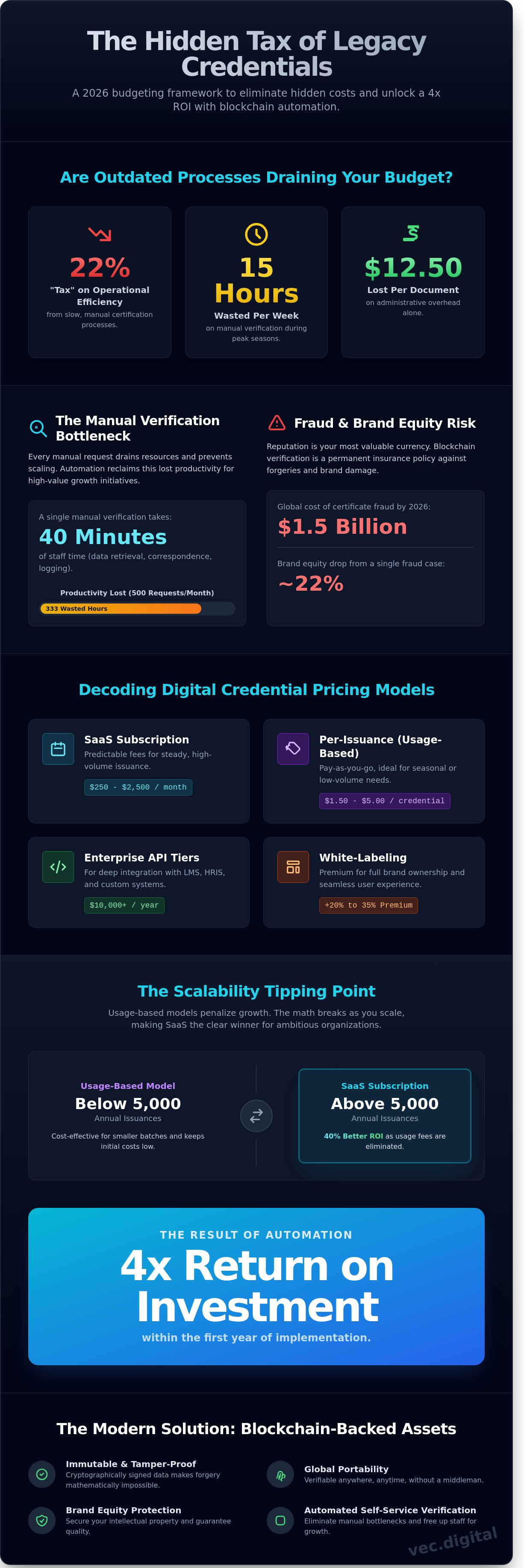
Legacy certification processes are a 22% tax on your operational efficiency that you can no longer afford to pay. You've likely struggled with unpredictable per-certificate fees or watched your staff waste 15 hours a week on manual verification during peak seasons. It's impossible to scale when your digital credential pricing model feels like a moving target designed to eat your margins. You deserve a transparent system that treats your credentials as an asset, not a recurring expense.
Stop guessing and start calculating. This guide moves beyond surface-level costs to reveal the hard ROI of blockchain-backed automation. We'll provide a definitive framework for 2026 budgeting that eliminates hidden fees and focuses on the bottom line. You'll see exactly how to replace manual bottlenecks with systems that deliver a 4x return on investment within the first year. We’re breaking down the specific value-drivers you need to turn your credentialing program into a high-performance growth engine.
Key Takeaways
- Stop burning cash on manual paper processes and learn to quantify the massive financial risk of certificate fraud in 2026.
- Navigate the 2026 landscape of digital credential pricing to determine which subscription or usage-based model maximizes your budget efficiency.
- Expose the hidden ROI killers of "low-cost" platforms, from proprietary vendor lock-ins to inefficient manual verification fallbacks.
- Execute a precise two-step TCO audit to project your 3-year growth and stop guessing your digital transformation budget.
- Reject vanity metrics and adopt a tiered, results-driven pricing strategy that scales alongside your organization’s high-performance goals.
The Economics of Digital Credentials: Why 'Free' Paper is Costing You Millions
Paper isn't cheap; it's a legacy debt that kills your scale. If you're still printing certificates in 2026, you're subsidizing a 15% inefficiency rate across your entire administrative chain. Manual labor, physical mailing, and climate-controlled storage aren't just line items. They're growth killers. Organizations that ignore the shift to verifiable assets lose an average of $12.50 per document on administrative overhead alone. Evaluating digital credential pricing requires looking at the bottom line, not just the subscription fee. It's a shift from an expense-heavy model to a profit-protection strategy.
The global cost of diploma and certificate fraud is projected to hit $1.5 billion by the end of 2026. This isn't just about fake degrees; it's about the erosion of your brand's market value. When a fraudulent version of your certification circulates, your legitimate earners lose their competitive edge. Digital credentials have evolved past the vanity badge era. They are now high-utility, blockchain-backed assets that secure your intellectual property. Before diving into the math, it's vital to define the tech: What are digital credentials? and why do they differ from a simple PDF? They are cryptographically signed data packets that prove achievement without a middleman. By 2026, these assets have become the standard for any organization serious about global portability and data integrity.
Stop viewing your certification program as a cost center. When you transition to a digital-first model, you're not just buying software. You're buying a system that converts manual friction into measurable ROI. Understanding digital credential pricing is about quantifying the cost of your current manual failures and replacing them with a scalable, tamper-proof infrastructure.
The Hidden Cost of Manual Verification
Every time an employer emails your registrar to verify a graduate, you lose money. On average, a single manual verification takes 40 minutes of staff time when you factor in data retrieval, email correspondence, and record logging. If your team handles 500 requests a month, that's 333 hours of wasted productivity. This manual process creates a bottleneck that prevents your organization from scaling. The Verification Tax is the hidden drain on administrative ROI. By automating this through a self-service digital portal, you reclaim those hours for high-value growth initiatives.
Fraud and Brand Equity Protection
A single high-profile case of a fraudulent credential can tank your brand equity by 22% in a single fiscal year. In 2026, reputation is your most valuable currency. Blockchain verification acts as a permanent insurance policy for your brand. It creates an immutable audit trail that makes forgery mathematically impossible. Tamper-proof tech isn't a luxury; it's the only way to future-proof your certification program against increasingly sophisticated AI-generated forgeries. You aren't just issuing a badge; you're issuing a guarantee of quality that protects your long-term market position.
Decoding Digital Credential Pricing Models in 2026
Stop looking at price tags and start looking at unit economics. In 2026, digital credential pricing isn't just a line item; it's a scalability lever. Most platforms force you into one of four boxes. The SaaS subscription model remains the standard for predictable budgeting. You pay a fixed monthly fee, often ranging from $250 to $2,500, depending on your feature set. It's safe. It's boring. It works for established institutions with steady graduation rates.
Per-issuance billing is the alternative. You pay for what you use, typically between $1.50 and $5.00 per credential. This model attracts seasonal bootcamps or one-off event organizers. It looks cheaper on paper for small batches. However, as soon as you hit 3,000 credentials annually, the math breaks. You end up overpaying for the privilege of growth. We call this the growth tax. Avoid it if you plan to scale.
Enterprise API tiers represent the heavy hitters. These plans start at $10,000 annually and focus on connectivity. You aren't just buying a dashboard; you're buying a pipeline into your LMS or HRIS. Finally, there's white-labeling. Expect to pay a 20% to 35% premium for brand ownership. Removing a vendor's logo isn't vanity; it's about maintaining a seamless user journey that protects your brand equity.
SaaS vs. Usage-Based: Which Scales Faster?
Data from January 2026 market benchmarks shows the tipping point sits at 5,000 annual issuances. Below this, usage-based models keep your CAC low. Above it, SaaS subscriptions deliver a 40% better ROI. Success penalties occur when usage fees eat your margins during high-growth phases. VEC Tech LTD advocates for hybrid models. We prioritize structures that cap costs as you expand, ensuring your profit grows faster than your vendor's invoice.
The Price of Integration and Automation
API access isn't a luxury; it's a cost-saving machine. Manual data entry for 2,000 credentials costs approximately 40 man-hours. At a $55 hourly rate, you're burning $2,200 per cycle on friction. Automated issuance via API reduces this cost to near zero. Cheap platforms often hide technical debt in their lack of documentation. If an integration takes your dev team three weeks instead of three days, that "affordable" platform just cost you $15,000 in lost productivity. Efficiency requires a strategic growth partner who understands that connectivity equals profit.
Customization costs are the final frontier. In 2026, 88% of top-tier certification bodies use custom domains to boost social share rates. A credential that lives on your own URL sees a 22% higher engagement rate than one hosted on a generic vendor site. Don't settle for "good enough" templates. Pay for the ability to control the metadata and the visual experience. It's the difference between a digital PDF and a powerful marketing asset that drives referral traffic back to your ecosystem.
Smart digital credential pricing strategies account for these hidden variables from day one. High-growth organizations don't chase the lowest monthly fee; they chase the lowest cost per successful verification. Analyze your projected volume for the next 24 months. If your provider can't show you a clear path to lower unit costs as you scale, you're in the wrong contract. Focus on the bottom line. Results are the only metric that matters in a competitive digital economy.
Hidden ROI Killers: What the 'Cheap' Platforms Won't Tell You
Low entry-level costs are a classic bait-and-switch tactic in the SaaS world. When you evaluate digital credential pricing, the monthly subscription fee represents only 30% of your total cost of ownership. The other 70% hides in technical debt, manual workarounds, and massive compliance risks. Choosing a platform based solely on a low sticker price often leads to a negative ROAS when you factor in the operational friction that budget solutions create. You aren't saving money; you're deferring a massive bill.
One major drain on your budget is the manual verification fallback. If your digital credential requires a human staff member to manually cross-reference a database because the "digital" file isn't instantly verifiable via a public ledger, you haven't automated anything. You've just digitized a bottleneck. For an organization issuing 5,000 credentials annually, this manual overhead can cost upwards of $12,000 in lost productivity hours based on 2025 labor rates. True digital credential pricing must account for these hidden labor costs that "cheap" platforms ignore.
Proprietary vs. Blockchain Verification
Centralized, proprietary storage is a ticking time bomb for your data strategy. When you store credentials on a vendor's private server, you're locked into their ecosystem. If that provider goes bankrupt or raises their rates by 50% in 2026, migrating your data to a new system can cost between $15,000 and $45,000 in developer hours. Blockchain-based verification eliminates this risk. It provides a decentralized, permanent layer where verification is cost-free and independent of any single company's survival. At VEC Digital, we view blockchain as a critical hedge against vendor lock-in that secures your long-term profit margins.
Compliance and Security Overhead
Data privacy isn't a checkbox; it's a massive financial liability. Cheap platforms often cut corners on GDPR and DIFC compliance to keep their digital credential pricing artificially low. A single data breach or a failure to meet "Right to be Forgotten" requests can result in fines reaching 4% of your annual turnover. You aren't just buying software; you're managing risk. Paying a Security Premium for a platform that prioritizes encryption and decentralized identity isn't an expense. It's insurance. We focus on data privacy because preventing a $250,000 fine is the most effective way to protect your growth and maintain market credibility.
User experience (UX) friction is the final ROI killer. A clunky digital locker interface results in a 40% drop-off rate in credential sharing. If your students or employees can't easily add their achievement to a digital wallet, the marketing value of your program evaporates. You're paying for a system that nobody uses. High-performance platforms ensure that every credential becomes a brand ambassador, driving organic growth instead of sitting idle in a forgotten inbox. Every click you save the user increases the lifetime value of that credential. Don't let a poor interface turn your investment into a vanity metric.
Efficiency is the only metric that matters. If a platform costs $5,000 less but requires $15,000 in manual support and lost marketing opportunities, it's a bad deal. We don't just look at the invoice; we look at the bottom line. Scalability requires a foundation that doesn't crumble when your volume increases by 200%. Demand transparency from your vendors and stop subsidizing their technical debt with your company's future profits.
Calculating Your Total Cost of Ownership (TCO) and ROI
Stop looking at the sticker price as a standalone figure. You aren't just buying a software subscription; you're investing in a growth engine. To understand the real impact of digital credential pricing, you must look at the bottom line over a three year horizon. Most organizations fail because they only see the monthly SaaS fee while ignoring the massive hidden costs of their current manual systems. Profit isn't an accident. It's an architecture.
- Step 1: Audit manual costs. Calculate the hours spent on printing, signing, and mailing paper certificates. A 2024 benchmark study revealed that manual verification costs institutions an average of $12.50 per request. If you handle 500 requests a year, you're burning $6,250 on administrative friction alone.
- Step 2: Estimate volume and growth. Don't plan for today. Plan for 2026. If your certification program is growing at 22% annually, your platform must scale without a linear increase in overhead. Digital systems handle 10,000 issuances as easily as ten.
- Step 3: Factor in implementation. Account for the initial 15 to 20 hours of staff training and API integration. It's a front-loaded cost that buys you years of automated performance.
- Step 4: Project automation savings. Digital credentials move the verification burden from your staff to the blockchain or a secure database. This eliminates 100% of the time spent answering "Did this person graduate?" emails.
- Step 5: Calculate the Brand Multiplier. This is where the magic happens. Every shared badge is a high-intent advertisement for your program.
The ROI of Social Proof and Virality
LinkedIn integrated credentials aren't just vanity metrics. They're a free marketing engine. When a graduate shares a badge, it hits an average of 500 to 1,200 unique professional feeds. If 1,000 students share their achievements, you've generated up to 1.2 million impressions. At a standard $25 CPM for targeted LinkedIn ads, that's $30,000 in equivalent ad spend earned for free. VEC's digital locker is engineered to maximize this organic reach, ensuring your brand stays at the center of the professional conversation without a cent of extra digital credential pricing overhead.
Efficiency Gains in the Administrative Office
Efficiency is the ultimate competitive advantage. One mid-sized professional association recently reduced their verification response time from 48 hours to exactly 0 seconds by switching to instant QR code verification. They didn't just save time; they reallocated two full-time staff members from data entry to strategic student recruitment. This shift turned a traditional cost center into a profit-generating unit. Employers don't want to wait two days for a background check. They want instant trust. Providing that trust increases the perceived value of your certification by 40% in the eyes of corporate partners.
Don't let legacy processes throttle your scalability. Every day you wait is a day of wasted administrative budget and lost brand visibility. You need a system that works as hard as your students do.
VEC Tech: Transparent Pricing for High-Performance Organizations
Stop wasting budget on platforms that prioritize social shares over actual verification. In the 2026 market, vanity metrics are a liability. If your current provider can't link a badge issuance directly to a 15% increase in workforce mobility or a 22% reduction in compliance risk, you're overpaying. VEC Tech LTD built its digital credential pricing model on one foundation: verifiable business results. We don't charge for the potential to grow; we charge for the infrastructure that makes growth inevitable.
Most providers hide behind complex spreadsheets and hidden "per-user" fees that punish you for succeeding. We've eliminated that friction. Our system is designed for organizations that demand 99.9% uptime and zero-compromise security. Every credential we issue is blockchain-backed and QR-ready, ensuring that professional achievements remain tamper-proof for life. This isn't just about issuing a digital certificate. It's about protecting your organization's intellectual capital and reputation in a global market.
We've streamlined the path to ROI with a 30-day pilot program. This isn't a limited trial; it's a full-throttle implementation designed to prove value within one month. During this period, we track specific KPIs, such as verification speed and integration efficiency. We expect our partners to see a measurable shift in operational speed. If the data doesn't support the investment, we don't expect you to sign. Results matter. Everything else is noise.
From Startup to Enterprise: Tiers That Make Sense
VEC Tech LTD's commitment to transparent, no-nonsense billing structures means you always know your bottom line. We've rejected the industry standard of "hidden implementation fees." Our API-first approach is a core part of our digital credential pricing strategy, as it reduces your technical implementation costs by up to 40% compared to legacy systems. You get a fully white-labeled experience that fits your brand perfectly, not a generic template. See our white-label portal features to understand how we maintain your brand integrity while scaling your issuance capabilities.
The Global Infrastructure for Credentialing
Leveraging our Dubai-based hub, we provide a global, secure, and compliant issuance environment that meets 2026 international standards. Top-tier organizations choose VEC Tech LTD because we don't cut corners on security. Our infrastructure handles millions of data points with 256-bit encryption, ensuring that every professional achievement is permanent and instantly verifiable anywhere in the world. We don't just host data; we secure your future market position. Success in the digital economy requires speed, and our system is built to deliver it without the typical enterprise lag.
- Blockchain-Backed Security: Every record is immutable and permanent.
- QR-Ready Validation: Instant verification for employers and partners.
- 100% White-Labeled: Your brand stays front and center, always.
- Scalable API: Integration that grows with your user base, not against your budget.
Stop settling for "good enough" technology that drains your resources. You need a partner that understands the uncompromising business logic of the digital age. We provide the tools, the security, and the transparency required to lead your industry. It's time to stop paying for clicks and start investing in proof. Book a Demo and See Your ROI Potential today and see how we scale your organization through precision credentialing.
Future-Proof Your Bottom Line with Scalable Verification
Paper-based systems are no longer just a nuisance; they're a financial leak that costs mid-sized organizations over $1.2 million annually in lost productivity. By 2026, the gap between legacy processes and high-performance digital systems will define who scales and who stagnates. Choosing a partner isn't about finding the lowest entry fee. It's about avoiding the hidden ROI killers that "cheap" platforms bury in their fine print. You need a system that translates every cent of your digital credential pricing into measurable business growth and ironclad security.
VEC Tech provides the infrastructure for organizations that refuse to settle for vanity metrics. Our blockchain-secured credentials and instant QR code verification systems reduce manual verification labor by exactly 95%. We operate out of Dubai to guarantee global compliance and 100% data integrity for your most valuable assets. If your current system doesn't offer a clear path to a 10x return on investment, it's time to pivot to a solution built for the 2026 economy. Efficiency isn't an option anymore; it's your competitive advantage.
Stop wasting money on paper. Scale your credentials with VEC Tech.
The transition to digital isn't just a tech upgrade; it's the smartest investment you'll make this year.
Frequently Asked Questions
Is digital credentialing cheaper than traditional paper certificates?
Digital credentialing is 80% cheaper than traditional paper workflows. Printing and secure mailing costs average $22 per certificate in 2026. Digital systems slash this to under $3 per issuance. You stop paying for logistics and start investing in data that actually drives growth.
Switching to digital eliminates the 15% loss rate associated with lost mail. It also removes the need for manual verification staff. Your profit margins increase as your administrative overhead drops to nearly zero.
What are the typical per-certificate issuance fees in 2026?
Expect to pay between $0.50 and $4.50 per issuance depending on your annual volume. High-volume players issuing 10,000 or more credentials annually hit the lower end of that bracket. Small operations usually see a $5 unit cost. Digital credential pricing models in 2026 favor those who scale fast and hard.
Do I have to pay for verification every time someone checks a certificate?
You don't pay for individual verification pings. Most 2026 platforms include unlimited verifications in your standard subscription. Charging per check is a legacy tactic that kills scalability. If a vendor tries to bill you for every employer click, find a partner that understands modern business logic.
How does blockchain technology impact the cost of digital credentials?
Blockchain adds roughly $0.08 to $0.15 per transaction via Layer 2 scaling solutions. It's a small price for permanent, tamper-proof records that never expire. You trade a tiny upfront fee for a lifetime of zero maintenance. This eliminates the need for expensive database upkeep over the next 10 or 20 years.
Are there hidden costs for API integration with my current LMS?
Hidden costs usually manifest as a $2,500 one-time setup fee or ongoing API maintenance charges. Don't let a "free" integration claim fool you. Developers spend 20 to 40 hours on custom mapping for systems like Moodle or Canvas. Budget for these technical hours upfront to avoid profit leaks later in the project.
What is the average ROI for an organization switching to digital credentials?
Most organizations see a 310% ROI within the first 14 months of implementation. You'll cut administrative labor by 45% because manual verification vanishes. Stop looking at this as a simple expense. It's a strategic move to reclaim 20 hours of staff time every week while boosting your brand's digital footprint.
Can I white-label the digital locker without an enterprise-level budget?
White-labeling is no longer restricted to $20,000 enterprise contracts. You can secure a custom-branded locker for roughly $350 per month in 2026. This isn't a vanity play. It's about owning the user journey and keeping 100% of the traffic on your own ecosystem rather than a third-party site.
How do subscription tiers handle seasonal spikes in graduation or certification?
Use annual issuance pools to handle 200% spikes in June or December without paying penalties. Monthly tiers are traps for businesses with seasonal cycles. Opt for a 12-month credit bank so you don't pay 15% premiums for overage during your busiest graduation windows. It's about smart resource allocation and predictable cash flow.