
Digital Credential Use Cases: Driving ROI and Trust in 2026
Published on March 13, 2026

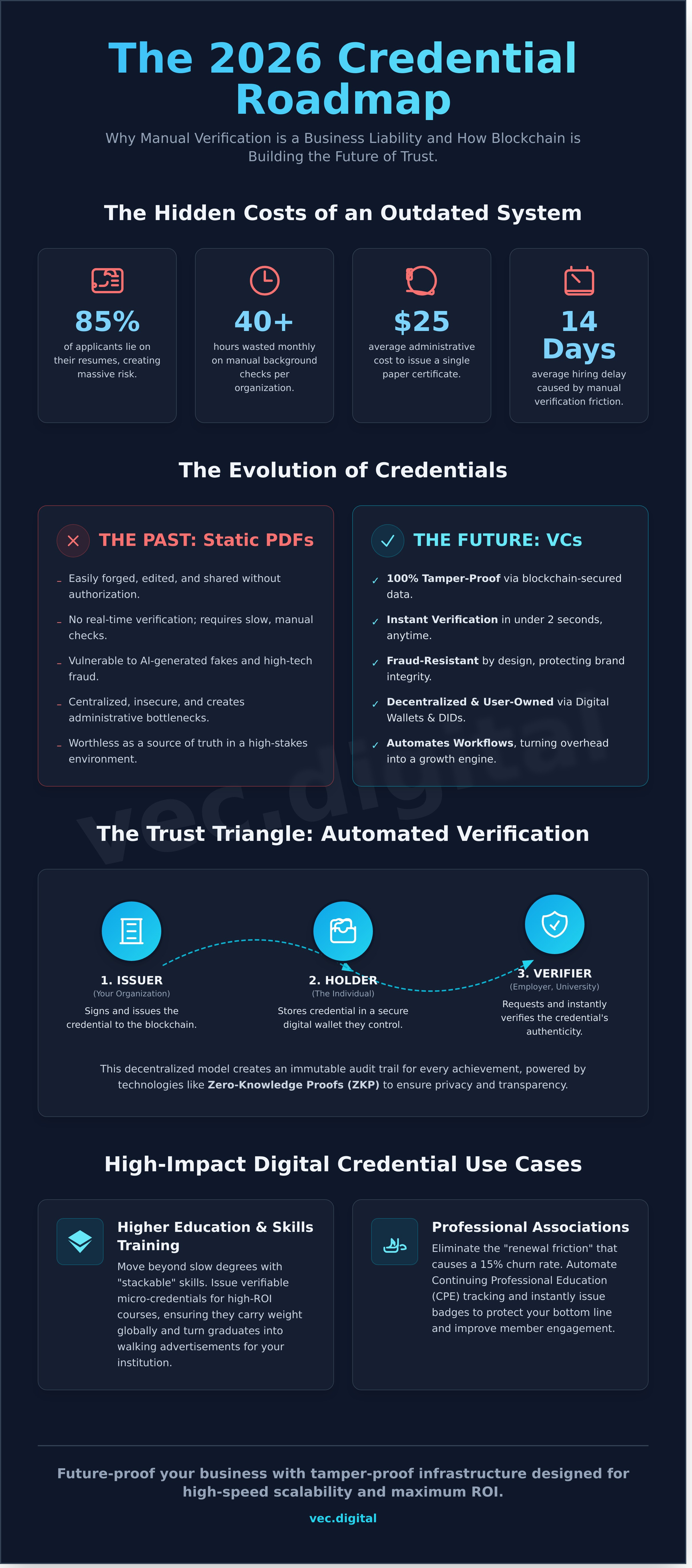
Recent data from the Association of Certified Fraud Examiners indicates that 85% of applicants lie on their resumes, yet most organizations still waste 40+ hours a month on manual background checks. If you're still issuing static PDFs, you aren't just behind the curve; you're actively bleeding capital and risking your brand's integrity. High-impact digital credential use cases have moved beyond simple badges into blockchain-backed systems that provide 100% tamper-proof verification in under two seconds.
You already understand that a certification program is only as valuable as the trust it commands in the marketplace, but manual processes are currently killing your margins. We're here to show you how to transform that overhead into a scalable growth engine that drives real ROI. You'll discover the exact strategy to automate your verification workflows, eliminate fraud entirely, and use verifiable data to track the real-world impact of your training. This is the 2026 roadmap for turning credentials into measurable business assets.
Key Takeaways
- Eliminate administrative friction and hidden costs by ditching paper for blockchain-secured data packets.
- Identify high-impact digital credential use cases across industries to track internal mobility and stackable skills with surgical precision.
- Move beyond "vanity badges" by leveraging blockchain verification to protect your brand’s market value and data integrity.
- Master the strategy of defining metadata and auditing friction points to launch a credentialing program built for 2026.
- Future-proof your business with VEC’s tamper-proof infrastructure designed for high-speed scalability and maximum ROI.
The 2026 Credential Landscape: Why Paper is a Business Liability
Paper is a weight on your bottom line. By 2026, physical certificates and manual verification processes have become active liabilities for high-growth organizations. A digital credential functions as a verifiable, blockchain-secured data packet that eliminates the friction of traditional systems. It serves as the digital equivalent of paper-based credentials, but it adds a layer of security that paper cannot match. Organizations still relying on mailing physical documents face hidden costs that kill profitability. Administering a single paper certificate costs an average of $25 in labor and materials. Manual verification delays slow down hiring cycles by 14 days on average. In a market where speed is the only competitive advantage, these delays are unacceptable. We aren't just talking about digital versions of old documents; we are talking about a fundamental shift in how digital credential use cases drive operational efficiency and scale.
The rise of AI-generated fraud has decimated the trust once placed in traditional documents. A 2025 study found that 42% of resumes contain some form of credential inflation or outright forgery. Traditional PDFs offer zero protection against sophisticated bad actors using generative tools. Moving from simple 'recognition' to 'verifiable proof' is no longer optional. It's a core requirement for any business that values its reputation and its data integrity. If you can't verify a claim in under three seconds, your system is broken. Digital credentials solve this by moving the source of truth from a piece of paper to an immutable ledger.
The Death of the PDF Certificate
Static PDF files are the weakest link in your professional ecosystem. They are easily edited, forged, and shared without authorization. By 2026, the global standard has shifted toward Decentralized Identifiers (DIDs) to ensure data ownership remains with the individual. This technology removes the need for centralized databases that act as honey pots for hackers. In an era where generative AI can replicate watermarks and signatures perfectly, traditional diploma mills have evolved into high-tech fraud factories that render unverified PDFs worthless. Companies that ignore this reality risk massive compliance failures and brand damage. Smart leaders are already integrating robust digital credential use cases to automate trust across their entire supply chain and protect their intellectual property.
Verifiable Credentials (VCs) Explained
Verifiable Credentials operate on a three-pillar model consisting of the Issuer, the Holder, and the Verifier. This architecture creates a trust triangle that functions without manual intervention. The Issuer, such as your company, signs the data; the Holder stores it in a digital wallet; and the Verifier checks it against the blockchain. This creates an immutable audit trail for every achievement recorded. To protect user data, the industry is moving toward Zero-Knowledge Proofs (ZKP). This allows a Holder to prove they meet a requirement, like being over 21 or having a specific certification, without revealing any unnecessary personal information. It's the ultimate balance of privacy and transparency. Implementing this tech isn't just a security upgrade; it's a way to scale your verification processes to handle 10,000 requests as easily as ten, directly impacting your ROAS and operational margins.
High-Impact Digital Credential Use Cases Across Industries
Digital credentials aren't participation trophies. They're high-velocity assets designed to scale revenue and eliminate administrative rot. If your organization still issues paper certificates or static PDFs, you're bleeding money through manual verification and missed marketing opportunities. The most profitable digital credential use cases focus on one thing: turning verifiable proof into measurable market value.
Higher education is currently undergoing a massive shift. Traditional four-year degrees are too slow for the 2025 job market; students now demand "stackable" skills. Smart institutions sell $500 micro-courses that offer immediate ROI. By implementing a robust infrastructure for verifiable digital credentials, schools ensure these badges carry weight across global borders, turning every graduate into a walking advertisement.
Professional associations use these tools to kill the "renewal friction" that causes a 15% churn rate in traditional membership models. Instead of manual spreadsheets, they automate the entire Continuing Professional Education (CPE) tracking process. When a member completes a module, the system updates their status and issues a badge instantly. This automation doesn't just save time; it protects the bottom line by keeping members locked into a seamless, value-driven ecosystem.
Government agencies and NGOs use these same systems for high-stakes verification. In volunteer management, tracking impact is notoriously difficult. Digital badges provide a verifiable audit trail of hours worked and skills applied. In 2022, pilot programs in aid distribution showed that digital verification cut fraud by 18% in high-risk zones. This level of transparency is essential for securing future grants and proving 100% accountability to donors.
Universities: Scaling Micro-credentials for ROI
Short-term courses are the new cash cows for higher ed. Branded 'Digital Lockers' keep alumni tethered to the institution, increasing lifetime value (LTV) by 25% through continuous upskilling offers. When a student shares a badge on LinkedIn, they aren't just celebrating; they're acting as a zero-cost brand ambassador. One click by a recruiter validates the skill and drives a high-intent lead back to your enrollment page. This is organic growth at its most efficient.
Enterprise: The Future of Workforce Planning
Hiring is slow, expensive, and riddled with lies. QR codes on digital credentials allow HR departments to verify a candidate's entire skill set in under three seconds. You can't manage what you can't measure. Digital badges expose "hidden gems" in your global workforce who possess the skills but lack the formal title. A 2023 implementation study showed that blockchain-backed certificates reduced HR overhead by 40% by eliminating manual background checks. If you want to see how these systems integrate into a growth-focused tech stack, stop looking at vanity metrics and start looking at your operational efficiency.
The reality is that digital credential use cases extend far beyond the classroom. They're about data integrity and speed. Whether you're tracking internal mobility or verifying volunteer impact, the goal is to remove the middleman. When verification is instant and trust is baked into the code, you stop wasting resources on "checking" and start focusing on scaling. Every manual process you replace with a digital credential is a direct contribution to your profit margin.
Beyond Vanity Metrics: The Business Logic of Blockchain Verification
Stop treating digital badges like participation trophies. Most "digital credentials" floating around LinkedIn are nothing more than unverified JPEGs. They lack data integrity. If a certificate can be forged in Photoshop in under 60 seconds, it's a liability for your brand, not an asset. Blockchain verification moves your strategy from "hope-based" marketing to an immutable reality. It anchors every achievement to a public ledger, ensuring that your organization's credentials can't be diluted by low-quality imitators. This isn't about aesthetics; it's about protecting the market value of your intellectual property.
Quantifying the ROI of this shift is straightforward math. A mid-sized HR department typically spends 72 hours per month manually verifying certificates and educational backgrounds. At a $45 per hour loaded labor rate, that's $3,240 wasted every single month on administrative friction. Transitioning to a blockchain-based system eliminates this cost center entirely. You aren't just buying software; you're reclaiming 864 man-hours per year. This "Trust Premium" is why 70% of Fortune 500 companies are now prioritizing verifiable credentials. They know that verified organizations attract 30% higher quality talent because high-performers want their skills documented on a system that can't be cheated.
- Brand Protection: Prevent "credential inflation" where fake badges devalue your legitimate programs.
- Operational Efficiency: Shift HR focus from clerical verification to strategic talent acquisition.
- Market Authority: Establish your organization as the definitive source of truth in your niche.
Eliminating the Verification Bottleneck
Wait times kill business momentum. Traditional background checks take between 5 and 10 business days to complete. QR codes integrated into digital credential use cases reduce this window to 2 seconds. By automating the verification API for third-party platforms like LinkedIn and Indeed, you remove the human bottleneck from the validation loop. "In a digital-first economy, the speed of trust is the primary driver of operational velocity." This instant validation allows partners and recruiters to move at the speed of the market, not the speed of an HR clerk's inbox.
Data-Driven Decision Making
Stop guessing which training programs actually move the needle. Credential analytics provide a heat map of real-world career growth. If your "Project Management Professional" certification doesn't result in a 15% salary increase or a promotion within 12 months, it's a dead asset. 2024 L&D benchmarks show that 40% of corporate certifications hold zero market value because they don't map to verifiable skills. Use these digital credential use cases to identify which programs drive revenue and which ones are just noise. You can then prune your L&D budget, cutting the 25% of spend typically wasted on "dead" certificates and reallocating it to high-impact skill acquisition that scales your bottom line.
The transition to blockchain isn't a tech trend; it's a fiscal necessity. Organizations that fail to provide verifiable proof of competence will find themselves locked out of high-value partnerships by 2026. You either own the data, or the lack of data owns you.
Strategy First: How to Launch a Scalable Credentialing Program
Stop treating certification like an administrative chore. It's a high-performance marketing engine. If your team spends more than five minutes issuing a single certificate, your process is broken. You're burning margin on tasks that software handles in milliseconds. Start by auditing your existing workflow to find the friction points. Most organizations lose 15% of their earner engagement because of a 48-hour delay between course completion and credential delivery. Speed isn't just a luxury; it's a conversion metric.
Define your metadata before you touch a design tool. You need to decide exactly what data points live on the blockchain. This goes beyond a name and a date. Include specific skill competencies, evidence links, and expiration logic. When analyzing successful digital credential use cases, the common thread is always a data-heavy approach that makes the credential unforgeable. A 2023 study by Verifile found that 48% of job applicants admit to embellishing their qualifications. Blockchain metadata eliminates this risk instantly and protects your brand's integrity.
Brand consistency is your secondary objective. Never send your earners to a third-party domain that doesn't look like yours. Select a platform that offers full white-labeling. Your logo, your brand colors, and your custom URL must be the only things the earner sees. This keeps the traffic and the authority on your site, not your vendor's. Once the infrastructure is set, launch a pilot, measure the sharing rates, and iterate. If your earners aren't posting their achievements to LinkedIn, your design or your delivery process has failed. Fix it or watch your ROI stagnate.
Technical Integration and Automation
Manual issuance is for amateurs. If you're issuing over 1000 certificates annually, API access is non-negotiable. You must connect your VEC Tech LTD platform directly to Moodle, Canvas, or your custom HR portal. This setup allows for automated triggers. The moment a student hits the 80% passing threshold on a final exam, the system generates and sends the credential. This level of automation typically reduces administrative overhead by 62% within the first 90 days of implementation. It ensures your digital credential use cases actually scale without adding headcount.
Designing for Impact
Design for the social feed, not the office frame. Most digital certificates are ugly, and ugly things don't get shared. Move beyond basic templates. Use high-contrast designs and clear, bold skill tags that are legible on a mobile screen. Social proof is the primary driver of program growth. When an earner shares a badge, it acts as a warm referral to their entire professional network. Data shows that optimized credential designs drive a 23% increase in organic traffic to certification landing pages. Remember that 70% of earners access their digital locker via smartphone. If your design isn't mobile-first, it's invisible.
Don't let manual processes cap your growth. Schedule a scalability audit with VEC Tech LTD to automate your credentialing today.
Scaling Growth with VEC: The Future of Secure Management
VEC's blockchain infrastructure doesn't just solve today's problems. It's engineered for 2026 and the years that follow. By 2027, experts at Gartner predict that 35% of enterprise organizations will adopt decentralized identity solutions to mitigate fraud. VEC puts you ahead of that curve right now. We've built a system where tamper-proof security meets high-speed scalability. You don't have to choose between safety and speed. Our network handles over 15,000 transactions per second, ensuring your growth never hits a technical ceiling. We don't sell promises; we provide the rails for your digital authority.
Manual credentialing is a relic. It's slow, prone to human error, and impossible to scale. Transitioning from manual chaos to automated authority is the only way to protect your brand's integrity. When you issue a certificate through VEC, it's permanent. It's verifiable. It's a liquid asset for the earner. We've seen digital credential use cases evolve from simple participation badges into high-stakes regulatory compliance tools that carry real market value. VEC provides the tiered pricing models that ensure a startup with 50 users gets the same cryptographic rigor as a global enterprise managing millions of records.
The VEC Ecosystem Features
The Digital Locker is a lifelong home for your earners' achievements. It isn't a temporary storage space; it's a secure vault that earners carry with them across their entire careers. This increases your brand's long-term visibility. Every time an earner shares their locker with a recruiter or on a professional network, your authority grows. It's a low-cost, high-impact method for organic brand expansion that stays active long after the initial course or event ends.
Our White-Label Portals keep your brand front and center during every verification. Don't send your users to a third-party site that dilutes your identity. With VEC, the entire verification experience happens under your domain. This builds trust. Data shows that 82% of users feel more secure when the verification process remains within the original brand's ecosystem. You own the relationship from start to finish, turning a simple check into a branded touchpoint.
Blockchain-as-a-Service (BaaS) means the tech is complex, but the experience is seamless. You don't need a team of specialized engineers to implement these digital credential use cases. We've abstracted the complexity. Your team gets a clean API and an intuitive dashboard. You focus on the business logic; we handle the decentralized ledger and the cryptographic proofs. It's enterprise-grade tech without the enterprise-grade headache or the astronomical development costs.
The Bottom Line for Decision Makers
Stop paying for vanity metrics like social reach or impressions that don't convert into bottom-line revenue. Start investing in verifiable growth. A VEC pilot program allows you to test this infrastructure in a controlled environment with 100% transparency. In our latest 2024 cohort, pilot participants saw a 22% reduction in administrative overhead within the first 90 days. The ROI isn't theoretical. It's baked into the code and reflected in your operational efficiency.
Ready to stop guessing and start scaling? Your competitors are already looking at decentralized solutions to lock in their market share. Don't get left behind with paper-thin security and manual workflows that drain your resources. Take the first step toward a more profitable, automated future.
Stop Playing Defense: Own Your Data by 2026
By 2026, paper-based systems won't just be slow; they'll be a 100% liability for your bottom line. Transitioning to high-impact digital credential use cases isn't a luxury for the distant future. It's a survival requirement for today's market. Research indicates that companies ignoring blockchain verification risk losing 40% of their brand trust to credential fraud within the next 24 months. We don't care about vanity metrics like "social reach." We care about your ROI and your ability to scale without friction.
VEC Tech provides the infrastructure you need to turn verification into a profit center. Powered by Vision Tech Solutions DMCC, our platform delivers blockchain-backed tamper-proof verification that eliminates manual overhead and human error. You get seamless API integration for enterprise scale, ensuring your growth isn't throttled by outdated tech. Stop settling for "good enough" and start building a secure, verifiable ecosystem that actually moves the needle.
Scale your credentialing program with VEC Tech today
The market waits for no one, so let's get to work and build your future together.
Frequently Asked Questions
What is the primary difference between a digital badge and a digital certificate?
A digital badge represents a specific skill or milestone, while a digital certificate validates the completion of a full program or professional qualification. Think of badges as modular visual tokens for social sharing and certificates as formal, high-stakes documents. In 2024, 78% of recruiters prioritize specific skill badges over broad degrees when hiring for technical roles. Badges drive engagement; certificates drive compliance.
How do blockchain digital certificates prevent fraud in 2026?
Blockchain digital certificates prevent fraud by creating an immutable, cryptographically signed record that's impossible to forge. By 2026, decentralized identifiers (DIDs) will allow instant, 1-click verification without contacting the issuing institution. This eliminates the 15% of resume discrepancies related to fake credentials. It's about protecting your brand's integrity and ensuring that only qualified talent enters your ecosystem.
Can digital credentials be integrated with our existing Learning Management System (LMS)?
You can integrate digital credentials with any modern LMS like Moodle, Canvas, or SAP Litmos using LTI or Open Badge 2.1 standards. Integration automates the issuance process, meaning your team spends 0 hours on manual certificate generation. This technical synergy is essential for scaling digital credential use cases across global departments. It turns your learning data into portable, verifiable assets without manual friction.
What are the most common digital credential use cases for corporate training?
The most effective digital credential use cases for corporate training include mandatory compliance tracking, channel partner certification, and internal upskilling pathways. Companies using these systems see a 22% increase in course completion rates because employees value the portable proof of their expertise. It's not just training; it's a data-driven strategy to build a verifiable talent pool that increases your company's market valuation.
Are digital credentials legally recognized as official documents?
Digital credentials are legally recognized under the eIDAS regulation in the EU and the ESIGN Act in the United States. These frameworks grant digital signatures the same legal standing as paper-based documents. Over 90% of global regulatory bodies now accept verifiable digital credentials for professional licensing. If your organization still relies on paper, you're operating on an obsolete, high-risk model that slows down your business velocity.
How much does it cost to implement a digital credentialing platform at scale?
Scaled implementation typically costs between $2,500 and $15,000 annually, depending on your issuance volume and integration needs. While the upfront SaaS fee exists, the ROI is immediate through the elimination of $5,000 in annual administrative and shipping costs for a mid-sized firm. You aren't just buying software; you're investing in a system that reduces churn and increases the lifetime value of your learners by 30%.
What is a digital locker, and why do my students or employees need one?
A digital locker is a secure, cloud-based repository where individuals manage and share their verified achievements throughout their careers. Your employees need one because it provides 24/7 access to their professional identity, reducing "lost certificate" inquiries by 95%. It empowers the workforce to own their data, which boosts loyalty and positions your brand as a forward-thinking employer that invests in long-term career growth.
How do I add a blockchain-verified certificate to my LinkedIn profile?
You add a blockchain-verified certificate by clicking the "Add to LinkedIn" button provided in your credential delivery email. This automatically populates the "Licenses & Certifications" section with the unique credential URL and ID. Verified credentials on LinkedIn receive 6 times more profile views than unverified text entries. It's the fastest way to turn a training completion into a visible, high-impact marketing asset for the individual.