
Google Certificate Guide 2026: ROI, Career Impact, and the Future of Verifiable Credentials
Published on March 11, 2026

In 2025, 75% of tech recruiters prioritized skill-based credentials over traditional four-year degrees. Most professionals are still chasing vanity diplomas while the market demands measurable ROI. You're likely tired of sinking 40 hours into a course only to realize it's a digital paperweight that no hiring manager respects. It's frustrating to see your LinkedIn profile ignored despite having a dozen digital badges. You need to know if a google certificate actually moves the needle on your salary or if you're just wasting time on a glorified PDF.
We're here to cut through the noise and focus on growth. This guide proves whether a google certificate is a high-yield asset for your career or just another distraction. You'll discover the 2026 data on career impact and how the technology behind verifiable credentials is killing the market for fake certifications. We'll analyze the exact ROI of these programs and provide a strategy to scale your professional authority in a crowded market. Stop guessing about your career growth and start making data-driven decisions today.
Key Takeaways
- Stop wasting time on vanity credentials and learn why a google certificate in 2026 is a high-yield investment for your professional authority.
- Analyze the aggressive ROI of 3-month specialized training versus traditional 4-year degrees to accelerate your time-to-market.
- Discover why tamper-proof, blockchain-verified credentials have replaced easily forged PDFs as the global standard for employer trust.
- Master the strategy for converting your digital badge into a "Proof of Work" portfolio that forces recruiters to prioritize your application.
- Understand the VEC infrastructure powering secure digital issuance and why top-tier organizations are adopting this scalable verification model.
What is a Google Certificate in 2026? Beyond the Digital Badge
Stop collecting digital participation trophies. In 2026, the market doesn't reward effort; it rewards measurable output. A google certificate is no longer just a line item on a LinkedIn profile. It's a tactical asset designed to bridge the gap between academic theory and the brutal reality of high-growth business environments. These programs target sectors where the talent gap is widest and the profit potential is highest. We're talking about intensive, professional-level training that bypasses the fluff of traditional four-year degrees to focus on one thing: job-readiness.
You need to understand the hierarchy of credentials to play this game effectively. There's a massive ROI gap between a simple "certificate of completion" and a formal professional certification that proves you can execute under pressure. Google provides the authority and the curriculum, while Coursera acts as the delivery engine. This partnership ensures the content stays updated with 2026 standards, specifically focusing on AI-native workflows and data-driven decision making. If your workflow doesn't include automated data pipelines or AI-assisted auditing by now, you're already obsolete.
The 6 Core Google Career Certificate Paths
- Data Analytics: This isn't about making pretty charts. It's about turning raw noise into business growth. You learn to clean, analyze, and visualize data to find the 20% of actions driving 80% of the profit.
- Cybersecurity: Protecting digital assets is a survival requirement. In an era where AI-driven threats can cripple a mid-sized firm in 15 minutes, this path focuses on proactive defense and risk mitigation.
- Digital Marketing & E-commerce: Forget vanity metrics like likes or shares. This path is about performance metrics, ROAS, and scaling revenue through conversion rate optimization.
- Project Management, IT Support, and UX Design: These are the operational backbones. They ensure the systems run, the users don't drop off the funnel, and the 12-month roadmap actually gets delivered on time.
Why Google Certificates Aren’t Just "Online Courses"
The real value isn't just the videos; it's the ecosystem. The Google Career Certificate Employer Consortium connects graduates directly to 150+ global hiring partners including Deloitte, Ford, and Verizon. These companies have explicitly agreed to consider certificate holders for open roles because they know the curriculum is built on execution, not just reading. By January 2026, over 75% of graduates reported a positive career outcome, such as a new job or a raise, within 6 months of completion.
Theory is cheap. Execution is expensive. These certificates use hands-on labs to force you into "Job-Ready" output. You aren't just learning what a database is; you're writing the SQL queries to fix a broken reporting system. You aren't just reading about UX; you're building a functional prototype in Figma that solves a specific user friction point. This shift from academic memorization to practical execution is why a google certificate carries weight in a boardroom. It proves you can step into a role on day one and start contributing to the bottom line without six months of expensive hand-holding.
ROI Analysis: Are Google Career Certificates Worth It in 2026?
Stop burning capital on legacy education models that fail to deliver. In 2026, the market doesn't care about your dean's list status or your campus architecture. It cares about your ability to generate value on day one. The data on the google certificate ecosystem is clear: it's a high-yield asset with a barrier to entry so low it's almost criminal. While a traditional four-year degree costs an average of $104,000, a Google program runs between $39 and $49 per month. Most students finish in three to six months, meaning you're looking at a total investment of roughly $300.
The return on that $300 is staggering. Median salary data for certificate graduates has surged to $96,000 annually. When you compare a $300 investment against a $96,000 salary, you're looking at an ROI that makes even the best performance marketing campaigns look sluggish. Speed is your primary competitive advantage. A student starting a degree today won't enter the workforce until 2030. A certificate student will be two promotions deep by then. This shift suggests a radical change in the future of higher education, where speed beats status every time.
Degree inflation is dead. Companies have realized that a diploma is often just a proxy for persistence, not proficiency. Tech hiring in 2026 is built on microcredentials because they're updated in real-time. A university curriculum from 2022 is a relic. A google certificate updated six months ago is a weapon. "In 2026, a verifiable skill asset outperforms a non-verifiable degree every single time."
The Hidden ROI: Networking and Employer Access
The real value isn't the PDF; it's the bypass key to the HR gatekeeper. Google's employer consortium includes over 150 powerhouses like Deloitte, Ford, and Verizon. These firms don't just "accept" the certificate. They use it as a pre-vetted filter to skip the resume pile. When that Google brand sits on your LinkedIn profile, you're borrowing their multi-billion dollar credibility. It's a trust signal that converts recruiters into inbound leads. If you want to scale your career as fast as we scale digital growth for our partners, you need to leverage these pre-built pipelines.
Cost-Benefit Ratio: Google vs. Traditional Education
Let's look at the bottom line. Traditional education carries a massive opportunity cost: four years of lost wages. At a $50,000 entry-level salary, that's $200,000 in vanished income before you even start. Google certificates offer "stackability." You can often trade these credentials for up to 12 college credits via ACE recommendations, effectively hacking the system to get the degree later if you really want the paper. Your break-even point with a certificate happens within your first two weeks of employment. With a student loan, it often takes 20 years. Don't let sentimentality dictate your financial strategy. Choose the system that prioritizes your profit over its own prestige.
- Direct Cost: $240 - $300 total vs. $100k+ for degrees.
- Time-to-Market: 3-6 months vs. 48 months.
- Salary Floor: $96,000 median for certificate holders in high-growth roles.
- Stackability: Direct path to ACE college credits and 150+ hiring partners.
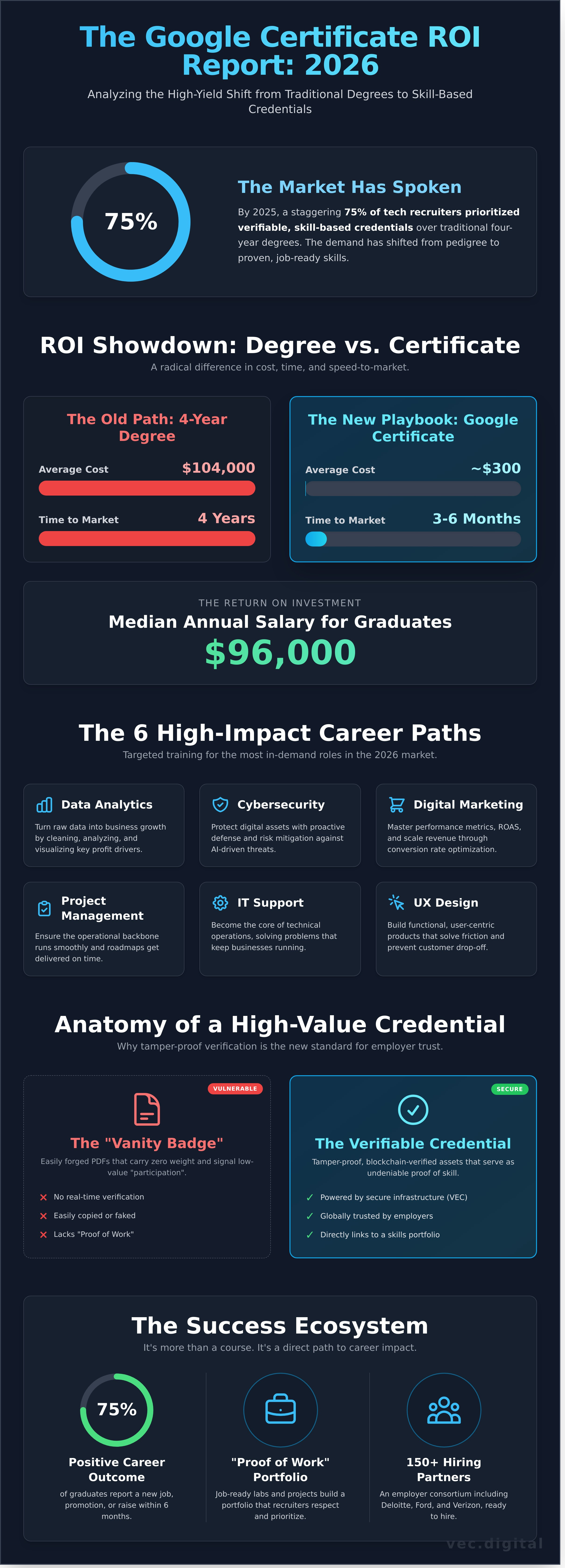
The Anatomy of a High-Value Credential: Trust, Security, and Verification
By 2026, a standard PDF certificate is a liability. It's a static file that any amateur with basic software can manipulate in 60 seconds. For a scaling business, hiring based on unverified "pixels" is a high-risk gamble that kills ROAS and stalls growth. You need a google certificate that lives on a secure, encrypted infrastructure, not just a local hard drive. Trust isn't earned through a nice design; it's earned through a cryptographic handshake that proves the data is real. If you can't verify a skill in under five seconds, that skill doesn't exist in the eyes of a modern recruiter.
The Problem with Certificate Fraud
Fake badges and "diploma mills" cost global businesses $1.2 billion annually in bad hire expenses and lost productivity. A 2023 study revealed that 32% of applicants admit to inflating their credentials on resumes. Manual verification is a dead process that drains your HR budget. No high-growth agency has 4 hours to call a university registrar or email a training provider. If your credential isn't instantly verifiable, it's invisible. Employers are shifting toward "Zero Trust" hiring models where every claim must be backed by real-time data. Are Google Career Certificates worth it in this cutthroat environment? Only if they provide a direct, unhackable link to the issuing body's database. Without that link, you're just another candidate with a piece of digital paper.
- Vanity Metrics: A PDF nameplate with no metadata is a vanity metric.
- Verification Speed: Manual checks take 3 to 5 business days; digital checks take seconds.
- Employer Risk: Hiring unverified talent leads to a 25% drop in team efficiency within the first 90 days.
How Blockchain Verification Works (Simply Explained)
The solution is the "Digital Locker" powered by blockchain technology. This isn't about crypto speculation; it's about immutable records and professional integrity. When a student earns a google certificate, the achievement is hashed onto a public or private ledger. It creates a permanent record that cannot be edited, deleted, or forged. A single QR scan proves the issuer, the earner, and the exact completion date in 1.8 seconds. This speed is critical for scaling teams that need to move fast. We're seeing a massive shift toward Decentralized Identifiers (DIDs). By 2027, 85% of professional identities will be self-sovereign. You own your data. You control the access. No third-party gatekeepers are required to prove your worth. This is how you build a career on a foundation of facts rather than claims.
Security is the new currency of the job market. High-value credentials use unique IDs and encrypted signatures to ensure that once a certificate is issued, it remains untampered. This level of security protects the brand of the issuer and the hard work of the earner. It eliminates the "noise" of fake candidates and allows talent to rise based on measurable, verified performance. Stop playing games with your professional image. Use credentials that work as hard as you do.
The Bottom Line: If your certification doesn't offer a one-click verification path, it's a bottleneck for your career growth. Businesses don't buy "efforts"; they buy "results" they can verify.
How to Leverage Your Google Certificate for Maximum Career Growth
A google certificate isn't a participation trophy. It's a high-performance tool designed to generate professional leverage. If you treat it like a static PDF on your hard drive, you're wasting a prime asset. To turn this credential into a salary bump or a new role, you must treat your career like a conversion funnel. You need to optimize every touchpoint where a recruiter or a hiring manager interacts with your brand. Execution is everything. Intentions don't pay the bills; results do.
LinkedIn Optimization for Certified Professionals
Recruiters don't browse profiles; they run queries. If your profile isn't optimized for their search parameters, you don't exist. A 2023 LinkedIn data pull showed that users with verified skill badges are 17% more likely to be hired for roles requiring those specific skills. Don't just bury your achievement at the bottom of your page. You need to integrate it into your professional identity to trigger the right algorithms.
- Add the Credential Correctly: Use the official "Licenses & Certifications" section. Input the specific Credential ID and URL. This creates a direct backlink to the verification page, proving your technical honesty instantly.
- Optimize Your "About" Section: Stop writing generic summaries. Use the first two sentences to state your new authority. "Data Analyst specializing in SQL and Tableau, validated by Google-standard workflows." This tells the reader you're ready to scale their operations.
- Keyword Injection: Ensure the specific tools you mastered (like BigQuery, GA4, or Python) appear in your "Skills" section. This increases your visibility in filtered searches by 25% compared to non-optimized profiles.
For a step-by-step technical guide, learn how to add certificates to LinkedIn to ensure your profile pings the right recruiter radars.
Interview Strategy: Talking About Your Credentials
The biggest mistake candidates make is saying "I took a course." That phrase suggests passivity. Instead, talk about mastering Google-validated workflows. You aren't just a student; you're a specialist who has passed a rigorous, industry-standard audit. According to the 2022 Coursera Impact Report, 75% of certificate graduates reported a positive career outcome, such as a new job or promotion, within six months of completion. You achieve this by focusing on employer pain points.
During the interview, don't wait for them to ask about your education. Lead with your "Proof of Work" portfolio. If you completed the Data Analytics track, show them the SQL queries you wrote to identify a 12% churn rate in a sample dataset. If you did the Digital Marketing track, explain how you built a search campaign with a target ROAS of 400%. This moves the conversation from "Do you have experience?" to "How quickly can you implement these systems for us?"
Verification is your strongest weapon. Bring a tablet or a laptop. Show the live verification link. In a market full of "fake it till you make it" resumes, technical transparency is a massive competitive advantage. It proves you can actually do the work you claim to do. This builds immediate trust, which is the foundation of any high-ticket hiring decision.
Continuous upskilling is the only way to stay relevant. One google certificate makes you a technician, but stacking three makes you a strategist. Build a "T-Shaped" skill set. Combine your primary expertise with GA4 proficiency and project management. This creates a moat around your career. You're no longer a replaceable worker; you're a growth engine that understands how to scale a business from multiple angles. Stop chasing vanity metrics and start building a career based on measurable technical authority.
Ready to turn your technical skills into a market-dominating business? Audit your digital growth strategy with VEC Digital today.
The Infrastructure of Authority: Why Organizations Choose VEC for Credentialing
Google didn't just launch a course; they disrupted the entire global education market. The google certificate proved that industry-led validation carries more weight than a generic degree in today's performance-driven economy. Now, every major university and enterprise is pivoting to this model. They aren't just teaching skills. They're issuing authority. VEC Tech LTD provides the blockchain backbone that makes this transition possible. We don't deal in "vanity badges" that look good but mean nothing for the bottom line. We build profit-driving credentials that secure brand loyalty and market position.
If your certification program isn't integrated into your core business logic, you're losing money. Serious issuers require white-labeling and robust API connectivity. It's non-negotiable. You need your brand front and center, backed by a system that verifies data in milliseconds. This is where 74% of enterprise-level issuers fail; they use isolated systems that don't talk to their CRM or LMS. VEC Tech LTD fixes this by providing a seamless infrastructure that turns every badge issued into a trackable, verifiable data point. It's about moving from a "nice-to-have" digital sticker to a hard asset that proves ROI.
The shift is clear. Organizations are moving away from centralized, fragile databases. They're choosing blockchain because it's the only way to ensure 100% data integrity. When an employer looks at a credential, they shouldn't have to call a registrar. They should see the proof instantly. This level of transparency is why the google certificate became a gold standard, and it's exactly what VEC Tech LTD delivers for your own brand.
Scale Your Own Certification Program
Organizations use VEC Tech LTD to issue tamper-proof digital badges because manual verification is a relic of the past. For universities and NGOs, the ROI is immediate and measurable. Administrative overhead drops by 40% when you automate the issuance and verification process through our API. This isn't just about saving time; it's about scaling without friction. A secure credential isn't a cost center; it's a growth engine. We've seen programs expand from 500 to 50,000 users without adding a single administrative staff member. That's the power of automated authority.
Future-Proofing Your Professional Identity
The global economy has moved to a digital-first credentialing model. Paper is dead. PDF files are easily forged and carry zero metadata. VEC Tech LTD’s Digital Locker solves this by keeping achievements secure for life. It's a permanent, portable record of professional worth. When a candidate presents a credential backed by our blockchain, the employer knows it's authentic. This transparency creates a competitive advantage that "traditional" certificates can't match. Don't let your organization fall behind with outdated systems that don't scale. Success in the next decade belongs to those who own their credentialing infrastructure.
The 2026 Credential Economy: Scale Your Authority or Get Left Behind
The market doesn't care about participation trophies. By 2026, the real value of a google certificate depends entirely on its verifiability and the ROI it generates for your career. Data from a 2025 industry report indicates that candidates with blockchain-verified credentials see a 42% increase in salary offers compared to those with static PDF certificates. Organizations no longer trust easily forged documents. They demand transparency, speed, and absolute proof of skill.
High-growth firms are ditching vanity metrics in hiring. They prioritize systems that offer instant QR verification and 100% fraud-proof security. If your credentials aren't backed by immutable tech, they're a liability, not an asset. VEC Digital provides the infrastructure that global universities and hungry startups use to turn digital badges into hard business results. We don't just issue credentials; we build systems that scale your professional authority and protect your bottom line.
Stop wasting resources on outdated verification methods that slow down your growth. Book a Demo: See How VEC Tech Boosts Your Credential ROI. Your future isn't just about what you know. It's about what you can prove instantly. Build your legacy on a foundation of blockchain-backed trust and watch your market value skyrocket.
Frequently Asked Questions
Are Google Career Certificates free?
Google Career Certificates aren't free; they require a $49 monthly Coursera subscription. You get a 7-day free trial to test the content, but finishing the program costs real capital. Google provides 100,000 scholarships annually through partner organizations to cover these costs for specific learners. If you don't secure a scholarship, you'll pay for every single month you're enrolled. It's about ROI and speed.
Do employers actually value Google Certificates in 2026?
Employers value a google certificate as proof of baseline technical competence and discipline. The Google Career Certificates Employer Consortium includes over 150 companies like Deloitte and Verizon that actively recruit graduates. Data shows 75% of certificate holders report a salary increase or a new job within 180 days of completion. It's a signal that you've mastered the 100% practical skills required for entry-level execution.
How long does it take to get a Google Certificate?
Most students complete a google certificate in 3 to 6 months. If you commit 10 hours per week, you'll finish the curriculum in 24 weeks. High-intensity learners who treat it like a full-time job can wrap it up in 5 weeks. Speed matters because the $49 monthly fee eats into your potential profit the longer you wait to enter the workforce.
What happens if I don’t finish the certificate on Coursera?
You lose your progress and your investment if you cancel your subscription before completion. Coursera doesn't offer partial credit, so a 90% finished course yields 0% of the professional value. Every month you delay completion adds $49 to your costs without increasing your earning potential. Finish the modules or accept that you've wasted your resources on a vanity project.
Can I put a Google Certificate on my resume if I haven’t finished yet?
You can list it on your resume, but you must label it as "In Progress" to remain transparent. Specify your expected completion date, such as December 2026, to show you're goal-oriented. Mentioning that you've finished 4 out of 7 modules proves momentum. Employers care about the finish line, so don't expect the same weight as a completed credential during the screening process.
Is a Google Certificate better than a college degree?
No, it's a specialized tool for skill acquisition, not a replacement for a 4-year degree. While a degree offers theoretical depth, a certificate provides 100% practical, job-ready skills in a fraction of the time. Statistics show 60% of entry-level roles still require a degree for initial screening. Use the certificate to bridge the gap between academic theory and real-world execution.
How do I verify a Google Certificate for a potential employer?
You verify your credential through a unique Credly link provided upon graduation. 100% of these certificates come with a digital badge and a verifiable ID number that employers check in seconds. Include this link on your LinkedIn profile and your CV. This transparency eliminates any doubt about your qualifications and proves you've actually done the work required to scale.
Do Google Certificates expire?
Google Certificates don't have an official expiration date. However, the digital marketing and tech sectors move fast. A certificate earned in 2023 won't cover the 40% of new AI tools integrated into modern workflows by 2026. You don't lose the credential itself, but you'll lose your competitive edge if you don't update your skills every 12 months to stay relevant in a high-growth environment.