
How Universities Can Safely Adopt Blockchain Certificate Verification Without Violating FERPA
Published on June 16, 2026

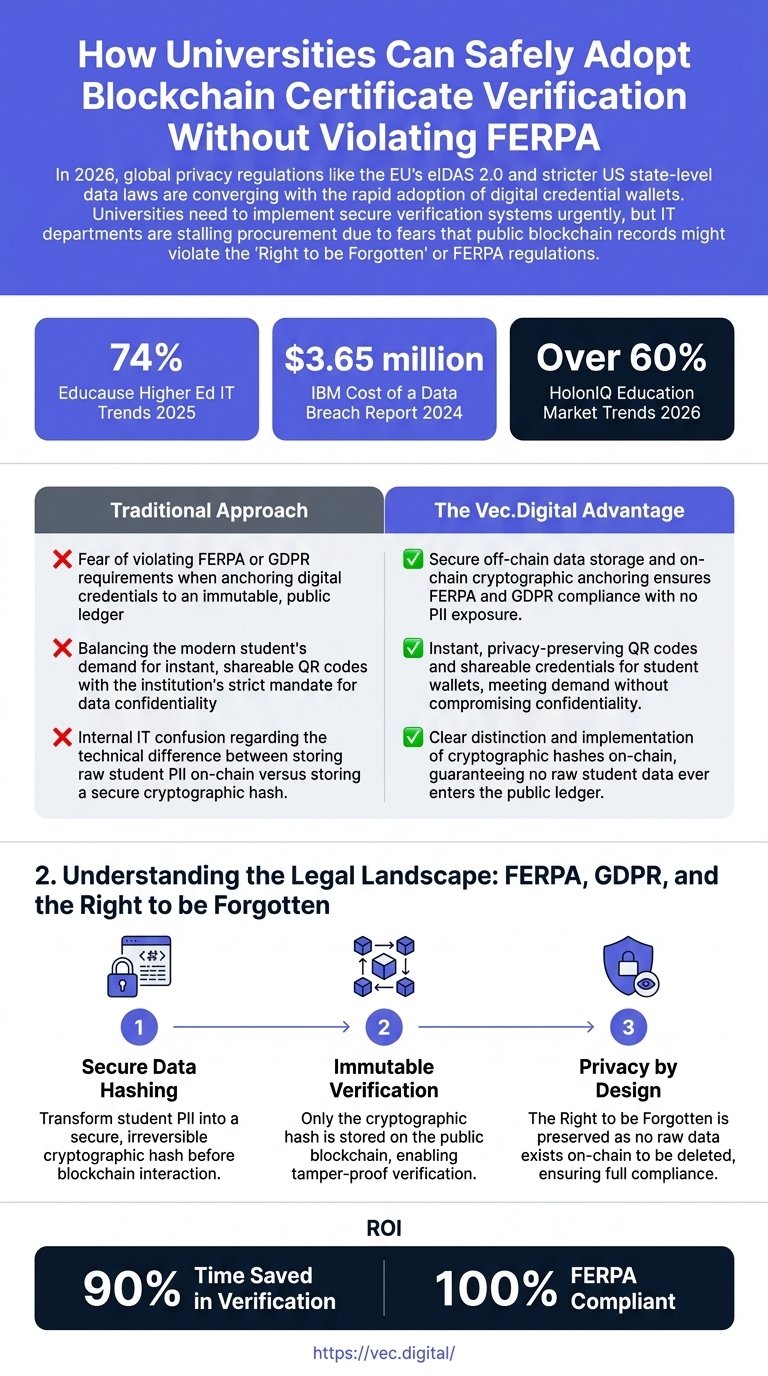
In 2024, the average cost of a data breach in the global education sector reached a staggering $3.65 million, heavily driven by exposed student records (IBM Cost of a Data Breach Report, 2024). As academic institutions race to digitize their credentialing processes, they face a critical paradox: how to issue tamper-proof records without compromising student privacy. Blockchain certificate verification offers an immutable solution to credential fraud, but implementing it requires a delicate balance between public authenticity and strict data protection laws.
In this comprehensive guide, our team of technology experts at Vec.Digital unpacks the cryptographic mechanics and legal frameworks that allow universities to safely adopt decentralized technologies. You will learn the technical differences between storing raw data and utilizing cryptographic hashes, how to navigate complex vendor security audits, and the exact automated processes required to issue verifiable digital credentials that strictly comply with global privacy standards.
Key Takeaways
- Blockchain certificate verification can be fully compliant with FERPA and GDPR when utilizing off-chain storage and zero-knowledge cryptographic hashing.
- Over 60% of students globally expect mobile digital wallets, necessitating a secure digital certificate maker for modern universities.
- A secure architecture ensures that student data privacy is maintained without ever storing raw Personally Identifiable Information (PII) on a public ledger.
- Institutions can safely issue secure digital diplomas for universities while retaining the administrative ability to revoke credentials if necessary.
- Implementing an automated bulk certificate generator reduces administrative overhead while helping IT departments pass strict vendor security audits.
1. The Intersection of Digital Innovation and Student Data Privacy
The landscape of higher education is undergoing a massive digital transformation. As universities expand their global reach, the traditional methods of printing, signing, and mailing physical diplomas are no longer sufficient. Today's global workforce demands agility, and blockchain certificate verification has emerged as the gold standard for proving academic achievement without the risk of forgery.
However, this technological leap brings significant challenges regarding data protection. Academic registrars, IT directors, and compliance officers are tasked with modernizing their systems while simultaneously shielding sensitive student information from increasingly sophisticated cyber threats. Understanding this intersection is the first step toward building a resilient, future-proof credentialing system.
The Rising Global Demand for Digital Wallets
The push for digitization is not solely an administrative initiative; it is heavily driven by student expectations. According to the HolonIQ Education Market Trends (2026), over 60% of university students globally expect to control and share their academic records via mobile digital wallets by the end of the year. This demographic shift means that institutions must adapt quickly to remain competitive and relevant.
Students and professionals want to know how to share digital certificate on LinkedIn and other professional networks seamlessly. They expect instantaneous access to their achievements. Consequently, universities are seeking solutions that allow them to create online certificates with QR code functionality, bridging the gap between secure institutional databases and the public-facing professional world.
The Procurement Roadblock: Balancing Security with Compliance
Despite the clear demand, adoption is frequently delayed in the procurement phase. An Educause Higher Ed IT Trends report (2025) revealed that 74% of higher education institutions cite data privacy and regulatory compliance as their primary barrier to adopting decentralized technologies. IT departments are understandably cautious; the financial and reputational penalties for a data breach are severe.
The core pain point is balancing the modern student's demand for instant, shareable QR codes with the institution's strict mandate for data confidentiality. When evaluating a digital certificate maker, procurement boards must ensure that the platform's underlying architecture does not inadvertently expose student data to unauthorized third parties or public ledgers.
Overcoming Internal IT Confusion
A significant hurdle in the adoption of these modern systems is internal IT confusion regarding the technical difference between storing raw student PII on-chain versus storing a secure cryptographic hash. Many legacy IT professionals associate the word "blockchain" with public cryptocurrencies, leading to the misconception that student names and grades will be broadcasted to the world.
Education is key to overcoming this internal resistance. By clearly defining how modern credentialing platforms utilize off-chain storage and zero-knowledge proofs, IT leaders can confidently advocate for the transition. This shift in understanding is crucial for institutions looking to deploy secure digital diplomas for universities without compromising their ethical and legal obligations to their students.
2. Understanding the Legal Landscape: FERPA, GDPR, and the Right to be Forgotten
To successfully implement blockchain certificate verification, institutions must navigate a complex web of international data privacy laws. With the European Union fully rolling out the eIDAS 2.0 framework in 2026 and standardizing digital identity wallets, educational institutions worldwide are forced to adopt interoperable, verifiable credentials.
However, cross-border data transfer laws require that any automated process generating these credentials heavily obfuscates student identities on public networks. Let us examine the most pressing legal questions surrounding this technology.
Are Blockchain Certificates FERPA Compliant?
One of the most common questions from academic registrars in the United States is: Are blockchain certificates FERPA compliant? The Family Educational Rights and Privacy Act (FERPA) strictly protects the privacy of student education records. The short answer is yes, they can be fully compliant—provided the right architectural approach is used.
A FERPA-compliant system never stores Personally Identifiable Information (PII) on the blockchain. Instead, the student's data remains securely within the university's encrypted, private database. The blockchain only receives a cryptographic hash—a randomized string of alphanumeric characters that acts as a digital fingerprint of the document. Because this hash cannot be reverse-engineered to reveal the original student data, the institution maintains full FERPA compliance while still offering irrefutable proof of authenticity.
Does Blockchain Violate the GDPR Right to Be Forgotten?
For institutions operating in or enrolling students from the European Union, the General Data Protection Regulation (GDPR) presents a unique challenge. Specifically, Article 17 outlines the "Right to be Forgotten," allowing individuals to request the deletion of their personal data. This creates an apparent paradox: if a blockchain is inherently immutable (unchangeable and undeletable), does it violate the GDPR right to be forgotten?
This is where the distinction between on-chain and off-chain data becomes legally vital. By keeping all PII off-chain and only anchoring the cryptographic hash on the immutable ledger, institutions resolve this contradiction. If a student exercises their right to be forgotten, the university simply deletes the raw data from their private off-chain database. Once the original data is destroyed, the hash on the blockchain becomes completely meaningless and orphaned, satisfying GDPR requirements without breaking the blockchain's architecture. This method is a cornerstone of issuing verifiable digital credentials globally.
Navigating Complex Vendor Security Audits
Because of these stringent legal requirements, the vendor selection process has become incredibly rigorous. According to the Gartner Higher Education SaaS Report (2025), 82% of university procurement boards now require strict GDPR and FERPA compliance audits before adopting any new SaaS credentialing platforms.
Institutions must look for a digital certificate maker that offers transparent documentation of its security practices. This includes end-to-end encryption, regular penetration testing, and a clear Service Level Agreement (SLA) guaranteeing high uptime. Navigating long, complex vendor security audits when upgrading from legacy paper systems to an automated digital platform is much smoother when the vendor inherently understands and builds for these legal frameworks.
3. The Mechanics of Secure Blockchain Certificate Verification
To truly understand how to safely deploy blockchain certificate verification, we must look under the hood at the cryptographic mechanics. Most existing industry content blindly praises the immutability of decentralized credentials without addressing the glaring legal contradiction of data deletion. Here, we fill that knowledge gap.
The secret to secure credentialing lies in a zero-knowledge approach to authentication. This means that a verifier (like an employer) can confirm that a statement is true (e.g., "This student graduated with honors") without the system revealing any other underlying data.
How Do Universities Verify a Digital Diploma Without Exposing Student Data?
When an employer wants to verify a candidate's credentials, they do not need access to the university's entire student database. Instead, the process relies on a unique identifier, typically accessed via a QR code. When the employer scans the code, the system recalculates the cryptographic hash of the presented digital certificate.
It then compares this newly calculated hash against the hash permanently anchored on the blockchain. If the two hashes match perfectly, the document is mathematically proven to be authentic and unaltered. If even a single pixel or letter has been changed in the digital document, the resulting hash will be drastically different, instantly flagging the document as a forgery. This entire process happens in milliseconds, proving authenticity without exposing any extraneous student data.
Hashing vs. Storing: Keeping PII Off-Chain
The fundamental difference between hashing and storing is the key to data privacy. Storing data means placing the actual text—such as "John Doe, Bachelor of Science, 2025"—into a database or ledger. If this were done on a public blockchain, it would be a massive privacy violation.
Hashing, on the other hand, uses a cryptographic hash function to map data of arbitrary size to a fixed-size array of characters. For example, passing the student's credential data through an SHA-256 algorithm will generate a unique 64-character string. It is a one-way mathematical function; you cannot take the 64-character string and decode it back into "John Doe." By anchoring only this hash on the blockchain, institutions achieve absolute document security while keeping all PII safely off-chain.
Can Universities Revoke Verifiable Digital Credentials Once Issued?
A frequent concern among academic administrators is the loss of control. Can universities revoke verifiable digital credentials once issued? Yes, they absolutely can. While the blockchain record of the issuance is immutable, modern credentialing systems utilize smart contracts and revocation registries.
If a degree needs to be revoked due to an administrative error or academic misconduct, the university can update the credential's status in their secure dashboard. The system then issues a new transaction to the blockchain, updating the revocation registry. The next time an employer scans the QR code, the verification page will instantly reflect that the credential is no longer valid, ensuring that the university maintains ultimate authority over its issued awards.
4. Bridging the Gap: Modern Solutions for Higher Education
The global blockchain in education market is projected to surpass $3.5 billion within the next two years, driven largely by immutable record keeping (Grand View Research, 2026). To capitalize on this, institutions need practical, user-friendly tools that bridge the gap between complex cryptography and daily administrative tasks.
Choosing the right technology partner is critical for ensuring that the transition to digital credentials is secure, efficient, and legally compliant.
Is Student Personally Identifiable Information Safe on the Blockchain?
To reiterate a critical point: student PII is never actually on the blockchain. Therefore, the question of whether PII is safe on the blockchain is resolved by the fact that it is completely absent from the public ledger. The actual data is stored in highly secure, encrypted, and localized cloud environments that comply with regional data sovereignty laws.
This architecture provides the ultimate peace of mind for both the institution and the student, ensuring that the benefits of blockchain certificate verification can be realized without any of the associated privacy risks.
The Role of a Secure Digital Certificate Maker
What is the most secure digital certificate maker for higher education? The ideal platform combines enterprise-grade security with an intuitive, drag-and-drop design interface. It should allow academic staff to create beautiful, branded diplomas without needing a background in graphic design or cryptography.
Furthermore, the platform must support dynamic fields and automated data population. By integrating seamlessly with existing Student Information Systems (SIS) or Learning Management Systems (LMS), the platform eliminates manual data entry, drastically reducing the risk of human error and ensuring that the correct data is hashed and anchored securely.
Integrating QR Code Certificates into Academic Systems
The integration of QR code certificates is revolutionizing the way academic achievements are verified in the real world. By embedding a unique, dynamic QR code onto every issued diploma, universities empower their graduates with a tangible link to their digital proof of authenticity.
This technology is not limited to higher education. It is equally valuable as an employee training compliance tracking software for corporate HR departments, or for generating sustainable paperless certificates for NGOs. The universal scannability of a QR code means that any employer, anywhere in the world, can verify a credential instantly using a standard smartphone camera, without needing to download a proprietary app or register for an account.
5. Transitioning from Legacy Systems to Automated Digital Delivery
Moving away from legacy paper systems is not just about security; it is about operational efficiency. The administrative nightmare of manually creating, personalizing, printing, signing, and mailing thousands of diplomas is a massive drain on university resources and budgets.
By adopting modern digital solutions, institutions can streamline their operations, align with global sustainability goals, and provide a vastly superior experience for their students and alumni.
Replacing Paper with a Bulk Certificate Generator
To handle the high volume of graduations or corporate training completions, organizations require a robust bulk certificate generator. This automated process allows administrators to upload a CSV file containing hundreds or thousands of recipient details, mapping them directly to the dynamic fields within their chosen certificate template.
Once initiated, the system's engine processes the data, generates the unique cryptographic hashes, anchors them to the blockchain, and automatically dispatches the digital credentials via secure email links. What previously took weeks of manual labor can now be accomplished securely in a matter of minutes. This efficiency is why many consider this technology to be the best certificate maker for online courses and large-scale academic programs.
Ensuring Cross-Border Interoperability
In our increasingly globalized economy, a degree earned in one country must be easily verifiable by an employer in another. This is where the debate of blockchain vs traditional certificates is definitively settled. Traditional paper certificates require slow, expensive, and easily forged apostille processes for international verification.
Conversely, a blockchain-anchored digital credential is borderless. Whether it is used as an academic diploma or within an HR employee certification platform to track corporate compliance, the cryptographic proof remains universally valid and instantly accessible. By adhering to international standards like the upcoming eIDAS 2.0 framework, forward-thinking universities ensure their graduates hold credentials that are respected and verifiable worldwide.
6. Secure Your Institution's Future with Vec.Digital
The transition to digital credentialing is no longer an optional upgrade; it is a fundamental requirement for modern educational institutions. As the threat of credential fraud grows and data privacy regulations become increasingly stringent, universities must adopt systems that offer absolute security without compromising compliance.
By understanding the mechanics of off-chain data storage, cryptographic hashing, and zero-knowledge verification, your institution can confidently implement blockchain certificate verification. You can meet the demands of your students, satisfy the rigorous requirements of your IT procurement boards, and protect your hard-earned academic reputation.
At Vec.Digital, we have built our platform specifically to address these complex global challenges. Our comprehensive suite of tools offers effortless digital certification, dynamic QR code generation, and immutable blockchain security—all while guaranteeing 99.98% uptime and strict adherence to global data privacy laws. We empower you to automate your bulk issuance processes and deliver verifiable, beautiful credentials that your graduates will be proud to share.
Ready to learn how to issue verifiable digital certificates securely and efficiently? Secure your organization's credentials today and join the future of academic authentication.
Website: https://vec.digital/
Email: support@vec.digital