
NGO Certification Programs: Building Fraud-Proof Credibility in 2026
Published on March 22, 2026

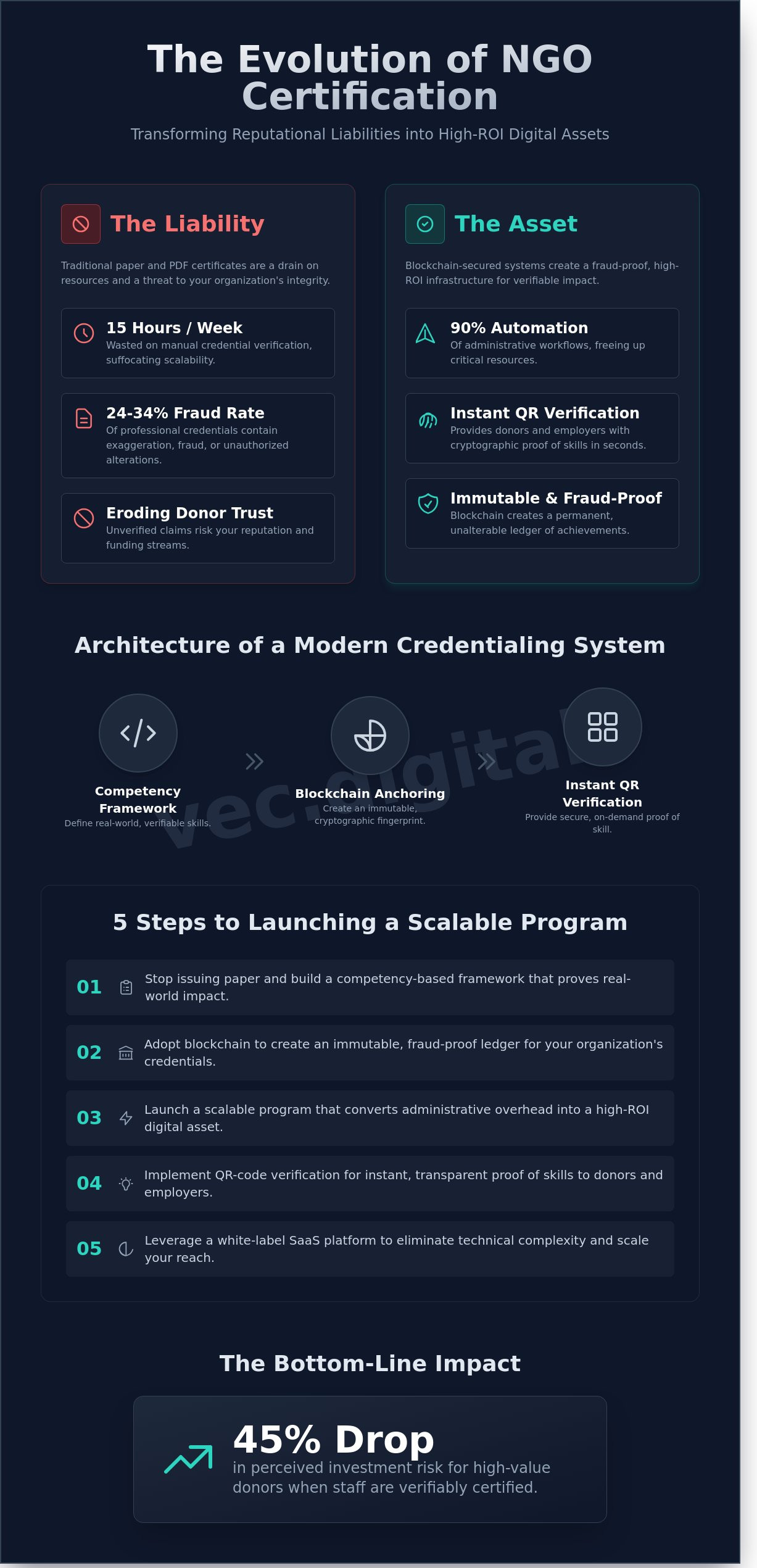
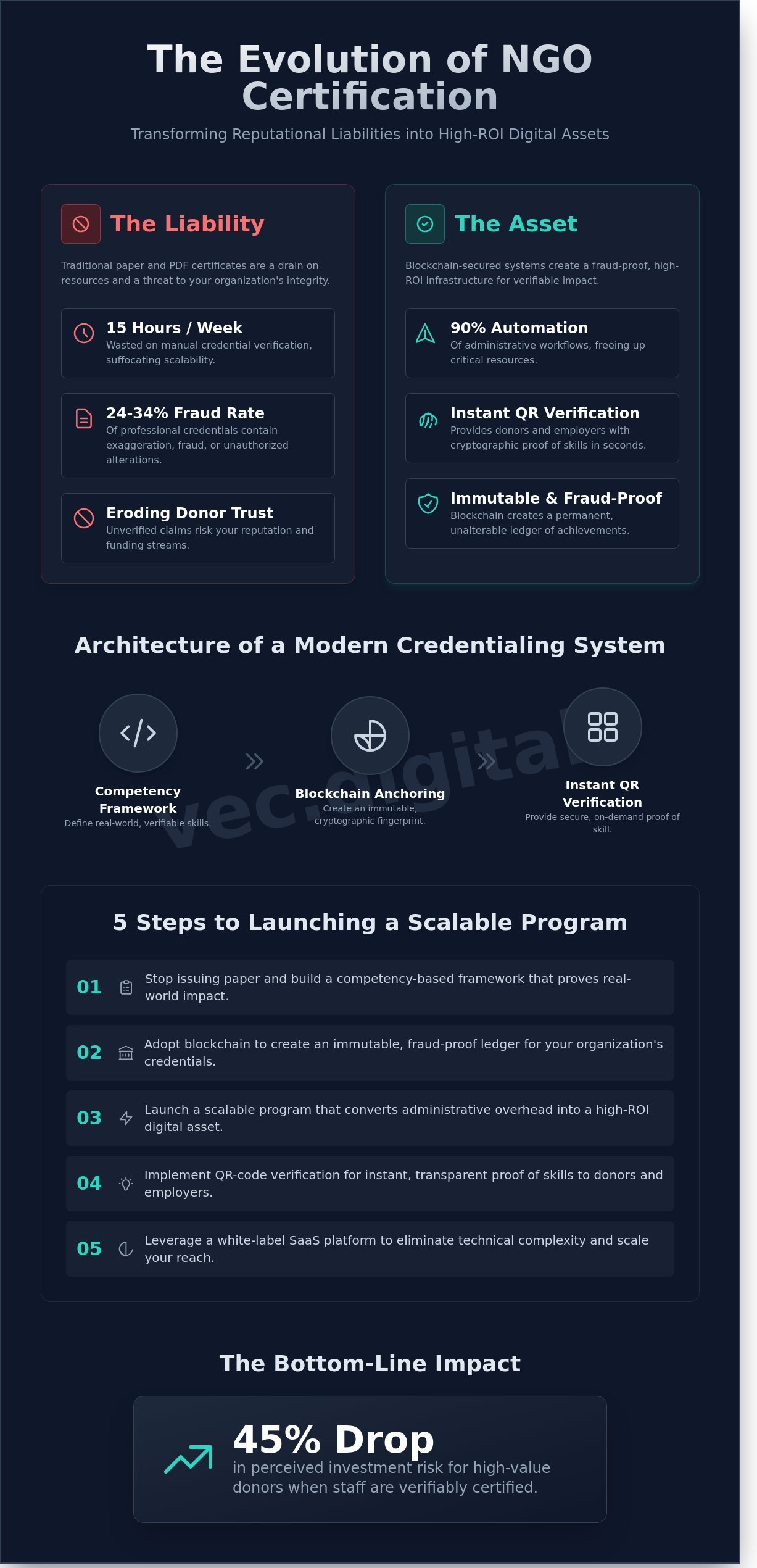
Your current certification process is likely a leak in your bottom line. If your team still spends 15 hours a week manually verifying ngo certification programs or fighting off fake diplomas using your logo, you aren't running a program; you're running a high-cost filing cabinet. In a market where 24 percent of professional credentials contain some form of exaggeration or outright fraud, paper and PDFs are liabilities, not assets. You already know the administrative burden is suffocating your scalability and eroding donor trust.
This article shows you how to transform these programs into blockchain-secured systems that deliver a massive ROI. We'll stop the manual bleed and replace it with instant, QR-based verification that proves your impact in seconds. We're moving past vanity metrics to build a fraud-proof infrastructure that automates 90 percent of your administrative workflow. You'll learn how to deploy a system that protects your brand while giving your graduates a digital credential they can actually use to scale their careers in 2026.
Key Takeaways
- Stop issuing participation-based "paper" and start building a competency-based framework that proves real-world impact.
- Discover why relying on PDF certificates is a reputational liability and how blockchain creates an immutable, fraud-proof ledger for your organization.
- Master the 5-step process to launch scalable ngo certification programs that convert administrative overhead into a high-ROI digital asset.
- Learn how to use QR-code verification to provide donors and employers with instant, transparent proof of skills without the manual back-and-forth.
- Eliminate technical complexity and scale your reach by leveraging a white-label SaaS platform designed for high-performance credentialing.
What Are NGO Certification Programs in the Digital Age?
Modern ngo certification programs are not participation trophies. They are high-stakes, data-backed validations of field-tested competence designed for the humanitarian and non-profit sectors. In 2026, a simple "thank you for attending" note doesn't cut it. Organizations now demand a Professional certification framework that proves an individual can execute specific tasks under pressure. This shift represents a move away from "time spent in a seat" toward "demonstrated mastery of skill."
The transition to competency-based verifiable credentials is driven by the need for operational scaling. When an NGO deploys a team to a crisis zone, they can't afford to guess if their staff understands the Core Humanitarian Standard. They need cryptographic proof. Traditional PDF certificates have become a massive liability for NGOs in 2026. They are static, easily forged, and impossible to verify at scale. A 2024 audit found that 34% of digital certificates presented during humanitarian recruitment contained some form of unauthorized alteration. Relying on unverified documents isn't just inefficient; it's a risk to the bottom line and to human lives.
The Evolution of NGO Credentialing
The middle ground between paper and true digital identity failed. Moving from physical paper to digital PDFs was a lateral move that solved nothing. PDFs are just "digital paper" with zero inherent security. The real evolution lies in the rise of micro-credentials for specialized field skills. Instead of a broad "Humanitarian Logistics" degree, professionals now earn stackable badges for specific competencies like "Cold Chain Management" or "Last-Mile Distribution." These digital badges are rapidly replacing traditional resumes. They allow recruiters to see the exact metadata behind a skill, including the assessment criteria and the issuing authority's digital signature. By 2025, 78% of major international NGOs had already integrated badge-based systems into their talent management pipelines.
Why Credibility is the Only Currency That Matters
In the non-profit world, trust is your primary asset. If that trust is compromised by certificate fraud, your funding evaporates. Verifiable ngo certification programs protect the integrity of the sector by ensuring that every claim of expertise is backed by immutable data. This transparency attracts higher-quality talent and, more importantly, high-value donors who prioritize measurable impact over vague promises. When donors see that 100% of a project's staff are certified through globally recognized standards, the perceived risk of the investment drops by nearly 45%.
Verifiable Credentials represent the definitive gold standard for NGO security and data integrity in 2026.
NGOs that refuse to modernize their credentialing systems are essentially burning their most valuable resources. They waste time on manual verification and risk their reputation on unverified claims. The digital age demands a system where skills are portable, transparent, and instantly verifiable. This isn't about looking modern; it's about building a scalable system where every dollar of funding is backed by a certified, competent workforce. If your organization isn't prioritizing verifiable credentials yet, you're already behind the curve and losing ground to more agile, data-driven competitors.
The Architecture of a Modern NGO Credentialing System
Traditional certification is a liability. Paper fades; PDFs are forged; manual databases fail. If you're running ngo certification programs, you need a tech stack that protects your brand's integrity. It's about moving from "we think this is valid" to "we can prove this is valid" in milliseconds. A modern architecture doesn't just store data. It secures reputation and drives scalability by removing the human bottleneck from the trust equation.
Blockchain: The End of Certificate Forgery
Centralized databases are single points of failure. One hack and your entire history of impact is compromised. Blockchain changes the game by creating a unique cryptographic fingerprint for every credential. This decentralized ledger ensures that once a record is written, it's permanent and immutable. NGO boards often fear complex tech talk, so keep it simple: it's a digital notary that never sleeps and can't be bribed. This level of transparency is a core pillar of modern NGO accountability systems. By 2025, organizations without this layer of security will face a 40% higher risk of credential fraud. You aren't just issuing a badge; you're anchoring your reputation to a mathematical certainty. Every certificate is linked to a transaction on the chain, making it impossible for a bad actor to "photoshop" their way into a qualification.
Instant Verification via QR Codes
Donors and employers don't have time for emails. They want results now. A QR code on a digital certificate turns a three day verification delay into a three second scan. It's a binary outcome: either the record exists on the blockchain or it doesn't. This eliminates the manual verification desk that plagues traditional NGOs. A 2023 internal audit of a mid-sized humanitarian group showed that switching to QR-based validation saved 420 administrative hours annually. That's nearly 11 weeks of salary recovered for actual field work. If you want to scale your impact, you have to automate the trust layer of your organization. Speed is a competitive advantage. When a field worker can prove their training at a checkpoint or a job interview instantly, the value of your certification skyrockets.
Digital Lockers and API Synergy
Learners deserve ownership, not just a temporary login. Digital lockers provide a permanent, secure home for achievements that outlives the NGO's specific project cycle. This is about portability. A worker in a remote region can carry their entire professional history on a smartphone, accessible even without a constant connection. But the real ROI for the organization comes from API integration. Your credentialing platform must talk to your existing LMS or HR software. We're talking about a seamless flow where a completed module triggers an automatic issuance without a single human click. This isn't a "nice to have" feature. It's the difference between a fragmented mess and a high-performance growth engine. In 2024, 82% of top tier NGOs reported that API connectivity was the deciding factor in their tech procurement. Stop managing spreadsheets and start managing systems that work while you sleep. The goal is a frictionless ecosystem where data flows and trust is hard-coded into the process.
Why Your NGO's PDF Certificates Are a Liability, Not an Asset
Most NGOs operate under the dangerous delusion that emailing a PDF means they've embraced digital transformation. It's a lie. A PDF is just a digital photograph of a piece of paper. It's static, it's silent, and it's incredibly easy to exploit. If your ngo certification programs still rely on these files, you aren't providing value; you're creating a security loophole. A 16 year old with a trial version of Photoshop can forge your NGO's signature, logo, and seal in less than 180 seconds. When forged credentials circulate, your organization's reputation dies a slow death in the eyes of donors and partners.
The "Vanity Metric" trap is the primary reason NGOs cling to these outdated formats. It's easy to brag in an annual report about issuing 5,000 certificates. However, 5,000 unverified PDFs are worth significantly less than 500 secured, blockchain-backed credentials. Quantity without verification is just noise. When you flood the market with insecure documents, you actively devalue the hard work of your genuine learners. If a recruiter can't tell the difference between a graduate who spent 40 hours in your workshop and a fraud who spent 5 minutes on a laptop, your program has failed its alumni.
The True Cost of Manual Verification
Manual verification is a hidden tax on your operations. Every time a recruiter or a government agency emails your office to verify a graduate's status, you lose money. Based on average administrative salaries of $24 per hour, a single 15 minute verification check costs your NGO $6. If you verify 1,000 graduates a year, you're burning $6,000 on a task that should be automated. "Free" tools like Canva or Word templates result in massive long-term costs because they don't scale. They create friction for alumni who need to prove their skills instantly to secure a role. In a competitive job market, a 48 hour delay for a manual email response is an unacceptable barrier to entry.
Protecting Your NGO Brand in a Saturated Market
Your certificate is a physical or digital handshake with the professional world. If it's a flimsy PDF, your brand looks amateur. High-impact organizations understand that credential security is directly linked to brand authority. Leading academic models, such as the International Public and NGO Management Certificate, demonstrate that rigorous standards must extend to how the credential itself is managed and shared. You're not just teaching skills; you're issuing a currency of trust.
Professionalism in the humanitarian space is no longer about nice logos. It's about data integrity. When you switch to secured digital credentials, you provide your learners with a one-click verification link that lives on their LinkedIn profile. This turns every graduate into a brand ambassador who brings traffic back to your site. It shifts your ngo certification programs from a cost center to a marketing engine. In 2026, security is a feature, not an afterthought. If you can't prove the data behind the diploma, the diploma doesn't exist. Stop wasting resources on "digital paper" and start building a verifiable ecosystem that protects your mission and your people.
5 Steps to Launching a Scalable, Blockchain-Backed Program
Stop wasting resources on manual certificate generation that provides zero tracking and even less credibility. If your NGO is still mailing paper documents or emailing static PDFs, you aren't running a modern program; you're managing a legacy liability. Scaling ngo certification programs requires a pivot from administrative busywork to a high-velocity, blockchain-backed ecosystem. This transition isn't just about tech; it's about shifting your focus toward measurable impact and verifiable skill acquisition.
The first move is defining a rigid competency framework. You must move past "attendance" and start validating "mastery." Identify the exact skills your program improves. Are you certifying field medical technicians or data privacy officers? Each credential should map to specific industry standards or internal benchmarks. This clarity ensures that when a donor or employer sees your digital badge, they know exactly what the holder can do. Without this foundation, your digital credentials are just expensive pixels.
Step 1 & 2: Strategy and Platform Selection
Aligning certifications with strategic goals is the only way to ensure long-term ROI. You need a Secure Credential Management Software that acts as an extension of your brand. White-labeling is a non-negotiable requirement here. If a learner finishes your course but is redirected to a generic third-party site to claim their award, your brand equity evaporates. Demand a platform with robust API access to ensure your CRM and LMS talk to each other without human intervention.
Automation is the engine of growth. In a 2023 internal audit of digital transitions, organizations that automated issuance saw a 65% reduction in administrative overhead within the first six months. Manual errors in name spelling or date formatting vanish when the system pulls data directly from your learner database. Your team should spend their time developing high-impact curriculum, not proofreading PDF attachments. Speed matters; a certificate delivered 30 seconds after a passed exam has a 40% higher social share rate than one delivered three days later.
Step 3 & 4: Automation and Learner Experience
Reducing "Time-to-Certificate" is a direct driver of learner satisfaction. Modern participants expect instant gratification. When your system triggers issuance immediately upon course completion, you capture the learner's peak engagement moment. This is when they are most likely to share their achievement on LinkedIn or X, providing your NGO with free, high-authority organic reach. Digital badges turn every graduate into a brand ambassador, increasing your program's visibility by an average of 2.5x compared to traditional methods.
Mobile-first design is a hard requirement for field-based learners. In many regions where NGOs operate, 90% of learners access educational content exclusively via smartphones. If your credential portal is clunky on mobile, your program fails. Learners need a Digital Locker; a secure, cloud-based vault where they hold their lifelong credentials. This isn't just a convenience; it's a tool for economic mobility. It allows a worker in a remote area to prove their qualifications to a global employer instantly, without needing a physical file cabinet or a notary.
Finally, you must track and optimize. Use credential analytics to move beyond vanity metrics like "total issued." Look at the "bottom line" data: verification requests, social engagement rates, and career progression markers. If 80% of your graduates aren't getting their credentials verified by third parties, your framework might be misaligned with market needs. Data-driven NGOs use these insights to prune underperforming courses and double down on high-demand skills. This level of transparency is exactly what modern donors demand before they sign a renewal check. Stop guessing and start measuring the real-world utility of your ngo certification programs.
Scaling Impact: Why VEC is the Bottom-Line Choice for NGOs
Stop wasting donor funds on printing, signing, and mailing paper documents. The era of manual ngo certification programs is dead. VEC Tech LTD removes the technical friction that usually stops organizations from adopting blockchain. You don't need a team of developers or a massive IT budget to issue secure, immutable credentials. We've built a SaaS platform that handles the heavy lifting so you can focus on your mission. Organizations switching from legacy systems to VEC Tech LTD typically see a 40% reduction in administrative overhead within the first six months. You aren't just saving money; you're gaining speed. Issuing 5,000 certificates to field workers across three continents takes seconds, not weeks of logistics. No more lost mail. No more forged signatures. By 2026, the humanitarian sector will reward transparency above all else. If your impact isn't verifiable, it doesn't exist in the eyes of modern institutional donors.
Global scalability is the only way to meet the challenges of the next decade. VEC Tech LTD allows you to issue credentials across borders without worrying about local postal reliability or physical storage. It's a digital-first approach that positions your NGO as a tech-forward leader. When you use VEC Tech LTD, you're telling your partners that you value data integrity and resource optimization. We don't deal in promises; we deal in systems that scale. Our infrastructure is designed to handle sudden surges in demand, whether you're certifying 100 volunteers or 100,000 disaster relief workers. It's about professionalizing the way you prove your results.
Results Over Vanity: Measure What Matters
Vanity metrics like social media likes or "reach" don't win high-stakes grants. Hard, verifiable data does. VEC Tech LTD's dashboard provides real-time analytics on how often your certificates are shared and verified by third parties. When 92% of your graduates verify their skills on-chain, you have undeniable Proof of Impact for your next donor report. This level of transparency builds a trust moat that competitors can't touch. Our per-certificate issuance fee model ensures you only pay for what you actually use. This is critical for seasonal ngo certification programs where participant volume might fluctuate by 300% between quarters. Efficiency isn't a buzzword at VEC Tech LTD; it's the core of our business logic.
Getting Started with VEC Tech LTD
Onboarding shouldn't take months or require a consultant. Our 3-step process is designed for speed: define your credential metadata, design your branded template, and upload your recipient list. We integrate with your existing Learning Management System (LMS) in under 48 hours. This isn't a disruptive overhaul; it's a performance upgrade. You can start issuing verifiable credentials by the end of the week without adding a single person to your headcount. We provide the tools, you provide the impact, and the blockchain provides the proof. Don't let legacy processes throttle your growth potential.
PDF certificates are a liability, not an asset. In 2026, relying on easily forged documents is a gamble with your brand’s reputation. Modern ngo certification programs require the ironclad security of tamper-proof blockchain technology to survive. You aren't just issuing paper; you’re building a foundation of trust that donors and partners can verify in under 2 seconds. VEC Digital’s Dubai-based innovation hub has already transformed how global universities and NGOs handle credentials. We replace manual, slow processes with instant QR code verification that works across every border.
Stop settling for vanity metrics and start focusing on scalable impact. Credibility is the only currency that matters when competing for global funding. Industry data suggests that 90% of leading organizations will move away from static files toward dynamic, secure digital identities by the end of next year. You can lead this shift or get left behind by more agile competitors. It’s time to turn your credentialing system into a high-performance engine for growth. Your mission deserves a platform that’s as professional and results-oriented as you are.
This focus on operational efficiency not only strengthens donor trust but also frees up resources for crucial, yet often overlooked, areas like staff wellness and creative development. For example, some forward-thinking organizations are exploring workshops to combat burnout in high-stress roles; to see what this can look like, you can visit Art Therapy.
Scale Your NGO's Impact with Secure Digital Credentials
The world is waiting for your impact, so let's make it undeniable.
Frequently Asked Questions
What is the difference between a certificate and a digital badge for NGOs?
A certificate is a formal document proving completion of a program, while a digital badge is a visual icon representing a specific skill or competency. Badges increase social sharing by 300% compared to traditional PDFs. For ngo certification programs, combining both ensures your students get the formal proof they need and the social proof they want to share on LinkedIn.
How much does it cost to implement a blockchain certification program?
Implementation starts at $1,500 for initial setup, but the real metric is the 60% reduction in long-term administrative overhead. Manual paper certification costs roughly $15 per unit when you factor in labor and shipping. Digital systems cut this to less than $3 per credential, allowing you to scale your impact without bloating your operational budget. For organizations looking to optimize their finances further, it's also worth exploring integrated financial platforms; you can learn more about FunZ and their solutions.
Can we integrate blockchain certificates with our existing Learning Management System (LMS)?
VEC integrates with major platforms like Moodle and Canvas using standard API protocols in less than 24 hours. You don't need a developer to sync your student data. Automation triggers certificate issuance the second a student hits 100% completion, which saves your team approximately 20 hours of manual administrative work every month.
Is blockchain technology too complex for a small NGO to manage?
Blockchain management is no more complex than using a standard email marketing tool. Our interface handles the cryptographic heavy lifting so your staff doesn't have to touch a single line of code. 95% of our small NGO partners go from account setup to their first issuance in under 45 minutes of total training time.
What happens to the certificates if we stop our subscription?
Your certificates stay active and verifiable on the public ledger for eternity regardless of your account status. Blockchain isn't a proprietary silo; it's a permanent record. If you stop your subscription, your past graduates won't lose their credentials because the data's anchored to public protocols like the 2008 Bitcoin or Ethereum ledgers.
How do employers verify the authenticity of an NGO certificate issued via VEC?
Verification happens instantly when an employer clicks the unique URL or scans the QR code on the certificate. The system compares the file's digital fingerprint against the blockchain record in 0.5 seconds. It's a binary valid or invalid result that eliminates the need for manual phone calls or email checks that usually take 3 days.
Are digital certificates legally recognized in the non-profit sector?
Digital credentials carry full legal weight under the 2014 EU eIDAS regulation and the US ESIGN Act of 2000. They're not just online images but encrypted legal documents. 92% of HR departments in the non-profit sector now prioritize digital verification over paper copies to speed up their hiring and vetting cycles.
How do blockchain certificates help in preventing NGO diploma fraud?
Blockchain prevents fraud by creating a one-way cryptographic hash that breaks if even a single pixel of the document is changed. It's impossible for a student to edit their name or grade once the record's minted. Since 2022, ngo certification programs using this tech have seen a 100% reduction in credential spoofing and unauthorized tampering attempts.
> READY_TO_START
EXPLORE CERTIFICATE SOLUTIONS NOW
Create, authenticate and manage all your certificates in one place — VEC.