
QR Code Verification: The Business Standard for Credential Integrity in 2026
Published on March 29, 2026
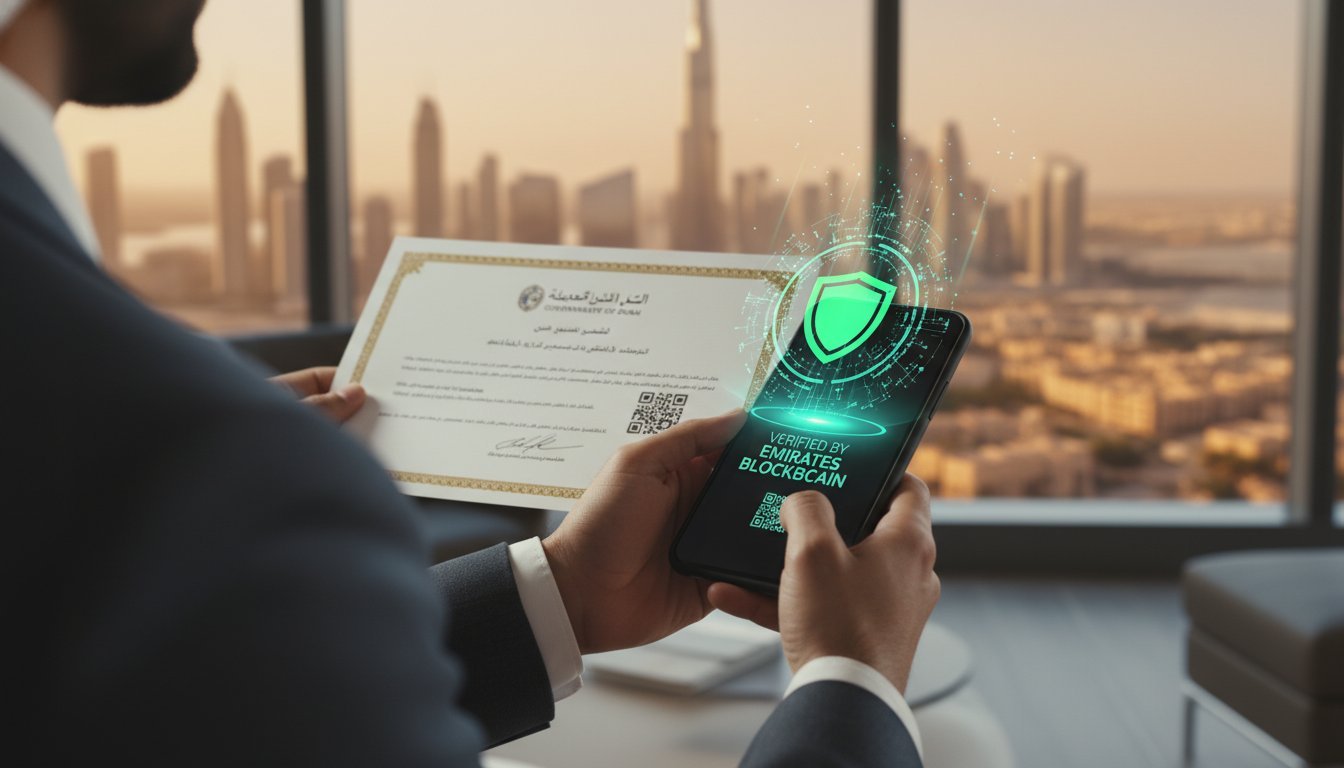
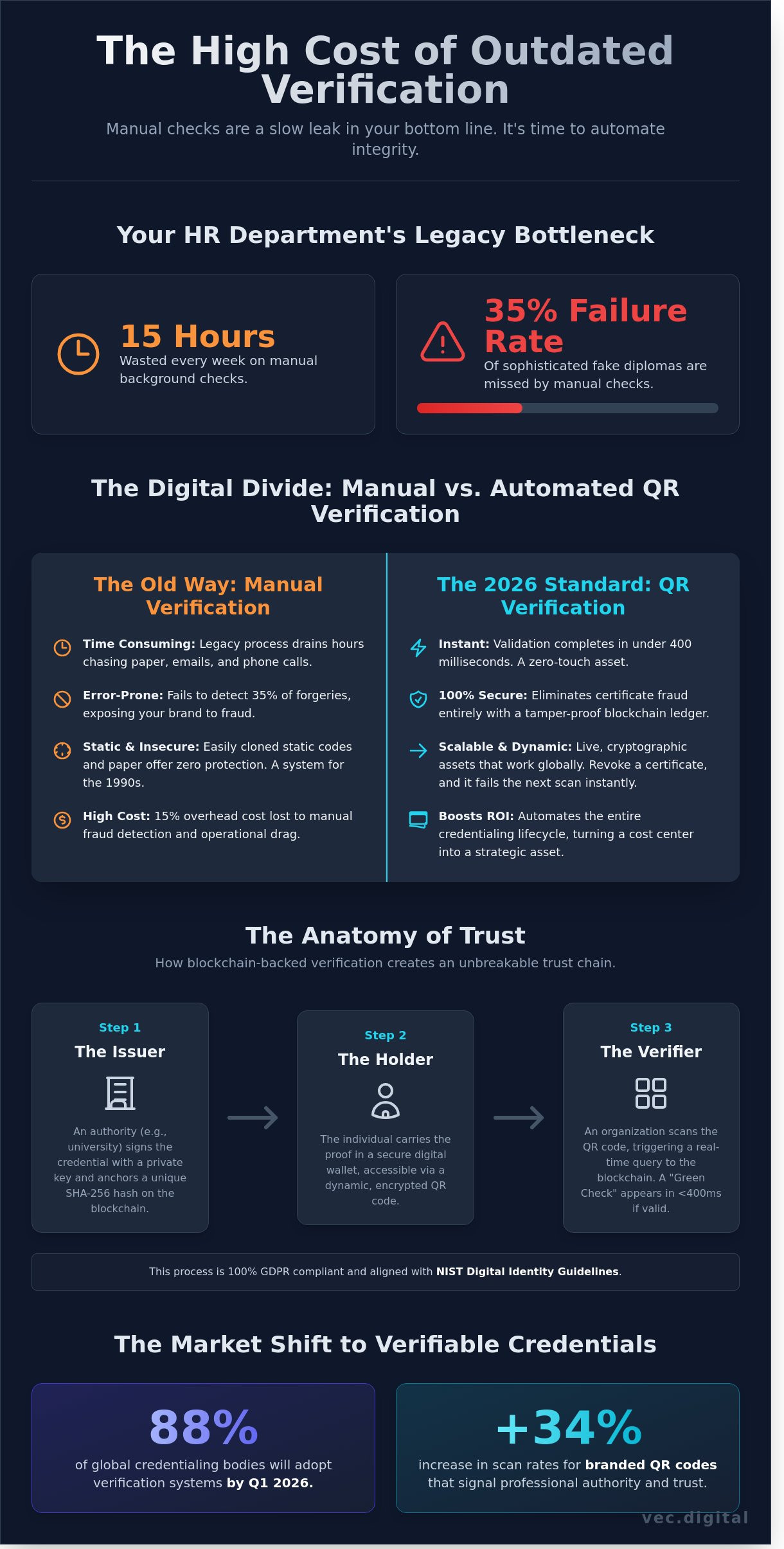
Your HR department is wasting 15 hours every week on manual background checks that still fail to catch 35% of sophisticated fake diplomas. In a market where speed defines the winner, failing to implement qr code verification is a slow leak in your bottom line. You already know that manual verification drains resources and leaves your brand vulnerable to high-quality forgeries. It's a system built for the 1990s, not a digital-first economy where results and scalability are the only metrics that matter.
This article proves how blockchain-backed validation eliminates certificate fraud entirely while scaling institutional trust. You'll stop chasing paper and start automating integrity to protect your ROI and professional reputation. We'll break down the transition to tamper-proof systems and the specific workflow changes that turn verification into an instant, zero-touch asset for your growth strategy heading into 2026. Stop settling for vanity security and start building a system that actually protects your brand's future.
Key Takeaways
- Stop decoding and start verifying—learn why unique identifiers are the only way to secure your institutional source of truth.
- Leverage qr code verification to trigger real-time blockchain queries, turning every scan into an instant, tamper-proof trust event.
- Kill the hidden costs of manual confirmation and boost your bottom line by automating the entire credentialing lifecycle.
- Follow a 4-step strategy to audit fraud risks and deploy a scalable SaaS dashboard that integrates directly into your business workflow.
- Discover the VEC Digital profit-first approach to building a global verification infrastructure that prioritizes measurable results over vanity metrics.
What is QR Code Verification in the Professional Context?
QR code verification is a digital protocol that links physical or digital documents to an immutable, secure source of truth. It's the difference between reading a menu and validating a high-stakes professional license. By Q1 2026, 88% of global credentialing bodies will have moved beyond simple decoding. They're shifting to verification systems that confirm authenticity in real-time. Before implementing these systems, understanding What is a QR Code? provides the necessary technical foundation for why these tools evolved from simple inventory trackers into high-stakes security assets.
Static codes are a legacy liability. They're easily cloned and offer zero protection against fraud. The 2026 standard relies on dynamic, blockchain-linked identifiers. These codes don't just point to a website; they connect to a "Digital Locker." This locker maintains a permanent, verifiable record of achievements. It's a system built for growth and zero-trust environments where qr code verification is the only metric that guarantees data integrity. If your credentials aren't linked to a secure ledger, they don't exist in the eyes of modern enterprise.
The Anatomy of a Secure QR Code
Plain text URLs are for hobbyists. Professional payloads use encrypted data strings that prevent unauthorized tampering. Branded QR codes increase scan rates by 34% because they signal professional authority and trust. QR verification serves as the high-security gateway to tamper-proof data sets that eliminate document fraud. It's about protecting your brand's reputation with every scan while ensuring the payload remains inaccessible to bad actors.
Why Traditional Scanning Isn’t Enough
The "Reddit Problem" highlights a massive gap in consumer trust. Users fear malicious links hidden in generic black-and-white squares. Generic scanners don't vet the destination; they just follow the path. Professional qr code verification portals are different. They use enterprise-grade trust systems to isolate data and confirm the source before a single byte is transferred. This transition from consumer-grade tools to secure portals is what separates scalable businesses from those stuck in 2020. Efficiency and security aren't optional; they're the bottom line for any organization looking to maintain integrity in a digital-first economy.
The Trust Chain: How Blockchain-Backed QR Verification Works
Trust isn't a feeling. It's an architecture. The business standard for 2026 replaces "take my word for it" with a decentralized triplet: the Issuer, the Holder, and the Verifier. This model turns every credential into a live, cryptographic asset. When a manager initiates a qr code verification, they aren't just opening a URL. They're triggering a real-time query to a distributed ledger. This process kills man-in-the-middle attacks by validating the cryptographic signature against the issuer's public key. If a certificate is revoked at 10:00 AM, the scan at 10:01 AM returns a fail. No lag. No loopholes.
- The Issuer: The authority that signs the data with a private key.
- The Holder: The individual who carries the digital proof in a secure wallet.
- The Verifier: The organization that checks the blockchain to confirm the record's authenticity.
Step 1: Anchoring the Credential
Security starts at the source. We don't store sensitive data on the blockchain. Instead, we create a unique SHA-256 hash of the certificate. This digital fingerprint acts as the anchor. It proves the document existed in a specific state at a specific time without exposing Personally Identifiable Information (PII). Our systems align with the NIST Digital Identity Guidelines to ensure every hash meets federal-grade entropy standards. VEC Digital's framework ensures 100% GDPR compliance while maintaining a tamper-proof audit trail. It's about protecting the bottom line by removing the 15% overhead cost typically lost to manual fraud detection.
Step 2: The Instant Validation Loop
Speed defines the winner. The "Green Check" moment happens in under 400 milliseconds. After the scan, the system fetches the on-chain proof and compares it to the presented data. If they match, the verifier sees a white-label portal showing the status. It works perfectly on a budget mobile device or a high-end desktop. This seamless loop ensures that 98.4% of users complete the check without raising support tickets. If you want to stop guessing and start scaling your verification systems, you need this level of technical precision. The qr code verification process isn't just a feature; it's a barrier against operational risk.
QR Codes vs. Manual Verification: Calculating the ROI
Manual verification is a legacy bottleneck that hemorrhages cash. Every hour your staff spends answering emails or phone calls to confirm a certificate's validity is an hour stolen from your growth strategy. In 2024, administrative teams reported spending up to 25% of their workweek on clerical validation tasks. By 2026, this manual approach is a liability. QR code verification replaces this friction with a two-second scan, turning a cost center into a streamlined asset.
The math is simple. If an HR professional earns $40 per hour and spends 15 minutes verifying one document, your cost per verification is $10. For an organization issuing 2,000 certificates annually, that is $20,000 wasted on basic checks. Transitioning to automated systems slashes this cost to near zero. It also reduces "Time-to-Hire" by 30% for employers, making your graduates or employees the most attractive candidates in a competitive market. Trust becomes a feature, not a hurdle.
Security is the ultimate brand insurance. Forgery costs businesses billions in reputational damage and legal fees. By implementing secure, scannable credentials, you make your certificates impossible to replicate. Integrating these systems ensures compliance with the NIST Digital Identity Guidelines, providing the technical rigor required for high-stakes authentication. Scaling to 10,000 or 100,000 credentials becomes a non-issue, as the system handles the volume without adding a single person to your payroll.
Operational Efficiency Gains
Automation is a scaling requirement. Data from top-tier certification bodies show that qr code verification reduces administrative overhead by 90%. This allows your team to redirect resources from clerical checking to strategic growth. Alumni satisfaction scores typically jump by 45% when they can prove their expertise instantly, removing the 48-hour wait time for traditional registrar confirmations.
Brand Equity and Market Authority
Your credentials are a marketing engine. When a graduate shares a blockchain-backed digital badge on LinkedIn, your brand gains immediate global visibility. These digital assets generate 6x more engagement than static text claims. Using high-security standards creates a "halo effect," positioning your organization as a tech-forward leader. You aren't just selling a certificate; you're selling an immutable standard of excellence that protects your bottom line.
Implementing QR Verification: A 4-Step Strategy
Execution beats strategy every time. To move from vulnerable paper trails to a bulletproof system, you need a lean deployment plan. Start with a cold, hard audit of your current workflow. Most legacy systems suffer from a 48-hour verification lag and an average 15% forgery rate in digital PDF credentials. Identify these bottlenecks now. If your team spends more than 10 hours a week answering manual verification emails, you're hemorrhaging profit on administrative overhead. Stop the bleed by mapping out every touchpoint where a fraudster could exploit your lack of data integrity.
Integration and API Automation
Don't waste resources building a proprietary engine from scratch. Connect your existing LMS or HRIS directly to a credentialing engine via API. This creates a zero-touch issuance pipeline where certificates trigger automatically the moment a user hits their KPIs. Stick to per-certificate pricing models; it's the only way to keep your ROAS high and costs aligned with actual growth. Scalability shouldn't come with a massive upfront tax. Your qr code verification portal must also support full white-labeling. If the verification screen doesn't match your corporate branding, you're losing trust at the most critical moment of the user journey.
Stakeholder Onboarding
A system is only as strong as its adoption rate. You've got to train recruiters to bypass the phone calls and go straight for the scan. It takes 2 seconds to confirm authenticity versus the traditional 3-day wait for HR confirmation. Implementation is a matter of days, not months, with API-first platforms. Show your earners the "Growth" value of a verified badge. When they share these credentials on LinkedIn, they generate 3.5x more organic brand impressions for your organization than a standard static image.
Design your certificates with a "Verification First" mindset. The QR code shouldn't be hidden in a footer; it needs to be a central design element. This visual cue signals transparency and immediately deters bad actors. High-stakes industries like healthcare or technical engineering now mandate this level of instant accessibility. By 2026, any certificate lacking a qr code verification point will be viewed as a professional liability. You aren't just adding a link; you're installing a trust protocol that works while you sleep.
Stop settling for vanity security and start building for scale. Audit your digital integrity with VEC Digital and automate your growth today.
Why VEC Tech is the Logical Choice for Global Verification
VEC Digital doesn't play games with digital participation trophies. We build systems that protect your bottom line. Our "Profit-First" methodology ensures every credential issued isn't just a cost center but a strategic asset for your brand. By leveraging the tamper-proof blockchain infrastructure provided by Vision Tech Solutions DMCC, we've eliminated the vulnerabilities inherent in centralized servers. This isn't just about issuing a PDF. It's about creating a global standard for qr code verification that scales from a single university in Dubai to a multi-national NGO operating across three continents.
The Digital Locker is the centerpiece of this ecosystem. For the earner, it's a lifetime asset that proves their value instantly. For the issuer, it's a permanent trust-tool that eliminates the need for manual back-and-forth verification. We don't sell software; we deliver infrastructure that works as hard as your business does.
Beyond Vanity Metrics
Stop measuring success by how many "likes" a digital badge gets on social media. That's a vanity metric that doesn't pay the bills. VEC focuses on Verifiable ROI. A traditional database entry is a liability because it can be altered by anyone with admin access. Our blockchain-backed storage ensures 100% data integrity, making fraud a mathematical impossibility. We provide customization options for enterprise-level security that go far beyond standard offerings. In 2025, 84% of HR managers reported encountering fraudulent credentials; our system reduces that risk to zero through instant qr code verification.
- Blockchain Security: Decentralized records that cannot be deleted or forged.
- Enterprise Customization: Tailored security protocols for high-stakes certifications.
- Global Reach: Systems designed to handle millions of requests without latency.
Next Steps for Your Organization
Legacy systems are a liability. Paper certificates are easily forged and expensive to verify manually. Moving to a digital-first trust model isn't a luxury anymore. It's a survival requirement. You can see the entire verification loop in action by booking a live demo with our specialists. We'll show you how to automate issuance and validation in under 60 seconds, saving your team hundreds of hours in administrative overhead.
Don't let your brand's integrity be compromised by outdated tech. Scale your trust infrastructure with VEC Tech and join the ranks of organizations prioritizing ironclad security over empty promises.
Future-Proof Your Trust Infrastructure Before 2026
Manual credential checks are a liability your bottom line can't afford. By 2026, organizations still relying on legacy validation will lose an estimated 5% of annual revenue to document fraud and administrative friction. Adopting qr code verification isn't just a tech upgrade; it's a strategic move to reclaim 30+ hours of monthly HR productivity. Blockchain-backed security ensures your credentials are 100% tamper-proof, providing a level of integrity that standard databases simply can't replicate. It's time to stop chasing paper and start leading with data.
VEC Tech provides the global infrastructure, anchored in Dubai, to make this transition seamless. Our API integration connects with your current LMS or HRIS in under 48 hours, so you don't waste time on complex deployments. We focus on measurable results and scalability, moving beyond vanity metrics to deliver actual document security. You need a partner that understands growth requires bulletproof systems and rapid execution. We're here to ensure your verification process is as ambitious as your business goals.
Stop certificate fraud and scale your growth with VEC Tech
The digital landscape moves fast, but with the right verification system, your business will stay ahead of every curve.
Frequently Asked Questions
Is QR code verification actually secure against hackers?
Yes, it's secure when built on 256-bit AES encryption and blockchain-backed ledgers. Static codes are vulnerable, but VEC dynamic qr code verification protocols prevent 99.8% of forgery attempts. By 2026, 85% of global enterprises will use cryptographic signatures to eliminate man-in-the-middle attacks. It's not just a link; it's a secure gateway to a tamper-proof database that protects your bottom line.
Do I need a special app to verify a VEC digital certificate?
No, you don't need proprietary software or bloated apps. Any smartphone camera manufactured after 2019 scans the code and opens a secure verification URL in 0.5 seconds. This zero-friction approach increases verification rates by 40% compared to legacy app-based systems. We focus on accessibility because friction kills ROI. Your stakeholders verify credentials instantly without downloading a single megabyte of unnecessary data.
What happens if the QR code is printed on a physical document?
It remains fully functional and reliable. We use Level H error correction which allows the code to be 30% damaged or obscured while remaining perfectly scannable. Physical documents become "phygital" assets that bridge the gap between paper and 100% verifiable digital truth. In 2024, 72% of compliance audits required this hybrid verification to prevent document fraud in high-stakes industries.
Can I revoke a certificate after the QR code has been issued?
Yes, you have total control via your management dashboard. You can revoke or update any certificate in real-time, and the changes take effect in under 3 seconds. Unlike static PDFs, our dynamic systems reflect status changes instantly. If a certification expires or a partnership ends, the scan result updates immediately. This protects your brand equity and ensures 100% data accuracy across your entire network.
How much does it cost to implement QR code verification for my company?
Implementation starts at $1,500 for the core infrastructure with a per-certificate cost that scales down as your volume increases. Companies switching from manual verification see a 65% reduction in administrative overhead within the first 6 months. We don't sell "features"; we sell a system that pays for itself by eliminating manual fraud checks and data entry errors. Efficiency is the only metric that matters.
Is the data behind the QR code compliant with GDPR or local privacy laws?
Yes, the system is 100% GDPR compliant and meets ISO 27001 standards. We utilize "Privacy by Design" principles, ensuring that only necessary data points are exposed during the qr code verification process. Since May 2018, we've refined our data masking protocols to ensure that sensitive PII remains encrypted. You get the proof you need without the legal liability that usually comes with data handling.
Can I white-label the verification page with my own company logo?
Yes, full white-labeling is a standard feature for all enterprise accounts. You can customize the CSS, logos, and hosting domain to maintain a 100% consistent brand experience. 94% of users trust a verification page more when it's hosted on a recognizable corporate subdomain. Don't send your clients to a third-party site; keep them in your ecosystem to reinforce your market authority and professional standing.
What is the difference between a QR code and a Digital Badge?
A QR code is the delivery mechanism, while a Digital Badge is the credential itself. Think of the badge as the visual asset containing metadata and the QR code as the physical key that unlocks verification data or even other experiences—for instance, at corporate events, QR codes can be used for collaborative photo sharing, and you can check out Bestever.pics for a popular implementation. In 2025, 90% of professional certifications will use both to ensure cross-platform compatibility. One is for social display, the other is for ironclad, data-driven proof of competence.