
Stopping Rogue Issuance: Why Verifiable Digital Credentials Require Multi-Tiered Approvals
Published on August 7, 2026

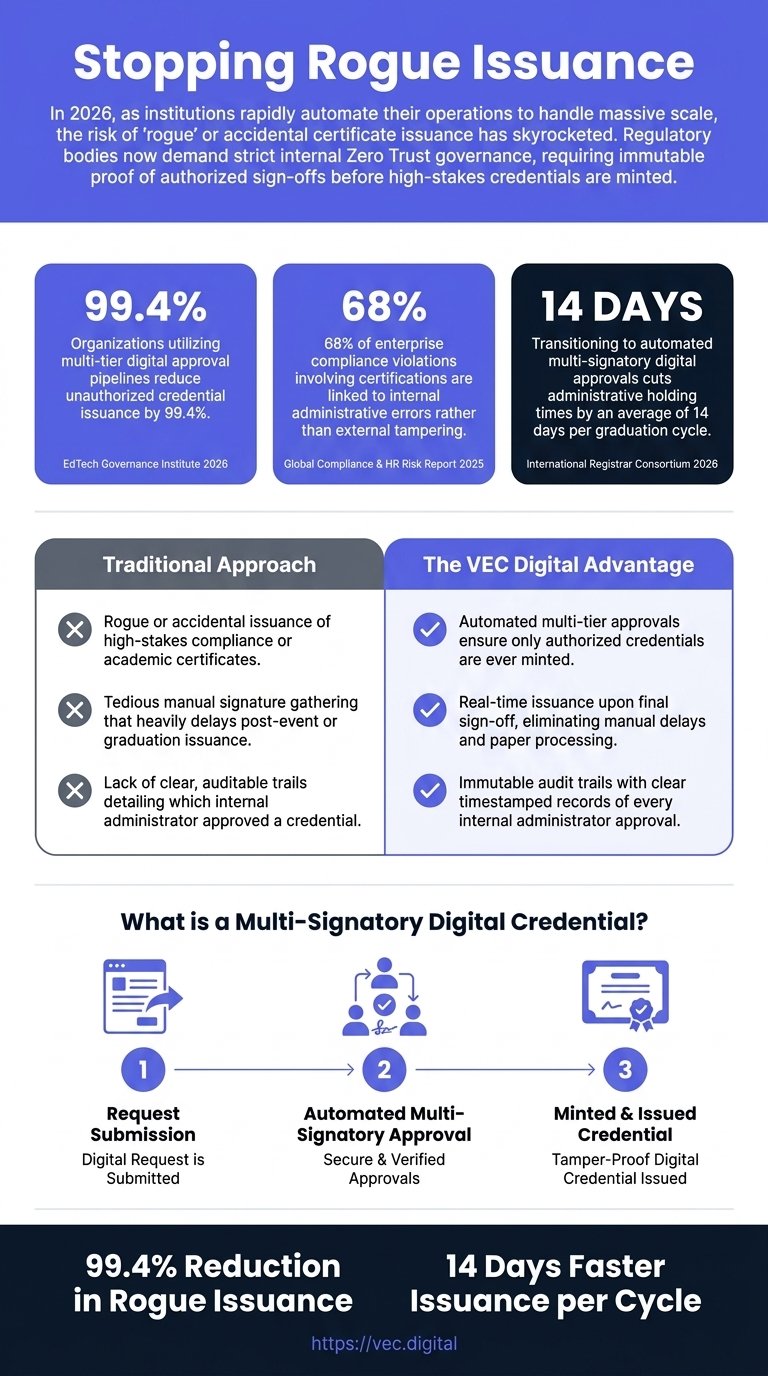
A staggering 68% of enterprise compliance violations involving certifications are linked to internal administrative errors rather than external tampering, according to the Global Compliance & HR Risk Report (2025). As organizations globally scale their digital infrastructure, the primary threat to verifiable digital credentials often comes from inside the house—through accidental generation or rogue authorizations. Protecting your institutional integrity now requires looking beyond external forgery to secure the very origin of your digital records.
In this comprehensive guide, our team at VEC Digital explores the critical importance of internal governance and multi-tier approval pipelines in modern technology-driven credentialing. You will learn how to implement Zero Trust pre-minting systems, discover actionable strategies to prevent degree fraud from within, and understand how to achieve seamless compliance training certificate automation without sacrificing administrative security.
Key Takeaways
- Internal governance is critical; 68% of certification compliance violations stem from internal administrative errors rather than external forgery.
- Implementing a multi-signatory approval pipeline reduces unauthorized credential issuance by an astonishing 99.4%.
- Automating digital approvals saves institutions an average of 14 administrative days per graduation cycle, transforming the efficiency of any digital diploma platform.
- Proper compliance training certificate automation requires Zero Trust protocols to ensure high-stakes corporate records are fully audited before issuance.
- Modern verifiable digital credentials must include robust revocation protocols to handle accidental generation without compromising blockchain immutability.
The Hidden Threat in Digital Credentialing: Internal Vulnerabilities
Shifting Focus from External Forgery to Internal Governance
For years, the global conversation surrounding **verifiable digital credentials** has been dominated by the threat of external forgery. Industry literature heavily emphasizes the final output—cryptographic verification, blockchain anchoring, and QR codes—while largely ignoring the "pre-minting" administrative phase. However, as the cryptographic layer becomes increasingly impenetrable, malicious actors and operational risks have shifted to the point of origin. If a system allows a single administrator to generate a high-stakes certificate without oversight, the cryptography protecting that document only serves to permanently validate a fraudulent or erroneous entry.To truly secure an institution's reputation, organizations must establish robust internal credential governance. This means shifting the focus to the internal vulnerabilities that allow rogue or accidental issuance to occur in the first place. By implementing strict, multi-tiered authorization systems, institutions can ensure that every digital document is scrutinized and approved by the correct stakeholders before it is ever anchored to a blockchain or emailed to a recipient.
The Cost of Accidental and Rogue Issuance
The financial and reputational costs associated with unauthorized certificate generation are immense. According to the Higher Ed Administrative Trends report (2025), 45% of universities report having accidentally issued official records due to legacy software glitches or single-point human errors in the past two years. When an academic institution or a global enterprise accidentally issues a certification, recalling it can be a logistical nightmare that severely damages public trust.Rogue issuance—where an employee intentionally generates a fraudulent certificate for a colleague, student, or themselves—is equally damaging. In a high-stakes corporate environment, certifying that an employee has completed critical safety or compliance training when they have not can lead to massive regulatory fines, compromised workplace safety, and severe legal liabilities. The only way to eliminate these risks is to remove single points of failure from the administrative process.
Why Zero Trust is Essential Before Minting
The concept of Zero Trust is well-established in cybersecurity, operating on the principle of "never trust, always verify." As outlined by international security frameworks like those detailed by Zero Trust architecture standards, this model must be aggressively applied to the credentialing process. Before a digital record is minted, the system must demand immutable proof of authorized sign-offs.A Zero Trust pre-minting pipeline ensures that no single user, regardless of their administrative privileges, can unilaterally generate a high-stakes certificate. Instead, the system holds the document in a secure draft state, automatically routing it to designated authorities for review. Only when all cryptographic conditions are met—specifically, the required digital signatures from authorized personnel—will the system proceed with the final generation and delivery.
What is a Multi-Signatory Digital Credential?
Defining the Pre-Minting Approval Phase
When administrators ask, "What is a multi-signatory digital credential?" they are often looking for a solution to complex organizational hierarchies. A multi-signatory credential is a digital document that requires cryptographic approval from two or more designated authorities before it can be officially issued. This pre-minting phase acts as a holding area where **verifiable digital credentials** remain in a pending status until all governance conditions are satisfied.During this phase, the credential contains all the dynamic data—recipient name, course details, dates, and unique identifiers—but lacks the final blockchain anchor and the digital signatures of the issuers. This deliberate pause in the automation engine prevents accidental dispatches, allowing registrars, deans, or compliance officers to review the batch data for accuracy. According to the EdTech Governance Institute (2026), organizations utilizing multi-tier digital approval pipelines reduce unauthorized credential issuance by an astonishing 99.4%.
How to Implement Approval Systems for Digital Certificates
Understanding how you implement approval systems for digital certificates is crucial for modernizing your operations. The process begins within the template design phase. A sophisticated platform allows administrators to designate specific signatory roles directly onto the visual layout of the certificate. Once a batch issuance is triggered—whether via manual entry, a bulk CSV upload, or an API call—the system does not immediately send the emails.Instead, the automated system triggers a notification to the required signatories. These individuals must securely log into the platform, review the pending credentials, and apply their authorized digital signature. A robust system will support multi-level hierarchies; for example, a department head may need to sign first, followed by the university registrar. Once the final signature is captured, the system automatically finalizes the document, anchors it to the blockchain, and dispatches it to the learner.
The Role of Cryptography in Internal Sign-offs
Cryptography is not just for the final verification of the document; it is integral to the internal sign-off process itself. When a signatory approves a pending batch of certificates, their action is cryptographically recorded in the system's audit logs. This creates an undeniable trail of accountability.If an auditor later questions why a specific compliance certificate was issued, the organization can produce a cryptographic log proving exactly which internal authorities reviewed and approved the document, down to the exact timestamp. This internal cryptographic governance completely eliminates the "he-said, she-said" ambiguity that plagues traditional paper-based or legacy PDF approval processes.
How Universities Prevent Unauthorized Diploma Issuance
Overcoming Legacy System Glitches in Higher Education
Higher education institutions are prime targets for credential fraud, but they are equally vulnerable to their own aging infrastructure. So, how do universities prevent unauthorized diploma issuance? The answer lies in abandoning single-tier legacy software that is prone to glitches and human error. To truly **prevent degree fraud**, universities must adopt systems that enforce mandatory, multi-step human verification before any automated dispatch occurs.Legacy systems often lack the nuanced permission controls required by modern universities. A single click from an overworked administrative assistant can accidentally release thousands of unverified transcripts. By implementing a multi-signatory pipeline, universities create a mandatory operational fail-safe. Even if a junior administrator accidentally triggers a massive batch issuance, the credentials will remain safely locked in a pending state until the Academic Dean and the University Registrar explicitly authorize the release.
Eradicating Manual Signature Bottlenecks
While security is paramount, efficiency cannot be sacrificed. Traditional multi-signatory processes involve printing thousands of diplomas and physically routing them across campus for wet signatures—a process fraught with delays, lost documents, and massive administrative overhead. Transitioning to automated multi-signatory digital approvals cuts administrative holding times by an average of 14 days per graduation cycle, according to the International Registrar Consortium (2026).With a modern digital infrastructure, signatories can review and approve a batch of 5,000 diplomas in a matter of minutes from any secure device globally. This rapid turnaround is essential for graduating students who urgently need to prove their qualifications to prospective employers. The physical-to-digital link is maintained through embedded QR codes, ensuring that when the digital document is eventually printed, it remains instantly verifiable.
Choosing a Secure Digital Diploma Platform
When evaluating what is the most secure **digital diploma platform** for administrative governance, institutions must look for specific architectural features. A secure platform will offer granular role-based access control (RBAC), allowing administrators to define exactly who can design templates, who can upload recipient data, and who possesses the authority to sign off on final issuance.Furthermore, the platform must seamlessly integrate with existing Student Information Systems (SIS) or Learning Management Systems (LMS) via a robust REST API. This integration ensures that the data flowing into the certificate generator is accurate and untampered, maintaining a pristine chain of custody from the student's final grade entry to the generation of their blockchain-secured diploma.
Securing Enterprise Compliance Through Automated Pipelines
Protecting High-Stakes Corporate Training Records
In the corporate sector, the stakes for accurate credentialing are incredibly high. Enterprises must maintain rigorous records of OSHA safety training, GDPR compliance, and industry-specific certifications. How do you secure compliance training certificates from internal fraud? The strategy requires implementing the same multi-tier approval pipelines used by elite universities, tailored for the corporate environment.If an employee in a high-risk industry (such as manufacturing or healthcare) is falsely certified as having completed mandatory safety training, the enterprise faces catastrophic liability. By requiring a dual-signature process—for example, the direct training supervisor and the regional compliance officer—enterprises ensure that compliance training certificate automation does not bypass critical human oversight. This Zero Trust approach protects the company from internal negligence and deliberate falsification.
Achieving Compliance Training Certificate Automation Without Risk
Enterprises are rapidly moving toward fully automated L&D ecosystems, where completing a module in a corporate LMS instantly triggers the creation of a digital badge or certificate. However, automation without governance is a massive risk. True **compliance training certificate automation** integrates multi-signatory holds into the API logic itself.When an employee finishes a course, the LMS communicates with the credentialing API to generate the certificate. Instead of immediate delivery, the API places the certificate in a secure queue. The designated compliance manager receives an automated prompt to review the training logs and apply their digital signature. This seamless integration of human oversight into an automated engine provides the best of both worlds: frictionless operational scale and bulletproof internal security.
Meeting Global Regulatory Frameworks
Global regulatory landscapes are becoming increasingly stringent regarding digital identity and verifiable data. Across the European Union, initiatives like the EU Digital Identity Wallet are setting new standards for how credentials must be issued and verified. Similarly, in the Middle East, government-led mandates such as the UAE's Paperless Strategy are forcing institutions to digitize records while maintaining absolute accountability.Organizations must now prove not only that a certificate is authentic, but that it was authorized by the correct internal stakeholders before issuance. Compliance with international standards, such as those outlined by ISO information security protocols, requires comprehensive audit trails. A platform that natively enforces multi-signatory approvals ensures that global enterprises remain fully compliant with these evolving international frameworks, avoiding costly penalties and regulatory audits.
Establishing Auditable Trails and Revocation Protocols
Building Immutable Records of Administrative Actions
The hallmark of a secure credentialing system is its ability to provide a transparent, immutable audit trail. Every action taken within the platform—from the initial creation of a design template to the final digital signature applied by a dean—must be logged. When **verifiable digital credentials** are scrutinized during an external audit, the organization can instantly produce a comprehensive history of the document's lifecycle.This level of internal transparency is invaluable. It protects the institution from accusations of negligence and provides clear accountability. If an error is discovered post-issuance, the audit trail allows administrators to pinpoint exactly where the breakdown in governance occurred, whether it was a flawed CSV upload or a signatory approving a batch without proper review.
Handling Mistakes: Can Credentials Be Revoked?
A common concern among administrators is the permanence of blockchain technology. Can verifiable digital credentials be revoked if issued by mistake? The answer is a definitive yes, provided the platform is architected correctly. While the blockchain record of the issuance is immutable, a sophisticated credentialing engine allows the issuing authority to cryptographically revoke the validity of that specific certificate.When a credential is revoked, the original blockchain hash remains, but the system updates the verification status. If a user scans the QR code or clicks the verification link, they are instantly met with a clear, authoritative message stating that the credential has been revoked by the issuer. This capability is essential for correcting rare administrative errors or addressing situations where a graduate or employee subsequently violates institutional honor codes, ensuring that the organization maintains absolute control over its brand reputation.
Future-Proofing with a $8.5 Billion Market
The global shift toward secure, accountable digital records is accelerating at an unprecedented pace. The global market for verifiable credentials is projected to reach $8.5 billion by 2027, driven largely by enterprise Zero Trust compliance demands, according to Tech Security Insights (2026). Institutions that fail to modernize their internal governance pipelines will find themselves at a severe competitive disadvantage, struggling with manual overhead and high risk profiles.By adopting a platform that natively supports multi-signatory workflows, API integrations, and blockchain anchoring, organizations future-proof their operations. They align themselves with the trajectory of global technology, ensuring that their credentials remain trusted, interoperable, and universally recognized in an increasingly digital world.
Secure Your Organization's Credentials Today
The integrity of your institution's certifications relies on more than just preventing external forgery; it requires absolute control over your internal issuance processes. From preventing accidental generation to establishing auditable, multi-tier signatory pipelines, adopting a Zero Trust approach to digital credentialing is no longer optional—it is a critical business imperative.
At VEC Digital, our team provides the comprehensive trust infrastructure required to scale your operations safely. Our platform seamlessly combines intuitive visual design, high-volume automation, and strict multi-signatory governance, all anchored by immutable blockchain verification. Whether you are a university registrar looking to protect your academic legacy or an enterprise HR director streamlining global compliance, our solutions are engineered to eliminate risk and maximize efficiency.
Secure your organization’s credentials today by implementing a system designed for absolute accountability and frictionless scale.
Contact us to modernize your credentialing infrastructure: Website: https://vec.digital Email: support@vec.digital