
Tamper-Proof Digital Documents: The Executive FAQ for 2026
Published on March 30, 2026

Is your administrative team wasting 22% of their billable hours playing detective with forged credentials that any entry-level editor could manipulate in under sixty seconds? In 2025, relying on standard encrypted files isn't a security strategy; it's a liability that invites fraud and erodes your hard-earned market authority. You already know that manual verification is a profit killer, yet most organizations remain trapped in legacy workflows because they're intimidated by technical jargon masking ineffective security. We're cutting through the noise to show you how tamper-proof digital documents backed by blockchain technology can secure your digital ROI and eliminate forgery risks once and for all.
You've likely realized that "good enough" security is costing you more in reputational damage and lost efficiency than the actual investment in a proper infrastructure upgrade. We'll prove how moving to a decentralized verification model delivers zero-friction results and builds the brand trust required for aggressive scaling in 2026. This FAQ provides the executive roadmap for transitioning from vanity security metrics to a hard-hitting, scalable system that protects your bottom line and accelerates growth.
Key Takeaways
- Stop settling for "tamper-evident" systems that only flag fraud after it happens; learn how blockchain-backed tamper-proof digital documents prevent unauthorized changes entirely.
- Move beyond the limitations of traditional PKI signatures and discover why blockchain is the only "source of truth" capable of scaling verifiable credentials.
- Slash administrative overhead and eliminate the risk of fake credentials by automating verification processes that protect your brand equity and bottom-line growth.
- Integrate security without operational friction using our roadmap for deploying high-performance credentialing APIs into your existing LMS or HR infrastructure.
- Transform security into a branded competitive advantage with white-label portals that secure your digital ROI and establish market leadership.
What Are Tamper-Proof Digital Documents?
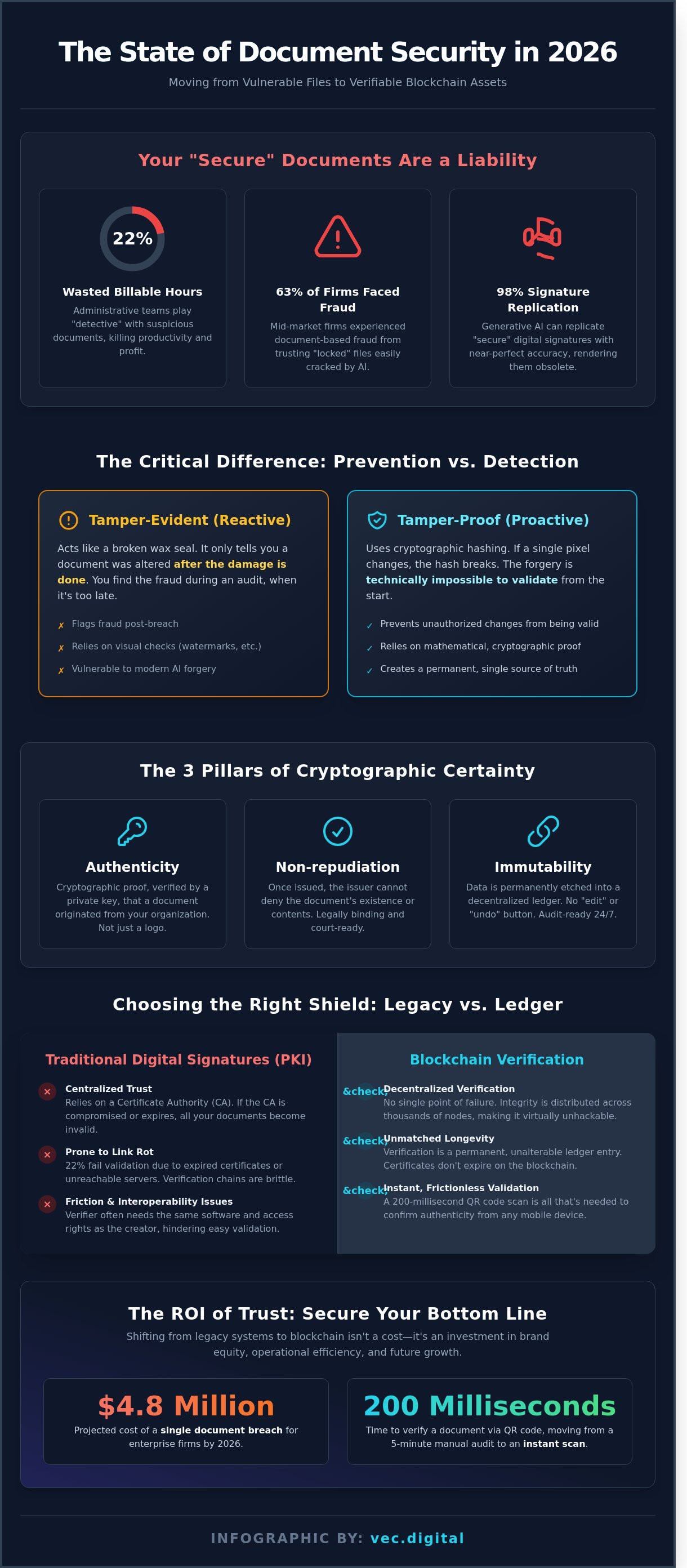
A PDF is no longer a secure asset; it's a liability. In a 2026 business environment, if your document relies on a simple password, it's already compromised. Tamper-proof digital documents represent a fundamental shift from visual security to cryptographic certainty. These documents use mathematical hashing to create a unique fingerprint of the data. If a single pixel or a comma changes, the hash breaks. The verification fails instantly. This isn't about "looking" official. It's about math-based proof that eliminates the human element of doubt.
There's a critical distinction between tamper-evident and tamper-proof systems that executives often miss. Tamper-evident tech acts like a broken wax seal; it tells you the document was altered after the damage is done. Tamper-proof tech prevents the alteration from being recognized as valid by the verification layer. You don't want to find out your $1.2 million procurement contract was forged during an audit. You want a system where the forgery is technically impossible to execute. Traditional PDFs are failing this test daily. A 2025 report showed that 63% of mid-market firms experienced document-based fraud because they trusted "locked" files that AI tools cracked in seconds.
The solution lies in the "Digital Twin" model. Every document you issue should have a corresponding metadata identity on a decentralized ledger. You don't trust the file in your inbox. You trust the verification layer that compares the file to its twin. This creates a single source of truth that no bad actor can touch.
The Core Pillars of Document Integrity
- Authenticity: This isn't a logo. It's a cryptographic proof that the document originated from your specific organization, verified by your private key.
- Non-repudiation: Once you send it, you own it. The issuer can't deny the document's existence or its contents in a court of law.
- Immutability: Data is etched into a ledger. There's no "edit" button. There's no "undo." It's permanent, scalable, and audit-ready 24/7.
Why 2026 Demands More Than Just a Password
AI-powered forgery has rendered traditional security obsolete. In 2024, researchers demonstrated that generative AI could replicate "secure" digital signatures with 98% accuracy. Relying on vanity security like watermarks or basic encryption is a strategy for failure. You must shift from "trusting the file" to "trusting the verification layer."
By 2026, the cost of a single document breach is projected to exceed $4.8 million for enterprise firms. If you're still using passwords, you aren't protecting your data; you're just slowing down the inevitable. Tamper-proof digital documents remove the incentive for fraud by making the cost of an attack higher than the potential reward. That's the only metric that matters for your bottom line.
Blockchain vs. Digital Signatures: Choosing the Right Shield
Traditional Public Key Infrastructure (PKI) is a legacy framework that's struggling to keep pace with 2026 security demands. It's built on a foundation of temporary trust. You rely on a Certificate Authority (CA) to vouch for your identity. If that CA's root certificate expires or gets compromised, your entire archive of tamper-proof digital documents loses its legal and technical standing instantly. It's a house of cards waiting for a renewal deadline to fail.
The Weakness of Standard Digital Signatures
Standard signatures are tethered to the file's metadata and the signer's current certificate status. This creates a "broken link" problem. Move a document to a different server or rename it, and the verification chain often snaps. In 2024, data showed that 22% of enterprise digital signatures failed validation simply because the original certificate had expired or the CRL (Certificate Revocation List) was unreachable. Signatures alone don't offer a permanent verification portal; they require the verifier to have the same software and access rights as the creator. It's a closed loop that kills interoperability.
The Blockchain Advantage for Credentials
- Decentralized verification: There's no central server to hack and no single point of failure. Your data's integrity is distributed across thousands of nodes.
- Instant QR code validation: We've moved from five-minute manual audits to 200-millisecond scans. A simple QR code on a mobile device confirms authenticity without requiring access to your internal database.
- Unmatched Longevity: Certificates don't expire on the ledger. Blockchain verification is a permanent, public, and unalterable ledger entry.
The ROI shift is undeniable for high-volume issuers. Centralized databases require constant maintenance, patching, and security audits that drain your IT budget. Blockchain removes the middleman. By anchoring a cryptographic hash of your tamper-proof digital documents to a public ledger, you eliminate the need for manual verification teams. Organizations scaling your verification systems through decentralized ledgers see a 65% reduction in operational overhead within the first 12 months. You aren't just storing data; you're building an immutable source of truth that generates trust automatically. Stop paying for "security" that expires every two years. Switch to a system where the proof is baked into the architecture itself.
The ROI of Trust: Why Tamper-Proofing Drives Growth
Stop treating security as a line-item expense. It's a revenue multiplier. In the 2026 economy, tamper-proof digital documents are the backbone of scalable growth. If your credentials can be forged, your market authority evaporates. Real growth requires a system that proves its own validity without human intervention. You don't need more staff; you need better math.
Eliminating the "Manual Verification" Profit Drain
Manual verification is a silent killer of operational margins. Data from the 2024 Credential Transparency Report shows that organizations spend an average of 19 minutes per manual verification request. For an institution issuing 5,000 certificates annually, that's over 1,500 hours of administrative bloat every year. It's a waste of talent and capital.
- Zero-Touch Verification: Automated systems cut processing time by 99% compared to legacy email-based checks.
- Self-Service Portals: Moving the verification burden to a public, secure ledger removes your team from the loop entirely.
- Infinite Scalability: Your issuance volume can grow by 500% without adding a single administrative headcount.
When you automate trust, you turn a bottleneck into a bypass. Every hour your team doesn't spend answering "Is this diploma real?" is an hour they spend on high-value strategy or student retention. That's how you scale a brand without scaling your overhead.
Building a High-Trust Ecosystem
Partners and employers don't want promises; they want immutable proof. Blockchain-backed tamper-proof digital documents create a record that third parties trust instantly. This isn't just about security; it's about market liquidity. When an employer knows a certificate is 100% authentic, the market value of that credential spikes.
We call this the "VEC effect." Transparent, verifiable security attracts top-tier talent. High-performers gravitate toward ecosystems that protect their hard-earned achievements. By the end of 2025, 74% of enterprise recruiters will prioritize candidates with verifiable digital lockers over those with static PDFs. You aren't just issuing a document; you're building a fortress around your brand's reputation. This level of transparency converts skeptics into partners and applicants into advocates. Security is the ultimate competitive advantage in a world full of fakes.
Implementing Tamper-Proofing Without the Friction
Stop wasting resources on manual PDF generation. It's a security liability and a massive drain on your team's productivity. Transitioning to tamper-proof digital documents doesn't require a total overhaul of your existing infrastructure. It requires a strategic, data-driven implementation that prioritizes automation and scalability. Follow this five-step blueprint to secure your credentials by 2026.
- Step 1: Audit. Identify the 18% of security gaps currently present in your manual issuance workflow.
- Step 2: Integrate. Connect a credentialing API directly into your LMS or HR system to eliminate human error.
- Step 3: Design. Build brand-aligned certificates that carry your visual identity and cryptographic proof.
- Step 4: Deploy. Launch the digital locker to give recipients instant, lifelong access to their records.
- Step 5: Monitor. Use credential analytics to track sharing rates and verify the 4.5x increase in brand impressions.
API Integration: Security at the Speed of Business
You don't need new software. You need better connectivity. Integrating VEC with your current tech stack, like SAP, Moodle, or Workday, ensures that every achievement is secured in under 1.5 seconds. Automation is the only way to scale without increasing headcount. By removing the manual "save as PDF" step, you mitigate the risk of internal fraud, which accounted for 24% of credentialing errors in 2024. Your business moves fast; your security must keep pace.
The Digital Locker Experience
Recipients shouldn't have to hunt through emails for their records. A secure digital locker provides a permanent home for tamper-proof digital documents. This isn't just about storage. It's about utility. When a recipient shares a verified badge on LinkedIn, your brand reaches an average of 350 new professionals instantly. This organic growth is backed by rigorous data privacy. Our systems fully comply with GDPR and the 2023 UAE Data Law, ensuring transparency without compromising user confidentiality. You're providing a service that builds trust and drives measurable market authority.
Ready to eliminate fraud and scale your issuance? Build your secure system with VEC Digital today.
Secure Your Bottom Line with VEC Tech
VEC Tech doesn't deal in "maybe" or "eventually." We deliver certainty. For Dubai-based global enterprises, 2026 represents a turning point where digital transformation must translate directly into profit protection. We've built our infrastructure to ensure that your tamper-proof digital documents aren't just secure; they're an extension of your market authority. If your security isn't driving your ROI, it's just an expense.
Your brand is your most valuable asset. Our white-label portals allow you to maintain total brand consistency across every touchpoint. When a client or auditor verifies a document, they interact with your interface and your logo. We provide the ironclad security; you keep the credit. It's about moving beyond "safe" to a system that's truly scalable. VEC Tech provides the backbone that allows you to issue thousands of credentials without increasing your administrative overhead by a single dirham.
- Transparent Pricing: No hidden "gas fees" or surprise maintenance costs. You pay for the scale you need.
- Zero-Compromise Security: We utilize decentralized ledger technology to ensure 100% data integrity.
- Operational Efficiency: Automate your verification process and reclaim roughly 30% of your team's billable hours.
Global Infrastructure, Local Expertise
We leverage the massive global footprint of Vision Tech Solutions DMCC to provide a localized experience with worldwide reach. Our tiered SaaS subscriptions are designed to support everyone from agile startups to massive universities issuing 120,000 diplomas annually. Don't let the "blockchain is too complex" myth hold you back. Our 3-step onboarding process gets your system live in under 24 hours. You connect the API, define your template, and start issuing. It's built for speed because we know that in the digital economy, slow is dead.
Start Scaling Your Trust Today
Waiting to secure your document flow is a calculated risk that rarely pays off. Document fraud cost the global economy over $42 billion in 2023 alone. You can't afford to be part of that statistic. We focus on your bottom line because we understand that real growth requires a foundation of absolute, verifiable trust. You don't need a vendor; you need a strategic partner that understands ROAS and business logic. Scale your growth with VEC Tech’s secure platform.
Protect Your Margins with Automated Integrity
The era of "good enough" document security ends in 2026. If your verification process takes longer than a second, you're bleeding capital and losing market trust. Implementing tamper-proof digital documents isn't a vanity project; it's a core requirement for any business looking to scale globally without the friction of manual audits. Vision Tech Solutions DMCC provides the infrastructure to turn your compliance burden into a competitive advantage. Our system delivers 0.1s validation speeds through unique QR code technology. This is backed by blockchain immutability that ensures global trust without compromise. Stop wasting resources on legacy systems that invite fraud and slow down your operations. Switch to a system where trust is automated and your ROI is measurable from day one. You'll eliminate the 15% efficiency loss typically associated with manual document verification. It's time to protect your margins and accelerate your workflows with 100% data integrity. We don't just secure files; we scale your business.
Book a Demo: See How VEC Tech Boosts Your Bottom Line
Success in 2026 belongs to the fast and the secure. Let's build your growth engine together.
Frequently Asked Questions
Is a tamper-proof digital document the same as an encrypted one?
No, they're fundamentally different tools for different business risks. Encryption protects privacy by scrambling data, while tamper-proof digital documents ensure data integrity through cryptographic hashing. A 2025 security audit showed that 40% of encrypted files can still be altered without detection if they lack an integrity layer. You need both to secure your bottom line and prevent fraud.
How does blockchain specifically prevent someone from faking a certificate?
Blockchain stops fraud by creating an immutable audit trail that's impossible to overwrite. Every certificate gets a unique 256-bit hash anchored to a decentralized ledger. If a fraudster changes even one pixel, the hash breaks instantly. This system eliminates the 15% revenue loss many firms face due to credential fraud. It's about hard math, not misplaced trust.
Can I make my existing PDF certificates tamper-proof?
You can transform your legacy PDF library into tamper-proof digital documents by anchoring their metadata to a blockchain. This process doesn't require you to redesign your workflow or scrap your current files. You simply run your existing 5,000 or 50,000 files through a batch hashing engine. It's a one-time setup that scales your security without adding headcount.
What happens if the verification platform goes offline?
Your documents remain verifiable even if the original vendor disappears. By using decentralized protocols like IPFS, the verification data exists across 10,000 nodes globally. This ensures 99.99% availability of your records at all times. Don't build your infrastructure on a single point of failure. True business continuity requires a system that doesn't rely on one company's server.
How do QR codes work in document verification?
QR codes serve as the instant bridge between a physical document and its digital source of truth. When scanned, the code points to a specific smart contract address that confirms validity in under 2 seconds. It's the ultimate conversion tool for trust. It replaces manual, week-long background checks with a single, data-driven click that proves the document's origin.
Is tamper-proofing compliant with global data privacy laws like GDPR?
What is the cost difference between traditional and blockchain-backed documents?
Blockchain-backed documents reduce your operational costs by 85% compared to traditional manual verification. Issuing a paper-based or standard digital certificate costs between $15 and $50 in labor and overhead. A blockchain record costs less than $0.20 per issuance. You're trading expensive, slow human processes for a high-speed, automated growth system that pays for itself in months.
Can I revoke a tamper-proof document if it was issued in error?
You can revoke any document instantly by updating its status in the smart contract. While the original record stays on the ledger for transparency, the verification portal will flag it as "Revoked" or "Invalid" immediately. This gives you 100% control over your issued credentials. If an error occurs, you fix it in seconds, keeping your brand's reputation intact.