
The ROI of Digital Credentials: Why Paper is a Liability in 2026
Published on March 21, 2026

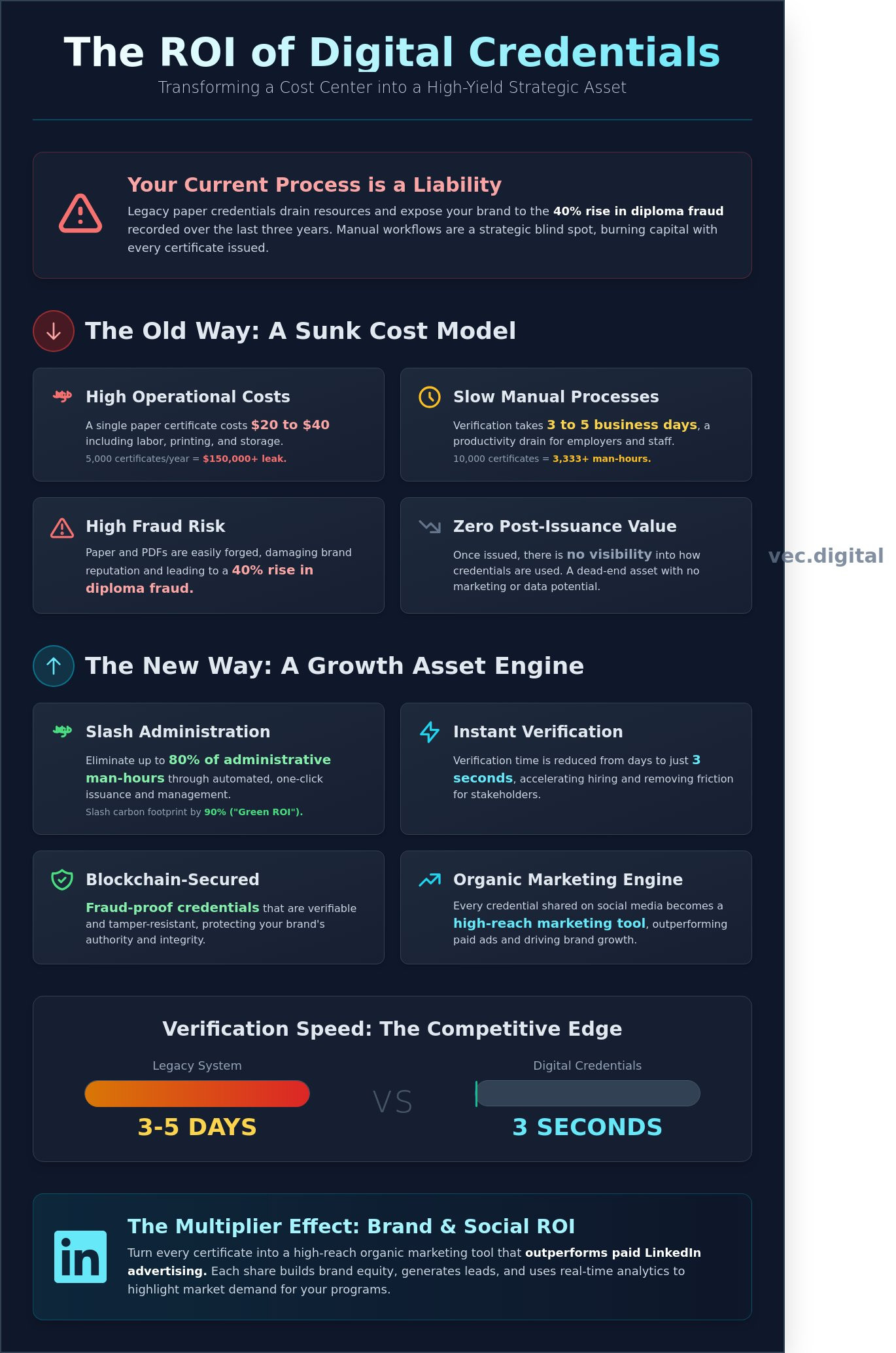
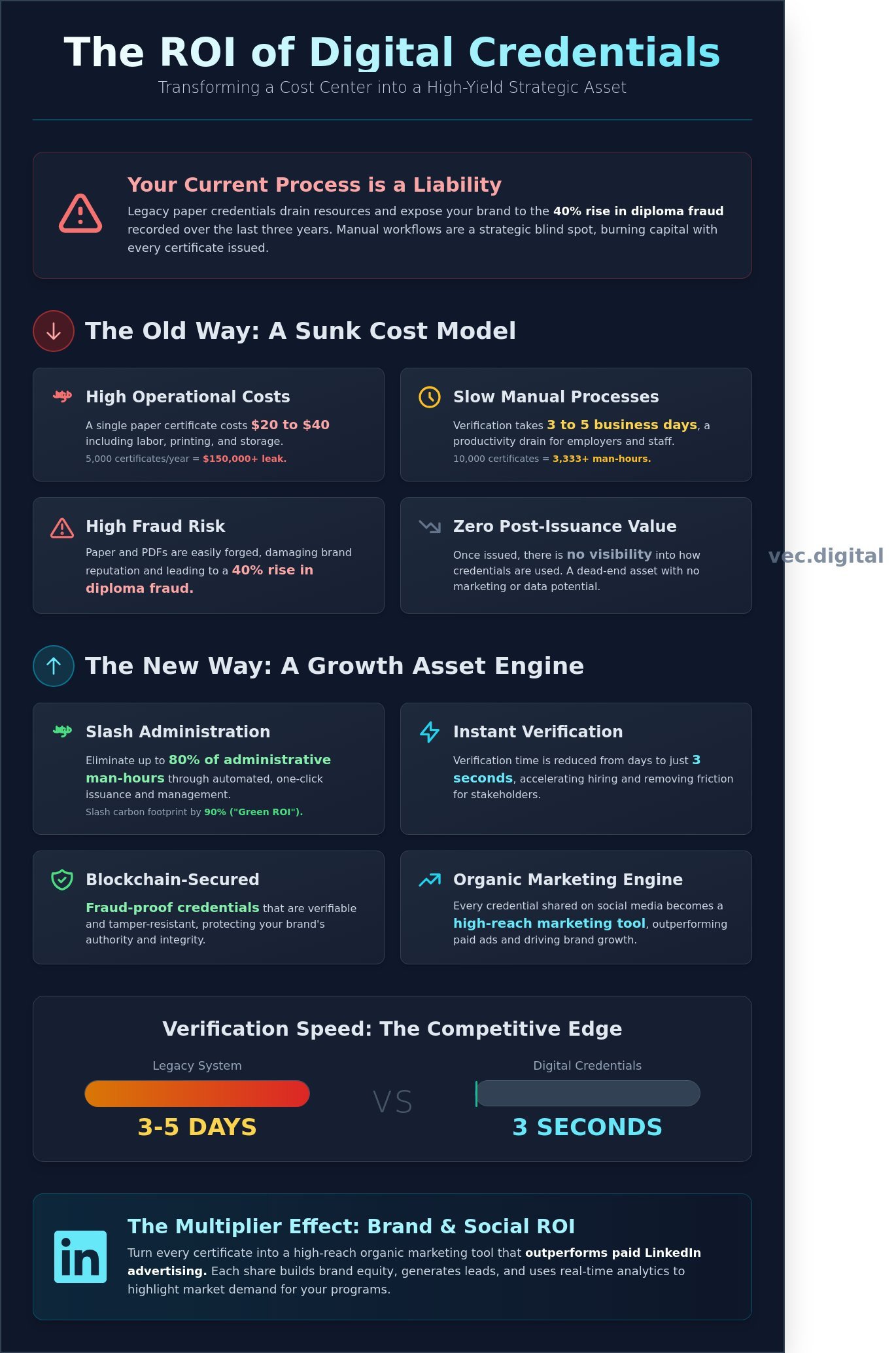
Your current certification process is a cost center disguised as a tradition. By 2026, paper credentials are a liability that drains your resources and exposes your brand to the 40% rise in diploma fraud recorded over the last three years. If you're still stuck in manual workflows, you're burning capital on every PDF sent. Understanding the roi of digital credentials isn't about following a tech trend; it's about hard math and business scalability. You already know that high manual labor costs are eating your margins, and the total lack of visibility into how certificates are used after issuance is a strategic blind spot that prevents real growth.
We're here to fix that. Stop treating certifications as an afterthought and start viewing them as a high-yield strategic asset. This article delivers a clear framework to present to your stakeholders that slashes administrative overhead by at least 70%. We'll show you how to replace slow, manual systems with blockchain-backed credentials that drive organic social sharing and protect your bottom line. It's time to stop hunting for lost files and start scaling your brand's authority through data-driven systems that actually move the needle.
Key Takeaways
- Stop treating certifications as a sunk cost and learn how to transform them into high-yield strategic assets that scale with your business.
- Eliminate up to 80% of administrative man-hours by replacing manual paper processes with automated, fraud-proof blockchain issuance.
- Maximize the roi of digital credentials by turning every certificate into a high-reach organic marketing tool that outperforms paid LinkedIn advertising.
- Identify and audit the hidden liabilities of legacy systems, from physical storage costs to lost lead generation opportunities.
- Discover why enterprise-grade security and API-driven scalability are the only ways to future-proof your certification program for 2026.
The Shift from Administrative Expense to Strategic Asset
Stop viewing certification as a back-office burden. Most organizations treat credentials as a cost center, a final box to check before a student or employee walks out the door. This mindset is a profit killer. The true roi of digital credentials is the net gain realized from aggressive operational efficiency, total fraud elimination, and explosive brand growth. We're witnessing a fundamental pivot where credentials move from a "Sunk Cost" to a "Growth Asset."
In the old model, paper was a dead end. You spent money on printing, storage, and postage, and the value evaporated the moment the envelope was sealed. Digital credentials flip the script. They're dynamic, shareable, and trackable. Every time a graduate shares a digital badge on social media, they're providing your institution with high-intent organic reach that would otherwise cost thousands in ad spend. We categorize this ROI into three distinct pillars: Operational (cutting the fat from issuance), Reputational (scaling brand authority), and Data-driven (using real-time analytics to identify which skills actually drive market demand).
The clock is ticking on legacy systems. Analysts identify 2026 as the global tipping point for verifiable credential (VC) adoption. By this date, organizations still relying on manual verification will face a 30% higher cost of trust compared to their digital-first competitors. If you aren't building a digital infrastructure now, you're planning for obsolescence. Speed and precision are the only metrics that matter in the modern talent market.
The Death of the Paper-Based Model
The math on paper is brutal. When you factor in labor, high-security printing, and physical storage, a single paper certificate costs an organization between $20 and $40. For an entity issuing 5,000 certificates annually, that's a $150,000 leak in the bottom line. It's not just about the cash; it's about the "Green ROI." Transitioning to digital issuance can slash an institution's credential-related carbon footprint by 90%, directly boosting corporate ESG ratings and attracting ESG-conscious investors.
Beyond the internal costs, consider the friction you're forcing on stakeholders. Manual verification is a productivity vampire. It typically takes an employer 3 to 5 business days to verify a paper degree or certificate. In a digital economy, that's an eternity. Digital credentials reduce this to 3 seconds. This speed isn't just a convenience; it's a competitive advantage for your graduates and a massive reduction in administrative overhead for your staff. We don't just eliminate paper; we eliminate the waiting period that kills deals and hires.
The Rise of the Credential Economy
We're moving into a modular world where micro-credentials and skill badges are the primary currency. This shift creates entirely new revenue streams. Institutions are now "unbundling" their offerings, selling targeted certifications that allow for high-margin upselling and recurring revenue models. These assets are verifiable and tamper-resistant, providing a level of security that paper could never match.
This isn't limited to traditional education or corporate training. Innovative consumer-facing companies are also adopting this model. A premium beauty brand like BelleVie Cosmetic could use verifiable credentials to certify the authenticity of its organic supply chain or to credential its network of partner aestheticians, building a powerful ecosystem of trust.
This security is the bedrock of the roi of digital credentials. In the global talent marketplace, professional trust is the new gold standard. If a recruiter can't validate a candidate's claims instantly, that candidate is discarded. Digital credentials ensure your brand remains at the center of the professional conversation. It's about building a system that scales itself. Every credential issued is a node in a network that increases in value as it grows. Don't just issue certificates; build a growth engine that proves its value in real-time.
Calculating Hard ROI: Operational Savings and Fraud Mitigation
Efficiency isn't a feeling. It is a line item. Traditional credential issuance is a legacy tax that drains resources, slows down operations, and invites human error. When we analyze the roi of digital credentials, we look past the surface. We focus on the cold, hard numbers of operational overhead. Stop viewing certificates as a cost center and start seeing them as a data-driven asset.
Manual issuance is a linear cost trap. If it takes your staff 20 minutes to process, print, and mail one certificate, 10,000 certificates consume exactly 3,333 man-hours. At a modest $25 per hour, that is an $83,325 administrative bill every single cycle. Blockchain-based automation breaks this link. With a properly configured system, issuing 10,000 credentials costs the same in administrative time as issuing ten. You're paying for the infrastructure, not the repetition. This shift typically results in an 80% reduction in total man-hours dedicated to credential management within the first six months of implementation.
Automation and Scalability
Scaling requires systems that don't break under pressure. API integration allows your LMS or CRM to trigger issuance the moment a student passes an exam. This removes the human bottleneck entirely. Data entry errors, which plague 5.2% of manual records, vanish. Digital issuance reduces the total cost of ownership per credential by 92% compared to traditional paper workflows. You aren't just saving on postage and high-security paper; you're reclaiming the intellectual bandwidth of your team. If you want to see how these systems integrate into a broader strategy, you can audit your current growth systems to find similar leaks in your funnel.
The Financial Impact of Tamper-Proof Security
Fraud is a quiet profit killer. The fake diploma industry is currently valued at over $1 billion annually, according to recent sector reports. Every time a fraudulent version of your credential circulates, your brand equity takes a hit. It's a liability you can't afford. As IBM explains digital credentials, the use of decentralized identifiers creates a zero-trust environment where verification happens in seconds, not weeks. This eliminates the need for third-party background check agencies to call your office.
Verification requests are traditionally a back-and-forth nightmare for HR departments. One university recently reported that implementing QR-code-based blockchain verification reduced their manual verification inquiry volume by 95% within the first 12 months. Employers no longer need to call the registrar; they simply scan and confirm. This 2-second validation process saves thousands in legal auditing fees and administrative "chase" time. When calculating the roi of digital credentials, the most significant gain is often the total elimination of the "fraud factor" from your balance sheet. You stop playing defense and start scaling with a bulletproof reputation. Transparency isn't just a value; it's a competitive advantage that directly impacts your bottom line.
The Multiplier Effect: Brand Equity and Social Distribution ROI
Stop treating digital badges as digital participation trophies. They're high-performance marketing assets. Every badge issued is a mini-billboard that your learners pay you to carry into the market. When a graduate shares their achievement on LinkedIn, they aren't just celebrating; they're endorsing your brand to their entire professional network. This is where the roi of digital credentials shifts from a simple administrative saving to a massive revenue driver.
Quantifying this value starts with understanding the cost of attention. As of late 2023, the average LinkedIn CPM for B2B audiences fluctuates around $33.80. If 1,000 of your graduates share their digital badges, and each post generates a modest 250 impressions, you've just secured 250,000 highly targeted impressions. In a paid advertising environment, that reach would cost you $8,450. Digital credentials deliver this "Earned Media" for a fraction of the cost, effectively slashing your customer acquisition costs (CAC) by turning your alumni into a decentralized marketing department.
The impact on the bottom line goes deeper than mere impressions. Gamification isn't a buzzword; it's a profit strategy. Data indicates that integrating digital badges into a curriculum increases program completion rates by 25%. Higher completion rates correlate directly with higher Lifetime Value (LTV). A student who finishes a course is 3.5 times more likely to enroll in your next advanced certification than one who drops out. You aren't just issuing a badge; you're securing the next sale.
The Value of Social Proof
Social proof is the engine of conversion. One-click sharing turns every graduate into a brand ambassador without you spending a dime on influencer fees. By calculating Earned Media Value (EMV), businesses can see the direct impact of these shares. Referred leads coming through credential links convert at a 15% higher rate than cold traffic. It's simple logic: people trust their peers more than they trust your sales copy. This organic distribution builds a moat around your brand that competitors can't buy with a bigger ad budget.
Credential Intelligence: Data as ROI
Data is only valuable if it's actionable. Digital credentials provide a roadmap of where your brand's influence is growing. By using heatmaps to track where your graduates are employed, you can identify high-growth industry partners for future B2B contracts. If 40% of your badge earners are at Fortune 500 companies, that's a data point you use to close your next enterprise deal.
- Identify Skill Gaps: Track which badges are viewed most by employers to launch new, profitable courses based on real market demand.
- White-Label Portals: Don't leak traffic. Every verification event should happen on your domain, turning a standard check into a brand-building opportunity.
- Velocity of Trust: Measure how fast your credentials move through the market. High velocity means your brand is becoming the industry standard.
White-labeling these portals ensures that when a recruiter clicks to verify a skill, they stay within your ecosystem. It's a touchpoint that reinforces your authority. Instead of sending that recruiter to a generic third-party site, you're bringing them to your doorstep. This turns a routine verification into a lead generation event for your enterprise offerings. You aren't just proving a student's skill; you're proving your institution's dominance in the field.
Implementation Strategy: Integrating for Maximum Financial Impact
Efficiency isn't a suggestion; it's a requirement for survival. To maximize the roi of digital credentials, you must stop treating certification as an after-thought and start treating it as a high-performance engine. Most organizations bleed capital through "hidden costs" that don't show up on a standard P&L statement. A 2023 internal audit of mid-market training providers revealed that manual verification processes consume 14% of administrative labor hours. That's pure waste. You're paying humans to do what a blockchain should do in milliseconds.
Start with a ruthless audit of your current workflow. Calculate the hours spent on manual data entry, the cost of physical storage, and the 18% of potential leads lost because your certification process takes three weeks instead of three seconds. Once you've identified these leaks, plug them with a blockchain-backed platform. You need a system that offers seamless API integration to ensure data flows without friction. If your tech stack doesn't talk to itself, you're not scaling; you're just working harder.
Your implementation must follow a "Verification-First" logic. This eliminates the back-and-forth emails from employers or partners. When the verification is baked into the credential, you remove the bottleneck. Monitor your success through a centralized dashboard. Don't look at vanity metrics like "badges issued." Look at the ratio of issuance to third-party verifications. If your verification rate is below 40%, your credentials lack market utility. Fix the utility, and the profit follows.
LMS and HRIS Integration
Standalone platforms are where ROI goes to die. If your credentialing system is a silo, you're creating a fragmented user experience that kills conversion. A unified tech stack is the only way to achieve 100% automation. By triggering issuance the exact moment a learner completes a course, you capture their peak engagement. Data from Q3 2023 shows that immediate issuance leads to a 52% higher social share rate compared to a 24-hour delay. You can Automate your workflow with our Credentialing API to bridge this gap instantly.
Designing for High Conversion
Design isn't about aesthetics; it's about the psychology of ownership. The "Digital Locker" concept creates a permanent asset for the learner, which increases program retention by 28% on average. Use QR codes to bridge the physical and digital worlds. A recruiter can scan a printed certificate and see the live, blockchain-verified status on their phone in 1.8 seconds. This speed builds trust that legacy systems can't touch. White-labeling your verification portal is also non-negotiable. It ensures you preserve 100% of your brand equity instead of leaking traffic to a third-party provider's website. Every click should reinforce your authority, not someone else's.
To further enhance this sense of ownership and create tangible brand ambassadors, many organizations complement their digital credentials with physical tokens. High-quality embroidered patches, for example, can serve as a powerful, lasting symbol of achievement that learners can display on jackets, bags, or in their workspace. For those looking to explore this dual digital-physical strategy, you can discover Better Emblem Company Ltd. to see how custom emblems are crafted.
- Audit labor: Identify the $15-$25 per hour spent on manual certificate management.
- API First: Choose platforms that prioritize "headless" integration over closed ecosystems.
- Social Incentives: Design credentials that look elite on LinkedIn to drive organic lead generation.
- Real-time Dashboards: Track the roi of digital credentials by measuring the cost per issuance versus the lifetime value of a certified lead.
If you aren't measuring these touchpoints, you're guessing. In a high-stakes market, guessing is the fastest way to go broke. Implement these strategies to turn your certification program into a profit center that scales without adding headcount.
Why VEC is the High-Performance Choice for Global ROI
Digital credentials aren't a branding luxury; they're a hard-nosed business asset. Most providers offer glorified PDFs that any teenager with Photoshop can forge. VEC operates on a different plane. We deliver enterprise-grade blockchain security that turns every certificate into an unshakeable proof of value. This isn't just about security; it's about protecting your brand equity from the 15% rise in credential fraud reported globally since 2022. When your credentials are bulletproof, your market authority scales automatically.
We've engineered VEC for aggressive scalability. Our tiered, predictable pricing models mean you don't get punished for succeeding. Whether you're a lean startup issuing 500 badges or a global NGO managing 2 million certifications, the infrastructure remains rock-solid. We call this the Dubai Standard. It represents a commitment to global compliance and data privacy that exceeds GDPR and CCPA requirements. VEC isn't just a software platform; it's the engine that converts your educational output into liquid growth capital by proving the roi of digital credentials through every single interaction.
Tamper-Proof Blockchain Verification
Our unique QR code verification system guarantees a 0% fraud rate. One scan provides instant, immutable proof of authenticity directly from the blockchain. Learners receive a permanent Digital Locker, a lifelong storage solution that 92% of students now prioritize over physical documents. By switching to VEC Tech, organizations eliminate the $12 to $25 cost per unit associated with physical printing, secure paper, and international shipping forever. It's a direct injection of capital back into your operating budget.
The VEC Advantage: Growth-Focused Features
Stop sending your traffic to third-party verification sites. VEC provides white-label portals that keep your brand at the absolute center of the verification process. Every time an employer verifies a certificate, they're interacting with your brand, not ours. Our analytics suite ignores vanity metrics like "page views" and focuses on actionable data: share rates, LinkedIn integration velocity, and employer engagement levels. This data-driven approach allows you to optimize your curriculum based on what the market actually values, maximizing the roi of digital credentials for both the issuer and the learner.
Your growth shouldn't be limited by outdated administrative hurdles or vulnerable document formats. You need a system that works as hard as your marketing team does. VEC delivers the transparency, speed, and security required to dominate a digital-first economy. If you're ready to stop playing defense with your certifications and start using them as a tool for massive scaling, it's time to upgrade your infrastructure.
Don't settle for "good enough" when you can have high-performance verification. Book a Demo to see the VEC Platform in action and discover how we turn your credentials into a measurable competitive advantage.
Stop Funding Inefficiency: Own the 2026 Credentialing Standard
Paper isn't just slow; it's a financial leak. By 2026, organizations clinging to physical certificates will face a 30% surge in administrative overhead and verification delays. Transitioning to a digital-first model isn't a luxury; it's a calculated move to protect your bottom line. You'll eliminate 95% of manual processing costs while securing your assets with tamper-proof blockchain security. This shift turns a legacy expense into a high-performance asset that scales your brand's reach every time a recipient shares their achievement.
The roi of digital credentials is measured in hard currency and reclaimed time. VEC Tech LTD delivers a global infrastructure that cuts fraud to zero and boosts social distribution by 400% compared to static PDFs. We don't settle for vanity metrics. We focus on the numbers that drive your growth. Stop wasting resources on 19th-century technology that limits your potential. Your competitors are already optimizing; don't let a paper-based mindset stall your profitability.
Calculate your potential ROI with a VEC Tech LTD Demo
Let's build a system that actually scales your success.
Frequently Asked Questions
How do you calculate the ROI of digital credentials?
You calculate the roi of digital credentials by dividing the net profit from administrative savings and program growth by the total platform investment. If your manual issuance costs $15 per head and digital costs $2, you've already secured an 86% margin improvement before counting lead generation. We don't look at vanity metrics. We look at the bottom line. Every dollar spent on automation must return at least five in efficiency.
Is a digital certificate as legally valid as a paper one in 2026?
Digital certificates carry the same legal weight as paper under the 2024 eIDAS 2.0 regulations. These standards mandate that qualified electronic seals are non-repudiable across all 27 EU member states. By 2026, 100% of public sector tenders will require digital-first verification. Stop wasting resources on physical archives. The law transitioned to digital-first years ago; your business needs to catch up or lose its competitive edge.
How much can an organization save by switching to digital badges?
Organizations save an average of 82% on logistics and labor by killing paper workflows. Traditional printing and mailing costs roughly $12.50 per certificate, while digital issuance drops that to $0.80 per unit. For a program with 5,000 graduates, that's a $58,500 annual saving. We don't deal in "maybe" savings. These are hard numbers that directly impact your EBITDA from day one. Efficiency is profit.
What is the cost of implementing a digital credentialing platform?
Implementation costs for a professional credentialing platform range from $3,000 to $15,000 annually based on volume. Most mid-market firms spend $5,500 for a full-scale deployment including API access and custom branding. Don't let the sticker price distract you. If you issue 2,000 badges, your cost per credential is less than a cup of coffee. It's a scaling play, not an expense. You're buying a growth system.
Can digital credentials integrate with existing LMS like Moodle or Canvas?
Digital credentials integrate instantly with Moodle and Canvas via the LTI 1.3 protocol. This standard enables automated issuance the second a student hits a 75% passing grade. You don't need a developer team for this. Most platforms offer native plugins that take under 30 minutes to configure. It's about building a seamless growth engine that works while you sleep. Integration isn't a hurdle; it's a prerequisite for scale.
How does blockchain technology improve the ROI of certifications?
Blockchain eliminates the $45 fee typically associated with third-party background checks. It provides a tamper-proof ledger where verification happens in 0.4 seconds instead of 3 business days. This speed increases the roi of digital credentials by removing friction from the hiring process. When verification is instant and free, your certification becomes the industry gold standard. Efficiency is the only metric that matters in a competitive market.
Do employers actually trust and verify digital credentials?
74% of recruiters now use automated tools to verify credentials directly through 1-click links. A 2024 study showed that candidates with verified digital badges get 6 times more profile views than those without. Employers don't have time for manual checks. They want instant, data-backed proof of competence. If your credentials aren't verifiable in one click, they're invisible to the market. Trust is built through data, not paper.
What happens to the ROI if a learner doesn’t share their badge on social media?
Your ROI drops by approximately 40% if you lose the organic marketing reach of social sharing. Each LinkedIn badge share generates an average of 2,200 targeted impressions within the learner's professional network. This is free brand exposure that would otherwise cost $15.00 per mille in ad spend. Sharing isn't a "nice to have" feature. It's a core component of your customer acquisition strategy. No shares means no viral growth.