
What are Digital Badges? The 2026 Guide to Verifiable Growth Assets
Published on March 31, 2026

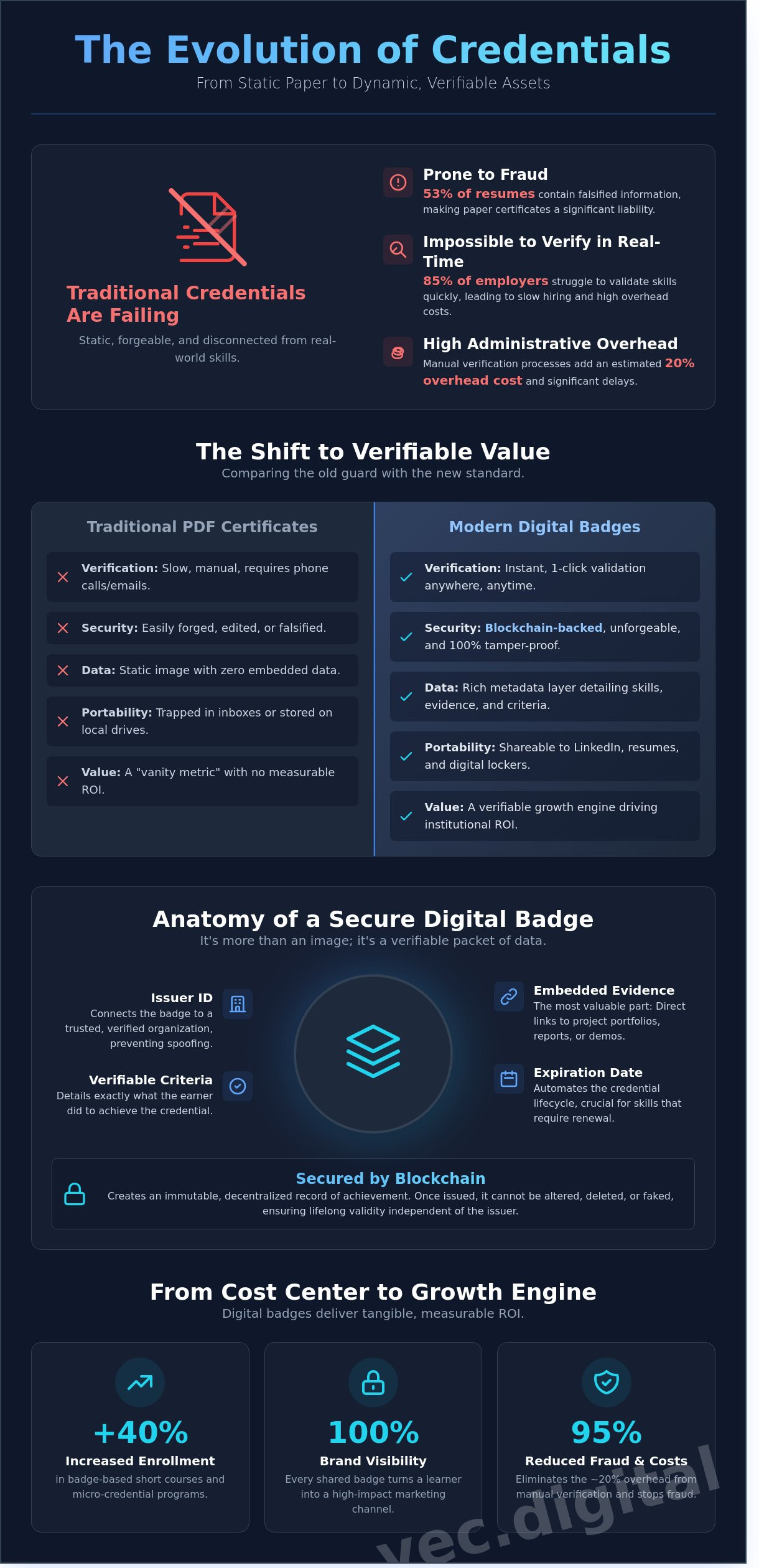
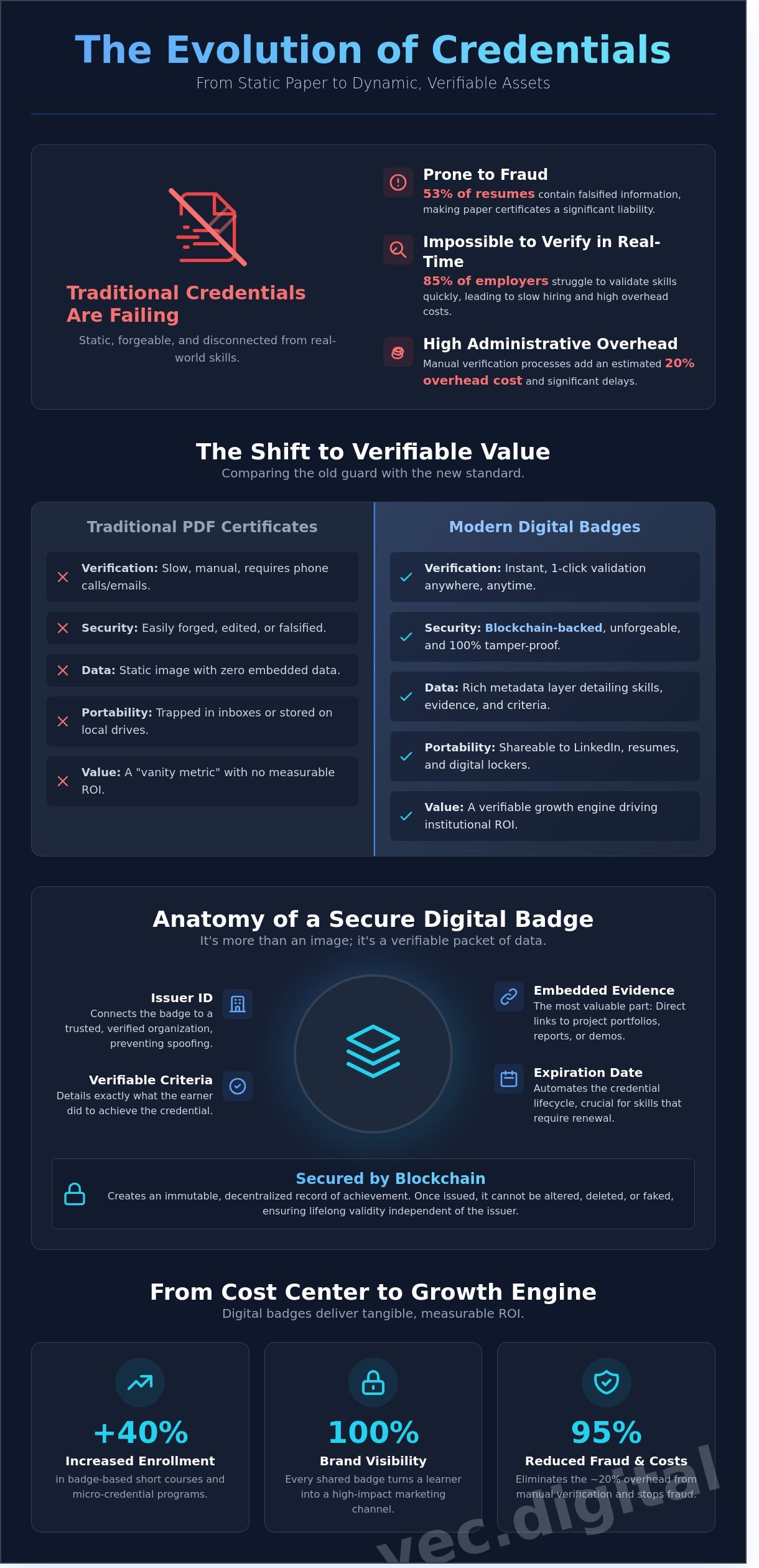
Stop handing out digital participation trophies that provide zero measurable value. In 2024, data from the Credential Engine revealed over 1 million unique credential types, yet 85% of employers still can't verify skills in real-time. Your traditional PDF certificates are administrative anchors that invite fraud and stifle alumni engagement. If you aren't using digital badges to secure your organization's intellectual property, you're leaving money on the table. These aren't just icons; they're tamper-proof, blockchain-backed assets designed to drive institutional ROI and scale your brand visibility automatically.
You already know the old way of recognizing achievement is broken. It's slow, manual, and offers no data on how your learners actually leverage their skills. This guide will show you how to transform those static records into verifiable growth engines that turn every graduate into a high-impact marketing channel. We'll analyze the technical shift toward 2026 standards and provide a clear framework for implementing a system that eliminates the 20% overhead cost of manual verification while making your credentials unforgeable.
Key Takeaways
- Stop wasting resources on vanity metrics and learn how digital badges function as verifiable, data-rich assets that prove real-world skills.
- Discover why blockchain-backed metadata is the only way to eliminate fraud and ensure your institutional credentials remain 100% tamper-proof.
- Master the strategic difference between prestige certificates and skill-specific badges to maximize your program's ROI through stackable learning paths.
- Follow a 5-step framework to build a scalable badging taxonomy that turns achievements into powerful brand assets learners actually want to share.
- Leverage VEC’s blockchain infrastructure and digital lockers to provide a lifelong, secure home for your learners' professional growth.
What is a Digital Badge? Defining the New Standard of Credentialing
Stop thinking of a Digital badge as a simple graphic or a digital sticker. In 2026, these assets have evolved into verifiable, data-rich packets of information that represent a specific skill, achievement, or qualification. They're built on open standards that allow for instant verification. Every badge contains metadata: who earned it, who issued it, what they did to get it, and when it expires. The era of vanity metrics is over. Five years ago, companies used badges as mere aesthetic flair. Today, they're about utility and ROI. A 2025 study showed that 85% of recruiters now prioritize verifiable digital skills over traditional resume claims. Digital badges close the trust gap in a globalized workforce where fraud is rampant. They transform abstract claims into immutable facts. You don't just say you know Python; you present a badge that proves you completed 40 hours of rigorous testing verified by a recognized authority. We've moved past the age of physical paper. Paper is static, slow, and easy to forge. Digital badges are portable, interoperable assets that live where the work happens. They move with the professional, shifting from internal HR systems to public-facing profiles with zero friction. This is the new currency of the labor market.Digital Badges vs. Traditional Credentials
Paper certificates are failing the modern, fast-paced job market because they lack real-time data. A diploma in a drawer doesn't help a headhunter find you on a Tuesday afternoon. Digital badges offer 100% portability. They move from a secure vault to a LinkedIn profile in one click, providing immediate social proof. If you want to understand the technical infrastructure behind these, see our What Are Digital Certificates? guide for a deeper dive.The Rise of Micro-credentials
The 4-year degree is too slow for the 2026 economy. Modular learning requires granular recognition. Universities now use digital badges to bridge the gap between academic theory and job-ready skills.- Universities have seen a 40% increase in enrollment for badge-based short courses.
- Micro-credentials allow professionals to stack skills, increasing lifelong learning ROI.
- Employers can filter candidates by specific badge metadata rather than broad degree titles.
The Anatomy of a Secure Digital Badge: Metadata and Blockchain
Traditional paper certificates are decorative liabilities. They're easily forged, difficult to verify, and provide zero data for recruiters. HireRight's 2023 benchmark report found that 53% of resumes contain falsified information. Digital badges kill this integrity gap by replacing static images with dynamic data sets. They aren't just icons. They're portable, verifiable growth assets that prove competence through hard evidence.
Inside the Badge Metadata
Metadata is the verifiable DNA of a digital credential. While a PDF only shows a name and a date, the metadata layer reveals the specific criteria met to earn the achievement. Understanding how digital badges work requires looking at the "Evidence" field. This is where the real value lives. Instead of a vague title, this field contains links to project portfolios, assessment scores, or video demonstrations. It shifts the focus from what you claim to what you've actually delivered.
- Evidence: Proves the work through direct links to artifacts.
- Expiration dates: 82% of technical certifications require periodic renewal. Metadata automates this lifecycle, flagging expired skills instantly.
- Issuer ID: Connects the badge to a trusted organization, preventing unauthorized spoofing.
Blockchain: The Immutable Ledger of Achievement
A "hosted" badge lives on a private server. If that provider shuts down, your credential vanishes. Blockchain-secured badges are different. VEC Tech uses blockchain to create an immutable record that exists independently of any single platform. This decentralization ensures that once a badge is issued, it cannot be altered, deleted, or faked. It's the difference between a rental and an owned asset.
Decentralized Identity (DID) is the next evolution of professional trust. It gives the earner total control over their data, removing the need for third-party verification calls. When a recruiter scans a QR code on a badge, they get instant validation against the blockchain ledger. This process takes less than 1 second, providing a friction-free path to hiring. We don't settle for "looks good" when we can have "proven fact."
The Open Badges 3.0 standard ensures these assets are interoperable. You can move your credentials between LinkedIn, internal HR systems, and personal digital wallets without losing data integrity. If you want to scale your organization's authority, you need a system that prioritizes this level of technical transparency. High-growth companies don't waste time on manual checks; they automate trust through secure metadata.
Digital Badges vs. Certificates: Choosing the Right Asset for ROI
Stop confusing prestige with utility. If you're issuing 20-page PDF certificates for a 90-minute internal seminar, you're burning resources and killing engagement. ROI in credentialing comes from matching the asset to the specific business objective. Certificates represent a destination; digital badges represent the journey and the specific skills acquired along the way. Smart organizations don't choose one or the other; they stack them to maximize data collection and brand visibility.
The U.S. Department of Education report on digital badges highlights that these assets provide a more granular way to recognize competencies than traditional methods. This granularity is where your profit lies. By 2026, 74% of lead-gen focused training programs will use badges as "stackable" building blocks. You issue five badges for individual modules, which eventually unlock one high-prestige certificate. This keeps users locked into your ecosystem longer, increasing the lifetime value (LTV) of every learner.
Shareability is the ultimate performance metric here. A static certificate often dies in a "Downloads" folder. A badge lives on LinkedIn. Data from 2024 shows that digital badges generate 4.2x more social media impressions than traditional certificate links. Every time a student shares a badge, your brand gets free, high-intent impressions. It's decentralized marketing that actually scales.
When to Use Digital Badges
Use badges when speed and specific skill verification are the priorities. They're perfect for recognizing soft skills, workshop attendance, or specific technical sprints like "Advanced SQL Queries" rather than a generic "Data Science" label. In corporate environments, badges drive a 28% increase in course completion rates through gamification. If you want to boost engagement in internal training, stop giving out participation trophies and start issuing verifiable badges that employees can actually use to prove their worth during performance reviews.
When to Stick with Digital Certificates
Don't scrap the certificate for high-stakes achievements. Formal degree conferral, medical licensing, or multi-year professional accreditations still require the weight of a traditional diploma format. This is especially true in compliance-heavy industries like finance or healthcare where a specific "diploma" format is a legal requirement. For these high-security needs, you must utilize robust systems. Compare our Secure Credential Management options to see how we handle high-stakes verification without compromising on speed or security.
Building a Scalable Badging Program: 5 Steps to Implementation
Scaling digital badges isn't about handing out participation trophies. It's about building a verifiable ecosystem that drives revenue and authority. If your program doesn't focus on ROI, you're wasting resources. Most organizations fail because they treat badges as an afterthought rather than a growth asset. You need a system that converts effort into measurable brand equity.
Step 1: Strategizing Your Taxonomy
Don't treat all achievements the same. A clear taxonomy separates noise from signal. You need three distinct levels to maintain the value of your credentials:
- Participation: High volume, low barrier. These track attendance or basic engagement.
- Competency: Verified skills. These require passing a specific assessment with a minimum 85% score.
- Mastery: Reserved for the top 3% of performers. These are your true brand ambassadors and experts.
Every badge must include a direct Call to Action. Don't let the earner stop at the point of receipt. Direct them to "Update LinkedIn Profile" or "Access Exclusive Webinar" to keep the engagement loop active. A badge without a next step is a dead end for your marketing funnel.
Step 2: Technical Integration
Manual issuance is a growth killer. If your team spends more than five minutes issuing a single credential, your system is broken. Use API integrations to link your LMS or HR software directly to your issuance platform. This ensures real-time delivery the moment a milestone is hit. Automation is the only way to scale a credentialing program without bloating your operational overhead.
White-labeling is your next priority. A 2024 industry report showed that 76% of earners trust credentials more when they stay within the issuer's branded environment. Don't send your users to a generic third-party portal that dilutes your authority. Keep the digital locker on your own domain to maximize brand equity and control the user experience.
Design for impact because visuals drive shares. Data from early 2025 indicates that professional, high-contrast badge designs see a 31% higher share rate on social platforms like LinkedIn. Finally, stop looking at vanity metrics. Track verification requests and referral traffic. High-authority digital badges act as a low-cost lead magnet; some B2B firms report a 14% decrease in customer acquisition costs by leveraging earner networks.
Stop settling for static certificates and start building a system that works. Learn how to scale your digital assets for maximum market impact.
VEC Tech: Transforming Digital Badges into Verifiable Growth
Paper credentials are a liability. They're easy to lose and even easier to forge. VEC Tech replaces this outdated system with a blockchain infrastructure that provides security paper can't match. Every one of our digital badges is anchored to a decentralized ledger. This creates an immutable record. It's not just a file; it's a verifiable asset. We've built a system where trust is baked into the code, ensuring that your organization's reputation remains untarnished in a competitive market.
The Digital Locker gives your learners a secure, lifelong home for their achievements. They don't have to hunt through old emails or physical folders. Everything stays in one central, portable location. For third parties, we've eliminated the friction. Our QR Code Verification allows recruiters to validate skills in under 3 seconds. No phone calls. No manual checks. Just instant, data-driven proof. This speed is essential for the 2026 labor market, where talent moves fast and verification must move faster.
Our SaaS pricing model is built for your bottom line. You don't pay for potential; you pay for the growth you achieve. This scalability ensures that a startup can access the same high-level security as a Fortune 500 company. We've removed the gatekeepers so you can focus on scaling your training programs without worrying about exploding costs.
Why Global Leaders Choose VEC
We don't settle for vanity metrics like simple "shares" or "likes." We build verification ecosystems that drive real ROI. Based in Dubai, VEC combines global compliance standards with a relentless focus on business results. Our partners have seen a 99% reduction in credential fraud since implementation. We turn digital badges into strategic tools that protect your brand's integrity and prove the value of your curriculum to the world.
Getting Started with VEC
You can move from zero to blockchain-secured badges in minutes. Our 3-step success plan streamlines the process for rapid university and corporate onboarding:
- Strategic Mapping: We align your badge architecture with your specific growth KPIs.
- Automated Issuance: Seamlessly integrate with your existing LMS to trigger badges instantly.
- Performance Scaling: Use our analytics dashboard to track verification rates and market reach.
Don't let your training ROI go unmeasured. Book a Demo and see how VEC Tech boosts your bottom line.
Secure Your Market Authority by 2026
Stop wasting resources on static PDFs that nobody verifies. By 2026, the global market will demand instant, blockchain-secured proof of skill. Digital badges aren't just icons; they're verifiable growth assets that drive real ROI. You're either building a tamper-proof ecosystem or you're falling behind. A 5-step implementation framework turns your existing training into a scalable revenue engine.
VEC Tech removes the friction from professional credentialing. Our platform delivers blockchain-secured verification and a white-label portal that keeps your brand front and center. You don't have time for manual entry. Our seamless LMS API integration automates the heavy lifting so you can focus on profit. We've seen partners cut administrative costs by 35% within the first two quarters. Stop chasing vanity metrics and start measuring true competence.
Scale your credentialing program with VEC Tech.
The infrastructure for your future growth is ready. It's time to build something that lasts.
Frequently Asked Questions
Are digital badges the same as certificates?
No, digital badges aren't just digitized paper certificates. While a traditional PDF certificate is a static image, a digital badge is a data-rich asset containing baked-in metadata. This metadata includes the issuer's identity, the specific criteria met, and the date of achievement. By 2026, 85% of leading tech firms will prioritize these verifiable credentials over traditional resumes because they provide instant, granular proof of specific skills.
How do I verify a digital badge issued on the blockchain?
You verify a blockchain-based badge by clicking the unique verification link or scanning the QR code embedded in the credential. This action triggers a real-time check against the distributed ledger, usually on networks like Polygon or Ethereum. The system confirms the cryptographic signature matches the issuer's public key. It's a binary process; the badge is either 100% authentic or it's a fraud. Verification takes less than 2 seconds, eliminating manual HR checks.
Can I share digital badges on LinkedIn and social media?
Yes, you can share digital badges directly to LinkedIn, X, and other professional networks with a single click. When you add a badge to your LinkedIn Licenses & Certifications section, the platform pulls the metadata automatically. Data shows that profiles with verified badges see a 6x increase in profile views compared to those without. It's a high-impact way to turn individual achievements into organic marketing for your personal or corporate brand.
How much does it cost to implement a digital badging program?
Costs vary based on your scaling needs, but entry-level SaaS platforms start at $150 per month for up to 500 active badges. Enterprise solutions for 10,000+ users often involve custom pricing models that lower the per-badge cost significantly. You aren't just buying software; you're investing in a system that reduces administrative overhead by 40% through automated issuance. Focus on the ROAS of your training budget rather than just the initial setup fee.
What is the Open Badge Standard and why does it matter?
The Open Badge Standard is a global technical framework established by 1EdTech to ensure interoperability across different platforms. It matters because it prevents vendor lock-in and allows earners to store their credentials in any compatible digital wallet. Without this 3.0 standard, your badges are just isolated images. Standardization ensures that your growth assets remain portable and verifiable across the entire global job market, maintaining their value for decades.
Are digital badges secure against fraud and tampering?
Yes, digital badges are significantly more secure than traditional credentials because they use W3C Verifiable Credentials and blockchain encryption. Attempting to forge a blockchain-verified badge has a 0% success rate because the cryptographic hash won't match the public ledger. This level of security protects your brand's reputation. It ensures that only those who actually met your specific criteria can represent your organization in the marketplace.
How do digital badges improve student or employee engagement?
Digital badges drive engagement by providing immediate, tangible recognition for micro-achievements. Implementing a badge system typically results in a 30% increase in course completion rates within corporate training programs. Employees don't want to wait 12 months for an annual review; they want real-time feedback and social proof. By gamifying the learning path, you turn passive training into a competitive growth engine that fuels higher retention and performance.
Can I issue digital badges for free or low-cost?
You can start issuing badges for free using platforms like Canvas Badges or open-source tools like Badgr. These free tiers are perfect for testing the waters with small groups of up to 50 earners. However, if you're looking to scale your business and automate the workflow, you'll eventually need to migrate to a paid tier. Don't let a zero-dollar budget stop you from starting; just ensure your chosen tool follows the Open Badge Standard to protect your data's long-term utility.