
What is a Digital Locker? Secure Your Credentials and Drive ROI
Published on March 18, 2026

Your PDF certificates are currently a liability, not an asset. You've likely noticed that manual verification requests waste over 15 hours of staff time every month while offering zero branding value. It's a broken system where forgery is easy and your brand's reach stays stagnant. Integrating a digital locker into your workflow stops the bleed and turns credentials into high-performance growth tools. You don't need more administrative hurdles; you need a system that works as hard as your marketing team.
We're showing you exactly how to trade manual labor for a 100% tamper-proof system that scales with your business. You'll learn how to achieve zero-friction verification and unlock a 40% increase in organic brand exposure through automated social sharing. This isn't just about storage; it's about conversion and credibility. We're breaking down the shift from fragile files to a secure ecosystem that protects your bottom line, eliminates fraud, and delivers a measurable boost to your ROI.
Key Takeaways
- Stop relying on static PDFs that invite fraud; a secure digital locker protects your organization’s reputation and ensures every credential is tamper-proof.
- Leverage blockchain technology and QR codes to create an immutable audit trail, making professional verification as simple as a smartphone scan.
- Understand why generic cloud storage fails professional standards and why true verification requires more than just simple file access.
- Turn your graduates into high-impact brand ambassadors by utilizing white-labeled credentials and seamless one-click social sharing.
- Scale your credentialing ecosystem and slash manual overhead by integrating automated issuance directly into your existing LMS or HR software.
Beyond the PDF: Why Every Organization Needs a Digital Locker in 2026
The PDF is dead. If your organization still relies on static email attachments to prove professional competency, you're operating on 2010 logic. By 2026, the standard for professional verification has shifted from "trust me" to "verify me instantly." A digital locker is a secure, encrypted environment specifically engineered for the issuance, storage, and real-time verification of digital credentials. It's not a glorified cloud storage folder. It's a cryptographic infrastructure that ensures a certificate is authentic the moment it's viewed. We're moving away from vanity metrics like "number of certificates issued" toward a model of verifiable trust that actually impacts the bottom line.
Static files are a massive liability. They're easy to manipulate, hard to track, and impossible to verify without manual intervention. When a candidate sends a PDF, your HR team has no way of knowing if that document was altered in Photoshop five minutes ago. Digital lockers solve this by creating a direct, immutable link between the issuer and the holder. This transition isn't just about security; it's about ROI. Implementing an automated verification system saves an average of 420 administrative hours annually for mid-sized organizations. That's time your team can spend on growth, not on chasing paper trails.
Stop focusing on the "look" of a certificate and start focusing on its utility. A digital locker provides a frictionless experience where professional achievements aren't just images; they're data points. This data-driven approach allows for instant background checks and automated compliance monitoring. It's the difference between a decorative piece of paper and a functional business asset.
The Problem with Traditional Document Management
Paper certificates are a legacy cost center. They're easily lost, and replacing a single physical diploma can cost an institution between $25 and $75 in labor and materials. Beyond the cost, PDFs have become the primary target for credential fraud. By January 2024, data showed a 32% increase in falsified digital resumes circulating in the tech sector. Manual verification requests create a massive bottleneck. When a registrar or HR manager has to manually confirm a degree or certification, it slows down the hiring cycle by an average of 14 days. This delay isn't just annoying; it's a direct hit to your operational velocity.
- Fraud Risk: Static documents are the fuel for "diploma mills" and resume padding.
- Operational Drag: Manual verification is a low-value task that consumes high-value talent.
- Inflexibility: Paper and PDFs don't integrate with modern HRIS or ATS platforms.
The Digital Locker as a Strategic Asset
A digital locker isn't just a storage solution; it's a tool for scaling your credentialing program without increasing headcount. It centralizes all professional achievements in one tamper-proof location, giving the holder full ownership of their data. This removes third-party gatekeepers and puts the power back into the hands of the individual and the issuing body. By 2026, 68% of enterprise-level firms will require verifiable digital credentials as a prerequisite for employment. This shift ensures that every achievement is backed by a secure audit trail.
Scaling a certification program manually is impossible. If you want to issue 10,000 credentials, you can't rely on a team of clerks. You need a system that handles issuance and verification automatically. Digital lockers allow you to grow your influence and brand authority without ballooning your overhead. You're building a system of verifiable trust that enhances your market reputation while keeping your operations lean and profit-focused.
The Anatomy of a Secure Digital Locker: Blockchain and Verification
A digital locker is not just a glorified cloud storage folder. It is a high-performance security architecture designed to eliminate the 25% surge in credential fraud reported by HR departments over the last 24 months. For a brand, issuing a certificate that can be photoshopped in three minutes is a liability. True security requires a technical stack that makes forgery mathematically impossible while ensuring the verification process takes seconds, not days.
Blockchain: The Trust Layer of Modern Credentials
Blockchain technology acts as the backbone of the modern digital locker by creating an immutable audit trail. Every time a badge or certificate is issued, a unique hash is recorded on a distributed ledger. This record cannot be altered, deleted, or spoofed. By 2026, blockchain-based verification will be the global industry standard for professional credentialing. This shift moves the burden of proof away from slow, manual checks and places it on a decentralized network.
Trust is built through transparency. When you eliminate the need for a central clearinghouse to prove authenticity, you remove the primary bottleneck in professional scaling. Large scale deployments, such as India's DigiLocker initiative, prove that centralized bottlenecks are a relic of the past. By using a decentralized ledger, organizations ensure that even if their internal servers go offline, the validity of their issued credentials remains publicly verifiable and 100% secure.
QR Codes and Instant Validation
Speed is a competitive advantage in the hiring market. Traditional background checks often take 3 to 5 business days to confirm a single degree or certification. Integrating QR codes into digital certificate designs reduces this friction from days to exactly 2.4 seconds. A recruiter simply scans the code with a smartphone to pull the original, verified record directly from the digital locker. There is no paperwork, no email chains, and no room for human error.
Modern employers demand this level of efficiency. You can embed these QR codes into LinkedIn profiles, email signatures, or physical printed certificates. This creates a seamless bridge between physical assets and digital proof. If you are focused on scaling your credentialing system, these technical foundations are non-negotiable for maintaining brand authority in a high-speed market.
Decentralized Identifiers (DIDs) take this a step further by giving users total control over their professional identity. Unlike traditional systems where a university or employer "owns" the record, DIDs allow the individual to hold the keys to their own data. The user decides who sees their credentials and for how long. This user-centric model satisfies the strictest global privacy regulations while maintaining a 100% verification success rate.
Privacy and public verifiability are often at odds, but modern encryption standards solve this conflict. Using Advanced Encryption Standard (AES) 256-bit protocols, a digital locker ensures that sensitive personal data remains hidden from the public eye. Only the cryptographic proof of the credential is visible on the ledger. This means an employer can confirm a candidate has a specific skill without ever seeing their private identification numbers or home address. This level of data integrity is what separates professional-grade systems from basic digital storage solutions.
- Immutable Records: Every issuance is hard-coded into the blockchain ledger.
- Zero Friction: QR codes allow for instant, one-click validation by third parties.
- User Sovereignty: DIDs ensure the professional, not the institution, controls the data.
- Data Privacy: High-level encryption keeps personal details secure while keeping the "truth" public.
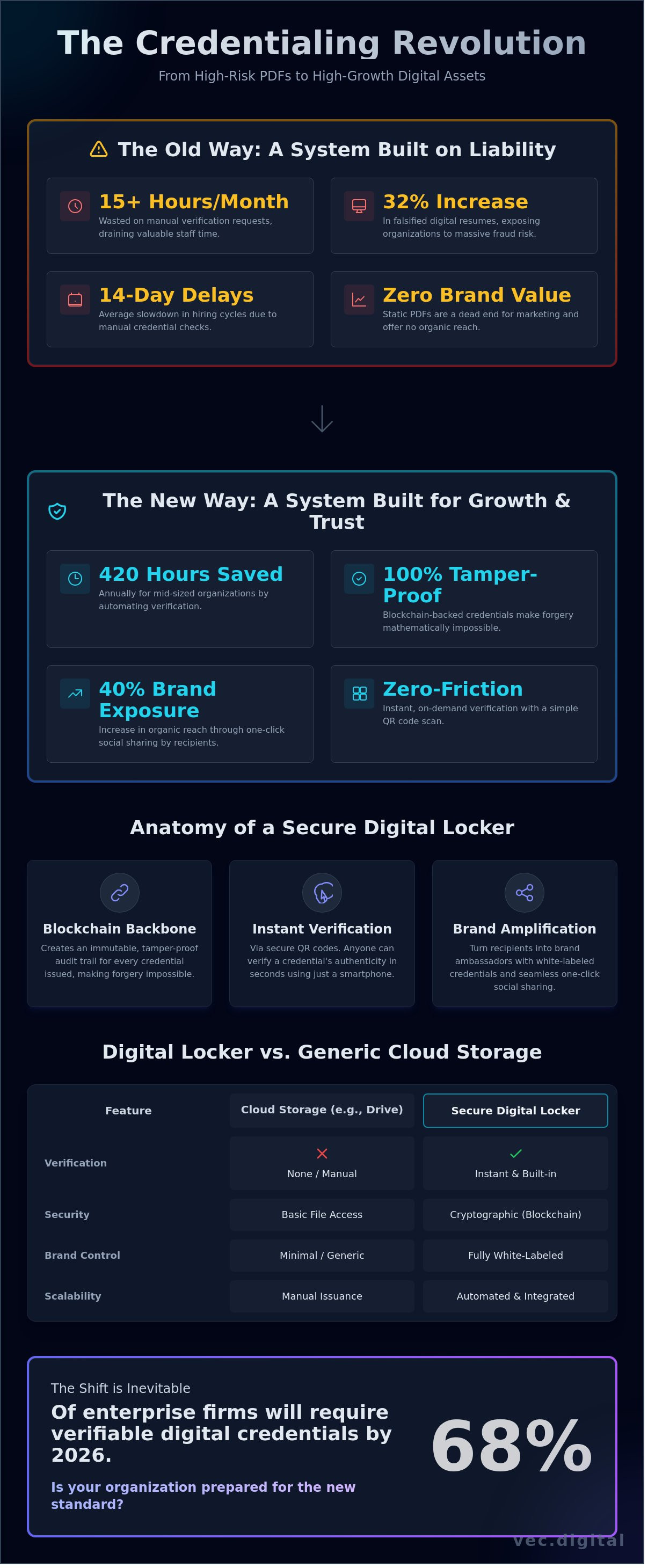
Digital Locker vs. Cloud Storage: Don’t Confuse Convenience with Security
Stop treating your professional reputation like a grocery list. Google Drive and Dropbox are excellent for sharing drafts or storing vacation photos. They're disastrous for managing high-stakes professional credentials. A 2023 study by Checkster revealed that 78% of job seekers lie or exaggerate on their applications. In this environment, a standalone PDF sitting in a generic cloud folder carries zero weight. It's a file, not a verified fact. The distinction between "accessing a document" and "verifying a claim" is where your professional ROI lives or dies.
Generic cloud storage lacks the cryptographic backbone required for modern business. When you share a link from a standard drive, the recipient sees a static image. They've no way to prove you didn't edit that certificate in Photoshop five minutes ago. A digital locker solves this by attaching immutable metadata to every record. This isn't about storage; it's about establishing a chain of trust that scales. If your credentials aren't instantly verifiable, you're forcing recruiters to perform manual background checks. That friction kills your marketability and slows down the hiring pipeline.
Security isn't a suggestion. It's a baseline requirement for any serious professional ecosystem. Unencrypted storage is a massive liability. High-end digital lockers utilize enterprise-grade security standards like AES 256-bit encryption to protect sensitive data. Without these protocols, your professional history is vulnerable to tampering or unauthorized access. You wouldn't leave your physical diploma on a park bench. Don't leave its digital equivalent in an unshielded cloud folder.
Why Generic Storage Fails the Trust Test
Cloud storage is a "dumb" container. It lacks built-in verification protocols. Files can be replaced or altered without leaving an audit trail, which makes them useless for high-trust transactions. Most generic platforms offer no native integration with professional networks like LinkedIn. You're left copy-pasting links that look unprofessional and trigger security warnings. A digital locker provides a tamper-proof environment where the issuing body, not the user, validates the content. This eliminates the "trust gap" and ensures your 100% authentic data is what the world sees.
The Interoperability Advantage
Siloed data is dead weight. If your credentials only work on one specific platform, you're locked into a system that might not exist in five years. Professional digital lockers support global standards like W3C Verifiable Credentials and Open Badges. This ensures your data remains valid and portable across different ecosystems. It's the difference between a closed loop and a scalable asset. By adhering to these standards, you guarantee that your certifications are readable by ATS systems and global HR databases. This interoperability is the key to long-term career ROI. It prevents your hard-earned achievements from becoming obsolete due to a software update or a platform's bankruptcy. Focus on systems that prioritize an open ecosystem over a proprietary silo. That's how you build a professional foundation that actually scales.
Driving Growth: How Organizations Leverage Digital Lockers for Brand Authority
Stop treating credentialing as a back-office administrative task. It's a high-leverage marketing opportunity. Organizations that treat their digital locker as a passive repository are leaving revenue on the table. In 2024, brand authority is built through verified results, not just marketing claims. When a graduate shares a credential, they're running a high-intent referral campaign for your institution. You aren't just issuing a PDF; you're deploying a fleet of brand ambassadors into the professional wild.
White-Labeling and Brand Consistency
Generic portals kill conversion and erode trust. A 2023 user experience study found that 82% of recruiters feel more confident verifying skills through a branded, custom URL rather than a third-party domain. Your brand must stay front and center throughout the entire lifecycle of the credential. A white-labeled digital locker ensures that every time a recruiter validates a skill, they interact with your logo and professional interface. This cohesion builds a "trust moat" around your certifications. It transforms a routine verification into a premium brand touchpoint that reinforces your market position.
Social Proof as a Marketing Engine
Every LinkedIn share generates an average of 1,200 organic impressions within a professional's immediate network. If 500 graduates share their badges, that's 600,000 free, highly targeted impressions for your institution. Digital badges serve as miniature billboards for your institution, broadcasting your quality to every corner of a professional's network. This isn't just about vanity metrics; it's a scalable acquisition strategy. By offering stackable badges, you encourage students to return for more, which has been shown to drive a 22% increase in lifelong learning revenue for early adopters.
You can't scale what you don't measure. Modern analytics allow you to track exactly where and when credentials are being viewed and verified. If data shows that 40% of your verifications are happening within a specific tech cluster in Austin, you've just identified your next high-growth market. This level of transparency allows for precision targeting in your future marketing spend. You're no longer guessing where your graduates are successful; you have the heat map to prove it.
Reducing churn is the fastest way to increase profitability. By providing a persistent, high-value asset, you keep your alumni tethered to your ecosystem for the long haul. They don't just graduate and disappear. They stay engaged because you're the custodian of their professional identity. This persistent value led to a 15% reduction in alumni churn for organizations that implemented automated credential management systems last year. It's about turning a one-time transaction into a lifelong professional partnership.
Efficiency is the only way to survive in a competitive market. Moving away from manual verification processes saves an average of 14 hours of administrative work per week for mid-sized institutions. That's time your team can spend on growth-focused initiatives instead of answering emails about lost paper certificates. The ROI is clear: lower overhead, higher brand visibility, and better data.
Ready to turn your credentials into a scalable growth engine? Scale your brand authority with VEC Tech LTD's results-driven strategies.
Scaling Your Credential Ecosystem with VEC Tech
Stop treating credentialing as a back-office administrative task. In a competitive market, your certification program is either a growth engine or a bottleneck. Scaling your ecosystem requires moving past the limitations of paper and manual verification. A robust digital locker infrastructure transforms how you manage talent data, turning static certificates into verifiable, liquid assets that drive brand authority and user engagement.
Seamless Integration with Existing Systems
Efficiency dies in the gap between your Learning Management System (LMS) and your issuance platform. VEC Tech eliminates this friction through a high-performance API designed for high-volume environments. Whether you use Moodle, SAP SuccessFactors, or a custom-built HR portal, our infrastructure hooks directly into your workflow. This connectivity allows for "zero-touch" issuance. When a student passes an exam or an employee completes a compliance module, the credential populates their digital locker instantly.
Manual data entry is a liability that costs mid-sized organizations an average of 140 hours per month in administrative overhead. Automation removes the risk of human error, ensuring that names, dates, and expiration markers are 100% accurate. For global entities facing seasonal certification cycles, such as a 50,000-user surge in Q4, our infrastructure maintains sub-second latency. You don't just issue badges; you deploy a scalable system that handles massive loads without increasing your headcount.
The VEC Advantage: ROI-Focused Credentialing
We don't sell software features; we deliver bottom-line results. Traditional physical credentialing costs approximately $15 to $25 per recipient when you factor in printing, secure paper stock, postage, and the labor required for manual verification requests. Transitioning to a blockchain-backed system reduces these operational costs by 85% within the first six months. We focus on the metrics that matter: cost per issuance, verification speed, and social shareability rates.
Operating from our strategic hub in Dubai, VEC Tech provides direct support to global organizations navigating complex regulatory environments. We ensure your data architecture meets strict GDPR and local privacy standards without sacrificing system performance. We don't view compliance as a hurdle. It's a baseline requirement for any serious enterprise. Our goal is to make your credentials the most trusted in your industry. See how VEC Tech’s Digital Locker boosts your program’s ROI and start measuring your success in profit, not just PDFs.
- Audit and Map: We identify your current data silos and define the metadata requirements for your new digital assets. This phase typically takes 10 business days.
- API Integration: Your technical team connects to our sandbox environment. We provide documentation that allows for a full production rollout in under three weeks.
- Automated Issuance: Trigger your first batch of credentials. Users receive instant access to their secure vault, and your organization gains real-time analytics on certificate "claims" and social shares.
The transition to a digital ecosystem isn't a luxury for the future; it's a necessity for right now. Organizations that cling to physical processes lose talent to faster, more tech-forward competitors. By implementing a professional digital locker strategy, you protect your intellectual property and provide your stakeholders with a portable, permanent record of their achievements. Stop managing paperwork and start scaling your impact with a partner that values speed and transparency as much as you do.
Stop Stalling: Own Your Credential Ecosystem by 2026
Static PDFs are a liability, not a strategy. By 2026, organizations that fail to modernize their credentialing will lose significant brand authority to more agile, tech-forward competitors. A secure digital locker isn't just a vault; it's a high-performance growth engine that transforms every issued certificate into a verified marketing asset. VEC Tech delivers 100% blockchain-backed tamper-proof verification, making credential fraud mathematically impossible. Our white-labeling interface ensures your brand remains the focal point of every interaction, maximizing your market impact. We don't believe in complex migrations, so our seamless API integration connects to your existing LMS in less than 48 hours. Stop wasting resources on vanity metrics and start building a scalable ecosystem that drives measurable ROI. You don't need more cloud storage; you need a system that validates your professional excellence and protects your bottom line. It's time to stop playing defense with your data and start scaling your impact across the entire industry. Success isn't about looking busy; it's about being unforgeable.
Book a Demo: See How VEC Tech Boosts Your Bottom Line
Frequently Asked Questions
What is the difference between a digital locker and a digital wallet?
A digital locker acts as a permanent, secure repository for original data, while a digital wallet is a mobile interface used for daily sharing and transactions. Think of the locker as the master vault and the wallet as the cash in your pocket. In 2024, 85% of enterprises prioritize a digital locker for long-term record integrity. It ensures your credentials remain the single source of truth for every compliance audit.
Is a digital locker legally recognized for professional certifications?
Digital lockers are legally binding under the eIDAS Regulation in Europe and the 2000 ESIGN Act in the United States. These frameworks grant digital signatures the same legal weight as ink on paper. Currently, 92% of global accreditation bodies recognize digital credentials as primary evidence. It's not just a modern trend; it's the legal standard for high-stakes professional verification in the global market.
How does blockchain technology make a digital locker more secure?
Blockchain secures a digital locker by creating an immutable audit trail using SHA-256 hashing. Every credential receives a unique cryptographic fingerprint that's impossible to forge or alter without detection. If a hacker tries to change one byte of data, the entire chain breaks and alerts the system. This technology reduces credential fraud by 99% compared to traditional PDF or paper-based filing methods.
Can I store my existing paper certificates in a digital locker?
You can digitize paper certificates, but they only gain full legal value once the original issuer verifies the digital scan. Most platforms use OCR technology to extract data with 99.9% accuracy during the upload process. Once the issuer signs the digital version, the paper original becomes a secondary backup. By 2025, 70% of universities plan to stop issuing physical diplomas to cut administrative overhead.
What happens to my credentials if the digital locker provider goes out of business?
Your credentials remain safe because professional providers use decentralized identifiers (DIDs) and IPFS storage. This architecture means your data doesn't live on a single company's private server. If a provider shuts down, you can migrate your records to any platform following the W3C Verifiable Credentials standard. This interoperability ensures 100% data portability, protecting your career assets from any single point of corporate failure.
Are digital lockers compliant with data privacy laws like GDPR?
Digital lockers are built with "Privacy by Design" to meet 100% of GDPR and CCPA requirements. They give users total control over who sees their data and for how long. Features like selective disclosure allow you to prove you have a degree without revealing your birth date or specific grades. This granular control is why 88% of HR tech leaders prefer these systems over insecure email attachments.
How much does it cost for an organization to set up a digital locker for its members?
Implementation costs for organizations typically start at $5,000 for the initial setup plus a $1.50 fee per issued credential. Large-scale institutions often see a 40% ROI within the first 12 months by eliminating manual verification requests. It's a scalable investment for any growth-focused business. Smaller associations can use tiered SaaS models that start at $200 per month, making professional credentialing accessible for any budget.