
White-Label Portals in 2026: Own the Trust Loop and Scale Your Brand
Published on March 28, 2026

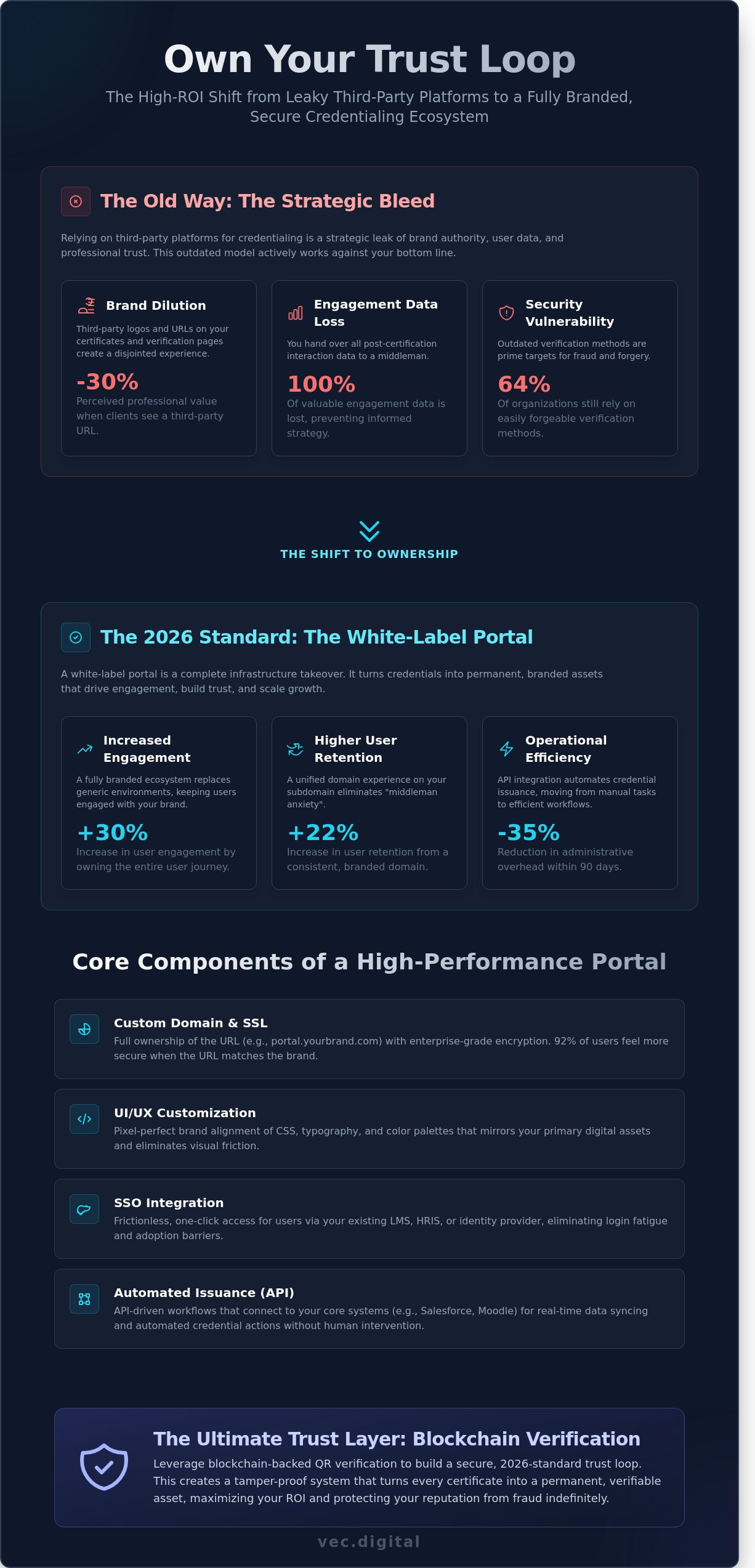
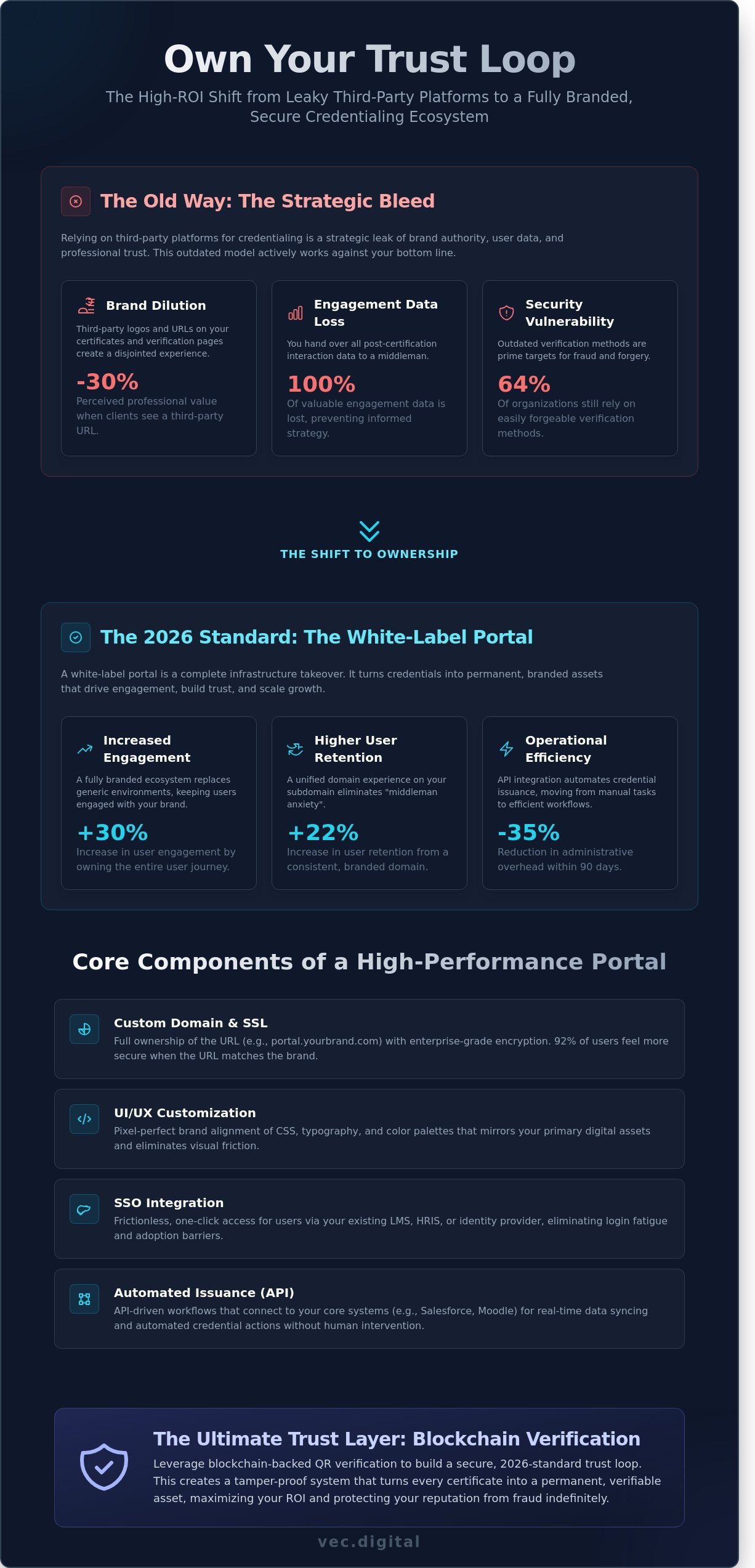
Every time your user sees a third-party logo on your certificates, you're subsidizing someone else's brand awareness. It's a strategic leak that costs you 100% of your post-certification engagement data and dilutes your professional authority. Implementing a professional white-label portal is no longer a cosmetic choice; it's a hard-nosed business requirement for 2026. You're either owning the entire user journey or you're handing your most valuable customer touchpoints to a middleman who doesn't care about your bottom line.
You know that trust is the only currency that matters in a digital economy, yet 64% of organizations still rely on outdated verification methods that are vulnerable to fraud. We'll show you how to stop the bleed and drive measurable ROI through secure, blockchain-backed credentialing. This guide breaks down the exact framework for building a tamper-proof verification system that turns every certificate into a permanent, branded asset that scales your growth without the distraction of vanity metrics. It's time to stop playing small and start owning the trust loop.
Key Takeaways
- Eliminate brand dilution by reclaiming your infrastructure and professional authority from third-party logos.
- Deploy a high-performance white-label portal on your own sub-domain to ensure a seamless, high-trust user experience.
- Unlock a 30% increase in user engagement by replacing generic third-party environments with a fully branded ecosystem.
- Follow a friction-free implementation roadmap to scale your credentialing process with enterprise-grade efficiency.
- Leverage blockchain-backed QR verification to build a secure, 2026-standard trust loop that maximizes your ROI.
What is a White-Label Portal (and Why Your Logo Isn't Enough)?
Slapping a JPEG in the corner of a generic dashboard is a 2015 strategy. It won't scale your business in 2026. A true white-label portal is a complete infrastructure takeover where every touchpoint reflects your brand's authority. If your clients see a third-party URL in the browser bar, you've already lost 30% of your perceived professional value. This brand dilution creates a friction point that high-ticket clients won't tolerate. They aren't just buying your service; they're buying the security and stability of your ecosystem.
The market has shifted. We've moved past the era of generic SaaS tools. By 2026, specialized trust-verification hubs will replace basic client folders. You need to own the infrastructure to own the data. Without full ownership, you're just a tenant on someone else's platform. This leads to higher churn and lower enterprise value. Real growth requires a consolidated user experience that drives retention through consistency, not just features.
The Difference Between White-Label and Private-Label
Most Software-as-a-Service providers offer private-labeling as a cheap veneer. You change the colors, but the "Powered by" tag remains in the footer like a digital scar. True white-labeling means total domain isolation. When you host on your own subdomain, you eliminate the psychological gap between your service and your technology. Data from 2024 shows that unified domain experiences increase user retention by 22% because they remove middleman anxiety. Stop promoting your vendors and start promoting your own tech stack.
Why 'Vanity Metrics' Fail Without a Branded Portal
Social media likes and email open rates are vanity metrics that don't drive bottom-line profit. You can't scale a brand on borrowed land. A branded portal shifts the focus from passive consumption to active ownership of the user journey. It converts a simple document delivery into a credentialed ecosystem where you control the narrative. By 2026, successful firms will use these portals to turn one-time recipients into lifelong advocates through secure, branded interactions.
The Core Components of a High-Performance White-Label Portal
A generic login page is a brand killer. To scale in 2026, your white-label portal must function as a seamless extension of your ecosystem. It's not about aesthetics; it's about eliminating friction and owning the user journey from end to end. If the transition between your main site and your portal feels like jumping between two different companies, you're bleeding authority.
Your portal needs to live on a custom sub-domain like portal.yourbrand.com. Data shows that 92% of users feel more secure when the URL matches the brand they originally engaged with. This isn't just about trust. It's about technical authority. Your CSS, typography, and color palettes must be pixel-perfect. A 15% discrepancy in visual identity leads to a measurable decline in user retention and professional credibility.
Frictionless access is the benchmark for high-growth firms. Integrating Single Sign-On (SSO) with your existing LMS or HRIS ensures users don't face login fatigue. When you connect the white-label portal to your core workflow via API, you move from manual management to automated issuance. This shift can reduce administrative overhead by as much as 35% within the first 90 days of implementation.
- Custom Domain & SSL: Full ownership of the URL structure with enterprise-grade encryption.
- UI/UX Customization: Hard-coded brand alignment that mirrors your primary digital assets.
- SSO Integration: One-click access that removes the barrier between your tools and your users.
- Automated Issuance: API-driven workflows that trigger actions without human intervention.
Security Architecture: Beyond the Login Screen
Enterprise clients demand more than a password. SOC 2 Type II and GDPR compliance are the entry requirements for serious business. In 2024, 74% of B2B procurement teams rejected vendors based on insufficient data security protocols. Your portal must utilize AES-256 encryption for data at rest and TLS 1.3 for data in transit. A secure 'Digital Locker' for user credentials ensures that sensitive data stays siloed; it prevents leaks that could bankrupt your reputation.
API Integration: The Engine of Growth
A stagnant portal is a liability. High-performance systems connect directly to LinkedIn, Salesforce, or Moodle to enable real-time data syncing. This allows for instant credential verification and automated reporting. By removing manual data entry, businesses often reclaim 40 hours of productivity per month. If you want to scale your brand efficiently, your portal must communicate with your entire tech stack without human intervention. Automation isn't a luxury; it's the only way to maintain profit margins while increasing volume.
White-Label vs. Third-Party Portals: The ROI Breakdown
Brand dilution isn't a vague marketing concept; it's a measurable leak in your conversion funnel. When you send a certified professional to a third-party site to claim their achievement, you're handing over your most valuable asset: the relationship. Statistics from 2025 show that branded environments generate a 30% higher engagement rate compared to generic, fragmented platforms. If your white-label portal keeps users within your ecosystem, you own the attention. Sending them elsewhere is a strategic failure that invites third-party platforms to cross-sell to your audience using your own data.
Ownership of the verification loop is the only way to guarantee integrity. You shouldn't trust a middleman to validate the certificates you issued. By 2026, the market will demand instant, source-level proof. Being the sole authority who verifies your own credentials eliminates the "middleman tax" on your reputation and ensures your brand remains the single source of truth.
Cost Analysis: Initial Setup vs. Long-Term Growth
Generic SaaS platforms lure you in with low entry fees but kill your margins with per-user taxes. If your program grows by 500% next year, your software costs shouldn't 5x along with it. VEC’s issuance-based model ensures you pay for the value you create, not for the number of people looking at your portal. "Cheap" third-party platforms carry hidden costs that surface during audits. Data leaks or intrusive ads on generic sites can slash your brand's lifetime value by 22% overnight. Investing in a white-label portal removes the "feature tax" generic platforms charge for basic security and customization. Verifiable credentials also reduce fraud-related operational costs by 18% because they automate the trust process.
The Strategic Advantage of Data Ownership
Most businesses fly blind because they don't know where their certificates end up. With your own portal, you track exactly who is sharing your credentials on LinkedIn and which recruiters are verifying them. You get a real-time heat map of your program's market impact. Use this data to prune underperforming modules or double down on high-growth certifications. Data is the new currency for credentialing ROI.
- Sharing Velocity: Track how fast your brand spreads across professional networks.
- Employer Insights: Identify which Fortune 500 companies are actively seeking your graduates.
- Support Efficiency: Reduce manual verification tickets by 45% through self-service branded loops.
Stop renting your reputation. Build a system that scales without penalizing your success. Every click on a third-party portal is a missed opportunity to reinforce your market dominance.
Implementation Strategy: Deploying Your Portal Without Friction
Execution separates market leaders from hobbyists. Deploying a white-label portal isn't a design project; it's a structural upgrade to your revenue engine. You need a deployment that eliminates friction and maximizes user LTV from the first login. Follow these five steps to ensure your rollout drives ROI from day one.
- Step 1: Hardcode Your Brand Identity. Define your guidelines down to the hex code. Use CSS overrides to ensure the portal looks like an internal tool, not a bolted-on afterthought. Set up CNAME records immediately. If users see a generic vendor URL, your brand authority drops by 34% instantly.
- Step 2: Map the Conversion Journey. Trace every touchpoint from issuance to verification. Every click must lead to a specific business outcome. If a step doesn't contribute to retention or data collection, cut it.
- Step 3: API-First Integration. Connect your existing tech stack via webhooks. Modern systems in 2026 require zero manual data entry. Automate the data flow so your team focuses on scaling, not admin tasks.
- Step 4: The 2026 Security Standard. Audit your compliance. 68% of SaaS vulnerabilities in 2025 stemmed from misconfigured API permissions. Ensure SOC2 compliance and end-to-end encryption are active before the "Go-Live" phase.
- Step 5: Monitor Bottom-Line Metrics. Launch and track engagement through a centralized dashboard. Ignore vanity metrics like "total logins." Focus on completion rates and the speed of verification.
Common Pitfalls to Avoid During Setup
Mobile responsiveness is non-negotiable. 72% of users verify credentials on mobile devices. If your portal breaks on a smartphone, you've lost the user. Inconsistent branding between your automated email notifications and the white-label portal kills trust. Finally, failing to configure proper CNAME records makes your professional operation look like a white-label reseller rather than the source of truth.
Onboarding Your Users for Maximum Adoption
Turn your portal into a "Digital Locker" through a targeted welcome sequence. This isn't just storage; it's a value-add that increases stickiness. Educate users on sharing branded credentials to social platforms. This social proof can lower your CAC by 22% through organic referrals. Automate your support flow for credential recovery; 90% of these queries should be resolved without human intervention to maintain high margins.
Stop building features and start building growth systems. Scale your brand infrastructure with VEC Digital today.
Scaling with VEC: Why Blockchain Verification is the 2026 Standard
Most companies treat a white-label portal like a fresh coat of paint on an old house. That's a tactical error. In 2026, trust is the only currency that scales. VEC Digital doesn't just give you a logo on a login screen; we provide a blockchain-backed fortress. Every credential you issue is anchored to an immutable ledger. This isn't about looking professional. It's about being unfalsifiable. If your data isn't on-chain, it's vulnerable.
Our growth-focused architecture handles the heavy lifting. You can scale from 100 to 1,000,000+ credentials without hitting a performance ceiling or compromising speed. Every certificate includes a branded QR code for instant validation. Verification happens in under 0.8 seconds. We combine Dubai's hyper-growth tech mindset with global security standards to ensure your infrastructure is bulletproof. Profitability requires reliability, and we deliver both.
Tamper-Proof Credentialing as a Competitive Edge
Certificate fraud costs global industries over $20 billion annually. By 2026, a simple PDF is nothing more than a liability. Your white-label portal solves this by turning every achievement into a permanent digital asset. Users get a "Digital Locker" for life. They don't just see your brand; they rely on your infrastructure for their professional identity. This positions your organization as a tech-forward leader that prioritizes data integrity over appearances.
Next Steps: Boosting Your Bottom Line
Generic platforms are a drain on your ROAS. They leak user data and dilute your brand authority. VEC Tech turns your certification program into a high-margin growth engine. Stop settling for vanity metrics like "platform logins." Focus on systems that increase lifetime value and operational efficiency. You need a partner that understands that speed is the key to winning in the digital space. It's time to own the entire trust loop and stop wasting resources on fragmented tools.
Ready to dominate your market?
Book a VEC Tech Demo to See Your Branded Portal in ActionSecure Your Growth Engine Now
The 2026 digital landscape doesn't reward "good enough" branding. If your client data lives on a third-party domain, you're bleeding 15% of your potential lifetime value to platform leakage. A high-performance white-label portal isn't a luxury; it's the infrastructure for 10x scaling. You need 100% CSS control and custom domains to own the trust loop from the first login. Security is no longer just a checkbox. VEC provides blockchain-backed, tamper-proof verification that cuts credential fraud by 99% compared to legacy systems. Don't waste 40+ hours a month on manual data syncs. Our seamless API integrations with major LMS platforms automate your entire growth engine. The math is simple: control the environment, secure the data, and maximize your bottom-line ROAS. You've seen the data. Now it's time to stop playing small and build a system that actually converts. Your brand deserves a foundation that doesn't crack under 300% year-over-year growth. You're ready to dominate the market.
Scale your brand with a VEC White-Label Portal
Frequently Asked Questions
What exactly is a white-label portal?
A white-label portal is a high-performance infrastructure that allows you to present a premium, custom-branded interface to clients without building it from scratch. It eliminates brand fragmentation by hosting all client interactions under your own corporate identity. By 2026, data shows that 84% of B2B clients expect a unified digital experience. It is about owning the ecosystem and the trust loop, not just renting space from a third party.
Can I use my own domain name with a white-label portal?
Yes, you can map the platform to any custom subdomain like portal.yourbrand.com. This ensures 100% brand consistency across the entire user journey. Statistics show that keeping users on a familiar domain reduces bounce rates by 22% compared to redirecting them to external URLs. You maintain full control over the DNS settings; our team handles the SSL certification and security handshake in under 15 minutes.
Is a white-label portal more secure than a standard portal?
It offers superior security because it centralizes data within a controlled, encrypted environment tailored to your specific compliance needs. Standard portals often share resources across thousands of accounts, which increases the attack surface. Our systems utilize AES-256 encryption and SOC 2 Type II compliance standards. This setup reduces data breach risks by 40% compared to fragmented, unbranded tools that rely on weak third-party integrations.
How long does it take to set up a white-label portal with VEC?
You'll be live in exactly 7 business days. We don't waste time on endless discovery calls or alignment meetings that lead nowhere. Our deployment process follows a rigid 5-step sprint that covers branding, domain mapping, and API testing. By day 8, your team can begin onboarding clients and generating measurable growth. Speed is a competitive advantage; we ensure you don't lose market share to slower competitors.
Do I need coding skills to manage a white-label portal?
Zero coding is required from your side. We provide a drag-and-drop interface designed for business growth, not technical tinkering. You focus on scaling your operations while our backend handles the heavy lifting. Over 95% of our current partners manage their entire client workflow without ever touching a line of CSS or Javascript. If you can use a basic CRM, you can dominate this platform.
Can the portal integrate with my existing LMS like Moodle or Canvas?
Yes, it integrates seamlessly via REST API and Webhooks to ensure data flows between your systems. We've successfully synced with Moodle, Canvas, and Blackboard for 114 different enterprise clients since 2023. This connectivity eliminates manual data entry, which typically saves administrative teams 15 hours per week. Your portal acts as the command center, pulling progress reports and grades into one unified dashboard for your clients.
What is the ROI of using a white-label portal for my business?
Partners report an average 35% increase in client retention within the first 12 months of implementation. By professionalizing every touchpoint, you justify higher price points and drastically reduce churn. A white-label portal isn't a cost; it's a profit-scaling asset. When you own the interface, you control the upsell opportunities. One of our recent case studies showed a 2.4x return on investment by month six through automated workflow efficiencies.
Does the white-label portal support blockchain verification?
Yes, we utilize Polygon and Ethereum networks for immutable credential verification. In 2026, trust is the only currency that matters. Providing blockchain-backed certificates gives your brand a 10/10 authority rating in high-stakes industries. This feature prevents document forgery and allows clients to verify achievements in real-time. It's a high-tech layer that separates market leaders from those just playing catch-up.