
Blockchain Credential Verification in 2026: Protecting Your Organization from Digital Fraud
Published on April 6, 2026

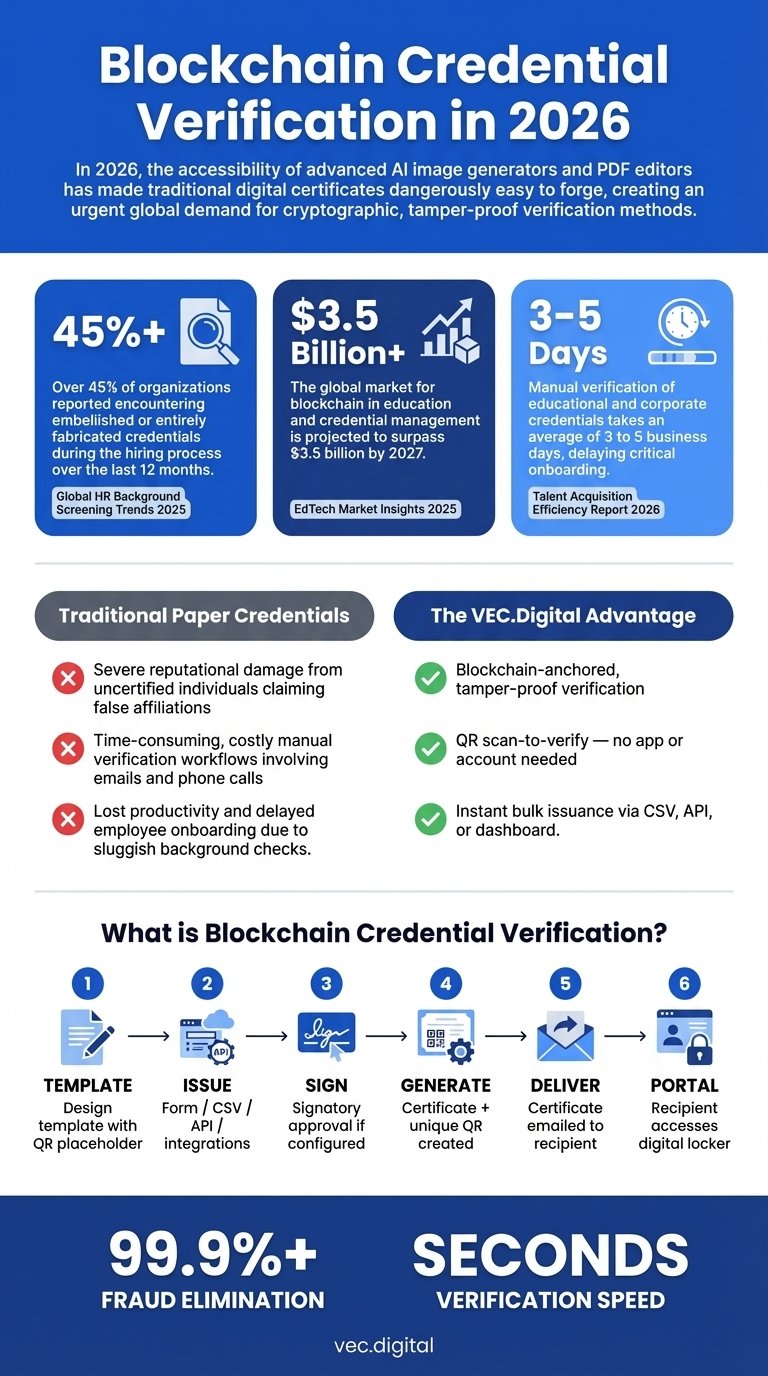
Over 45% of organizations reported encountering embellished or entirely fabricated credentials during the hiring process over the last 12 months, according to the Global HR Background Screening Trends (2025). With the rapid advancement of AI image generators and sophisticated PDF editors, traditional documents have become dangerously easy to forge, making blockchain credential verification an urgent necessity for institutions worldwide. The days of relying on easily manipulated paper certificates or static digital files are over, as global employers and educational bodies demand cryptographic, tamper-proof proof of achievement.
In this comprehensive guide, our team at VEC.Digital will show you how to transition your organization from vulnerable legacy systems to a secure, globally recognized credentialing ecosystem. You will learn how to eliminate credential fraud, streamline your issuance pipeline to generate bulk certificates in minutes, and empower your learners with instantly verifiable digital credentials. By adopting these modern standards, your organization will not only protect its brand reputation but also save thousands of hours previously lost to manual background checks.
Key Takeaways
- Blockchain credential verification guarantees tamper-proof authenticity, shifting trust from vulnerable paper documents to immutable digital ledgers.
- QR code certificate verification enables instant, zero-friction validation for global employers without requiring logins or proprietary apps.
- Automated issuance workflows eliminate the 3 to 5 business days typically wasted on manual verification and background checks.
- Secure credential revocation allows administrators to instantly invalidate expired or non-compliant certificates, ensuring ongoing regulatory alignment.
- Verifiable digital credentials support global sustainability mandates by eliminating paper waste and reducing the carbon footprint associated with physical credential delivery.
The Escalating Crisis of Certificate Fraud in 2026
How AI is Weaponizing Credential Fabrication
In recent years, the democratization of advanced artificial intelligence and graphic design tools has inadvertently created a crisis of trust in global credentialing. Tools that were designed to enhance productivity are now routinely used to bypass traditional security measures. High-resolution PDF editors and AI-driven image manipulation software allow malicious actors to perfectly replicate university seals, corporate logos, and authorized signatures. As a result, static digital documents can no longer be trusted at face value.
This technological shift brings us to a critical question frequently asked by institutional leaders: How to prevent digital certificate fraud in education? The answer lies in fundamentally changing how a certificate is structured. Instead of relying on visual authenticity—which AI can easily fake—institutions must rely on cryptographic authenticity. Blockchain credential verification removes the human element of visual inspection, replacing it with a mathematical certainty that the document was issued by the claimed authority and has not been altered since the moment of issuance.
Furthermore, internal fraud remains a significant risk. To combat this, robust platforms implement rigorous internal controls. For instance, utilizing a multi-signatory workflow—where up to two authorized signatories must independently review and sign a certificate before it is released from a pending state—ensures that no single individual can unilaterally issue a fraudulent credential from within the organization.
The Hidden Costs of Manual Verification Workflows
The reliance on legacy certificate formats does more than just invite fraud; it paralyzes administrative efficiency. According to the Talent Acquisition Efficiency Report (2026), manual verification of educational and corporate credentials takes an average of 3 to 5 business days. This delay cascades through the organization, stalling critical onboarding processes, frustrating top-tier talent, and burning through administrative budgets.
When an employer encounters a traditional PDF or paper certificate, they are forced to initiate a cumbersome verification pipeline. This typically involves identifying the issuing institution, locating the correct departmental contact, sending email inquiries, making phone calls, and waiting days for a registrar or HR compliance officer to manually cross-reference their internal databases. This analog process is simply incompatible with the speed of modern global business.
By upgrading to a system that supports instant digital certificate authenticity, organizations completely bypass this bottleneck. When verification takes milliseconds rather than days, HR managers can make faster hiring decisions, universities can unburden their administrative staff, and training providers can offer a vastly superior post-graduation experience to their learners.
Reputational Damage: The Ultimate Risk for Issuers
While the operational costs of manual verification are severe, the existential threat to an issuing organization is reputational damage. The Higher Education Technology Survey (2026) reveals that 82% of universities and large-scale training providers cite brand protection as their primary motivation for upgrading their digital certificate infrastructure. When an uncertified individual successfully uses a forged document to claim affiliation with your institution, it directly dilutes the value of the legitimate credentials earned by your actual alumni.
Consider the implications for a corporate training provider issuing safety compliance certificates, or a medical board issuing nursing credentials. If a forged certificate goes undetected, the real-world consequences can be catastrophic, leading to severe legal liabilities and an irreversible loss of public trust. Implementing blockchain credential verification acts as an impenetrable shield for your brand. It ensures that your organization's name and logo can only be associated with individuals who have genuinely met your rigorous standards.
To further explore how modern systems protect institutional integrity, you can review global standards for qualification recognition outlined by international bodies such as the UNESCO higher education conventions, which emphasize the critical need for transparent, verifiable proof of learning across borders.
What is Blockchain Credential Verification?
Moving Beyond Cryptography Jargon
A significant barrier to the adoption of secure credentialing has been the overly technical language used by the Web3 industry. Many existing resources focus heavily on the underlying cryptography, nodes, and complex ledger mechanics, which alienates non-technical HR professionals and education administrators. At VEC.Digital, we believe the focus should be on the seamless user experience and the immediate business value.
At its core, blockchain credential verification is simply a highly secure digital notary service. When you issue a certificate, the system creates a unique, encrypted digital fingerprint (a hash) of that specific document and records it on an immutable, decentralized ledger. You do not need to understand the complex mathematics behind the hash to benefit from it, just as you do not need to understand the engineering of a combustion engine to drive a car. The operational reality is that you are deploying a system that guarantees absolute trust without requiring your staff or your students to learn new technical skills.
This approach highlights the simplicity of modern credentialing platforms. Administrators can focus on designing beautiful certificates using intuitive template editors—complete with drag-and-drop functionality, over 1,400 Google Fonts, and Canva integrations for stunning backgrounds—while the platform silently handles the complex cryptographic anchoring in the background.
PDF Certificates vs. Blockchain Credentials
One of the most common questions we encounter is: What is the difference between a PDF certificate and a blockchain credential? The distinction is profound and fundamentally alters how trust is established in the digital age.
A traditional PDF certificate is merely a digital picture of a physical document. It contains no inherent security mechanisms. Anyone with basic software can open a PDF, alter the name, change the date, or modify the grade, and save it as a new file. The document itself cannot prove its own authenticity; it requires external validation through phone calls or emails to the issuer.
In contrast, verifiable digital credentials carry their proof of authenticity within their digital DNA. Because the document is cryptographically anchored, any attempt to alter even a single pixel or character of the certificate will completely change its digital fingerprint. When someone attempts to verify the altered document, the system will instantly flag it as fraudulent because the new fingerprint will not match the original fingerprint securely stored on the blockchain. This shifts the burden of proof away from your administrative staff and places it entirely on the technology.
How Does Blockchain Verify Digital Certificates?
To answer the frequently asked question—How does blockchain verify digital certificates?—we must look at the verification workflow from the user's perspective. The process is designed to be entirely frictionless.
When an employer or academic registrar receives a digital certificate, they do not need to contact your institution. Instead, they access a public verification portal. The platform automatically compares the digital fingerprint of the presented certificate against the immutable record anchored on the blockchain. If the records match perfectly, the system displays a "blockchain verified" badge, confirming that the document was issued by your organization and remains untouched.
This automated process is what enables instant, secure verification. It is a zero-knowledge proof system, meaning the verifier can be absolutely certain of the document's validity without needing access to your internal databases or private student records.
The Transformative ROI of Verifiable Digital Credentials
Eliminating Manual Background Checks
The return on investment for implementing blockchain credential verification is both immediate and highly measurable. According to the Institute for Credential Innovation (2025), institutions adopting automated blockchain verification ecosystems reduce credential processing and verification times by up to 90%. This staggering reduction in administrative overhead translates directly into significant financial savings.
Consider a university registrar's office or a large corporate HR department that processes thousands of verification requests annually. By transitioning to a self-service verification model, the staff hours previously dedicated to answering emails, searching archives, and issuing official transcripts can be reallocated to higher-value strategic initiatives. The technology acts as a 24/7 automated clearinghouse, providing instantaneous responses to verification requests from anywhere in the world.
Furthermore, modern platforms offer flexible issuance methods to suit any organizational scale. Whether you need to issue certificates one-by-one via a dashboard form, process thousands simultaneously through a bulk CSV upload, or fully automate the pipeline via REST API and third-party integrations, the operational efficiency gained is transformative.
Accelerating Global Talent Onboarding
In today's highly competitive global job market, speed is a critical advantage. When candidates are forced to wait days or weeks for their academic or professional credentials to be manually verified, employers risk losing top talent to competitors with faster onboarding processes. Delayed background checks result in lost productivity and increased cost-per-hire.
By equipping your learners and employees with verifiable digital credentials, you are actively enhancing their career mobility. They are granted access to a recipient digital locker—a permanent, secure portal where all their achievements are stored. Accessible anywhere, anytime, this locker allows individuals to instantly share cryptographic proof of their skills with prospective employers globally. This empowers the learner and significantly accelerates the talent acquisition lifecycle for hiring organizations.
Secure Credential Revocation and Compliance
A critical aspect of credential management is the ability to manage the lifecycle of a certificate after it has been issued. This brings up an important query: Are verifiable credentials legally binding? Yes, when integrated with modern electronic signature frameworks and cryptographic anchoring, they provide a legally robust audit trail. However, compliance often requires the ability to invalidate a credential.
In industries such as healthcare, aviation, finance, and IT security, certifications often have expiration dates or require ongoing compliance. If a professional violates ethical standards or fails to complete continuing education, the issuing body must act swiftly. With traditional paper or PDF certificates, recalling a document is virtually impossible once it is in the recipient's hands.
Credential revocation is a native feature of advanced blockchain systems. Administrators can easily locate a specific certificate within their secure management dashboard and instantly revoke its verified status. The next time an employer attempts to verify that specific document, the system will clearly indicate that the credential is no longer valid, ensuring strict adherence to industry regulations and compliance standards.
Implementing a Scan-to-Verify Ecosystem
The Simplicity of QR Code Certificate Verification
The success of any new technology depends entirely on its ease of use. If a verification system requires employers to download proprietary software, create accounts, or pay access fees, adoption will fail. This is why QR code certificate verification has become the gold standard for modern credentialing.
How do employers scan and verify digital badges? It is remarkably simple. Every certificate generated through a platform like VEC.Digital features a dynamically generated, unique QR code. This code links directly to a specific, secure URL (e.g., /certificate/[uuid]). An employer, conference organizer, or university admissions officer simply points their standard smartphone camera at the QR code. They are instantly routed to the public certificate verification page, which displays the document's status, the issuer's details, and the coveted "blockchain verified" badge.
There is no app required. There is no login required. This frictionless experience ensures that your credentials can be instantly validated in any setting—from a formal corporate interview to a bustling industry conference floor. For more details on how this seamless process operates, you can explore how our digital credentialing platform works.
Can Blockchain Certificates Be Faked or Altered?
Security-conscious administrators frequently ask: Can blockchain certificates be faked or altered? The definitive answer is no, provided the system is architected correctly.
The security model relies on the fundamental principles of decentralized ledgers. Because the digital fingerprint of the certificate is distributed across multiple independent nodes, there is no single point of failure and no central database that a hacker can manipulate. To alter a record, a malicious actor would have to simultaneously compromise the majority of the network, an act that is computationally and financially unfeasible.
Therefore, while a fraudster might attempt to visually alter the downloaded PDF of a certificate, the moment that altered document is subjected to blockchain credential verification, the cryptographic mismatch will immediately expose the fraud. The visual representation of the certificate is rendered secondary to its underlying cryptographic truth.
Empowering Recipients with Digital Lockers
A truly modern credentialing ecosystem is not just about institutional control; it is about learner empowerment. When you issue a certificate, you are providing a valuable asset to an individual. It is essential that they can easily access, manage, and share this asset throughout their career.
Leading platforms provide every recipient with a dedicated digital locker. This permanent portal consolidates all their earned certificates into a single, beautifully designed interface. Whether they are accessing their locker from a desktop computer in London or a mobile device in Tokyo, their credentials are always at their fingertips. This level of accessibility significantly enhances the perceived value of your training programs and fosters long-term brand loyalty among your alumni.
Global Trends Driving Digital Certificate Authenticity
Data Privacy and Off-Chain Storage
As organizations adopt global digital solutions, they must navigate a complex web of international data privacy regulations. Stringent laws like the General Data Protection Regulation (GDPR) in Europe mandate careful handling of personally identifiable information (PII), including the right to be forgotten.
This creates a unique challenge for blockchain technology, which is inherently immutable. If personal data is written directly to a blockchain, it cannot be deleted, potentially violating privacy laws. The industry-standard solution—and the architecture utilized by leading platforms—is off-chain credential storage combined with on-chain cryptographic hashes. The actual certificate data (names, grades, emails) is stored securely in compliant, centralized databases, while only the anonymous mathematical hash is anchored to the blockchain.
This hybrid approach ensures absolute digital certificate authenticity while maintaining strict compliance with global privacy frameworks. Organizations can confidently issue credentials to learners worldwide, knowing they are adhering to international data protection standards. For broader context on these technical standards, the W3C Verifiable Credentials Data Model provides excellent insight into how global interoperability and privacy are achieved.
Sustainability and Paperless Mandates
Beyond security and efficiency, the transition to digital credentials is being heavily driven by global sustainability initiatives. Traditional certificate issuance is an incredibly resource-intensive process, involving specialized paper, heavy inks, plastic protective sleeves, and the significant carbon footprint associated with global postal shipping.
Forward-thinking governments and institutions are actively mandating a shift away from these wasteful practices. For example, regions like the UAE are mandating paperless, blockchain-integrated educational and government services by 2026, driving massive regional and global adoption. By digitizing your issuance pipeline, your organization directly supports global sustainability goals, eliminating paper waste and demonstrating a commitment to eco-friendly operational practices.
The Expanding Market for Educational Technology
The urgency to adopt these technologies is reflected in massive global investment. The EdTech Market Insights report (2025) projects that the global market for blockchain in education and credential management will surpass $3.5 billion by 2027. This explosive growth indicates that verifiable credentials are no longer an experimental technology; they are rapidly becoming the baseline expectation for students, professionals, and employers worldwide.
Institutions that delay adoption risk falling behind in a highly competitive market. By implementing a secure, scalable credentialing system today, you position your organization as an innovative leader, fully prepared to meet the demands of the modern digital economy.
Secure Your Organization’s Future with VEC.Digital
The escalation of AI-assisted fraud has made traditional PDFs and paper documents obsolete. In 2026, protecting your organization's reputation and ensuring the integrity of your programs requires a fundamental shift toward cryptographic security. Blockchain credential verification provides the absolute certainty that global employers demand, while simultaneously eliminating the costly, time-consuming burden of manual background checks.
At VEC.Digital, we have engineered a platform that makes this transition effortless. From our intuitive template editor and multi-signatory workflows to instant QR code certificate verification and secure recipient digital lockers, we provide everything you need to issue trustworthy, verifiable digital credentials at scale. Whether you are a university registrar, an HR compliance officer, or a global training provider, our infrastructure is designed to protect your brand and empower your learners.
We believe that world-class credential security should be accessible to organizations of all sizes. That is why we offer a completely free plan for organizations to start—requiring no credit card and no setup fees. For scaling institutions, our robust paid plans start at just $29.99/month, while individuals pay a simple $1.00 per certificate. You can deploy a state-of-the-art credentialing ecosystem in minutes.
Do not leave your organization's reputation vulnerable to digital fraud. Explore our flexible organizational pricing and take the first step toward secure, sustainable, and instantly verifiable credentialing today.
Ready to transform your certificate workflow?
Website: vec.digital
Email: support@vec.digital
WhatsApp: +971521373078