
Combating Certificate Fraud in 2026: Why Blockchain Verification is the New Standard
Published on May 17, 2026

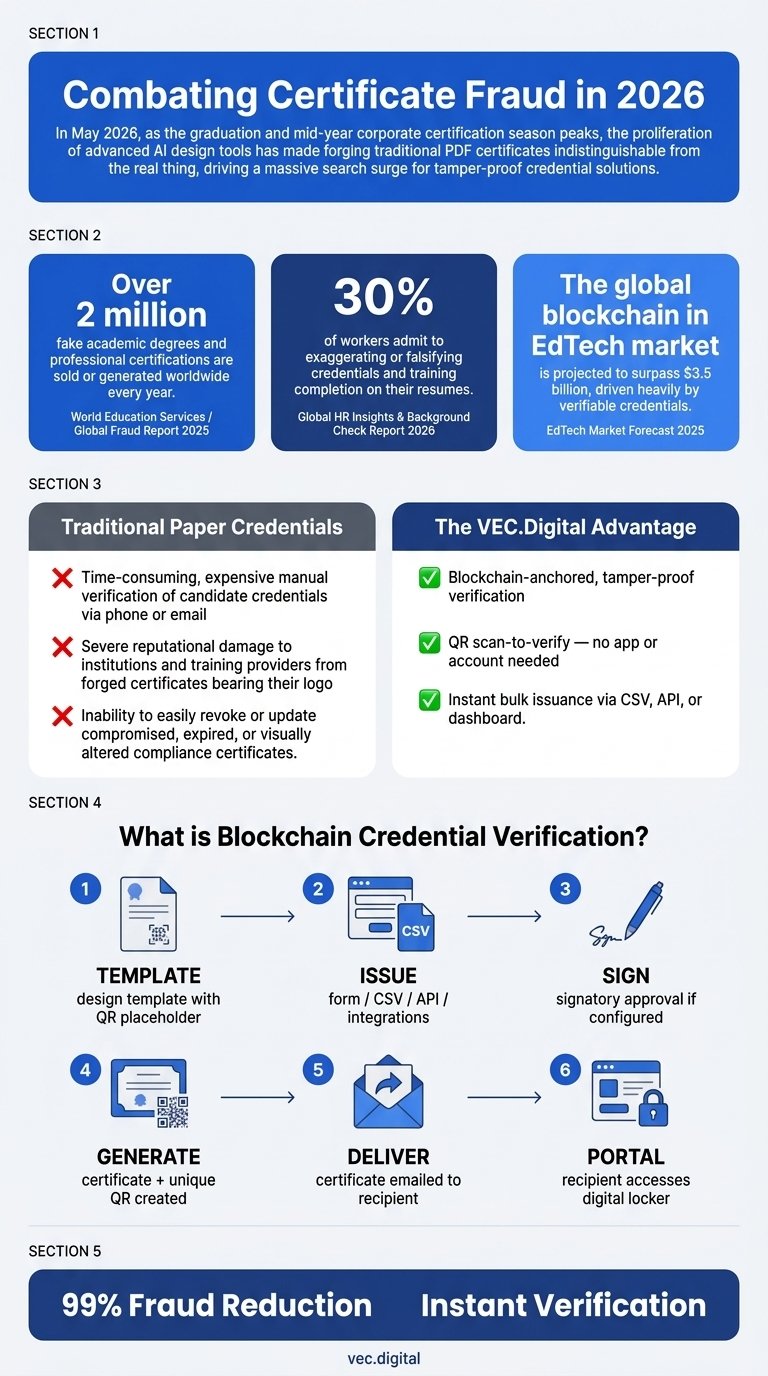
Every year, over 2 million fake academic degrees and professional certifications are sold or generated worldwide, creating an unprecedented crisis for HR managers and university administrators globally. As we navigate 2026, the proliferation of advanced AI design tools has made forging traditional PDF certificates indistinguishable from the real thing, driving a massive search surge for tamper-proof credential solutions. To protect institutional reputation and ensure compliance, organizations must adopt blockchain credential verification to guarantee the absolute authenticity of every issued document.
In this comprehensive guide, our team at VEC.Digital will show you how to transition from vulnerable legacy systems to secure, immutable credentialing. You will learn the fundamental differences between outdated secure PDFs and modern verifiable credentials, discover how to eliminate expensive manual background checks, and understand how to deploy a multi-signatory workflow that issues globally accessible, tamper-proof certificates in minutes. By leveraging blockchain-anchored technology, your organization can permanently safeguard its brand while providing learners with credentials they can trust and share worldwide.
Key Takeaways
- Blockchain credential verification replaces vulnerable PDFs with immutable, cryptographically secured digital assets that cannot be altered or forged.
- Implementing verifiable digital credentials can reduce manual background check and credential processing times by up to 80%.
- Modern digital certificate fraud prevention relies on zero-trust architectures, aligning with global frameworks like the EU Digital Identity Wallet.
- Instant QR code certificate verification removes friction, allowing employers to validate a candidate's qualifications in seconds without apps or logins.
- Robust certificate revocation management empowers issuers to instantly invalidate expired, compromised, or visually altered compliance certificates.
The Rising Threat of AI-Assisted Credential Fraud in 2026
The landscape of education and professional credentialing has fundamentally changed. In the past, creating a convincing fake diploma or compliance certificate required specialized graphic design skills, expensive printing equipment, and access to specific paper stock. Today, artificial intelligence has democratized forgery. With a simple text prompt, malicious actors can generate pixel-perfect replicas of certificates from the world's most prestigious universities and corporate training providers. According to the World Education Services / Global Fraud Report (2025), over 2 million fake academic degrees and professional certifications are sold or generated worldwide every year. This staggering volume of digital certificate fraud prevention failures has forced institutions to rethink how they issue and validate achievements.
For HR compliance managers and university administrators, the consequences of this fraud are severe. When a candidate secures a critical role—such as a healthcare provider, structural engineer, or financial compliance officer—using a forged credential, the liability and reputational damage to the supposed issuing institution can be catastrophic. Furthermore, the Global HR Insights & Background Check Report (2026) reveals that 30% of workers admit to exaggerating or falsifying credentials and training completion on their resumes. This reality has created an environment of zero trust, where employers can no longer take a submitted PDF or paper document at face value.
How Fake Degrees Impact Institutions and Employers
The impact of credential fraud extends far beyond a single dishonest applicant; it creates systemic friction for everyone involved. For institutions, there is the ever-present threat of severe reputational damage from forged certificates bearing their logo. When the public or regulatory bodies discover that an unqualified individual is operating under the guise of an institution's certification, the brand equity built over decades can evaporate overnight.
For employers, this lack of trust necessitates time-consuming, expensive manual verification of candidate credentials via phone or email. HR departments spend countless hours tracking down university registrars or corporate training directors to confirm if a specific individual actually completed a program. Conversely, this broken system creates massive friction for legitimate graduates and employees who struggle to prove their qualifications quickly to employers, delaying hiring decisions and stalling career progression.
What is the Difference Between a Secure PDF Certificate and a Verifiable Credential?
A common question among administrators is: What is the difference between a secure PDF certificate and a verifiable credential? Historically, institutions relied on "secure" PDFs protected by passwords, digital signatures, or visual watermarks. However, a PDF is fundamentally just a digital image of a document. Modern AI tools and basic PDF editors can easily strip passwords, clone watermarks, and alter names or dates without leaving a visible trace.
In contrast, a verifiable credential is a data-rich digital asset anchored to a cryptographic system. While it may have a visual representation (like a beautifully designed diploma), its true security lies in the underlying code. A verifiable credential contains a unique cryptographic signature that mathematically proves who issued it, who received it, and that not a single pixel or data point has been altered since the moment of issuance. If someone attempts to use AI to change the name on a verifiable credential, the cryptographic signature immediately breaks, flagging the document as fraudulent to anyone who attempts to verify it.
What is Blockchain Credential Verification?
To combat sophisticated forgery, the industry has turned to cryptographic immutability. Blockchain credential verification is the process of using distributed ledger technology to create a permanent, unalterable record of a certificate's issuance. When an organization like a university or a corporate training provider issues a certificate, the credentialing platform generates a unique cryptographic hash—a digital fingerprint—of that specific document. This hash is then anchored to a public blockchain.
Because blockchains are immutable (meaning data cannot be changed or deleted once recorded), that digital fingerprint serves as an eternal source of truth. The global blockchain in EdTech market is projected to surpass $3.5 billion, driven heavily by verifiable credentials, according to the EdTech Market Forecast (2025). This massive investment underscores the reality that traditional databases, which can be hacked or internally manipulated, are no longer sufficient for high-stakes credentialing.
The Mechanics of Cryptographic Hashing (Explained Simply)
Many institutional leaders feel intimidated by blockchain terminology, but the underlying mechanics are straightforward when viewed through a business lens. Imagine cryptographic hashing as a one-way mathematical meat grinder. You put the data of a certificate (the student's name, the course title, the date, the issuer) into the grinder, and it outputs a fixed-length string of letters and numbers—the hash.
Crucially, the actual personal data of the student is never stored on the public blockchain, ensuring complete data privacy and compliance with global regulations like GDPR. Only the hash is stored. If a fraudster tries to change the name on the certificate from "John Doe" to "Jane Doe," the data changes, which means running it through the grinder produces a completely different hash. When an employer compares the new hash against the original hash anchored on the blockchain, they will not match, instantly proving the document is a fake.
How Do You Verify a Blockchain Digital Certificate?
Another frequent inquiry is: How do you verify a blockchain digital certificate? The process is designed to be entirely frictionless for the end-user. With platforms like VEC.Digital, verifiers do not need to understand blockchain technology, download special software, or create an account.
Verification happens instantly via a public verification page. When an employer clicks a link provided by the candidate or scans a QR code, the system automatically recalculates the hash of the presented certificate and checks it against the blockchain. If the hashes match, the system displays a prominent "blockchain verified" badge, assuring the employer that the document is 100% authentic. You can see this seamless process in action on our certificate verification page.
Are Blockchain Certificates Legally Recognized by Employers?
Yes. Are blockchain certificates legally recognized by employers? Absolutely. Blockchain credentials adhere to international digital signature laws and open standards, such as those established by the W3C (World Wide Web Consortium) for verifiable credentials. Because the cryptographic proof provides a higher level of assurance than a traditional ink signature or a stamped piece of paper, multinational corporations, government agencies, and tier-one academic institutions globally recognize and increasingly mandate their use.
How to Prevent Fake Online Course Certificates with Tamper-Proof Tech
Online education and corporate training have exploded in popularity, but this growth has been accompanied by a surge in "diploma mills" and fake online course certificates. For training providers, answering the question of how to prevent fake online course certificates is critical to maintaining the perceived value of their programs. If employers believe that a certification can be easily bought or forged, they will stop valuing it, leading to a collapse in enrollment for the training provider.
The solution lies in issuing tamper-proof digital certificates. By integrating blockchain anchoring into your issuance pipeline, you guarantee that every certificate your organization generates is mathematically secured. Whether you are using a dashboard form for one-by-one issuance, a CSV upload for bulk graduating classes, or a REST API for programmatic generation integrated directly into your Learning Management System (LMS), the cryptographic anchoring happens automatically in the background.
What Makes a Digital Certificate Tamper-Proof?
So, what makes a digital certificate tamper-proof? It is the combination of decentralized anchoring and independent verification. Traditional certificates rely on a centralized authority (like a university registrar's database) to verify authenticity. If that database goes offline, or if a rogue employee alters the records, the trust is broken.
A tamper-proof digital certificate decentralizes that trust. Because the proof of authenticity lives on a distributed blockchain network, the certificate becomes self-sovereign. The learner holds the credential in their recipient digital locker—a permanent portal accessible anywhere, anytime—and can prove its authenticity independently of the issuer's internal server status. Furthermore, VEC.Digital employs a strict multi-signatory workflow, allowing up to two signatories per template. The certificate is held pending until all signatories have independently signed, ensuring internal compliance before the tamper-proof seal is applied.
How Do QR Codes Work on Digital Certificates?
To bridge the gap between the physical and digital worlds, organizations must utilize QR code certificate verification. But how do QR codes work on digital certificates? Every certificate issued through VEC.Digital is automatically embedded with a unique, unguessable QR code linking directly to its specific verification URL (e.g., /certificate/[uuid]).
When an employer or compliance auditor scans this QR code with any standard smartphone camera, they are instantly routed to the public verification page. There is no app to download and no login required. The page displays the original, unaltered certificate data alongside the "blockchain verified" badge. This instant visual and cryptographic confirmation completely eliminates the need for manual phone calls or emails to the issuing institution.
Streamlining HR and University Workflows with Verifiable Digital Credentials
The adoption of verifiable digital credentials is not just about security; it is about massive operational efficiency. Traditional credential management is incredibly resource-intensive. Printing paper certificates, paying for secure global shipping, and staffing verification hotlines consume significant portions of an institution's budget. By digitizing and cryptographically securing this process, organizations can redirect these resources toward their core educational or business missions.
According to the Higher Ed Tech Consortium (2026), 75% of tier-one universities and enterprise training providers globally plan to adopt cryptographic digital diplomas by 2028. This rapid adoption is driven by the clear return on investment that comes from automating issuance and verification workflows.
Solving the Time-Consuming Manual Verification Problem
One of the most significant pain points for both issuers and employers is the time-consuming, expensive manual verification of candidate credentials. Implementing verifiable digital credentials reduces background check and credential processing times by up to 80%, according to the HR Tech Trends Analysis (2025).
When an employer receives a VEC.Digital certificate, the cryptographic verification happens in milliseconds. This speed is a massive competitive advantage for the candidate, who can clear background checks faster, and for the employer, who can accelerate their time-to-hire. For the issuing university or corporate training provider, it means their administrative staff are no longer bogged down by endless verification requests from third-party background check agencies.
Certificate Revocation Management: Handling Expirations and Updates
A critical, yet often overlooked, aspect of credentialing is the lifecycle of the certificate itself. What happens when a professional license expires? What if a university discovers academic misconduct after graduation? What if a compliance certificate was issued with a typo in the recipient's name? Traditional paper or PDF certificates fail entirely in these scenarios, leading to an inability to easily revoke or update compromised, expired, or visually altered compliance certificates.
This is where robust certificate revocation management becomes essential. With a blockchain-anchored system, the issuer retains cryptographic control over the credential's validity status. If a certificate needs to be revoked, the administrator can simply update its status via the secure management dashboard. The next time an employer scans the QR code or clicks the verification link, the public page will clearly display that the credential has been revoked or expired, preventing its fraudulent use immediately. This dynamic lifecycle management is crucial for industries with strict recurring compliance requirements, such as healthcare, aviation, and finance.
The Global Shift Towards Zero-Trust Credentialing and Sustainability
The transition to blockchain-anchored credentials is a global phenomenon, driven by shifting regulatory landscapes and a growing emphasis on international mobility. With the European Union's Digital Identity Wallet regulations and similar global frameworks gaining rapid traction in 2026, governments and international employment bodies are increasingly mandating zero-trust, verifiable models for professional licensing, cross-border employment, and higher education credentials.
These frameworks require that digital identities and credentials be universally verifiable, privacy-preserving, and secure against AI-assisted fraud. Institutions that fail to adopt these standards risk having their graduates face significant barriers when applying for jobs or further education internationally. By partnering with a globally focused platform like VEC.Digital, organizations ensure their credentials meet these rigorous international standards, facilitating seamless cross-border employment and academic mobility.
Sustainability and the Future of Digital Diplomas
Beyond security and efficiency, the shift to digital credentialing aligns strongly with global sustainability initiatives, including the United Nations Sustainable Development Goals (SDGs). Traditional certificate issuance is an environmental burden, requiring massive amounts of paper, chemical inks, and the carbon footprint associated with global shipping and physical delivery.
By transitioning to VEC.Digital's platform, organizations completely eliminate paper waste and reduce their environmental impact. Digital certificates are delivered instantly via email and stored securely in the recipient's digital locker, requiring zero physical resources. This eco-friendly approach not only supports global sustainability targets but also resonates strongly with modern learners and corporate stakeholders who prioritize environmental responsibility. Furthermore, our intuitive template editor—featuring over 1400 Google Fonts, drag-and-drop functionality, A2–A5 size support, and Canva integration for backgrounds—ensures that these digital credentials are just as visually stunning as their physical predecessors.
Secure Your Institution's Reputation with VEC.Digital
As AI tools continue to advance, the threat of credential fraud will only grow more sophisticated. Relying on outdated PDFs, watermarks, or manual verification processes is a liability that modern organizations can no longer afford. The future of credentialing is immutable, verifiable, and instantly accessible.
At VEC.Digital, we empower universities, HR departments, and training providers globally to issue trustworthy, verifiable digital credentials efficiently. Our blockchain-anchored platform guarantees that every certificate you issue is tamper-proof, while our instant QR code verification and robust certificate revocation management ensure complete control over your credential lifecycle.
Ready to modernize your credentialing process and eliminate fraud? You can start completely free today—no credit card required, and no setup fees. As your organization scales, our paid plans start at just $29.99/month, or $1.00/cert for individuals. Discover how it works and secure your institution's reputation today.
Contact Us to Learn More:
Website: vec.digital
Email: support@vec.digital
WhatsApp: +971521373078