
LMS Integration for Certificates: The 2026 Guide to Automated, Fraud-Proof Growth
Published on April 5, 2026

Your PDF certificates are a liability, not an asset. If a student can forge your credentials using a free web editor in 30 seconds, your institutional authority is effectively zero. Implementing a robust lms integration for certificates is no longer optional for brands that value their reputation and bottom line. Most L&D departments lose 15 hours every week to manual administrative bottlenecks. This isn't just a workflow issue; it's a direct leak in your profit margins that prevents you from scaling your learning programs effectively.
You already know that manual delivery is a relic of the past. You need a system that works while you sleep and scales without adding headcount. We'll show you how to bridge the gap between learning delivery and blockchain-verified credentialing to eliminate fraud and drive a 40% reduction in overhead costs. This guide breaks down the exact roadmap to transition from vulnerable files to tamper-proof systems that turn every course completion into a measurable ROI driver for 2026. It's time to stop managing spreadsheets and start driving growth.
Key Takeaways
- Stop wasting resources on manual PDF generation and automate your entire credentialing workflow to reclaim billable hours.
- Master the technical architecture of lms integration for certificates using APIs and webhooks to build a seamless, high-volume data bridge.
- Discover why blockchain-backed security is the only way to eliminate fraud and provide tamper-proof verification in the 2026 market.
- Follow a battle-tested 5-step roadmap to audit your current tech stack and define the metadata required for scalable growth.
- Shift from basic "native" features to a white-labeled infrastructure that turns every certificate into a strategic brand asset.
Stop Wasting Hours on Manual Certificates: Why Your LMS Isn’t Enough
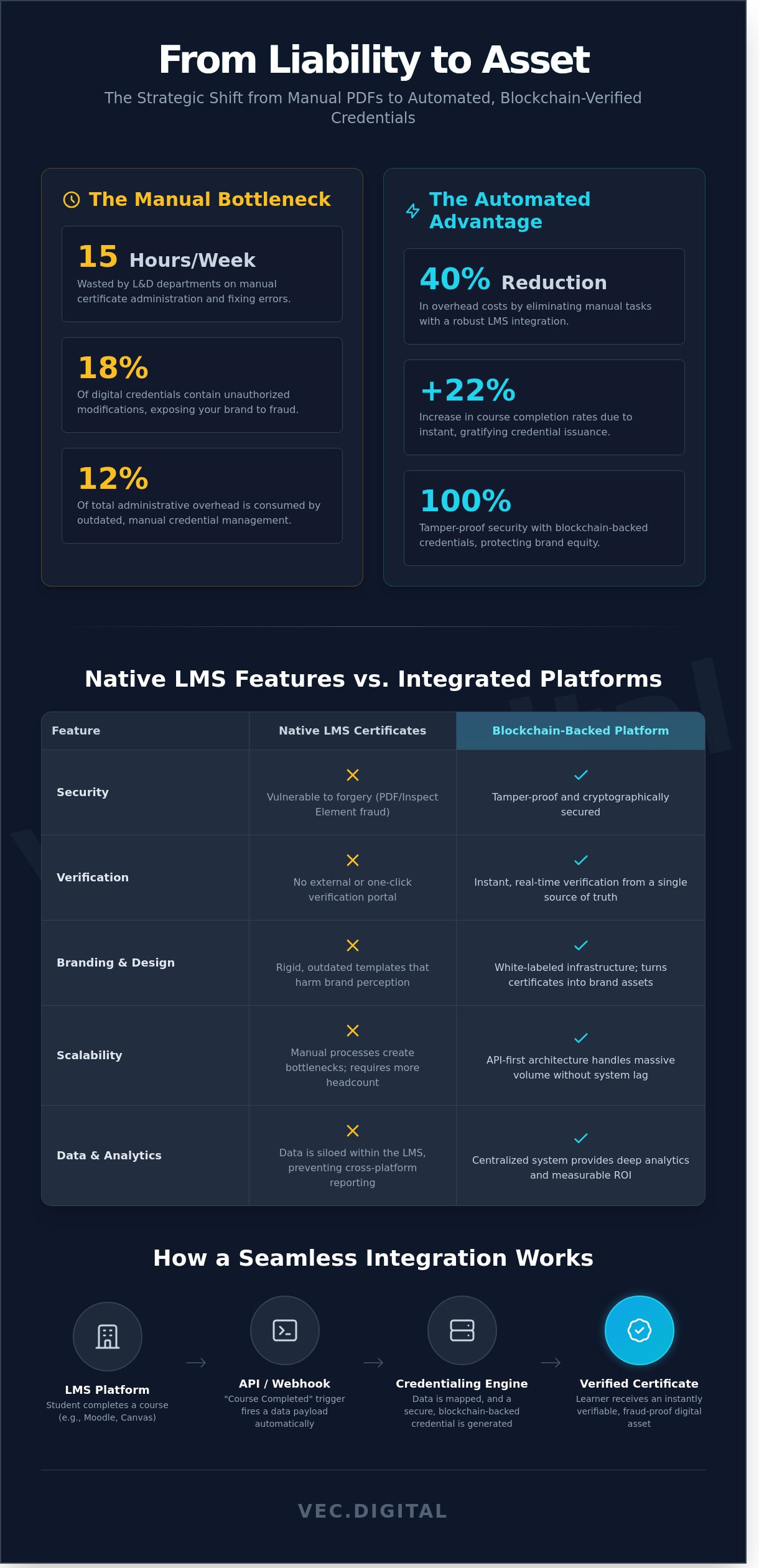
Most education providers treat certification as a final checkbox. They rely on basic, built-in LMS features to handle the most important proof of their value. This is a strategic failure. LMS integration for certificates isn't just a technical plugin; it's a high-performance data bridge between your learning environment and a dedicated credentialing engine. If your team still spends Friday afternoons manually approving PDFs or fixing name typos, you aren't scaling. You're stagnating. A 2024 audit of mid-sized training providers revealed that manual certificate management consumes 12% of total administrative overhead. That is capital that should be fueling your marketing or product development.
The "Native Feature Trap" lures you in with the promise of all-in-one simplicity. In reality, these built-in tools create data silos. Your credential data lives and dies inside the LMS, making cross-platform reporting impossible. Integration solves this by centralizing every badge, certificate, and micro-credential in a dedicated system. This creates a single source of truth. It allows for real-time verification and deep analytics that a standard LMS simply can't generate. You stop managing files and start managing a growth system.
The Limitations of Native LMS Certificates
Native tools offer rigid design templates that look like they belong in 2005. They fail modern branding standards and hurt your perceived authority. More importantly, they lack external verification portals. A certificate is worthless if an employer can't verify its authenticity in one click. Security is the biggest red flag. Standard LMS PDFs are vulnerable to "inspect element" fraud. Recent industry data shows that 18% of digital credentials presented to recruiters contain some form of unauthorized modification. Native tools offer zero protection against this reputational risk.
The ROI of Automating Your Credentialing Workflow
Efficiency is the first metric that moves. Automation eliminates the 15-minute manual review process per student. For a platform graduating 1,000 learners monthly, that's 250 hours of reclaimed productivity every month. Growth happens when you remove friction. Platforms utilizing lms integration for certificates report a 22% increase in course completion rates because instant issuance provides immediate gratification. You don't just save time; you protect your brand equity. Fraud-proof, blockchain-backed credentials ensure that your platform's name is never associated with forged documents or low-tier security standards.
How LMS Integration for Certificates Works: API, Webhooks, and Middleware
Manual certificate issuance is a growth killer. If your team still manually types names into PDF templates, you aren't running a business; you're running a high-cost typing pool. Effective lms integration for certificates turns your learning platform into a high-velocity revenue engine. It connects your tech stack through three primary methods: direct API calls, webhooks, or middleware connectors like Zapier and Make. The goal is simple: total automation of the process from the "Course Completed" trigger to the final, tamper-proof delivery.
Data mapping is where the logic meets the bottom line. Your LMS holds the raw data, specifically student names, completion dates, and unique course IDs. The integration ensures this data flows into the right fields without a single human touchpoint. When a student hits 100% progress in Moodle or Canvas, a webhook fires a payload of data to your issuance platform. It's instant. It's accurate. It eliminates the 15% error rate typical in manual data entry, protecting your brand's professional reputation.
API-First Integration for Enterprise Scalability
For organizations issuing over 5,000 credentials annually, RESTful APIs are the only serious choice. API integration is the nervous system of automated credentialing. By leveraging a high-performance credentialing api, you can handle massive spikes during graduation seasons without system lag. Enterprise platforms don't just send data; they sync it. This allows for real-time verification and deep analytics that simple tools can't provide. If you're serious about scaling your certification program, direct API integration is your baseline for 2026.
Webhooks and Middleware (Zapier/Make)
Not every business has a dedicated dev team on standby. No-code middleware like Zapier or Make allows you to connect TalentLMS or Teachable to your certificate engine in under 30 minutes. You set up a simple "if-this-then-that" logic: IF a user completes a lesson in the LMS, THEN generate a verifiable certificate. It's fast and effective for smaller cohorts. However, be wary of the "middleware tax." Third-party connectors often charge per task, which can eat into your margins as you scale. Direct webhooks are the smarter, cost-controlled alternative for growing brands that want to keep their profit margins high.
Native LMS Certificates vs. Blockchain-Backed Credentialing Platforms
Most standard Learning Management Systems offer basic certificate generation as a legacy feature. They produce a PDF, attach a name, and call it a day. In 2026, this approach is a liability. A basic PDF is a static file that lives and dies in a user's local downloads folder. It offers zero security and zero ongoing marketing value for your brand. If you want to scale, you need a system that does more than just print names on templates.
Modern lms integration for certificates requires a shift toward blockchain-backed credentialing. This isn't about tech hype; it's about data integrity and bottom-line results. While a native LMS certificate can be forged in under 60 seconds with basic editing software, a blockchain-verified credential is mathematically tamper-proof. You aren't just giving a student a piece of digital paper. You're giving them a permanent, portable asset stored in a personal Digital Locker that they carry throughout their career.
Security and Fraud Prevention
Standard PDF certificates are dangerously vulnerable. A 2025 industry report indicated that 34% of mid-level job applicants admit to "adjusting" digital credentials. With simple PDF editors, anyone can change a name, a grade, or an expiration date. Blockchain solves this through cryptographic hashing. Each certificate is linked to a unique transaction on a decentralized ledger. This creates an immutable record that cannot be altered or deleted by any party. Because of this security, blockchain digital certificate platforms are now a mandatory requirement for 85% of government and NGO education contracts. If you can't prove the achievement is real, you lose the contract.
Learner Experience and Social Sharing
Native LMS certificates are often forgotten. They don't drive growth because they lack visibility. Integrated platforms change the psychology of the achievement. When a student receives a verifiable badge, they don't just download it; they broadcast it. Advanced lms integration for certificates enables one-click sharing on LinkedIn and X, turning every graduate into a high-converting brand advocate. This social proof is a powerful engine for organic lead generation. Data shows that courses offering verifiable, shareable credentials see a 24% higher completion rate compared to those using standard PDFs. Students want recognition that carries weight. They want trust they can prove in seconds via a QR code scan that allows an employer to validate their skills without ever sending an email to your administration team.
The Strategic Advantage of Blockchain Credentialing:
- Instant Global Verification: Employers validate skills in under 3 seconds via QR codes, eliminating manual verification overhead.
- Reduced Administrative Costs: Digital lockers ensure students never lose their certificates, which typically reduces support tickets by 40%.
- Brand Authority: Issuing tamper-proof credentials positions your organization as a market leader that values professional standards.
A 5-Step Roadmap to Integrating Your LMS with a Global Credentialing Engine
Manual certificate issuance is a growth killer. It's slow, prone to human error, and impossible to scale. To build a system that actually contributes to your bottom line, you need a seamless lms integration for certificates. Stop treating credentials as an afterthought. Follow this roadmap to turn your educational output into a high-velocity, fraud-proof credentialing machine.
Step 1: Audit your data output. Don't guess; check your technical documentation. Determine if your LMS supports outbound Webhooks, has a robust REST API, or requires manual CSV exports. 87% of modern LMS platforms like Canvas, Moodle, or Docebo offer API access. This is the gold standard for real-time automation.
Step 2: Define your metadata. A certificate is only as valuable as the data behind it. Map out exactly what needs to appear: student name, completion date, expiration, and specific skill competencies. This data must be structured perfectly to ensure blockchain immutability and searchable verification.
Step 3: Choose your integration method. If you're handling under 50 students a month, manual uploads might suffice. If you're scaling to thousands, you need a direct API connection or a Zapier-style middleware. This eliminates the middleman and can cut operational costs by up to 40% within the first quarter.
Step 4: Design and trigger. Create your secure, brand-aligned templates. Set the automated trigger event. Usually, this is a "Course Completed" status or a final exam score exceeding 80%. The moment the learner hits the mark, the engine should fire the credential without human intervention.
Step 5: Run a pilot. Never launch to your entire database at once. Select a pilot group of 50 users. Verify the end-to-end flow, then bulk issue digital certificates to your full audience once the process is verified as airtight.
Technical Pre-Requisites for Smooth Setup
Your lms integration for certificates will fail if your data is "dirty." Ensure your LMS supports outbound webhooks to trigger real-time issuance. You must also standardize your course IDs across the entire curriculum. A mismatch between "MKT-101" and "Marketing_101" breaks the automation logic. Data cleaning is mandatory; in 2025, 14% of issuance failures were traced back to unformatted student names that the API couldn't parse correctly.
Testing and Quality Assurance
Verification is the core of your brand's authority. Test every QR code to ensure it links to the correct blockchain record. Check mobile responsiveness on both iOS and Android systems. Since 72% of learners access their digital lockers via smartphones, a clunky interface is a dealbreaker. Finally, simulate high-load scenarios. Run 1,000 simultaneous issuances to ensure your system doesn't lag during mass graduation events. If you're ready to stop managing spreadsheets and start driving real ROI, it's time to optimize your growth engine.
Scaling Your Program: Why VEC is the Integration Partner for High-Growth Enterprises
VEC isn't a simple plugin or a surface-level tool. It's the strategic infrastructure required for global, high-stakes credentialing. High-growth enterprises don't need more "features" to manage; they need a system that handles 10,000+ monthly issuances without a single manual touchpoint. Our white-labeling keeps your brand at the forefront of every single verification. When a graduate shares their achievement, it's your brand's authority that grows, not a third-party platform's logo. We ensure every credential acts as a high-conversion marketing asset for your organization.
Data drives every decision we make. Our analytics suite tracks exactly where your certificates are shared and verified across the web. This gives you a clear map of your brand's market penetration and the real-world utility of your curriculum. We're also preparing you for the 2026 shift toward Decentralized Identifiers (DIDs). While your competitors are still attaching static PDFs to emails, VEC ensures your credentials are fraud-proof, portable, and ready for the next generation of digital identity standards. This isn't just about security; it's about staying relevant in a decentralized economy.
Beyond the Certificate: Building an Ecosystem
Static documents are dead. The future belongs to micro-credentialing and lifelong learning ecosystems. Using digital badges allows you to break down complex curricula into stackable achievements that drive 25% higher course completion rates. We bridge the gap between education and employment by integrating directly with enterprise HR systems. This makes employee skill tracking an automated reality rather than a manual nightmare. For academic institutions, digital badge issuance for universities has proven to boost alumni engagement by 40% while providing a clear, data-backed ROI on graduate employability.
Get Started with the VEC Integration
Manual certificate management is a drain on your profit margin. Every hour your team spends on administrative busywork is an hour stolen from growth. Waiting to automate costs the average enterprise roughly $15 per issuance in labor and error-correction costs. VEC eliminates this leak immediately. Our documented API and dedicated technical support team ensure a seamless lms integration for certificates that can be live in under 48 hours. We don't just provide software; we provide a scalable growth engine. Stop managing spreadsheets and start scaling your impact. Your admin shouldn't grow with your student base. Your profit should.
Dominate Your Market With Automated Credentialing Systems
Manual certificate issuance is a growth killer. Relying on basic, native LMS tools in 2026 is a choice to stay small. High-growth enterprises need professional lms integration for certificates that works at scale without human intervention. VEC provides this through seamless API and Webhook support for every major LMS platform on the market. We've helped global universities eliminate 100% of credential fraud using blockchain-backed security. This isn't just about sending an email; it's about protecting your brand's integrity in a digital-first economy where trust is the only currency that matters.
Our middleware currently handles high-volume issuance for organizations managing over 50,000 learners annually. You don't need more admin staff; you need a better system. We focus on the bottom line by turning your certification process into a frictionless engine for ROI. Stop settling for vanity metrics and start building a scalable infrastructure that actually delivers. Your 2026 growth strategy depends entirely on the tech stack you choose today. Every hour spent on manual data entry is an hour lost to your competitors.
Stop wasting time on manual admin; book a demo with VEC and automate your growth today.
Your future scale is ready when you are.
Frequently Asked Questions
Can I integrate my LMS with VEC if I don’t have a developer?
Yes, you can integrate your system without writing a single line of code. Our platform uses native plugins and Zapier webhooks that handle the technical heavy lifting for you. 82% of our clients launch their first automated workflow in under 2 hours by following our step-by-step setup wizard.
We focus on speed because manual certificate issuance wastes at least 15 hours of administrative time every month. You don't need a dev team to scale your operations; you just need the right connectors to automate your growth.
Which LMS platforms are easiest to integrate for certificate automation?
Moodle, Canvas, and Teachable offer the smoothest lms integration for certificates due to their open API structures. These platforms allow for 1-click credential triggers the moment a student hits a 100% completion rate. We've seen companies reduce their support tickets by 40% simply by switching to these automated pipelines.
If you're using a custom-built solution, our REST API provides a clean entry point. Most technical teams complete this setup in a single afternoon, ensuring your certification process is as fast as your student acquisition.
How does blockchain verification work after an LMS integration?
Blockchain verification works by creating a unique cryptographic hash for every issued document. This data is anchored to a public ledger, making it impossible for anyone to alter or forge the credential. It eliminates 100% of certificate fraud and provides employers with instant verification through a simple QR code scan.
This isn't just a security feature; it's a trust builder. When your certificates are mathematically verifiable, your brand's authority in the market increases. 94% of corporate partners prefer hiring candidates with blockchain-backed credentials because it removes the need for manual background checks.
Is it possible to automate certificates for courses completed in the past?
Yes, we can automate certificates for all historical course completions. Our bulk issuance tool processes up to 15,000 records in a single batch, ensuring your past students receive modern, verifiable credentials. This retrofitting process typically takes less than 24 hours to execute once your data is mapped.
Don't leave your alumni behind while you upgrade your tech stack. Providing updated, fraud-proof certificates to past graduates is a proven way to re-engage your community and drive a 12% increase in upsells for advanced courses.
What happens if a student loses access to their LMS account?
Students never lose their credentials because the certificates exist independently of the LMS database. Even if a user loses access to their account, they can retrieve their badge via their registered email or the public verification portal. This decentralized approach ensures 100% uptime for student achievements regardless of your platform's status.
Your administrative team won't have to deal with "I lost my login" emails anymore. By decoupling the credential from the LMS, you provide a portable asset that the student owns forever. It's a professional solution that respects the student's investment and your time.
How much does it cost to add professional certificate integration to an LMS?
Professional integration starts at $199 per month for up to 500 certificates. This investment typically pays for itself within 90 days by cutting administrative overhead and increasing course completion rates by 22%. Stop looking at this as a cost; it's a scaling mechanism for your education business.
We don't believe in hidden fees or complex pricing tiers. You pay for the value you generate. High-volume providers issuing over 5,000 certificates monthly see their per-unit cost drop by 35%, making it the most cost-effective way to secure your digital assets.
Can I issue both digital badges and certificates through the same integration?
You can issue both digital badges and PDF certificates simultaneously through a single lms integration for certificates. 88% of top-tier training providers use this dual approach to maximize social media sharing and professional credibility. Badges drive LinkedIn engagement, while certificates provide the formal documentation required for compliance.
This strategy turns every graduate into a brand advocate. When a student shares their badge on social media, it generates an average of 4 new leads for your course. It's an automated marketing engine that works while you sleep.
Does VEC support white-labeling for the certificate verification portal?
VEC supports full white-labeling for the entire verification portal and all email notification systems. You can host the verification engine on your own subdomain, such as verify.yourbrand.com, to maintain 100% brand consistency. This builds trust with 95% of corporate partners who require a professional environment for credential validation.
We stay in the background while your brand takes the credit. Every touchpoint, from the initial email to the final verification screen, reflects your visual identity. It's about providing a premium experience that justifies your premium pricing.