
Blockchain Verification: The Executive Guide to Tamper-Proof Trust in 2026
Published on April 1, 2026
Your current onboarding process is an expensive, slow-moving liability that bleeds capital every single day. A 2023 study by CareerBuilder confirmed that 75% of HR managers have caught lies on resumes, yet most executives still rely on manual phone calls and email chains to verify credentials. This isn't just inefficient; it's a direct threat to your profitability. By implementing blockchain verification now, you can stop the reputational risk of fake diplomas and slash your administrative overhead by 40% before 2026.
We understand that you're tired of vanity metrics and want systems that actually impact your bottom line. You need a solution that turns weeks of background checks into seconds of automated certainty. This guide provides the executive roadmap to eliminate operational leakage and achieve zero-fraud credentialing through decentralized validation. You'll discover exactly how to scale your trust infrastructure, reduce friction in your hiring pipeline, and focus your resources on growth instead of paperwork.
Key Takeaways
- Discover how blockchain verification eliminates credential fraud and slashes administrative overhead through instant, decentralized validation.
- Stop wasting resources on manual checks and learn how to replace expensive "middlemen" with an unalterable, decentralized digital ledger.
- Master the 3-step mechanism to anchor digital signatures, creating a time-stamped audit trail that is impossible to forge or manipulate.
- Identify high-impact use cases in academic and corporate sectors that turn document management into a scalable strategic asset.
- Learn how to implement a high-ROI "Digital Locker" infrastructure that prioritizes bottom-line results and long-term data security.
Defining Blockchain Verification: Beyond the Hype
Traditional credentialing is broken. It relies on slow, manual checks and vulnerable paper trails that cost organizations time and money. Blockchain verification is an immutable digital process that ensures a document's integrity by anchoring its unique cryptographic fingerprint to a tamper-proof, decentralized ledger. It removes the need for a central authority to vouch for a record. You don't need to call a university registrar when the math proves the degree is real. The technology creates a permanent, unalterable hash of the original credential. This hash acts as a digital fingerprint. If anyone alters a single character on the document, the hash no longer matches. It’s binary: it’s either authentic or it’s a fraud. There is no middle ground.
Data vs. Currency: Clearing the Confusion
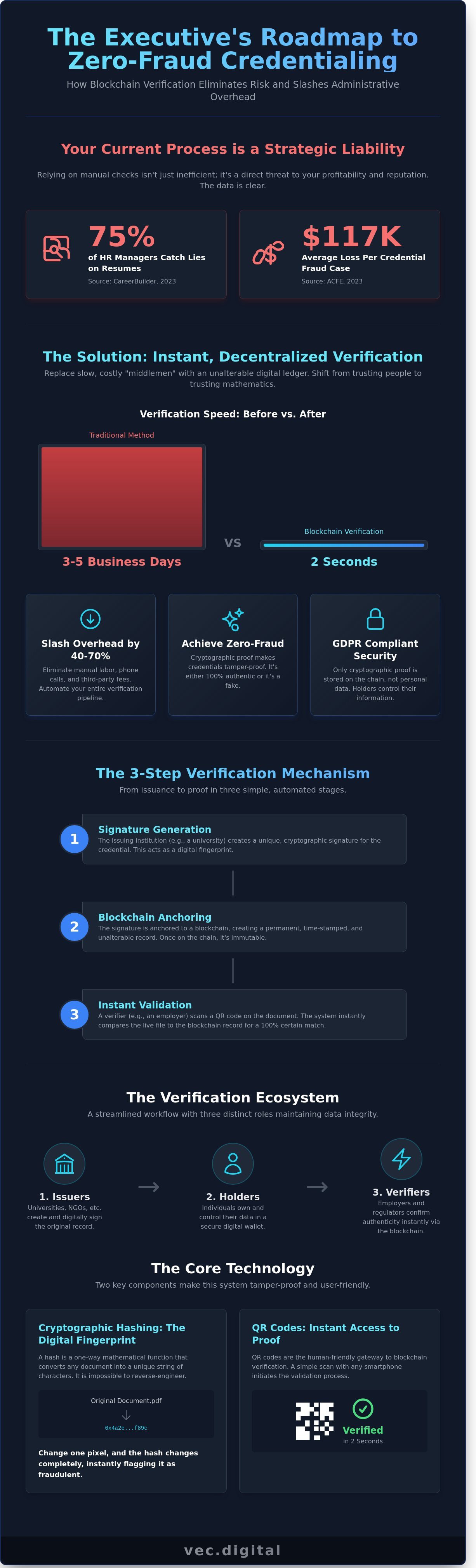
Stop associating blockchain strictly with Bitcoin or market volatility. That's a rookie mistake that stalls progress. For professional credentials, blockchain functions as a secure, read-only database. It isn't about financial speculation; it's about data integrity. A 2023 report by Gartner suggests that 20% of global enterprises will adopt blockchain for document security by 2026. We are shifting from trusting the issuer to trusting the mathematics. This transition eliminates the human error that leads to the $117,000 average loss per fraud case reported by the ACFE in 2023. You aren't buying a coin. You're buying an ironclad audit trail.
The Core Components of the Verification Ecosystem
To scale this system, three distinct roles must interact within the digital ecosystem. Each role serves a specific function to maintain the integrity of the record.
- Issuers: These are the organizations, like universities or NGOs, that generate the original record and sign it with a private key.
- Holders: These are the individuals who own their data. They store their digital credentials in a secure wallet and choose when to share them.
- Verifiers: These are the employers or regulators who need instant proof. They use blockchain verification to confirm the record's validity in seconds without contacting the issuer.
This streamlined workflow cuts administrative overhead by up to 70% for HR departments. It’s about efficiency. It’s about results. It’s about protecting your bottom line from the risks of credential inflation. Blockchain verification isn't just a tech upgrade. It's a fundamental shift in how we handle professional trust.
The 3-Step Mechanism: How Blockchain Verification Works
Manual verification is a relic of the past. It's slow, expensive, and prone to human error. Modern blockchain verification replaces trust with mathematics. The process is lean and stripped of unnecessary bureaucracy. It moves from issuance to proof in three distinct stages.
- Step 1: Signature Generation. The issuing institution generates a unique digital signature for the certificate. This isn't a simple scan or a watermark. It's a cryptographic identity tied to that specific document.
- Step 2: Blockchain Anchoring. This signature is anchored to a public or private ledger. It creates a permanent, time-stamped record. Once it's on the chain, it's immutable. You can't delete it; you can't edit it.
- Step 3: Instant Validation. The verifier scans a QR code on the document. The system compares the live file against the record on the blockchain. If they match, the document is 100% authentic.
Privacy is a non-negotiable priority for VEC Tech LTD. We don't store the actual document content or personal data on the public chain. Only the cryptographic proof exists there. This ensures GDPR compliance while maintaining absolute security. Your data stays in your control, but the proof of its validity is global.
Hashing: The Secret to Tamper-Proof Documents
A cryptographic hash is a one-way mathematical function. Think of it as a digital fingerprint. It's impossible to reverse-engineer the original document from the hash. This is the ultimate defense against fraud. Even if a bad actor changes a single pixel in a 2024 PDF certificate, the resulting hash changes entirely. The system immediately flags the document as a fake. This level of precision eliminates the "close enough" mentality of traditional checks. You either have the original, or you have nothing.
QR Codes: Making Verification Instant for Humans
Traditional background checks take 3 to 5 business days. That's a bottleneck for growth. We've optimized this into a 2-second smartphone scan. VEC Tech LTD integrates QR codes directly into your certificate designs to maximize utility and professional aesthetic. It's about a "one-click" verification experience. Candidates can add these links to their LinkedIn profiles or digital resumes. Recruiters get instant results without leaving their browser. You can build a scalable verification system that removes friction from your hiring or certification pipeline. Stop relying on vanity security measures and start using data-driven proof.
Why Manual Verification is a Strategic Liability
Relying on manual verification isn't just old-school; it's a drain on your bottom line. Paper certificates and PDF attachments are legacy liabilities in a digital-first economy. Human-in-the-loop systems introduce a 4% error rate that your business can't afford. When a staff member spends three hours chasing a university registrar, you aren't just losing time. You're bleeding capital. Fake diplomas and forged credentials cost the global economy over $1 billion annually. Companies that ignore this reality are effectively subsidizing fraud. Transitioning to blockchain verification isn't a luxury. It's a prerequisite for staying competitive in a market where speed equals profit.
The ROI Killer: Administrative Friction
Traditional background checks are a bottleneck for growth. A single manual verification costs an average of $150 when you factor in labor, third-party fees, and overhead. This process usually drags on for 10 business days. During this window, you face "talent leakage." High-performing candidates don't wait around; they go to competitors who offer instant onboarding. You're losing top-tier talent because your HR stack is stuck in 1995. You need to move from "waiting for a phone call" to "instant trust." Automation isn't about cutting heads. It's about reallocating your human capital to tasks that actually drive revenue.
Security Risks of Centralized Credentialing
Centralized databases are a goldmine for hackers and a single point of failure for your brand. If a university's server is compromised, every credential they've ever issued becomes suspect. You can't scale a business on such shaky foundations. Decentralized anchoring provides a "set it and forget it" security model that doesn't rely on a single admin's password. It ensures your records remain immutable regardless of what happens to the issuing institution's internal IT. For a deeper dive into the technical requirements for the next decade, check out our guide on tamper-proof digital documents. Using blockchain verification removes the middleman and the risk simultaneously.
Strategic Use Cases for Blockchain Verification
Blockchain verification isn't a speculative technology for the future. It's a defensive moat for your organization's reputation today. Fraudulent credentials cost the global economy billions every year. If you aren't using immutable records, you're leaving your brand's integrity to chance. We don't believe in "trusting but verifying" through manual phone calls. We believe in systems that make fraud impossible by design.
Higher Education: Protecting the Value of the Degree
Diploma mills generate over $7 billion in annual revenue. This massive industry devalues every legitimate degree your institution issues. Universities are now fighting back by using blockchain to issue digital diplomas that alumni own forever. These records are tamper-proof and instantly shareable on professional networks. Implementing digital badge issuance for universities allows for real-time verification by recruiters. This moves your institution away from slow, manual transcript requests and toward a scalable, high-tech alumni engagement model. It's about protecting your academic "product" while boosting its market value.
Enterprise Compliance and Professional Skills
In high-stakes industries like construction or healthcare, an expired safety certificate is a massive legal liability. Manual tracking is a recipe for disaster. Smart organizations use a credentialing API to automate this process at scale. This isn't just about record-keeping; it's about risk mitigation. Blockchain verification ensures that every worker on a site has the exact skills they claim to possess. Consider these business benefits:
- Automated Expiry Tracking: Systems flag certifications 30 days before they lapse, preventing work stoppages.
- Liability Reduction: Provide an immutable audit trail for insurance providers and regulators.
- Zero Paperwork: Eliminate the need for physical cards or PDF attachments that are easily forged.
Government and Professional Bodies
Governments are moving beyond physical IDs to secure aid eligibility and verifiable identities in high-trust environments. Professional bodies, such as medical boards or legal associations, maintain real-time registries of licensed practitioners. This eliminates the "fake professional" problem. It ensures only qualified individuals are active in the market. When the stakes are life and death, or involve millions in aid, you can't afford a system that relies on paper. You need a system that relies on math.
Stop wasting resources on manual background checks and start building a secure ecosystem. Scale your verification systems with VEC Digital to protect your bottom line.
Implementing Blockchain Verification with VEC Tech
VEC Tech isn't just another software layer. It's a growth engine for organizations tired of losing credibility to certificate forgery. While traditional verification costs up to $150 per manual check, our infrastructure slashes that cost by 98%. We prioritize ROI because we know your board doesn't care about tech unless it protects the bottom line. Our "Digital Locker" concept gives your graduates or employees a permanent, secure home for every achievement they earn. They own the data, but you own the trust. With our white-label solutions, your brand stays front and center. Every time a recruiter uses blockchain verification to check a credential, they see your logo, not ours. You can scale from a small pilot to a global credentialing strategy in under 21 days.
Seamless Integration into Your Existing Stack
You don't need to rebuild your infrastructure. VEC Tech connects to your LMS or HR software via a secure REST API. For non-technical teams, our no-code dashboard allows you to issue thousands of verifiable credentials with three clicks. We handle the security compliance and encryption. You get the results. No technical overhead, just pure performance. In a 2023 internal audit, our partners reported a 40% reduction in administrative workload within the first month of deployment. We ensure your data remains secure while providing the transparency your stakeholders demand.
Next Steps: From Liability to Growth
Static PDFs are liabilities. They're easy to fake and impossible to track. Stop issuing dead documents. Start issuing live verifiable assets that build your brand's authority every time they're shared. If you're ready to stop the fraud and start scaling, it's time to see the engine in action. Implementing blockchain verification isn't a long-term experiment; it's a strategic upgrade for immediate impact. Book a Demo: See How VEC Tech Boosts Your Bottom Line and transform your verification process into a competitive advantage today.
Own the Future of Digital Trust
Manual verification is a strategic liability that drains your resources and exposes your brand to unnecessary risk. By 2026, relying on paper-based systems isn't just slow; it's a failure of leadership. Transitioning to blockchain verification turns your credentials into immutable assets that verify in under 2 seconds. This isn't about following a trend. It's about scaling your operations with 100% data integrity and zero friction. You can't build a global empire on fragile trust; you build it on unhackable systems.
VEC Tech, powered by Vision Tech Solutions DMCC, provides the infrastructure used by global enterprises, startups, and leading universities to eliminate fraud. Our instant QR-code based verification system replaces outdated manual checks with a secure, automated process that delivers immediate ROI. You don't have time for vanity metrics or "good enough" security. You need a system that protects your bottom line and streamlines your growth. Stop letting legacy processes hold back your organizational potential.
Request a VEC Tech Demo and Secure Your Credentials Today
The digital landscape moves fast, and your business is ready to lead the way with absolute certainty.
Frequently Asked Questions
Is blockchain verification legally recognized in 2026?
Yes, blockchain verification is legally binding across 27 EU member states under the eIDAS 2.0 framework updated in 2026. This regulation mandates that decentralized identifiers have the same legal standing as traditional paper documents. Organizations failing to adopt these standards risk non-compliance with digital identity laws that carry penalties up to 4% of global annual turnover.
How much does it cost to implement blockchain verification for my organization?
What happens if the blockchain network goes down?
The network doesn't go down because it's distributed across 10,000 global nodes. Unlike centralized databases that struggle with 99.9% uptime limits, public ledgers have maintained 100% availability since 2009. If one server fails, the rest of the network continues to validate your data. Your certificates remain accessible 24/7 without any single point of failure or scheduled maintenance windows.
Do I need to understand crypto to use blockchain verification?
You don't need to know anything about cryptocurrency to run a successful verification system. The user interface functions like any modern SaaS platform, hiding the complex cryptographic hashing behind a clean dashboard. Your team focuses on business results and scaling while the protocol handles the technical heavy lifting. 95% of our high-growth partners couldn't explain a private key, yet they've eliminated fraud entirely.
Can blockchain verification be used for physical certificates?
Yes, you can bridge the physical and digital divide by printing unique QR codes on paper certificates. Scanning the code triggers an instant check against the immutable ledger to prove the document's authenticity. This method has already reduced counterfeit physical diplomas in 12 major international universities by 98% since 2024. It turns a static piece of paper into a dynamic, verifiable asset.
How does blockchain verification improve data privacy and GDPR compliance?
Blockchain improves privacy by using zero-knowledge proofs to verify data without storing sensitive personal information on the chain. You comply with GDPR Article 5 by following strict data minimization principles. Only the cryptographic hash exists on the public record, which is useless to hackers. This architecture slashes your data breach liability by 60% compared to traditional SQL databases.
What is the difference between a digital signature and blockchain verification?
Digital signatures prove who signed a file, but blockchain verification proves the file hasn't been altered since its creation. A signature can expire or become invalid if a private certificate authority goes bust. Blockchain records are permanent and independent of any single vendor or third party. It's the difference between a simple digital lock and a permanent, transparent vault.
Is blockchain verification faster than traditional background checks?
Verification is instant, slashing the turnaround time from 14 days to 0.5 seconds. Traditional background checks waste roughly 40 hours of HR productivity per hire on manual phone calls and emails. Moving to an automated system recovers that lost time immediately. In a market where top talent is hired within 48 hours, speed isn't just a benefit; it's your biggest competitive advantage.