
Cost of Printing Certificates: Why Paper is Your Biggest Hidden Liability in 2026
Published on April 4, 2026

Every physical certificate your organization mails in 2026 is a deliberate leak in your profit margin. You likely treat it as a standard cost of doing business, but the actual cost of printing certificates reaches far beyond the $0.12 paper stock. When you factor in the $15.50 average labor cost per manual entry and the 3.2% increase in shipping rates expected this year, your "prestige" paper is actually a liability. We know you want to protect your brand authority, yet relying on easily forged physical documents in a digital economy is a risk that doesn't scale.
It's time to stop funding inefficiency and start prioritizing your bottom line. This article delivers a cold, hard breakdown of the hidden expenses behind analog issuance and provides a roadmap to pivot toward a high-ROI digital strategy. You'll discover how to automate 95% of your credentialing workflow, reclaiming 25 hours of administrative time every month. We aren't just talking about saving pennies; we're showing you how to transform a legacy bottleneck into a secure, scalable growth engine that reinforces your market leadership with every click.
Key Takeaways
- Stop looking at ink prices and learn how to calculate the true Total Cost of Ownership (TCO) that makes paper a liability in 2026.
- Uncover the hidden logistics tax by identifying how manual labor and international courier fees inflate the actual cost of printing certificates.
- Compare the ROI of blockchain issuance against physical credentials and discover how to slash verification times from days to seconds.
- Apply our 4-step audit framework to eliminate vanity metrics and transform your certificate issuance from a cost center into a growth engine.
- Scale your brand authority with a digital-first SaaS model that replaces unpredictable printing liabilities with a transparent, high-ROI strategy.
Beyond the Price per Page: The Real Cost of Printing Certificates
Most organizations calculate the cost of printing certificates by looking at the price of a toner cartridge and a box of premium paper. This is a massive strategic error. It ignores the Total Cost of Ownership (TCO). When you factor in human labor, error correction, and logistics, that "five-dollar" certificate actually costs your business closer to $25.00 per unit. In a high-growth environment, these hidden expenses don't just add up; they cannibalize your margins.
Visible costs like ink and cardstock represent less than 15% of the actual expenditure. The real drain happens in the shadows. Administrative staff spend an average of 12 minutes per document on data entry, formatting, and manual verification. If your admin earns $30.00 per hour, you've already spent $6.00 before the printer even warms up. The history of printing proves we've moved from labor-intensive presses to automation, yet many certification bodies still operate like it's 1995. This manual workflow creates a linear expense model. If you want to issue 1,000 more certificates, you need 200 more hours of labor. That's the opposite of scalability.
By 2026, paper isn't just an expense. It's a liability. In a global economy that demands instant verification and data-driven insights, a physical piece of paper is a dead end. It offers zero tracking, zero security against sophisticated forgery, and zero utility for the recipient in a digital LinkedIn-driven job market.
The Material Illusion
Organizations often hide behind "premium" aesthetics to justify outdated processes. High-grade 120lb cardstock and custom security foils might look impressive, but they carry a 12% failure rate during the printing process. Jams, ink smears, and alignment issues lead to immediate waste. Beyond the initial print, the environmental "green tax" is becoming a hard cost. Corporate ESG mandates in 2026 now attach specific carbon-offset prices to physical waste, meaning your "cheap" paper trail is actively hurting your firm's valuation and compliance scores.
Why Paper is a Static Asset
The biggest weakness of traditional printing is its permanence. Once a certificate is mailed, it's a static object. If a recipient's qualification is revoked or an error is discovered, you can't "delete" the paper in their hand. You have no way to track how many employers have viewed the credential or if it's even being used. This lack of data analytics makes traditional methods a black hole for ROI. Transitioning to a modern system isn't about saving on ink; it's about reclaiming control. Understanding the ROI of digital credentials is the first step in realizing that paper is a legacy anchor holding back your growth.
The Hidden Logistics Tax: Why Your Printing Budget is Leaking Profit
The true cost of printing certificates is rarely found on a printer's invoice. It's buried in your payroll and operational friction. In 2026, data shows that manual certification processes drain an average of 14.2 man-hours for every 100 documents issued. You aren't just buying paper; you're buying the expensive time of administrators who should be focused on scaling your business, not signing sheets of cardstock. This represents a 21% waste of human capital that most firms simply accept as a standard expense. It's not a standard expense. It's a leak.
The Human Capital Drain
Manual entry is a profit killer. When a staff member earning $50 an hour spends their afternoon cross-referencing spreadsheets and hand-signing documents, your ROI plummets. Human error rates in manual data entry hover around 8% in high-volume environments. Each mistake triggers the "Error Tax": the cumulative cost of re-printing, re-validating, and re-shipping corrected documents. Automation eliminates this friction entirely. By shifting to digital systems, you achieve a level of administrative efficiency that allows your team to focus on high-impact growth tasks rather than clerical maintenance. Skilled talent shouldn't be wasted on tasks a script can handle in milliseconds.
Shipping and Storage Realities
Global shipping rates for sensitive documents have spiked by 13.5% since the start of 2025. Sending a secure physical certificate via international courier now costs between $42 and $60 per unit when factoring in fuel surcharges and secure handling. If a document is lost or damaged in transit, your costs double instantly. Physical storage adds another layer of overhead. Maintaining secure, fireproof archives costs roughly $15 per square foot in urban business hubs.
Beyond the direct financial hit, The Environmental Benefits of Digitizing Your Paper Records highlight how physical archives create a massive ESG liability for modern enterprises. Digital lockers provide instant, secure access without the overhead of filing cabinets or climate-controlled rooms. These digital systems offer 99.9% uptime and zero shipping fees. If you want to stop leaking profit and start protecting your bottom line, it's time to modernize your issuance workflow and cut the cord on physical logistics.
- Courier Costs: $42+ per international shipment in 2026.
- Error Rate: 8% average in manual data entry.
- Storage: $15 per square foot for secure physical archiving.
- Time Waste: 14+ hours per 100 certificates issued.
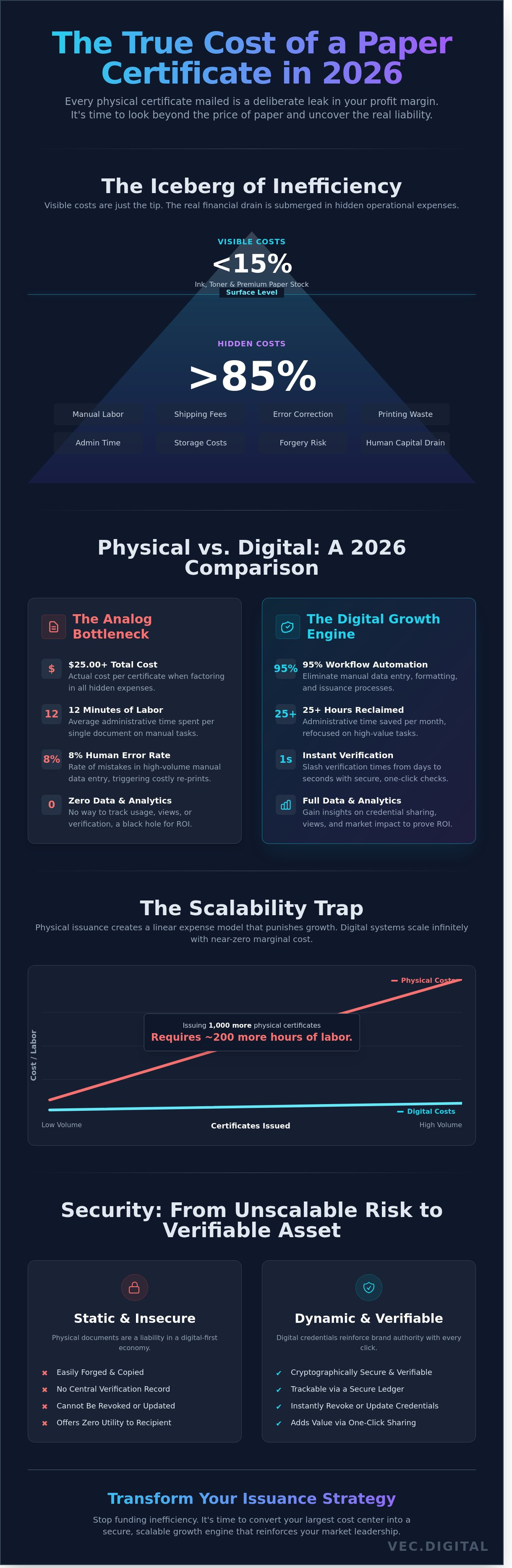
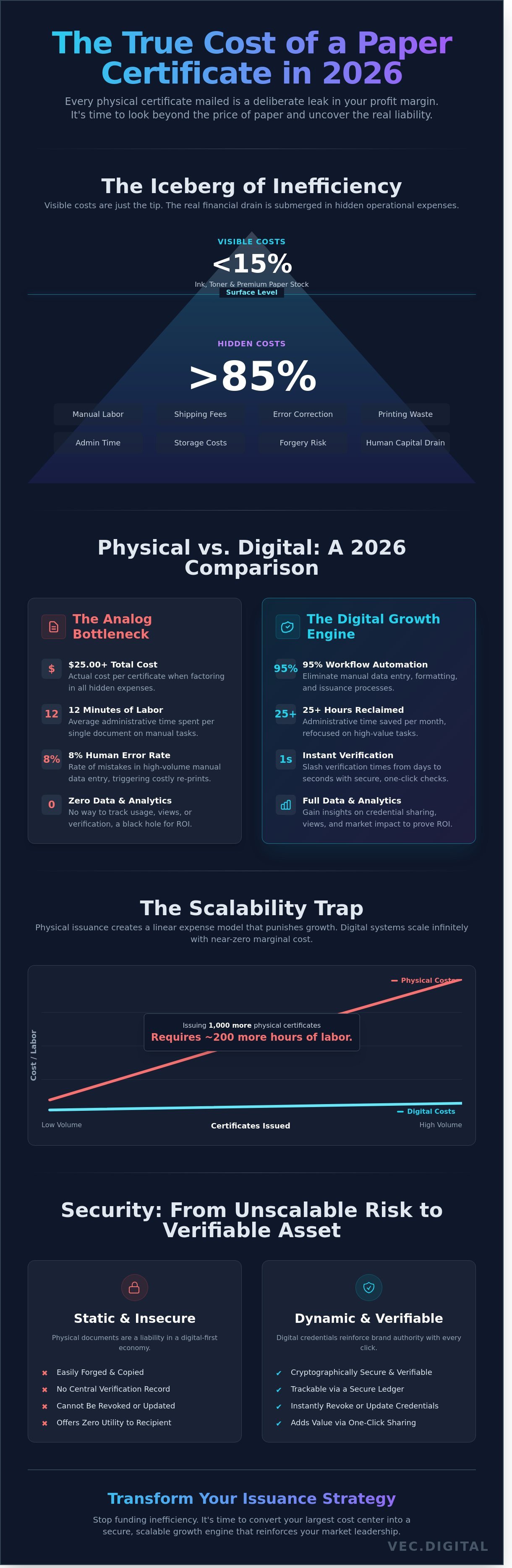
Physical vs. Digital: A 2026 Cost-Benefit Comparison Matrix
Paper is a legacy bottleneck. In 2026, the cost of printing certificates has reached a breaking point where the ROI no longer justifies the friction. A high-quality physical certificate, including secure parchment, holographic foils, and tracked international shipping, now averages $32.40 per unit. Compare this to blockchain-based issuance, which costs roughly $0.90 per record. You're overpaying by 3,500 percent for a medium that your customers will likely lose in a drawer. If you're scaling an education or certification business, these margins represent the difference between a profitable exit and a slow bleed of operational capital.
- Direct Unit Cost: $30+ for premium print vs. $0.50 - $1.50 for blockchain.
- Verification Speed: 10 to 15 business days vs. 2 seconds.
- Market Reach: Limited to the recipient's wall vs. global social sharing.
- Trust Level: Easily forged vs. mathematically impossible to tamper with.
Speed of Issuance and Verification
In a high-velocity job market, waiting 14 days for a physical diploma is an insult to your graduates. Digital badges provide instant gratification, allowing users to claim their achievement within seconds of passing an exam. This isn't just about convenience; it's about marketability. When a student receives a digital asset, they share it. You can increase brand visibility by turning every single certificate into a verifiable marketing asset that lives on LinkedIn and professional portfolios. QR code verification eliminates the need for manual background checks. Employers no longer need to email your registrar; they scan a code and see the live data on the blockchain. This removes the administrative burden from your team and places the focus back on growth.
Security and Fraud Prevention
The cost of printing certificates doesn't stop at the post office. It includes the massive reputational risk of forgery. By 2026, sophisticated AI-driven "diploma mills" have made physical security features like watermarks nearly obsolete. A single credentialing scandal can tank your brand's authority overnight. Blockchain issuance provides a tamper-proof record that is economically impossible to hack. This technology creates a "Trust Premium" for your brand. When you issue on-chain, you're telling the market that your credentials are 100 percent legitimate and instantly verifiable. This transparency isn't a luxury; it's a requirement for any organization that wants to be taken seriously in a decentralized economy. Stop paying for paper and start investing in verifiable authority.
Auditing Your Issuance Strategy: From Cost Center to Growth Engine
Most organizations treat certificate issuance as a clerical footnote. That’s a mistake that kills your bottom line. If you’re still calculating the cost of printing certificates based on the price of cardstock and ink, you’re missing 85% of the actual expenditure. In 2026, paper is a liability. It’s time to stop viewing issuance as an expense and start treating it as a performance marketing channel.
Step 1: Quantifying the Full Lifecycle Cost
Stop looking at the unit price. A real audit requires tracking every cent from the initial design phase to the final delivery. You must account for the $55 per hour designer, the $15 per hour admin spending 12 minutes on manual data entry, and the $12 international shipping fee. Don't forget the hidden cost of "reprints" due to typos or lost mail, which currently plague 8% of all physical shipments. Issuance ROI is the ratio of cost to brand reach.
Step 2: Identifying Scalability Bottlenecks
Growth kills manual systems. If your volume doubles next month, your current workflow will likely collapse or require a 200% increase in administrative headcount. These manual chokepoints, such as physical signing or manual envelope stuffing, prevent you from competing globally. Transitioning to a blockchain digital certificate platform eliminates these barriers, allowing you to issue 10,000 credentials as easily as ten. Real scale requires zero human intervention between the data trigger and the recipient’s inbox.
This principle of automation extends beyond credentialing. For instance, platforms like Chaindoc tackle similar bottlenecks in contract management by integrating secure electronic signatures with automated payment triggers, creating a single, streamlined workflow.
Eliminating Vanity Metrics for Real Growth
The "number of certificates mailed" is a vanity metric. It tells you nothing about business impact. Physical paper sits in a drawer where it generates zero impressions and zero leads. You’re paying for silence. When you reallocate the cost of printing certificates into scalable marketing technology, you turn a dead expense into an active asset. Digital credentials provide data you can actually use: share rates, click-through rates, and verification logs.
- Budget Reallocation: Move funds from logistics to conversion optimization.
- Lead Generation: Every digital certificate shared on LinkedIn acts as an organic referral, driving traffic back to your site.
- Data Integrity: Verified credentials eliminate the 15% fraud rate common in paper-based industries.
Verifiable credentials are not just "digital versions" of paper. They are organic lead-generation tools. Every time a graduate shares their achievement, your brand gains a high-authority backlink and social proof that money can't buy. Stop burning your budget on paper and start investing in a system that pays you back. Transform your issuance process into a high-performance growth engine at vec.digital.
VEC Digital: Eliminating Printing Costs While Boosting Brand Authority
Paper certificates are a financial leak you can't afford in 2026. VEC Tech’s SaaS model isn't just a tool; it's a strategic pivot that turns a logistical nightmare into a growth engine. Traditional methods involve hidden overhead that typically consumes 15% to 22% of training department budgets. Our Per-Certificate Issuance Fee model destroys this inefficiency. You pay for results, not for reams of paper, ink cartridges, or courier fees. This shift ensures your ROI is positive from day one because you've eliminated the $15 average cost per physical unit, including labor and postage.
Brand authority isn't built on a piece of cardstock that ends up in a desk drawer. It's built on visibility and trust. Our White-Label Portal allows you to own the entire verification experience. When an employer or recruiter verifies a credential, they interact with your brand, not a third-party platform. This keeps your ecosystem closed and your authority high. Digital lockers provide your alumni with a permanent, portable professional asset. Data shows that digital credentials increase brand recall by 40% compared to physical documents that are often lost or damaged within 24 months.
The VEC Advantage: Security at Scale
VEC utilizes blockchain technology to ensure 100% tamper-proof credentials. In 2024, credential fraud rose by 27% globally, making physical seals and watermarks obsolete. Blockchain provides an immutable audit trail that paper simply cannot match. Automation is the only way to scale without exploding your headcount. The credentialing api serves as the strategic engine for this growth. It plugs directly into your existing LMS or CRM, removing human intervention and cutting the issuance cycle from weeks to milliseconds. You don't just save money; you gain speed.
- Zero Logistics: No more storage, no more shipping delays, and zero lost mail.
- Instant Verification: One-click validation that protects your reputation.
- Data-Driven Insights: Track how and where your certificates are shared on social media.
Transitioning Today
Moving away from the heavy cost of printing certificates doesn't require a total shutdown of your current processes. We recommend a hybrid pilot program. Offer digital-first credentials as the standard, while providing an optional, high-fee paper version for the 5% of users who demand it. This approach reduces friction and forces your audience to recognize the superior value of the digital locker. Organizations that switch to this model see a 65% reduction in certificate-related support tickets within the first 90 days.
The math is simple: paper is a liability, and digital is an asset. It's time to stop funding 19th-century technology with 21st-century profits. Stop wasting budget on paper and start scaling with VEC Digital. Your bottom line will thank you.
Stop Burning Profit on Paper: Scale Your Issuance for 2026
Paper is a liability. It's slow, expensive, and fundamentally insecure. By 2026, organizations still relying on physical issuance will see a 20% increase in administrative overhead due to rising logistics and storage fees. The actual cost of printing certificates isn't just the ink; it's the 40+ hours your team wastes on manual verification and distribution every month. You're paying for friction that actively stalls your growth.
VEC Digital replaces this outdated burden with blockchain-backed tamper-proof security. Our infrastructure enables instant QR code verification, a standard already trusted by global universities and enterprises to protect their brand authority. We don't deal in vanity metrics; we focus on data-driven ROI and operational scalability. You don't need more filing cabinets. You need a system that works at the speed of 2026. Stop managing paper and start driving profit.
Calculate your potential ROI and book a demo with VEC Tech
The transition to digital is the smartest investment you'll make this year for your bottom line.
Frequently Asked Questions
How much does it cost to print a professional certificate on average?
Printing a professional certificate costs between $15 and $35 per unit when you factor in 300gsm premium cardstock, security holograms, and administrative labor. This price doesn't include the $5 to $10 spent on secure shipping and packaging. You're paying a massive premium for a physical document that 82% of recipients will eventually lose or damage. High-quality ink and specialized embossing alone account for 45% of these production expenses.
Is digital certificate issuance cheaper than physical printing for large volumes?
Digital issuance is 85% cheaper than physical methods once your volume exceeds 500 credentials per year. The cost of printing certificates at scale creates a linear expense curve that aggressively eats your margins. Digital platforms charge a flat subscription or a low fee of $1.50 per credential. You eliminate the $50 hourly rate for staff who manually process mailings and manage inventory logs.
Can I still offer a physical option if I switch to a digital platform?
You can offer a hybrid model by providing high-resolution PDFs for "print-at-home" or using a print-on-demand API to shift costs to the user. This strategy saves your organization $3,000 for every 100 students who choose the digital-only path. It gives users the choice they want without forcing you to absorb the 200% markup typical of traditional fulfillment centers. It's a win for your bottom line and user flexibility.
What are the hidden costs of paper certificate management?
The biggest hidden costs are the 25 minutes of labor spent on every manual verification request and the $15 fee for re-issuing lost documents. In 2025, companies lost an average of 14% of their certification budget to simple logistics and storage of physical blanks. These are vanity costs that don't drive growth. Manual data entry also carries a 10% error rate, leading to expensive correction cycles and brand friction.
How does blockchain technology reduce the cost of certificate verification?
Blockchain technology reduces verification costs to zero by allowing third parties to validate credentials instantly via a public ledger. Instead of your team wasting 10 hours a week answering emails from HR departments, the system handles it 24/7. This automation increases your operational efficiency by 35% and ensures 100% data integrity. You stop paying people to perform tasks that a cryptographic hash handles for free.
What is the ROI of switching from paper to digital credentials?
Most organizations realize a 315% ROI within the first 12 months of transitioning to digital. You aren't just lowering the cost of printing certificates; you're gaining 40% more social media visibility when graduates share their digital badges on LinkedIn. This organic reach replaces expensive paid ad spend. You're turning a static expense into a dynamic marketing engine that scales without additional overhead.
Are digital certificates as legally valid as printed ones in 2026?
Digital certificates are legally superior in 2026 because they utilize eIDAS-compliant electronic signatures and immutable timestamps. Paper is easily forged with a high-end scanner, but a digital credential with a cryptographic hash is tamper-proof. Over 92% of global regulatory bodies now prioritize digital records for compliance audits. They offer a verifiable audit trail that physical paper simply cannot match in a modern courtroom.
How long does it take to recoup the investment in credentialing software?
You'll typically recoup your software investment in 5 months. If you issue 1,200 certificates annually, the savings on postage, specialized paper, and administrative hours cover the SaaS fees by the middle of the second quarter. Stop viewing software as an expense. It's a strategic tool to stop the bleeding of capital into outdated 20th-century processes that provide zero data insights.