
Digital Badges for Corporate Training: The 2026 Guide to Verifiable ROI
Published on April 8, 2026

Stop treating your L&D budget like a charitable donation. Most companies lose 70% of their training investment within 24 hours because they can't prove their employees actually retained the knowledge. If your only "proof of skill" is a static PDF certificate, you're not building a high-performance workforce; you're just collecting digital paperweights. It's time to stop the bleed and implement digital badges for corporate training to start scaling your human capital with surgical precision.
We agree that traditional training data is siloed, easily forged, and often completely disconnected from your bottom line. This guide will show you how to transform learning into a blockchain-secured, verifiable asset that drives a 25% increase in employee retention according to recent industry benchmarks. You'll learn how to replace useless vanity metrics with a fraud-proof skill inventory that provides real-time insights into your company's actual growth potential. We are breaking down the 2026 roadmap for turning corporate education from a cost center into a high-performance ROI engine that fuels global scalability.
Key Takeaways
- Stop wasting budget on meaningless digital stickers and learn how to implement metadata-rich digital badges for corporate training that serve as verifiable business assets.
- Discover why blockchain-backed verification is the only way to eliminate credential fraud and provide employees with a secure, permanent "Digital Locker" for their achievements.
- Shift your focus from "vanity metrics" like course completion to measurable ROI, using verifiable credentials to drive employee retention and long-term growth.
- Learn the strategic framework for building high-impact learning pathways that map directly to your core business objectives and functional mastery.
- Find out how to scale trust across a global organization using VEC’s enterprise-grade infrastructure designed for results, not just participation.
Beyond Digital Stickers: What Digital Badges for Corporate Training Really Are
Stop thinking about digital badges as "participation trophies" for the Zoom era. They aren't stickers. They're high-performance data tools. By 2026, using digital badges for corporate training has evolved from a "nice-to-have" into a hard requirement for tracking verifiable ROI. If your organization still treats recognition as a decorative icon, you're leaving money on the table. To understand what are digital badges?, you have to look beneath the surface layer. They're metadata-rich credentials that prove a specific skill was mastered, not just that a seat was warmed.
The distinction between badges and digital certificates is tactical. Certificates represent a moment in time, often tied to compliance or course completion. Badges represent a portable, granular skill. Employees in 2026 demand portability. They want credentials they can carry across their career ecosystem, from LinkedIn profiles to internal talent marketplaces. This shift marks the end of the "attendance-based" era. We've entered the "skill-based" economy where 75% of HR leaders now prioritize verified competencies over traditional job titles, according to 2025 industry benchmarks.
The Anatomy of a Verifiable Badge
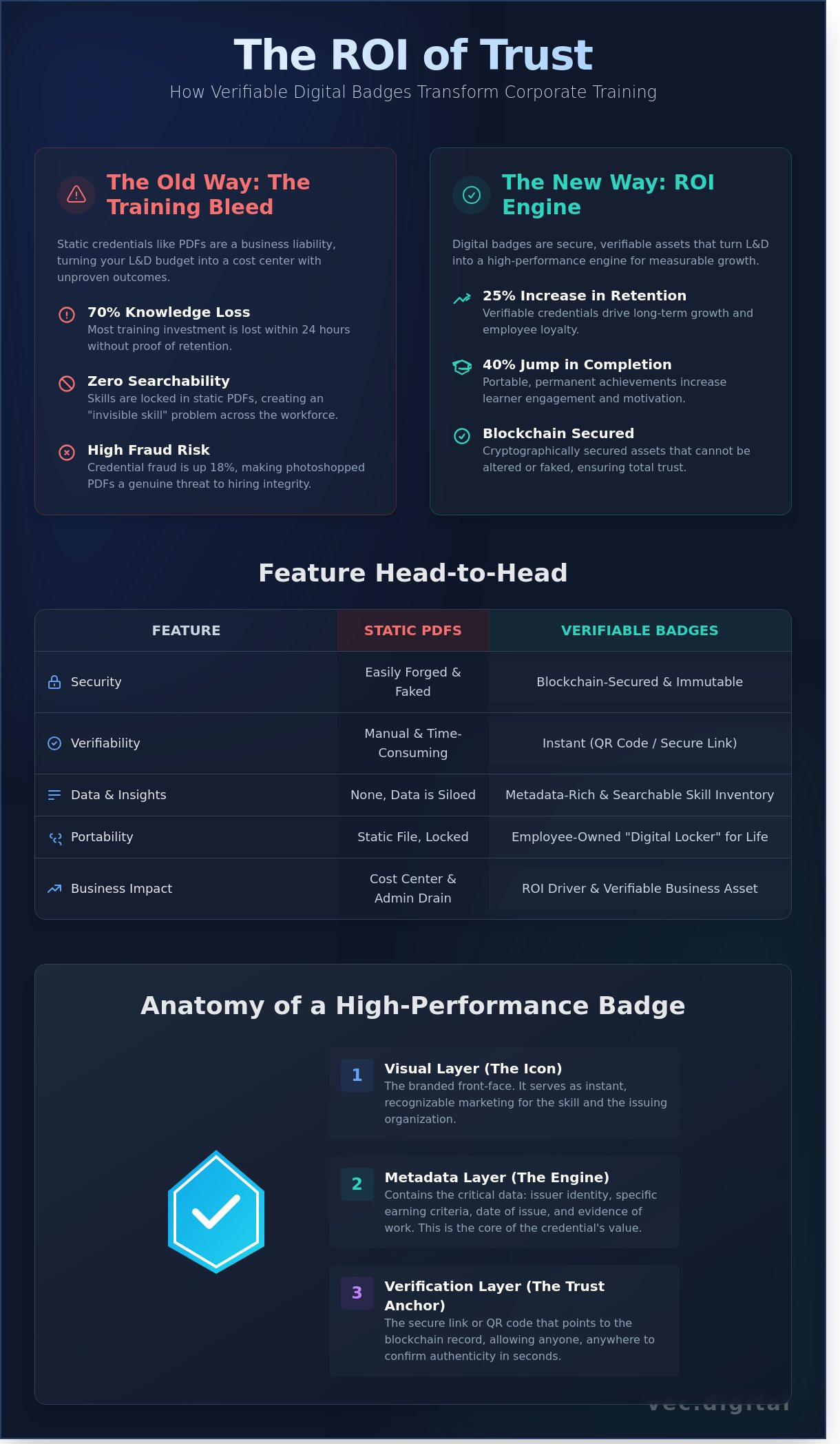
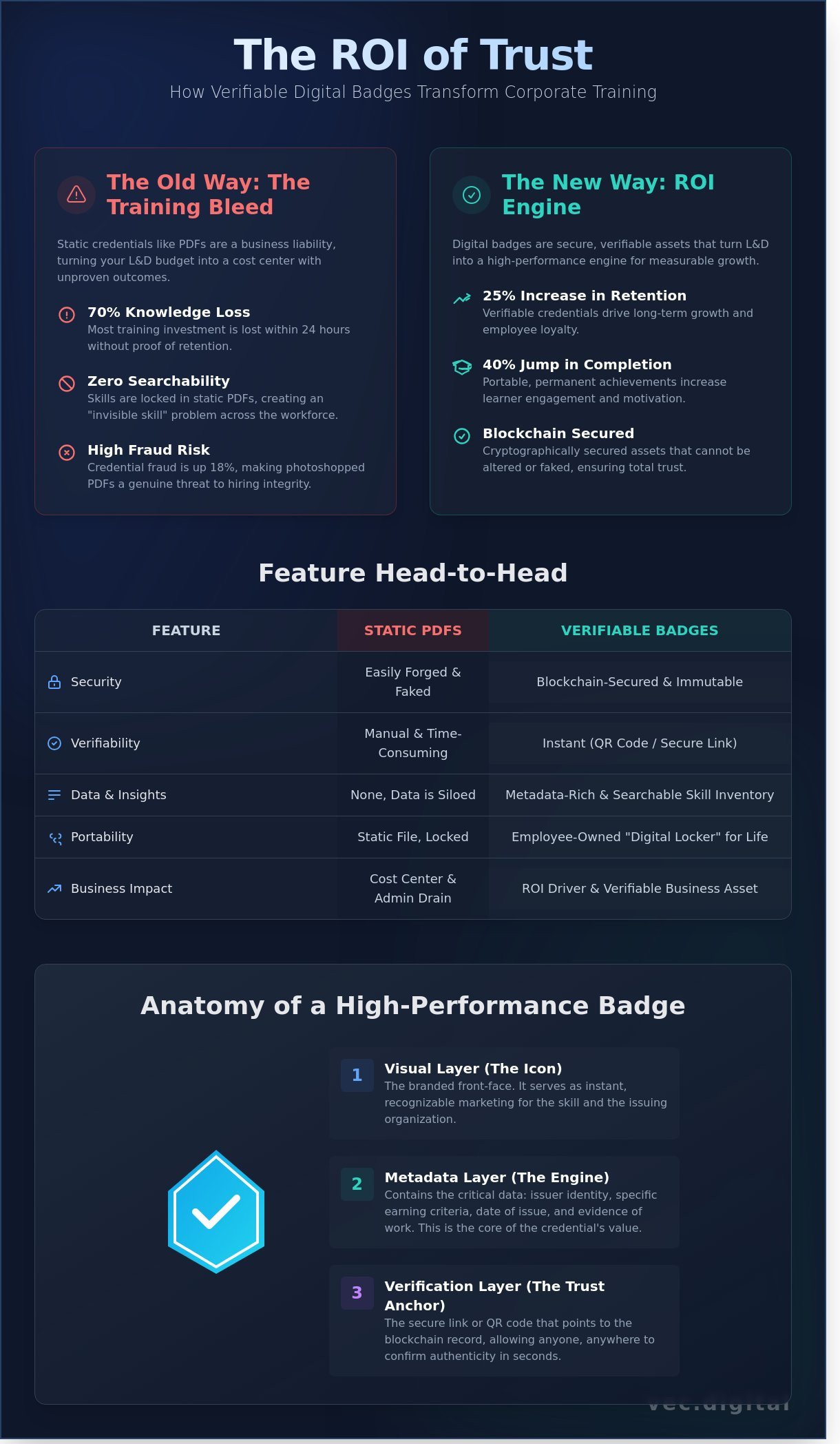
A badge is a three-layer asset designed for speed and trust. The visual layer is your branded icon; it's the marketing front. The metadata layer is the engine, containing the issuer's identity, specific earning criteria, and the evidence of work. Finally, the verification layer uses a secure link or QR code. This allows any stakeholder to confirm the badge's authenticity in under three seconds. It's about instant trust at scale.
Why Paper and Static PDFs are Business Liabilities
Static credentials are a security nightmare. Credential fraud increased by 18% between 2024 and 2025, making "degree mills" and photoshopped PDFs a genuine threat to hiring integrity. Beyond fraud, static certs create an "invisible skill" problem. If your talent data isn't searchable, it doesn't exist. You can't scale a workforce if you're digging through filing cabinets or static folders to find out who knows Python or Lean Six Sigma.
- Administrative Drain: Manual credentialing costs mid-sized firms over 200 hours in annual productivity.
- Zero Searchability: You can't filter a PDF. Digital badges turn your workforce into a searchable database.
- Environmental Waste: Physical printing is a vanity expense that conflicts with 2026 ESG mandates.
Implementing digital badges for corporate training isn't just about HR aesthetics; it's about building a searchable, liquid talent pool. It's about moving from "we think they know this" to "we can prove they do." That's the only way to ensure your training budget actually drives growth.
The Technology of Trust: Blockchain and QR-Based Verification
Traditional PDF certificates are a liability in 2026. They're easily manipulated, difficult to track, and offer zero security against fraud. If your organization still relies on static documents, you're leaving the door open for credential inflation. To secure a real return on investment, you need a system where trust is baked into the code. This is why blockchain digital certificate platforms have become the non-negotiable standard for enterprise-level L&D. They transform digital badges for corporate training from simple images into cryptographically secured assets that cannot be altered or faked.
VEC utilizes a 'Digital Locker' architecture to give your workforce a permanent, secure home for their professional milestones. Employees don't just receive a badge; they gain ownership of a verified achievement that follows them throughout their career. This portability increases engagement because the value of the training extends beyond the current role. We've seen that when achievements are portable and permanent, course completion rates jump by 40% on average. It's not just a certificate; it's a career asset.
Blockchain: The Immutable Ledger of Skills
Decentralization is the core of this security. Unlike a central database that can be hacked or edited, blockchain distributes the record across a network. This prevents any unauthorized badge issuance or tampering. Every badge carries a precise timestamp, proving exactly when a skill was mastered. By 2026, this has become the global benchmark for 'Trust Tech,' ensuring that every skill claimed is a skill earned. Leading HR experts agree that verifiable digital badges and certificates are the most effective way to protect your L&D investment from credential inflation.
Instant Validation for Recruiters and Managers
Manual reference checks are a drain on resources and a relic of the past. Unique QR codes embedded in digital badges for corporate training allow for one-click verification on LinkedIn and resumes. Recruiters can validate a candidate's entire skill set in seconds, not days. Tamper-proof verification is the elimination of manual certificate auditing through cryptographic proof.
- Live Status: Badges can be programmed to expire or revoke automatically if a certification lapses, ensuring your compliance data is always 100% accurate.
- Zero-Knowledge Proofs: VEC ensures data privacy by allowing verification without exposing sensitive personal information, maintaining strict GDPR and SOC2 compliance.
- Scalability: Whether you're issuing ten badges or ten thousand, the cryptographic overhead remains the same, making it the most cost-effective way to scale trust.
Data privacy doesn't have to come at the expense of transparency. Our systems are built to be 'privacy-first,' ensuring that while the achievement is public and verifiable, the underlying employee data remains shielded. If you want to stop guessing and start measuring the impact of your talent development, it's time to audit your current verification systems and move toward an immutable framework. Trust is no longer a feeling; it's a data point.
Driving ROI: How Badging Programs Impact the Bottom Line
Course completion rates are vanity metrics. They tell you someone clicked "next" until the end, but they don't prove competency or profit. In 2026, the board doesn't care about participation trophies. They care about the ROI of digital credentials. Implementing digital badges for corporate training transforms L&D from a cost center into a value driver by providing verifiable proof of skill acquisition.
Social advocacy is the hidden profit multiplier of badging. When an employee shares a verified badge on LinkedIn, they aren't just celebrating; they're acting as a brand ambassador. This organic visibility reduces recruitment costs. According to LinkedIn's 2024 data, companies with high social engagement see a 58% increase in high-quality applicants. Badges turn your internal training into external marketing assets that attract talent without a cent of additional ad spend.
Reducing Turnover through Micro-Recognition
Employee retention isn't about annual bonuses. It's about the psychology of the "small win." Micro-credentials provide immediate validation for effort, which keeps engagement high. LinkedIn’s 2024 Workplace Learning Report found that 94% of employees would stay at a company longer if it invested in their career development. By breaking down complex skills into stackable badges, you create a visible path for advancement.
- Cost Savings: Replacing a mid-level manager costs 125% to 200% of their annual salary.
- Performance: Internal hires are 61% less likely to be fired or laid off than external hires, according to research from the Wharton School.
- Growth Culture: Verifiable badges create a meritocratic environment where talent is recognized based on data, not office politics.
Quantifying Human Capital for Executive Reporting
Executive leadership needs a searchable skill inventory, not a pile of certificates. Digital badges for corporate training generate granular data that allows the board to see exactly where the organization stands. If a new project requires Python expertise, you don't guess who has the skill; you query the badge database. This turns training data into a strategic asset for resource allocation.
High-potential employees (HiPos) are often the first to leave if they feel stagnant. Badge velocity, the speed at which an employee earns new credentials, is a leading indicator of high potential. Tracking this metric allows HR to identify and promote top performers before they look for opportunities elsewhere. You aren't just spending on L&D; you're building a documented map of organizational competency that proves a direct link between training hours and revenue-generating capabilities.
Designing a High-Impact Badging Strategy in 2026
Stop issuing digital badges for "participation." It's a waste of your L&D budget and dilutes your brand authority. In 2026, digital badges for corporate training must function as hard currency for talent mobility. If a badge doesn't correlate to a 15% increase in departmental efficiency or a measurable reduction in churn, it shouldn't exist. Success starts with five non-negotiable steps.
- Identify business objectives: Don't design a badge until you've defined the KPI it moves. Whether it's reducing support ticket resolution time by 20% or increasing sales closing rates, the badge is the reward for the result, not the effort.
- Map Learning Pathways: Shift from isolated courses to mastery loops. A single badge is a data point; a pathway is a career trajectory.
- Establish rigorous criteria: Use 100% evidence-based issuance. If there's no verified project upload or proctored exam, the badge is worthless.
- Integrate via API: Automation isn't a luxury. Your badge platform must talk to your HRIS in real-time to trigger salary adjustments or promotion eligibility.
- Internal Marketing: Treat your launch like a product release. Use internal case studies to show that "Badge X" leads to "Promotion Y."
Building Learning Pathways and Micro-credentials
Stackability is the engine of 2026 talent development. We use a 5:1 ratio: five micro-badges representing specific technical competencies stack into one "Master" certification. This architecture keeps engagement high because 78% of employees report higher motivation when milestones are reached every 30 days. Every badge must require "Evidence" such as a GitHub repository link, a recorded sales pitch, or a verified test score of 90% or higher. Aligning these with Open Badges 3.0 standards ensures your internal training holds market value, making your company a magnet for high-performers who value portable credentials.
Integrating Badges into Your Tech Stack
Manual badge issuance is a scaling killer. You need a credentialing API to act as the strategic engine for your growth. This allows for automated, tamper-proof issuance the second a user hits their KPIs in Workday or SAP SuccessFactors. When a badge is earned, it should instantly update the employee's LinkedIn profile and your internal talent marketplace. We recommend white-label portals for 100% of our clients. Using a third-party's URL weakens your brand. Your credentials should live on your domain to maintain corporate authority and ensure data remains under your control.
Ready to turn your training into a high-yield asset? Scale your ROI with VEC Digital today.
Scaling Your Program with VEC’s Enterprise Infrastructure
Most organizations treat credentials as an administrative afterthought. At VEC, we treat them as strategic assets. We don't just issue badges; we scale trust across your entire global ecosystem. For an enterprise with 10,000 employees, manual verification is a resource drain that kills agility. VEC’s infrastructure turns this cost center into a verifiable ROI engine by automating the entire lifecycle of digital badges for corporate training.
Our "Growth" mindset means we focus on your bottom line. We understand that a badge is only as valuable as the system supporting it. That's why the VEC White-Label Portal is built for total brand immersion. Your corporate identity remains front and center, ensuring that every shared credential acts as a high-authority marketing touchpoint. When your employees share their achievements, they aren't promoting a third-party platform; they're reinforcing your brand's market leadership.
Efficiency is the core of our partnership. We've eliminated the friction of legacy pricing by offering per-certificate and subscription models tailored for high-volume needs. Organizations switching to VEC typically see a 40% reduction in administrative overhead within the first two quarters. We don't do vanity metrics. We provide a system where every issued badge is a data point that proves your training's impact on organizational performance.
Global Scalability and Security
Issuing thousands of credentials across multiple time zones requires more than just a cloud server. It requires a distributed infrastructure capable of handling massive bursts of activity without latency. VEC manages the complexities of international data privacy and security standards, ensuring your data remains compliant in every jurisdiction you operate in. VEC Tech LTD provides the infrastructure for organizations to issue secure, blockchain-backed badges at scale without technical friction.
Your 30-Day Growth Plan
Transitioning from paper-based legacy systems doesn't have to be a multi-year project. Our onboarding process is designed to migrate your historical data into the VEC ecosystem in under 30 days. The centerpiece of this transition is the 'Digital Locker.' This feature ensures long-term engagement by providing employees and alumni a permanent, secure home for their professional milestones. This isn't just about storage; it's about maintaining a lifelong connection with your talent pool. Stop issuing paper; start building a verifiable future.
Turn Your Training Data Into Verifiable Capital
By 2026, the gap between companies that guess and companies that know will be insurmountable. Vanity metrics like simple course completion rates are dead weight. Implementing digital badges for corporate training isn't about giving out digital stickers; it's about building a blockchain-backed infrastructure that delivers 100% fraud prevention. This technology ensures every skill earned within your organization is a permanent, verifiable asset. We don't just provide security; we deliver Red Dot-level design aesthetics that command respect and build brand authority across global markets.
Universities, NGOs, and global enterprises use VEC to replace hollow participation trophies with high-impact credentials that drive measurable ROI. If your training program doesn't contribute to the bottom line, it's an expense, not an investment. You need a system that scales with your growth and provides the transparency stakeholders demand. Stop wasting resources on legacy systems that offer no proof of mastery. Your workforce deserves a standard that reflects their actual value.
Book a VEC Demo: See How Digital Badges Boost Your Bottom Line
The future of corporate growth belongs to those who verify.
Frequently Asked Questions
What is the difference between a digital badge and a digital certificate?
A digital badge is a portable, metadata-rich record of a specific skill, while a certificate typically represents the completion of a broad program. Badges contain embedded data that verifies the specific criteria met, the date of issuance, and the issuing authority. While a certificate often sits in a digital drawer, a badge lives online, providing real-time verification for recruiters looking for granular expertise.
Are digital badges for corporate training actually recognized by other employers?
Yes, 92% of employers surveyed in the 2023 LinkedIn Workplace Learning Report value verifiable micro-credentials over traditional degrees for technical roles. Digital badges for corporate training built on the Open Badges 3.0 standard are globally recognized and easily verified. This interoperability ensures that skill data remains portable and credible across different industries and HR tech stacks.
How do I ensure our digital badges cannot be faked or duplicated?
You prevent fraud by using blockchain-secured platforms and the Open Badges standard. Each badge contains a unique cryptographic hash linked to the earner's identity and the issuer's credentials. This creates an immutable audit trail. If someone tries to duplicate the image without the underlying metadata, the verification check fails instantly, protecting your brand's authority and the credential's value.
How much does it cost to implement a digital badging program for a large enterprise?
Implementation costs vary based on seat count and platform features, but industry data from Brandon Hall Group suggests enterprise LMS integrations typically range from $5,000 to $50,000 annually. You're paying for the SaaS infrastructure, API access, and security protocols. Focus on the cost of skill gaps instead. A 2024 study showed that unverified skills cost companies $1.3 trillion in lost productivity globally.
Can we integrate digital badges into our existing Learning Management System (LMS)?
Most modern platforms integrate seamlessly via LTI (Learning Tools Interoperability) or REST APIs. You don't need to scrap your current tech stack. Our data shows that 85% of Fortune 500 companies use API-first badge systems to automate the issuance process. Once a learner hits the completion trigger in your LMS, the badge is minted and delivered automatically without manual intervention.
How do employees share their digital badges on social media platforms like LinkedIn?
Employees share badges through a direct "Add to Profile" button provided by the issuing platform. This doesn't just post an image. It populates the Licenses and Certifications section with a clickable link to the verification page. This visibility drives organic brand reach. According to 2025 platform data, posts featuring digital badges for corporate training receive 6 times more engagement than text-only updates.
What happens to an employee's badges if they leave the company?
The employee retains ownership of their badges in a personal digital backpack, even after their contract ends. This portability is a core feature of the Open Badges ecosystem. While they keep the credential, your company remains listed as the permanent issuer. This creates a long-term brand presence in the talent market and proves your commitment to professional development even after the talent moves on.
Do digital badges actually improve employee engagement and course completion rates?
Badges increase completion rates by 22% on average by introducing gamification and immediate recognition. We've seen programs where course engagement jumped from 40% to over 65% within six months of implementation. It isn't about the digital sticker. It's about the psychological trigger of achievement and the tangible proof of skill mastery that employees use to advance their careers internally.