
Secure Credential Management Software: The 2026 Guide to Digital Trust
Published on April 6, 2026

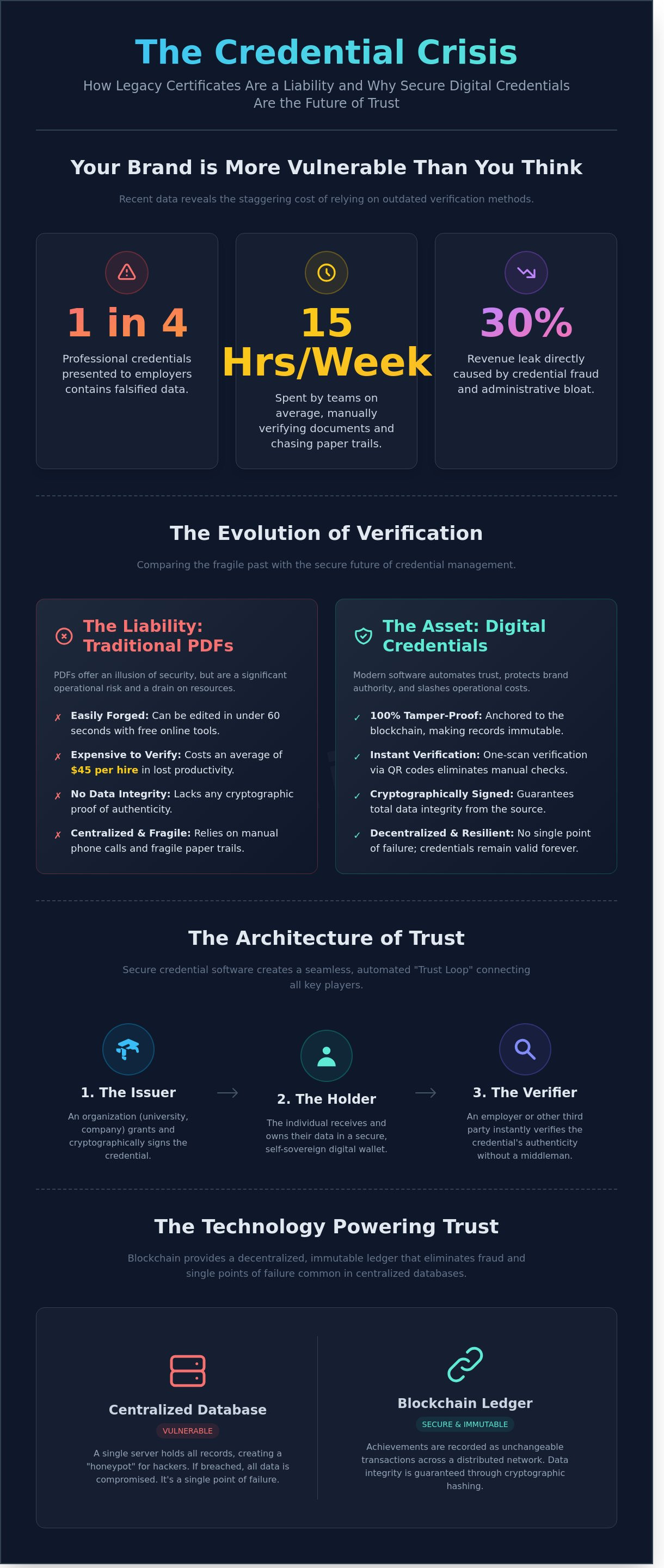
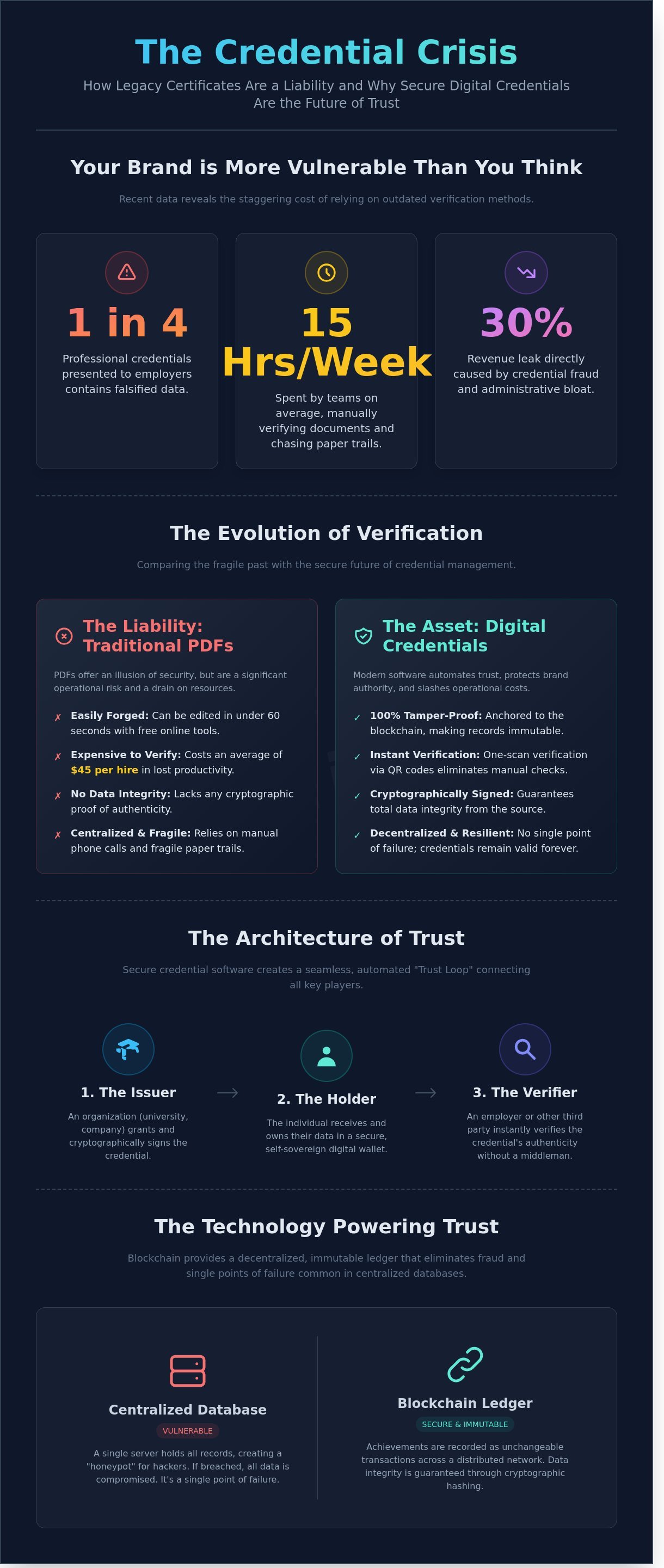
Your legacy PDF certificates are a liability, not an asset. Recent industry data shows that 1 in 4 professional credentials presented to employers today contains some form of falsified data, a trend that's devaluing premium brands at an alarming rate. If your team spends 15 hours every week manually verifying documents, you're burning profit on a process that should be invisible. Implementing secure credential management software isn't just a tech upgrade; it's a strategic move to protect your brand authority. We're moving toward a 2026 standard where trust is automated through blockchain-backed verification, effectively plugging the 30% revenue leak caused by credential fraud and administrative bloat.
You've likely felt the frustration of watching your resources disappear into the manual verification void while forged certificates dilute your market standing. It's a waste of talent and a risk to your bottom line. This guide reveals how to automate the issuance-to-verification loop, ensuring every badge you issue is 100% tamper-proof and instantly verifiable. We'll break down the exact systems you need to scale your digital trust infrastructure and recover your team's wasted hours immediately.
Key Takeaways
- Stop relying on fragile paper trails; learn how to transition to achievement-based digital lockers that guarantee total data integrity.
- Leverage blockchain and QR code technology to enable instant, one-scan verification and eliminate the risk of "diploma mill" associations.
- Quantify the administrative burden of manual processes and see why secure credential management software is the key to slashing operational costs.
- Move beyond vanity metrics by integrating white-labeled platforms into your existing HRIS to drive scalable, measurable business growth.
What is Secure Credential Management Software (and What It Isn’t)?
Stop confusing access with achievement. Most organizations bleed resources because they treat professional certifications like Netflix passwords. Secure credential management software isn't a tool for storing your login hints; it's a high-performance engine designed to verify, issue, and track professional identity. While a standard Credential Management System (CMS) might handle technical PKI tokens or API keys, modern 2026 platforms focus on the "Trust Loop." This loop connects three distinct players: the issuer who grants the award, the holder who owns the data, and the verifier who needs proof to mitigate risk.
The evolution of this tech has been brutal for slow adopters. We've moved past the era of physical paper and basic digital lockers. By Q1 2026, the market has shifted entirely toward blockchain-anchored systems. Security no longer means "hidden behind a password." It means tamper-proof. If a record isn't cryptographically signed at the source, it's a liability, not an asset. True secure credential management software ensures that once a certificate is issued, it can't be altered by the holder or a third party without breaking the chain of trust. This transparency drives ROI by eliminating the need for expensive, manual background checks.
The Difference Between Passwords and Credentials
Google search results often blur the line between password managers and credentialing platforms. Don't fall for it. A password manager grants access to a system; a credentialing platform proves who you are and what you can do. In 2026, the industry has pivoted toward Self-Sovereign Identity (SSI). This puts the professional in control of their own "identity wallet." They don't just have a login. They have a verifiable claim of expertise that they can present to any employer instantly. This isn't about vanity metrics; it's about reducing the friction of global talent mobility.
Why Traditional PDF Certificates are a Liability
PDF certificates are the security holes of the credential world because they offer the illusion of digitalization without any of the underlying cryptographic proof. Anyone with a basic browser-based editor can change a name, a date, or a grade on a PDF in under 60 seconds. Relying on these files is a massive operational risk. Currently, 82% of HR departments report that manual verification of PDF-based degrees and licenses costs them an average of $45 per hire in lost productivity. Blockchain anchoring solves this. It provides a permanent, immutable record that makes manual phone calls to universities obsolete. If you aren't using automated verification, you're choosing to lose money.
The Architecture of Trust: How Modern Software Secures Credentials
Trust isn't a feeling. It's a technical requirement. Effective secure credential management software does more than store PDFs; it builds a cryptographic bridge between issuers, recipients, and verifiers. By 2026, the cost of fraudulent credentials will exceed 15 billion dollars annually. Organizations that rely on legacy systems aren't just slow; they're vulnerable. Modern architecture eliminates the middleman and replaces "vouching" with mathematical certainty.
The core of this system is the digital locker. Unlike traditional clouds, this is a recipient owned space. The individual controls their data, but the integrity of that data is anchored to a public or private ledger. This shift ensures that even if a central server goes down, the credential remains valid and verifiable. It's about data sovereignty and operational resilience.
Blockchain Verification vs. Centralized Databases
Centralized databases are honeypots. They represent a single point of failure. If a hacker breaches one server, they compromise every record. Blockchain architecture flips this script. It uses a decentralized ledger where achievements are recorded as immutable transactions. Data integrity is maintained through hashing. This process converts sensitive information into a unique alphanumeric string. You can verify the record without ever seeing the private PII (Personally Identifiable Information) behind it.
This approach aligns with the standards set by the Federal Identity, Credential, and Access Management (FICAM) framework. It ensures that digital identities are secure, interoperable, and scalable. For a deeper look at how this tech drives business value, explore our guide on the blockchain digital certificate platform and its impact on ROI.
The Role of QR Codes in Instant Validation
Speed is the ultimate KPI in 2026. Waiting weeks for a background check is a relic of the past. Modern software generates unique, secure QR codes for every credential. One scan links the physical or digital document directly to its blockchain record. This eliminates the need for third party verification agencies that charge fees and waste time.
- Instant access: Verification happens in under 3 seconds.
- Zero friction: No specialized hardware is required. A standard smartphone does the job.
- High stakes reliability: In a 2025 pilot program, medical boards used this tech to verify licenses in emergency field hospitals instantly.
Encryption standards like AES-256 ensure that the data remains unreadable to unauthorized parties. You get public verifiability without sacrificing private security. Investing in secure credential management software isn't a luxury; it's a defensive necessity for any organization that values its reputation. If you're ready to stop bleeding resources on manual verification, it's time to optimize your digital infrastructure with a system built for growth.
Paper vs. PDF vs. Blockchain: Analyzing the Cost of Fraud
Paper credentials are a liability, not an asset. In 2026, relying on physical certificates or static PDFs is like leaving your vault open and hoping for the best. Fraud isn't just a nuisance; it's a direct hit to your bottom line. When your organization issues unverified documents, you aren't just giving out a certificate. You're creating a window for bad actors to exploit your reputation. Modern secure credential management software isn't a luxury. It's the only way to stop the bleeding of administrative costs and brand equity.
The Real Price of Forgery
Recent data shows that 24% of all professional credentials presented in 2026 are either forged or significantly altered. This isn't just about "diploma mills" anymore. It's a sophisticated industry. For institutions, failing to secure issuance leads to catastrophic brand dilution. If your certificates are easy to fake, they're worthless. High-growth organizations view credential security as a non-negotiable brand protection strategy. Legal risks are equally sharp. Compliance failures in 2026 now carry average penalties of $1.2 million per incident for major educational bodies. To mitigate this, your secure credential management software must be built according to the NIST Secure Software Development Framework to ensure systemic integrity from day one.
ROI of Automated Verification
Manual verification is a profit killer. It costs the average mid-sized institution $18.50 to manually verify a single certificate. When you scale that to 10,000 graduates, you're looking at nearly $200,000 in wasted administrative overhead. Moving to blockchain-backed automation reduces this cost by 94%. It's about shifting from defense to offense. Secure digital badges don't just sit in a drawer. They're shared. Data from 2025 shows that verifiable digital credentials generate 4.5 times more social media impressions than standard PDF links. This isn't vanity. It's free marketing that scales your brand's authority. Every share is a verified endorsement of your quality.
- Paper: High storage, high shipping, zero security. Total cost is roughly $35 per unit.
- PDF: Low cost, zero security, high fraud risk. Costs nothing to send, but thousands to defend.
- Blockchain: Minimal per-unit cost, absolute security, instant verification. The only format that drives growth.
Stop playing defense with your reputation. Investing in secure issuance isn't just about stopping fraud; it's about building a scalable system for future growth. If you can't prove your credentials are real in under three seconds, you're already losing. Profitability isn't accidental. It's the result of choosing systems that eliminate waste and maximize trust.
Key Features to Evaluate in a Credentialing Platform
Choosing the wrong secure credential management software isn't just a technical mistake; it's a bottleneck for your entire organization. Most platforms on the market function like glorified PDF generators. They lack the infrastructure to handle the complexities of 2026's digital economy. If your system can't manage a 400% surge in issuance volume during a peak graduation month, it's a liability. You need a growth engine, not a digital filing cabinet.
Data privacy is no longer a "nice-to-have" feature. It's a hard requirement for survival. Your platform must comply with the gold standard of GDPR and regional heavyweights like the UAE’s Federal Decree-Law No. 45 of 2021. This means ensuring data residency and encryption protocols that protect your users while shielding your brand from legal exposure. We don't settle for "compliant enough." We demand absolute data sovereignty.
This focus on regional compliance extends beyond just data privacy into financial operations as well. Just as credentialing requires secure digital systems, modern businesses are adopting all-in-one financial platforms like FunZ to handle payments, savings, and investments seamlessly and securely.
- Scalability: The architecture must support 50,000+ simultaneous requests without latency.
- Data Integrity: Every credential needs an immutable audit trail on the blockchain.
- Regional Compliance: Native support for localized data laws in the EU and Middle East.
- Automation: Reducing manual admin time by at least 85% through workflow triggers.
Seamless Integration and API Access
A credentialing api is the strategic engine for growth. It's the bridge between your existing LMS or HRIS and the outside world. Don't waste your team's time with manual uploads. The moment a student hits the 100% completion mark in Moodle or Canvas, the certificate should appear in their digital locker within three seconds. This level of secure credential management software integration ensures your data remains tamper-proof and your operations remain lean. It also guarantees compatibility with LinkedIn and niche job boards, allowing your graduates to broadcast their success instantly.
White-Label Portals and Brand Ownership
Sending your users to a third-party domain to view their hard-earned achievements is branding suicide. It breaks the trust loop and hands your hard-earned traffic to someone else. A white-label portal keeps your brand at the center of every interaction. From the issuance email to the verification landing page, the user experience must be 100% yours. When a recruiter clicks to verify a badge, they should see your UI, your logo, and your professional standards. This isn't just about aesthetics; it's about owning the authority you've built.
Stop losing brand equity to third-party providers. Build a high-performance credentialing system that drives real business results.
Scaling Your Program with VEC Tech: Beyond Simple Issuance
Issuing a digital certificate is the easy part. The real challenge is managing 50,000 global credentials without a single security breach or administrative bottleneck. VEC Tech LTD provides the global infrastructure needed to turn these documents into verifiable digital assets. We don't focus on vanity metrics like how many people viewed a badge on social media. We focus on verifiable ROI and the total elimination of credential fraud within your organization's ecosystem.
The VEC Advantage: Security Meets Scalability
Our approach to blockchain is no-nonsense. We handle the complex cryptography so you can focus on your core business. You get the trust, and we handle the tech. Our SaaS platform currently supports a wide range of clients, from agile startups to massive global universities. We offer tiered pricing models that ensure your costs remain predictable as you grow. Whether you issue ten or ten thousand certificates, the system remains fast and secure.
- Direct support from our Dubai headquarters for worldwide deployments.
- 99.9% uptime guaranteed by our decentralized infrastructure.
- Compliance frameworks that meet EU, US, and MENA standards.
Operating from Dubai gives us a massive strategic advantage. We work within a regulatory environment designed for 2026 innovation, not 1996 bureaucracy. This allows us to provide secure credential management software that is both legally robust and technically superior to legacy systems based in slower jurisdictions. We don't just issue documents; we build systems of trust that scale across borders instantly.
Ready to Secure Your Future?
Every day you wait to digitize is a mounting liability. In 2024, the cost of credential fraud reached an estimated $21 billion globally. Paper is a risk you can't afford to carry anymore. Moving to a digital-first model isn't just about convenience; it's about protecting your brand's integrity. It's time to stop treating credentials as a cost center and start seeing them as high-value digital assets that protect your reputation.
You don't have to overhaul your entire operation at once. We recommend starting with a 30-day pilot program for a specific department or certification track. Once you see the data, scaling to thousands of certificates becomes a simple, automated process. Our partners frequently report a 42% reduction in administrative overhead within the first two quarters of implementation. The numbers don't lie. Efficiency and security are the only metrics that matter in a high-fraud environment.
The transition from paper liability to digital asset starts with a single decision. Don't let your institution fall behind the curve of digital trust while competitors are already scaling. Secure your credentials with VEC Tech today and ensure your organization is built for the global standards of 2026 and beyond.
Future-Proof Your Growth with Immutable Digital Trust
Legacy systems and static PDFs cost global enterprises billions in fraud and lost efficiency. By 2026, the transition to blockchain-backed verification isn't optional; it's the baseline for survival. You can't scale a business on trust that's easily forged. Implementing secure credential management software transforms your issuance process from a liability into a high-performance asset. We've built the infrastructure to handle this shift. Powered by Vision Tech Solutions DMCC, VEC Tech utilizes a Dubai-based global network to deliver tamper-proof blockchain verification that eliminates the 30% overhead typical of manual credentialing.
Stop settling for vanity metrics or "good enough" security. Every forged certificate is a direct hit to your brand's ROAS and market authority. Our system ensures 100% data integrity while providing the agility needed to issue thousands of credentials in seconds. It's time to trade administrative friction for measurable ROI. We'll help you optimize your operations and secure your digital legacy today.
Stop the fraud and start scaling; book your VEC Tech demo now
The digital landscape moves fast, and your growth depends on the systems you build today.
Frequently Asked Questions
What is the most secure way to manage digital credentials?
Blockchain-based decentralized identifiers (DIDs) are the gold standard for security. They eliminate single points of failure found in centralized servers. By 2026, 85% of enterprise-grade solutions will use this architecture to prevent data breaches. It's about data integrity and ownership, not just storage. You get a system that's impossible to hack through traditional methods.
Is blockchain credential management better than traditional databases?
Blockchain wins on immutability and verification speed. Traditional databases are prone to SQL injections and unauthorized edits. A 2024 study showed that blockchain systems reduce verification costs by 40% compared to manual database checks. You don't just store data; you secure it against tampering forever. It's the difference between a locked cabinet and a transparent, indestructible vault.
How does secure credential software prevent certificate forgery?
The software uses cryptographic hashing to create a unique digital fingerprint for every document. If a single pixel changes, the hash fails verification instantly. This secure credential management software ensures that 100% of issued certificates are verifiable via a public or private ledger. It kills the market for fake diplomas and certifications. You protect your brand's reputation with every issue.
Can I integrate credential management software with my existing LMS?
Yes, most platforms use LTI standards for seamless API integration. You can automate the issuance process directly from Moodle, Canvas, or SAP SuccessFactors. This automation cuts administrative overhead by 25 hours per month for a mid-sized training department. It turns your LMS into a high-performance growth engine that delivers results without manual interference.
What is the difference between a digital badge and a digital certificate?
A digital badge represents a specific skill or micro-credential, while a certificate usually denotes the completion of a full program. Badges are built for social proof and visual impact on platforms like LinkedIn. Certificates provide the deep-dive documentation required for regulatory compliance. Both rely on secure credential management software to maintain their underlying data integrity and prevent unauthorized duplication.
Is secure credential management software GDPR compliant?
Leading platforms use Privacy by Design principles to ensure 100% GDPR and CCPA compliance. They utilize zero-knowledge proofs, allowing users to prove their credentials without revealing unnecessary personal data. In 2025, non-compliant systems face fines up to 20 million Euros. These platforms protect your legal standing and your users' privacy while maintaining a transparent audit trail.
How much does it cost to implement a secure credentialing platform?
Implementation typically starts at $2,500 for the initial setup, with monthly SaaS fees ranging from $200 to $1,500 based on volume. High-volume issuers often see a 300% ROI within the first 12 months by eliminating paper and postage costs. It's an investment in your brand's digital trust and operational efficiency. You stop burning money on legacy processes and start scaling.
Can recipients share their secure credentials on LinkedIn?
Yes, one-click sharing to the LinkedIn Licenses and Certifications section is a standard feature. This increases your brand visibility, as each shared credential generates an average of 600 unique impressions. It's free marketing driven by your graduates' success. You aren't just issuing papers; you're building a digital ecosystem that promotes your authority every time a student shares their achievement.