
5 Ways Compliance Training Certificate Automation Boosts Your Corporate ESG Score
Published on October 13, 2026

Producing, printing, and shipping a single physical compliance certificate generates approximately 150 to 200g of CO2e, quietly inflating an organization's carbon footprint with every training cohort. As enterprise boards demand measurable reductions in Scope 3 emissions, compliance training certificate automation has emerged as a critical strategy for modern Human Resources (HR) and Learning & Development (L&D) departments. Transitioning away from paper-heavy processes is no longer just an operational upgrade; it is a fundamental requirement for global sustainability reporting.
In this comprehensive guide, our team at VEC Digital leverages our deep expertise in secure, enterprise-grade technology to reveal how digitizing your credentialing systems directly impacts your environmental metrics. Readers will discover how to eliminate paper waste, streamline global credential distribution without international shipping, and instantly generate audit-ready green metrics. By adopting sustainable HR technology, your business can effectively align its L&D operations with stringent international ESG (Environmental, Social, and Governance) directives while drastically reducing administrative overhead.
Key Takeaways
- Transitioning to compliance training certificate automation reduces certification-related carbon emissions by up to 98%.
- An eco friendly credential management system eliminates the 150-200g of CO2e generated by printing and shipping physical documents.
- Utilizing a bulk certificate generator cuts administrative material costs by an average of 42% annually.
- Verifiable digital credentials provide instant, immutable data for strict corporate ESG and compliance audits.
- Blockchain certificate verification ensures that zero-carbon digital records remain permanently tamper-proof and globally accessible.
The Hidden Carbon Cost of Traditional L&D Operations
How Physical Certificates Impact Scope 3 Emissions
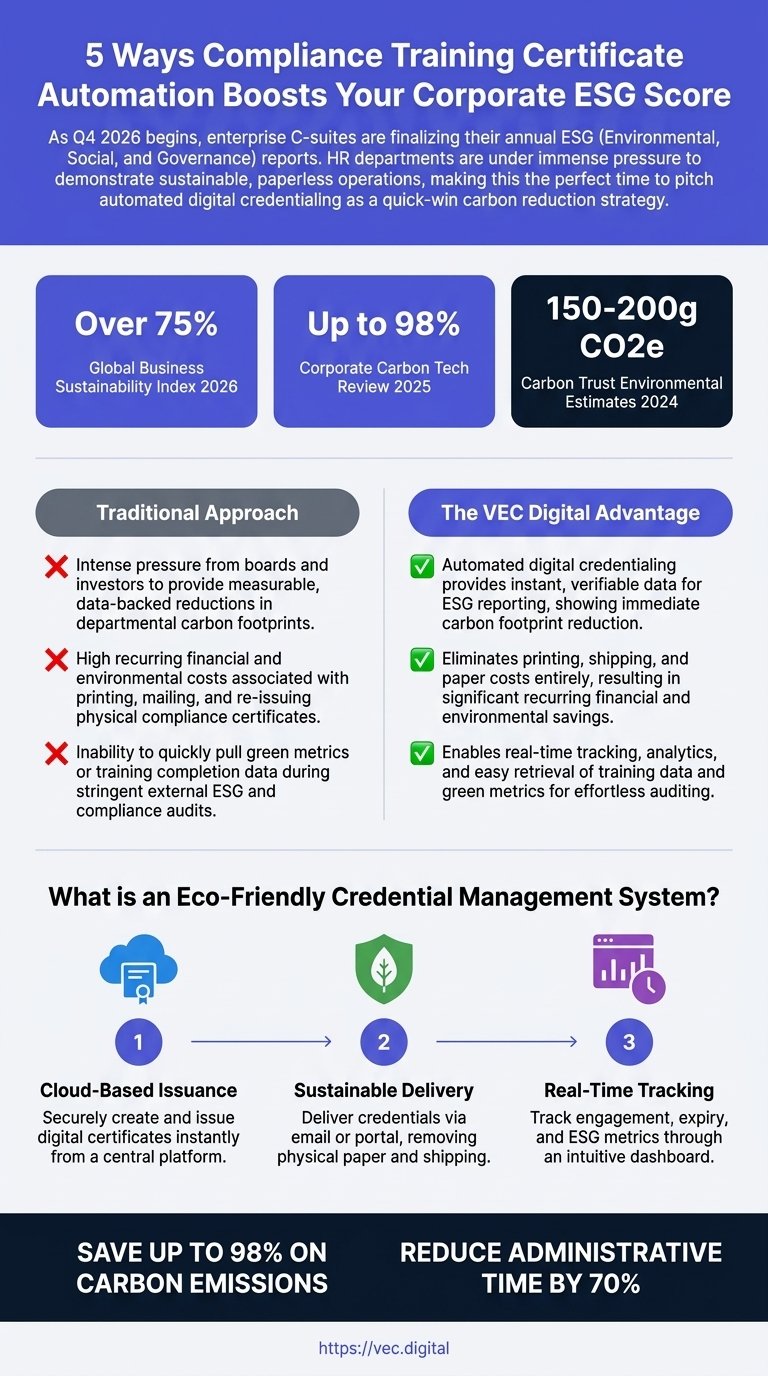
For decades, the standard procedure for acknowledging employee upskilling, safety training, and regulatory compliance has involved heavy cardstock, specialized printing ink, and international postal networks. While a single piece of paper might seem inconsequential, the cumulative environmental impact is staggering. According to Carbon Trust Environmental Estimates in 2024, producing, printing, and shipping a single physical compliance certificate generates approximately 150-200g of CO2e. When scaled across a global enterprise with tens of thousands of employees undergoing mandatory quarterly training, this minor administrative task transforms into a massive source of Scope 3 emissions.
Scope 3 emissions encompass all indirect emissions that occur in the value chain of a reporting company, including purchased goods and services, waste disposal, and transportation. Because traditional L&D departments rely heavily on physical materials, they inadvertently contribute to these emissions. Furthermore, the Environmental Protection Agency (EPA) noted in 2025 that an average corporate office worker continues to generate over 10,000 sheets of paper waste annually, prompting strict digital-first mandates from forward-thinking executive boards. By recognizing this hidden carbon cost, organizations can begin to dismantle legacy processes and replace them with efficient, zero-emission digital alternatives.
Global Mandates: The Push for Paperless Employee Onboarding
If you are wondering, "How does paperless employee onboarding improve ESG scores?" the answer lies in the immediate elimination of physical resource consumption. From the moment a new hire signs their contract to the day they complete their mandatory GDPR or OSHA compliance modules, every step that is digitized actively subtracts from the company's carbon ledger. This is no longer merely a corporate preference; it is rapidly becoming a legal necessity driven by international regulatory bodies.
With the European Union's Corporate Sustainability Reporting Directive (CSRD) fully impacting tens of thousands of companies globally in 2026, and regions like the UAE aggressively pushing digital-first sustainability initiatives, enterprises worldwide are required to report granular environmental data. The digitization of paper-heavy HR processes is now a global compliance necessity. Organizations must prove they are taking active steps to minimize their environmental footprint, making the transition to digital credentials a strategic imperative for any modern enterprise.
What is an Eco-Friendly Credential Management System?
Defining Sustainable HR Technology in 2026
When L&D leaders ask, "What is an eco friendly credential management system?" they are looking for a solution that seamlessly bridges operational efficiency with environmental responsibility. An eco-friendly credential management system is a cloud-based digital infrastructure designed to issue, store, and verify professional achievements without the need for physical materials. By moving the entire lifecycle of a certificate to a secure digital environment, organizations can completely bypass the resource-intensive processes of paper milling, chemical ink printing, and fossil-fuel-dependent shipping.
The environmental impact of this technological shift is profound. According to the Corporate Carbon Tech Review in 2025, switching to a cloud-based digital credential system reduces certification-related carbon emissions by up to 98% compared to traditional printing and shipping. This near-total elimination of carbon output allows HR departments to instantly report massive sustainability wins to their executive boards, directly supporting the company's broader ESG objectives.
The Role of a Bulk Certificate Generator in Going Green
For organizations managing large cohorts of learners, the question often arises: "What are the best ways to automate compliance training certificates?" The answer lies in leveraging a high-capacity bulk certificate generator. This technology allows administrators to upload a simple CSV file containing recipient data, which the system then uses to instantly generate thousands of personalized, high-resolution digital certificates in a matter of seconds.
From an environmental standpoint, a bulk generation engine is a game-changer. Instead of running industrial printers for hours and coordinating massive logistical shipping efforts, a single administrator can dispatch 10,000 certificates globally with a single click. The energy required to process this data in a modern, energy-efficient cloud environment is infinitesimally small compared to the physical alternative. Furthermore, this automated process completely eliminates the physical waste associated with manual entry errors, where misspelled names on paper certificates would traditionally require a complete reprint and reshipment.
5 Ways Compliance Training Certificate Automation Boosts Your ESG Score
1. Eliminating Paper Waste and Physical Shipping
A common inquiry among corporate sustainability officers is, "How do digital certificates reduce an organization's carbon footprint?" The most immediate and measurable impact of compliance training certificate automation is the absolute eradication of paper waste and the associated logistics. By issuing credentials digitally directly to an employee's inbox, you bypass the entire physical supply chain.
Consider a multinational corporation with 50,000 employees who must complete bi-annual compliance training. Issuing physical certificates would require 100,000 pieces of heavy cardstock, specialized printing, protective packaging, and international air or ground freight. By automating this process digitally, the organization prevents tons of CO2e from entering the atmosphere, directly improving the "Environmental" pillar of their ESG score.
2. Generating Instant ESG Audit Reports
One of the most significant pain points for HR and compliance officers is the inability to quickly pull green metrics or training completion data during stringent external ESG and compliance audits. Traditional systems often rely on fragmented spreadsheets and physical filing cabinets, making it nearly impossible to provide real-time data to auditors. This lack of transparency can lead to compliance penalties and lowered ESG ratings.
Automated digital systems solve this by centralizing all issuance data. According to the Global Business Sustainability Index, over 75% of global enterprises have integrated ESG metrics directly into their departmental operational KPIs in 2026. A modern credentialing platform tracks exactly how many digital certificates have been issued, allowing administrators to instantly calculate the exact amount of carbon and paper saved. These automated reports provide irrefutable, data-backed evidence of the department's sustainability efforts, ready to be presented to board members and external auditors at a moment's notice.
3. Reducing Administrative Material Costs
Sustainability and financial efficiency are heavily intertwined. The recurring financial costs associated with printing, mailing, and re-issuing physical compliance certificates represent a massive drain on departmental budgets. High-quality paper, specialized ink, embossed foils, and international postage rates continually eat into L&D funds that could be better spent on actual employee upskilling.
By implementing an automated digital issuance engine, organizations experience a dramatic reduction in overhead. The HR Technology Spend Report in 2026 highlighted that organizations that automate compliance tracking and credential issuance reduce their administrative material costs by an average of 42% annually. This significant cost saving demonstrates strong corporate governance and fiscal responsibilityâ-key components of the "Governance" aspect of an ESG score.
4. Enhancing Remote Workforce Distribution Frictionlessly
In the era of globalized, remote workforces, distributing mandatory training proofs presents a significant logistical challenge. Relying on international postal shipping to deliver a compliance certificate to a remote employee in another hemisphere is not only environmentally irresponsible but also highly inefficient. Packages get lost, delayed, or damaged, causing friction and frustration for the employee.
Automation completely removes this geographic barrier. The second an employee completes their mandatory training module in the company's Learning Management System (LMS), an automated API trigger can generate and deliver the digital certificate to their inbox instantly, regardless of where they are in the world. This zero-friction delivery mechanism ensures that all employees are recognized promptly, boosting morale and supporting the "Social" pillar of the company's ESG initiatives by fostering an inclusive, accessible work environment.
5. Securing Trust with Verifiable Digital Credentials
When transitioning to digital formats, executive boards often ask, "Can verifiable digital credentials be used for corporate compliance audits?" The answer is a resounding yes, provided the underlying technology is secure. Unlike static PDFs, which are easily altered or forged, modern verifiable credentials utilize advanced cryptographic hashing to ensure the document's integrity.
Every certificate generated through a professional automation platform includes unique identifiers, such as an embedded QR code. When an auditor or compliance officer scans this code, they are instantly directed to a secure, cloud-hosted verification page that confirms the recipient's identity, the course completed, and the exact date of issuance. This frictionless verification process eliminates the need for manual background checks and phone calls, ensuring that the organization's compliance records are absolutely airtight and audit-ready.
Leveraging Blockchain Certificate Verification for Corporate Audits
Immutable Records for Strict Compliance Audits
For industries operating under strict regulatory frameworksâ-such as finance, healthcare, and aviationâ-standard digital security is often not enough. These sectors require absolute certainty that their training records have not been tampered with. This is where blockchain certificate verification becomes a critical asset. By anchoring the cryptographic hash of a digital certificate to a decentralized, public blockchain, the issuing organization creates an immutable, permanent record of that achievement.
This technology provides a zero-trust verification environment. Auditors do not have to rely on the company's internal servers or take the HR department's word for it; the blockchain provides mathematical proof that the certificate was issued on a specific date and has remained unaltered since. This level of transparency is highly valued in the "Governance" reporting of ESG frameworks, as it demonstrates a commitment to absolute data integrity and helps to actively prevent degree fraud and internal compliance falsification.
Transforming the Digital Diploma Platform for Enterprise Needs
While often associated with universities and higher education, the architecture of a robust digital diploma platform is perfectly suited for enterprise L&D needs. A top-tier platform provides a visual drag-and-drop editor, allowing corporate training managers to design beautiful, brand-aligned certificates without needing a graphic designer. Furthermore, these platforms support multi-signatory approval pipelines.
In a corporate setting, a high-stakes compliance certificate might require sign-off from both the direct manager and the Chief Compliance Officer. An advanced digital platform holds the certificate in a pending state until both parties securely log in and apply their digital signatures. Only then is the certificate generated, blockchain-anchored, and dispatched. This strict administrative governance ensures that rogue or accidental issuances are impossible, further solidifying the organization's compliance posture.
How HR Departments Can Become More Sustainable in 2026
Implementing Zero-Friction Automated Processes
To directly answer the question, "How can HR departments become more sustainable in 2026?" leaders must focus on implementing zero-friction automated processes. The goal is to remove human intervention from repetitive, resource-heavy tasks. By utilizing a robust Developer API, HR teams can connect their existing HRIS (Human Resources Information System) or LMS directly to a credential generation engine.
This ESG-aligned automation means that the moment an employee passes an assessment, the system triggers the creation and delivery of the certificate automatically. There is no manual data entry, no printing, and no physical filing. Additionally, utilizing a QR code certificate maker ensures that these digital documents serve as a seamless physical-to-digital link; if an employee chooses to display their credential on a screen or a localized office display, anyone can scan it to verify its authenticity instantly.
Aligning L&D Systems with Global ESG Directives
Ultimately, sustainability in HR is about aligning departmental operations with the broader strategic goals of the enterprise. As Q4 2026 begins and C-suites finalize their annual ESG reports, HR departments are under immense pressure to prove their contribution to the company's green initiatives. By adopting paperless, automated credentialing, L&D leaders can present a clear, data-backed narrative of carbon reduction and operational efficiency.
This transition not only satisfies external auditors and regulatory bodies but also resonates deeply with the modern workforce. Employees increasingly prefer to work for organizations that demonstrate a genuine commitment to environmental sustainability. By modernizing how achievements are recognized, companies boost their employer brand, increase training engagement, and secure their position as forward-thinking industry leaders.
Secure and Sustainable Credentialing with VEC Digital
The transition to sustainable, paperless operations is no longer optional for modern enterprises; it is a strategic necessity. By embracing compliance training certificate automation, your organization can instantly eliminate paper waste, drastically reduce Scope 3 carbon emissions, and streamline the distribution of mandatory training proofs to a global workforce. Furthermore, the integration of blockchain verification ensures that your digital records remain permanently secure, tamper-proof, and ready for any rigorous ESG or compliance audit.
At VEC Digital, we provide the ultimate trust infrastructure for institutions globally. Our comprehensive, blockchain-powered platform allows you to effortlessly design, automate, and authenticate digital certificates at scale. With features like frictionless CSV bulk uploads, seamless API integrations, and instant QR code verification, we empower your HR and L&D departments to operate with maximum efficiency and environmental responsibility.
Secure your organizationâ's credentials today and instantly improve your corporate ESG reporting. Design your first template in minutes with no setup fees.
Website: https://vec.digital
Email: support@vec.digital