
7 Non-Negotiable Features Your Digital Certificate Maker Needs in 2026
Published on June 10, 2026

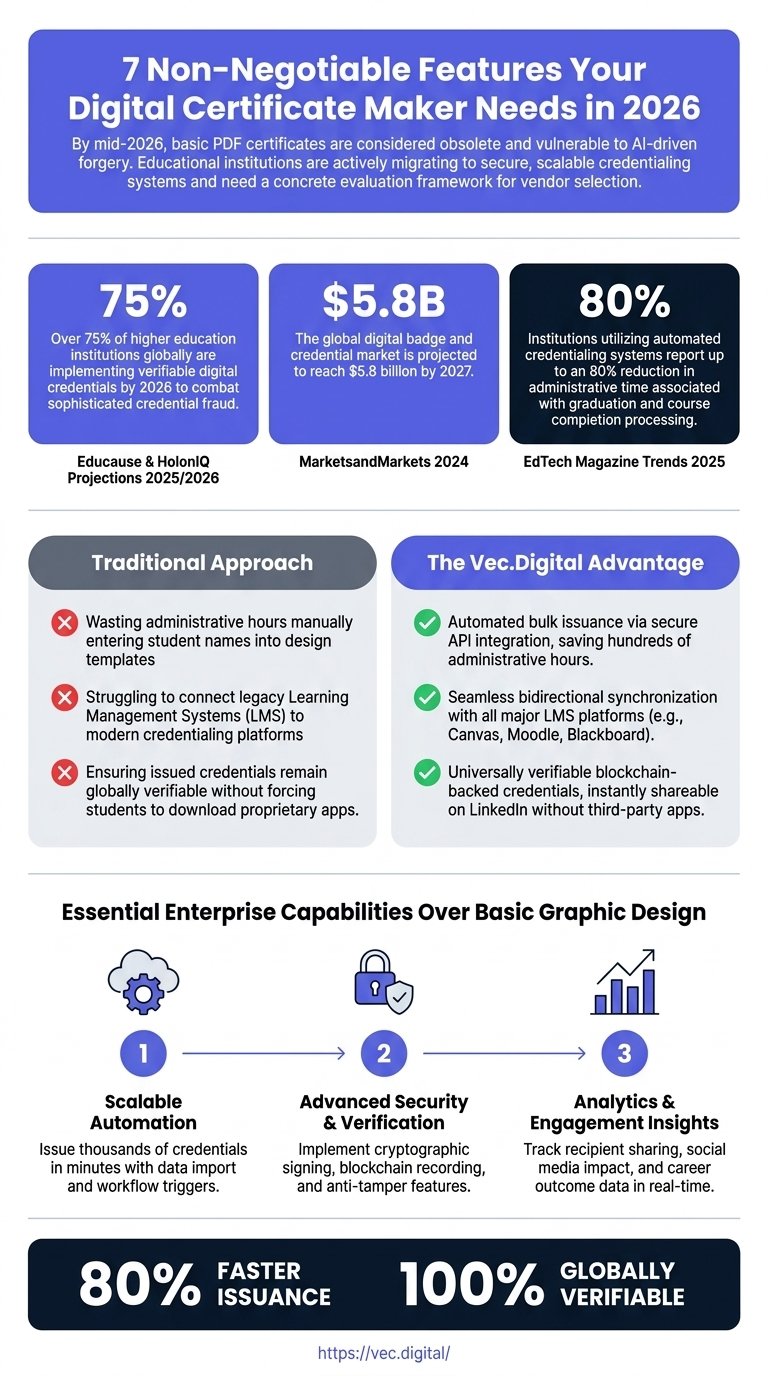
Over 75% of higher education institutions globally are implementing verifiable digital credentials by 2026 to combat sophisticated credential fraud, according to Educause & HolonIQ Projections (2025/2026). As basic PDF certificates become increasingly obsolete and highly vulnerable to AI-driven forgery, educational institutions are actively migrating to secure, scalable credentialing systems. Finding the right digital certificate maker is no longer just about aesthetics; it is a critical IT and security decision that shapes how your institution issues, manages, and authenticates real-world achievements.
In this comprehensive guide, our team at Vec.Digital leverages our extensive expertise in Technology to provide a concrete evaluation framework for vendor selection. You will learn how to shift your focus from basic graphic design capabilities to enterprise-grade requirements, discover the necessity of automated integrations for legacy systems, and understand how immutable verification protects your organizational reputation on a global scale.
Key Takeaways
- Transitioning to verifiable digital credentials is essential for combating global credential fraud and maintaining institutional integrity.
- A robust bulk certificate generator reduces administrative processing time by up to 80%, streamlining graduation and course completion events.
- Seamless API integrations enable automated credential issuance directly from your legacy Learning Management Systems.
- Blockchain certificate verification provides tamper-proof security without requiring proprietary apps or complex auditing.
- Dynamic QR code certificates offer instant, cross-border authentication for employers and organizations worldwide.
The Evolution of Academic Credentials: Why Now?
The Shift from Static PDFs to Verifiable Digital Credentials
The landscape of academic and corporate recognition is undergoing a profound transformation. For decades, institutions relied on physical paper or static PDF documents to signify achievement. However, as digital manipulation tools become more advanced and widely accessible, these legacy formats are no longer sufficient to prove authenticity. The global digital badge and credential market is projected to reach $5.8 billion by 2027, according to MarketsandMarkets (2024). This explosive growth underscores a fundamental shift: organizations are abandoning easily forged documents in favor of cryptographic, verifiable digital credentials.When evaluating a modern digital certificate maker, it is imperative to understand that the core product is no longer just a visual document. It is a secure data container. A true enterprise-grade platform ensures that the data representing an individual's achievement is immutably bound to the issuer's identity. This prevents bad actors from altering graduation dates, course names, or recipient identities, thereby safeguarding the issuing institution's reputation and the recipient's hard-earned achievements.
Global Context: Cross-Border Verification Demands
The demand for secure credentialing is not isolated to a single region; it is a global imperative. With the widespread adoption of digital identity frameworks like the European Digital Identity (EUDI) wallet and smart government initiatives in the UAE and APAC throughout 2026, universities are under immense pressure to issue interoperable credentials. These credentials must be verified seamlessly across borders by international employers, immigration authorities, and other academic institutions.A globally competent platform ensures that credentials comply with international data protection regulations, such as GDPR, while remaining universally accessible. It bridges the gap between localized academic achievements and the global workforce, ensuring that a diploma issued in one country can be instantly and confidently authenticated by a hiring manager in another, entirely eliminating the traditional, weeks-long manual auditing process.
Essential Enterprise Capabilities Over Basic Graphic Design
Escaping the Administrative Trap of Manual Entry
Many existing articles about credential platforms focus almost entirely on graphic design elements, such as font selections and background templates. While aesthetics are important, they completely ignore the enterprise IT requirements crucial to universities and large organizations. One of the most significant pain points for Academic Registrars and Event Organizers is wasting administrative hours manually entering student names into design templates. This outdated process is not only incredibly slow but also highly susceptible to human error, leading to misprinted names and costly re-issuances.An enterprise-ready digital certificate maker solves this by separating the design layer from the data layer. Administrators can design a template once, utilizing dynamic variables for fields like "Recipient Name," "Course Title," and "Date of Issue." The system then populates these fields automatically based on structured data inputs, removing the need for manual typing entirely and ensuring absolute accuracy across thousands of documents.
The Power of a True Bulk Certificate Generator
For institutions managing high volumes of learners, a powerful **bulk certificate generator** is an absolute necessity. Instead of generating awards one by one, administrators need the ability to upload a single CSV file containing thousands of rows of student data. The platform should instantly map this data to the dynamic fields within the chosen template and generate the entire batch in minutes.The impact of this automation is staggering. Institutions utilizing automated credentialing systems report up to an 80% reduction in administrative time associated with graduation and course completion processing, according to EdTech Magazine Trends (2025). This massive gain in operational efficiency allows administrative staff to focus on higher-value tasks, rather than acting as data-entry clerks during peak graduation seasons or post-event wrap-ups.
Seamless Integration with Your Existing Ecosystem
Connecting Legacy LMS to Modern Platforms
Another major challenge facing IT Directors and EdTech Founders is struggling to connect legacy Learning Management Systems (LMS) to modern credentialing platforms. Educational institutions often have deeply entrenched software ecosystems, and introducing a new tool that operates in a silo creates fragmented data and administrative headaches. A standalone **digital certificate maker** that requires manual data export and import is no longer viable in a modern IT environment.The solution lies in robust REST API connectivity. A premium platform provides comprehensive API endpoints that allow your existing infrastructure—whether it is a custom-built university portal, a corporate HR system, or a traditional LMS—to communicate directly with the credentialing engine. This ensures that data flows securely and seamlessly between systems without manual intervention, maintaining data hygiene and reducing friction for IT departments.
Automated Credential Issuance via API
When systems are properly integrated, organizations can achieve true **automated credential issuance**. This means that the moment a student completes a final exam, or an employee finishes a mandatory compliance training module, the LMS sends an automated trigger to the certificate platform. The platform instantly generates the credential, anchors it securely, and delivers it directly to the recipient's inbox.This level of automation is why leading platforms are considered the best certificate maker for online courses. It provides immediate gratification for the learner, drastically improves course completion satisfaction rates, and requires zero manual effort from the course creator or administrative staff. The entire sequence operates silently in the background, providing a flawless, modern user experience.
Ironclad Security and Immutable Verification
Why Blockchain Certificate Verification is the New Standard
Trust is the bedrock of any credential. If an employer cannot trust the document they are reviewing, the document is worthless. This brings us to the most critical feature of a modern **digital certificate maker**: security. Traditional digital signatures can be complex to verify and are sometimes vulnerable to sophisticated tampering. This is why **blockchain certificate verification** has emerged as the ultimate standard for high-stakes credentials.By anchoring issued certificates to an immutable public ledger, the platform creates a permanent, unalterable record of the achievement. As noted by experts analyzing blockchain architecture, once data is written to a decentralized ledger, it cannot be retroactively changed or deleted by any party, including the issuing institution or the software provider. This means credential fraud becomes cryptographically impossible. When an employer views the credential, a "verified badge" confirms that the data exactly matches the immutable record created at the exact moment of issuance.
Instant Authentication with QR Code Certificates
While blockchain provides the backend security, the frontend verification process must be effortless. A major pain point for institutions is ensuring issued credentials remain globally verifiable without forcing students or employers to download proprietary apps or create registered accounts. The solution to this is dynamic **QR code certificates**.An advanced platform automatically embeds a unique, scannable QR code directly onto every issued certificate. When an employer, auditor, or university admissions officer scans this code with a standard smartphone camera, they are instantly routed to a dedicated, secure public verification page. This page displays the issuer's details, the recipient's name, the date of achievement, signatory details, and the cryptographic proof of authenticity. It is foolproof, instantaneous, and universally accessible, bridging the gap between high-level security and everyday usability.
Brand Consistency and Collaborative Team Management
Maintaining Institutional Brand Integrity
Universities and large enterprise corporations often consist of dozens of different departments, faculties, and training divisions. A common challenge is maintaining brand consistency across hundreds of different departmental course certificates. When individual departments use disjointed software or basic design tools, the resulting certificates often feature mismatched logos, incorrect fonts, and inconsistent layouts, which dilutes the institution's overall brand prestige.A centralized digital certificate maker solves this by offering a unified organization dashboard. Administrators can establish brand guidelines, upload official high-resolution logos, set mandatory typography, and lock specific design elements. This ensures that whether the engineering department is issuing a hackathon award or the HR department is issuing a compliance record, every document adheres strictly to the organization's visual identity.
Streamlining Signatory Approvals
In higher education and corporate compliance, a certificate is rarely issued by a single individual. It often requires the authorization of multiple stakeholders, such as a Dean, a Department Head, or a Chief Compliance Officer. Chasing down physical signatures or routing PDFs through email chains is inefficient and insecure.Modern platforms feature built-in signatory approval sequences. Before a batch of certificates is finalized and distributed, the system securely notifies the required signatories. They can review the data and apply their cryptographic digital signatures within the platform. The certificates are held securely in the system until all required approvals are collected, ensuring strict adherence to internal governance and compliance protocols.
Answering Your Top Questions About Digital Credential Platforms
What is the best digital certificate maker for online courses?
The ideal solution for online courses goes beyond visual design. It must feature REST API connectivity, automated issuance capabilities, and seamless integration with your existing LMS. It should allow course creators to issue credentials automatically upon course completion, providing instant recognition to learners while requiring zero administrative overhead.How do I automate certificate generation from my LMS?
Automation is achieved by connecting your LMS to a credentialing platform via API endpoints or webhooks. When a learner meets the completion criteria in the LMS, a secure data payload is transmitted to the credentialing system, which then automatically populates the template, anchors the security data, and emails the final credential to the user.What makes a digital certificate verifiable?
A certificate is truly verifiable when its authenticity can be proven independently of the physical document. This is achieved through cryptographic hashing and blockchain anchoring. A verified digital credential contains metadata that links directly back to an immutable ledger, proving exactly who issued it, who received it, and that it has not been altered since its creation.How to bulk generate certificates with QR codes?
Bulk generation is handled through CSV data uploads. You map the columns in your CSV file (e.g., Name, Date, Course) to the dynamic fields in your certificate template. The platform's engine then processes the list, automatically generating a unique QR code for every individual row of data, ensuring each recipient receives a personalized, instantly verifiable document.Are digital certificates legally recognized by employers?
Yes. In fact, digitally verifiable credentials are increasingly preferred by global employers over paper documents because they eliminate the risk of forgery. When a credential is backed by blockchain technology and features a transparent verification page, employers can trust the data implicitly, drastically speeding up background checks and hiring processes.How can universities integrate digital credential platforms?
Universities should approach integration as an enterprise IT rollout. This involves selecting a platform with GDPR-compliant data architecture, utilizing REST APIs to connect the university's central student information system, establishing role-based access controls for different faculties, and setting up automated signatory chains for Deans and Registrars.Securing the Future of Your Institution's Credentials
The transition from vulnerable paper documents to secure, verifiable digital credentials is no longer a futuristic concept; it is an immediate necessity. As we move closer to 2026, institutions that fail to adopt robust verification systems will find themselves increasingly vulnerable to credential fraud and administrative bloat. Choosing the right digital certificate maker requires looking past superficial design features and prioritizing enterprise-grade security, automated API integrations, and immutable blockchain verification.
At Vec.Digital, we understand the complex technological and administrative challenges facing today's educational and corporate institutions. Our comprehensive platform is engineered to eradicate credential fraud while streamlining your entire issuance process, allowing you to scale effortlessly and protect your organizational reputation globally.
Ready to upgrade your credentialing infrastructure? Discover how our technology can transform your organization's achievements.
Website: https://vec.digital/
Email: support@vec.digital