
Accelerating International Admissions With Verifiable Digital Credentials
Published on June 7, 2026
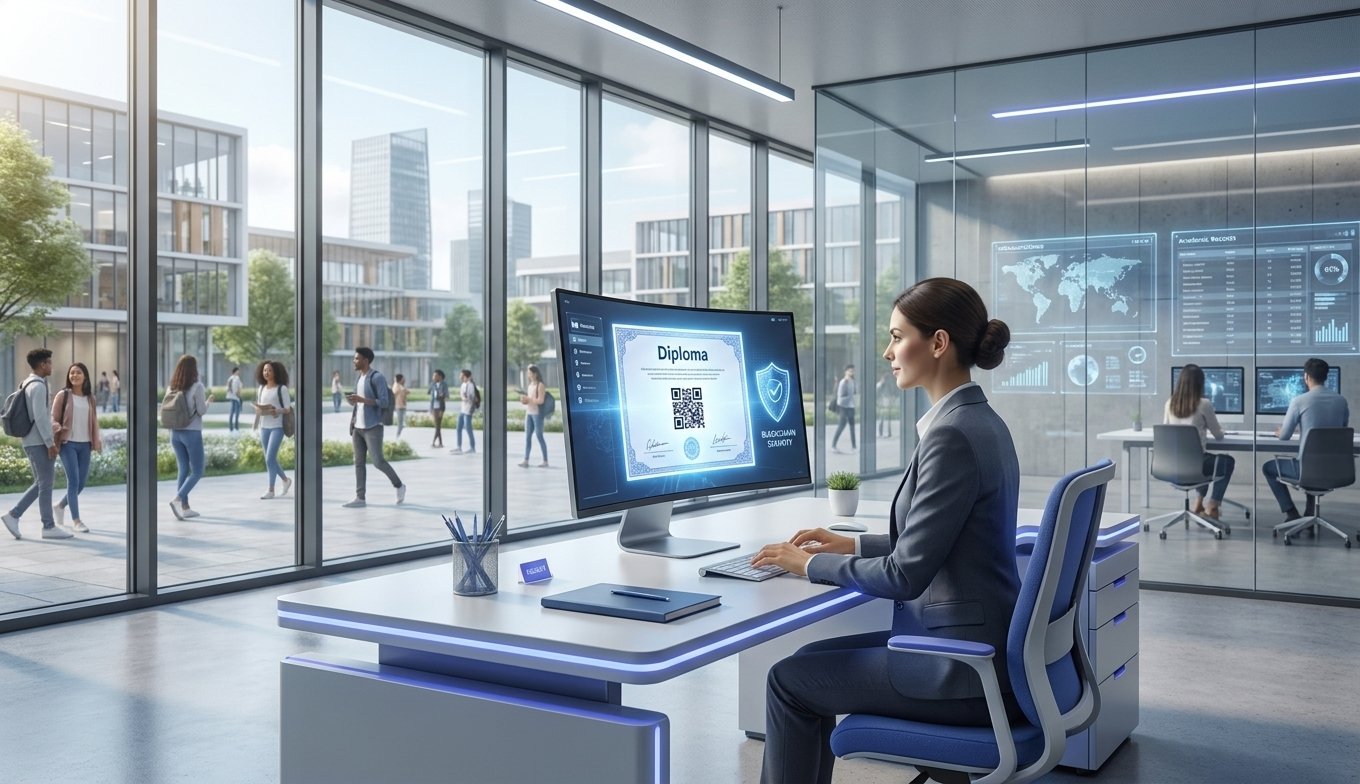
The globally mobile student population is projected to surpass 7 million by the end of 2026, drastically increasing the volume of cross-border document processing for institutions worldwide. For university registrars, admissions directors, and educational technology leaders, this surge presents a critical operational challenge: traditional paper-based administrative systems are simply failing to keep pace with global demand. Adopting verifiable digital credentials is no longer merely an innovative technological upgrade; it is an absolute necessity to prevent administrative gridlock, eliminate weeks of physical courier delays, and ensure that top international talent can transition smoothly across borders to begin their academic journeys.
In this comprehensive guide, our team at Vec.Digital leverages our deep expertise in educational technology to explore how modern digital infrastructure fundamentally accelerates the international admissions process. You will learn how to eliminate costly shipping delays, significantly reduce the administrative burden and burnout experienced by your admissions staff, and deploy secure digital diplomas for universities that empower international applicants to meet strict student visa deadlines with absolute confidence.
Key Takeaways
- The strategic adoption of verifiable digital credentials eliminates the traditional 4 to 6-week delay associated with cross-border academic document authentication.
- Implementing QR code certificates allows instantaneous, frictionless verification for embassies, higher education institutions, and foreign employers.
- Modernizing your admissions system with a robust digital certificate maker drastically reduces manual data entry, mitigating severe staff burnout.
- Leveraging blockchain certificate verification provides immutable, cryptographic trust while vastly improving the overall applicant experience.
- Global institutions must transition to secure digital diplomas for universities to remain competitive in attracting the projected 7 million globally mobile students.
The Bottleneck in Global Student Mobility
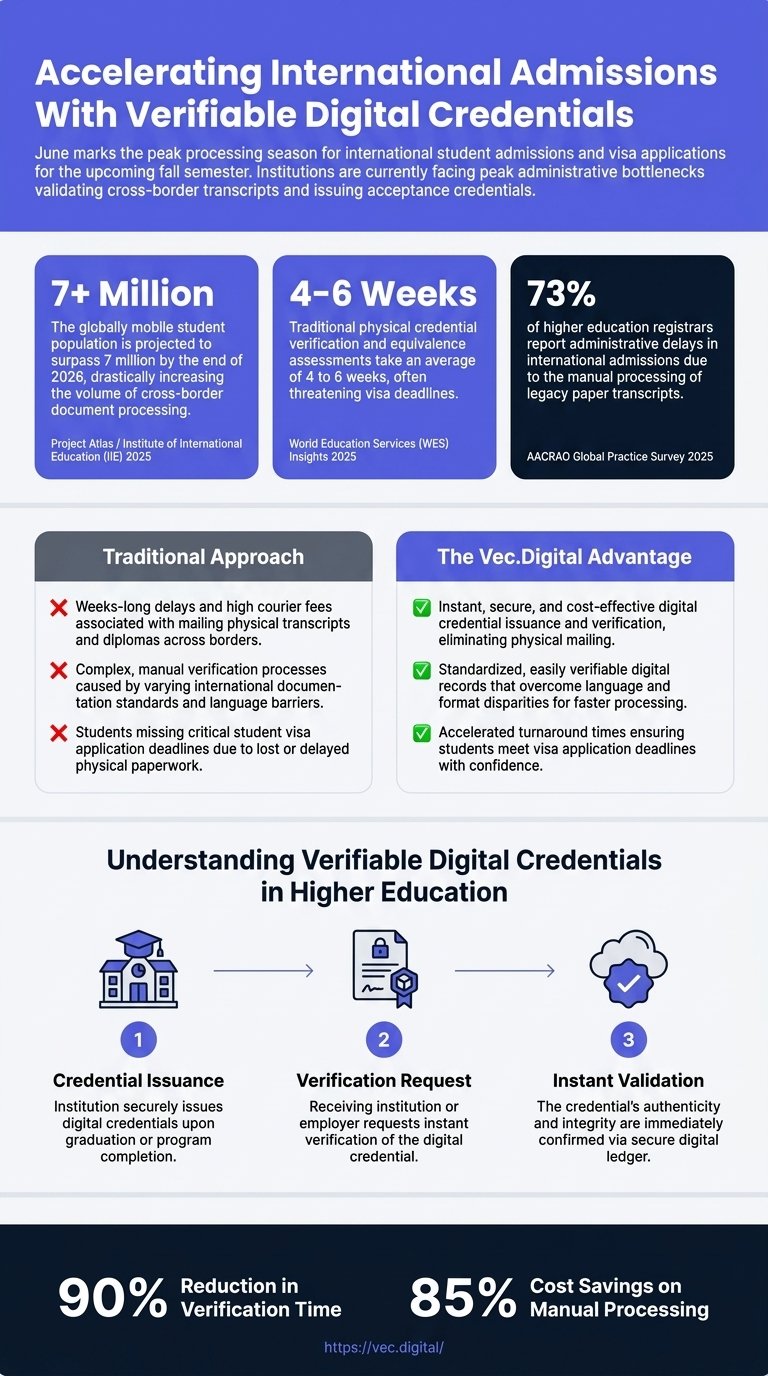
As the world becomes increasingly interconnected, the demand for cross-border education has reached unprecedented heights. According to a 2025 report by Project Atlas and the Institute of International Education (IIE), the globally mobile student population is projected to surpass 7 million by the end of 2026. This massive influx of international applicants brings a wealth of diversity and revenue to global institutions, but it also places an enormous strain on the administrative systems responsible for authenticating academic histories. The reliance on legacy, paper-based credentialing creates a severe bottleneck that threatens to stifle this mobility.
At the heart of this challenge is the sheer logistical nightmare of moving physical documents across continents. When a student applies to a foreign university, their home institution must manually print, stamp, seal, and ship physical transcripts via international couriers. This process is not only expensive but incredibly slow. To solve this, institutions are turning to verifiable digital credentials to digitize and automate the secure transfer of academic records, completely bypassing the physical mail system.
The Cost of Legacy Paper Transcripts
The financial and temporal costs of traditional paper transcripts are staggering. Institutions spend millions annually on secure paper, specialized printing equipment, and international courier fees. Furthermore, manual verification processes are heavily complicated by varying international documentation standards and language barriers. Admissions officers are frequently forced to cross-reference physical stamps and signatures with outdated international databases, a process that is highly susceptible to human error and deliberate forgery.
The administrative toll is equally severe. According to the 2025 AACRAO Global Practice Survey, 73% of higher education registrars report significant administrative delays in international admissions due directly to the manual processing of legacy paper transcripts. These delays create a cascading effect: late transcript processing leads to late acceptance letters, which in turn jeopardizes the student's ability to secure a visa in time for the fall semester.
Missing Visa Deadlines and Courier Delays
June traditionally marks the peak processing season for international student admissions and visa applications. During this critical window, time is of the essence. Unfortunately, weeks-long delays and high courier fees associated with mailing physical transcripts and diplomas across borders often result in students missing critical student visa application deadlines. A lost package or a delay in customs can literally cost a student an entire academic year.
By shifting to an automated digital delivery system, universities can entirely eradicate these logistical hurdles. Digital records are transmitted instantly, ensuring that students have the necessary documentation to proceed with their embassy appointments without the anxiety of waiting for a physical package to clear international customs.
The Global Push for Digital-First Standards
The transition away from paper is not occurring in a vacuum; it is part of a massive, coordinated global effort. Initiatives like the Groningen Declaration Network and the European Blockchain Services Infrastructure (EBSI) are aggressively pushing for a digital-first standard in academic mobility. These organizations recognize that seamless data exchange is fundamental to the future of education.
Universities that continue to rely on physical documents risk losing top international candidates to institutions that offer instantaneous, digitally verifiable acceptance and graduation records. The modern student expects a frictionless digital experience, and institutions must modernize their credentialing infrastructure to remain competitive on the global stage.
Understanding Verifiable Digital Credentials in Higher Education
To fully grasp how modern technology is accelerating admissions, it is essential to define exactly what these new digital assets entail. Unlike a simple PDF, which can be easily altered using basic photo-editing software, verifiable digital credentials are cryptographically secure data sets. They contain structured information about an individual's academic achievements, securely anchored to a tamper-proof system, ensuring that the data cannot be altered retroactively without invalidating the credential.
This technological leap fundamentally changes the nature of trust in academic admissions. Instead of trusting the physical appearance of a document (like a raised seal or a watermark), institutions can trust the underlying cryptography. This shift is what enables instantaneous verification across borders, regardless of the originating country's specific educational standards.
What Are Verifiable Digital Credentials?
People frequently ask: "What are verifiable digital credentials?" In the context of higher education, they are standardized digital records of learning achievements—such as degrees, diplomas, or course completions—that are issued, stored, and verified digitally. They utilize cryptographic signatures to guarantee that the credential was indeed issued by the claimed institution and that the contents have not been tampered with since issuance.
These credentials often employ a decentralized architecture, meaning the verification does not solely rely on a single vulnerable database. Instead, the proof of authenticity is embedded within the credential itself or anchored to a public ledger, allowing any authorized third party to confirm its validity in milliseconds.
How Do Universities Verify International Degrees?
Another common question is: "How do universities verify international degrees?" Historically, this involved a painstaking process of contacting the issuing institution via phone or email, waiting for a response, and cross-referencing physical signatures. Today, forward-thinking universities utilize integrated digital platforms to scan and authenticate incoming records instantly.
When an applicant submits a digital diploma, the receiving university's admissions system automatically reads the cryptographic signature. The system checks the signature against the issuing university's public cryptographic keys. If the signatures match and the blockchain anchor confirms the record is unaltered, the degree is verified immediately. This eliminates the need for manual outreach and drastically accelerates the admissions pipeline.
What is the Standard Format for Digital Academic Records?
As digital adoption grows, so does the need for standardization. "What is the standard format for digital academic records?" The industry is rapidly coalescing around standards set by organizations like the World Wide Web Consortium (W3C), specifically their Verifiable Credentials Data Model. This standard ensures interoperability between different systems globally.
By adhering to these open standards, institutions ensure that a credential issued by a university in Japan can be seamlessly read and verified by an admissions system in Germany or a corporate HR platform in Brazil. This interoperability is the bedrock of true global student mobility.
Transforming the Applicant Experience with Instant QR Verification
While much of the discourse surrounding digital records focuses on institutional security and fraud prevention, the most profound impact is arguably on the user experience. The modern international applicant is a digital native who expects fast, transparent, and mobile-friendly services. Providing verifiable digital credentials not only secures the institution but vastly improves the student journey.
According to the 2026 Educause Horizon Report, over 65% of international applicants expect secure, mobile-accessible academic records they can share instantly with embassies and foreign institutions. Failing to meet this expectation creates unnecessary friction and anxiety for students navigating the already stressful process of relocating internationally for their studies.
Empowering Students with Mobile-Accessible Records
A frictionless admissions process requires putting the power of proof directly into the hands of the student. By issuing credentials equipped with dynamic QR codes, universities provide students with a secure digital locker of their achievements. Students no longer need to carry fragile paper documents in folders or worry about losing their only certified copy during international transit.
Instead, they simply open their smartphone, generate a secure link or display a QR code, and present it to the relevant authority. This mobile-first approach lowers the barrier for global student mobility, transforming a historically stressful administrative hurdle into a seamless digital interaction.
Can Foreign Employers Verify a Digital Diploma via QR Code?
The utility of these credentials extends far beyond university admissions and into the global job market. Students frequently ask, "Can foreign employers verify a digital diploma via QR code?" The answer is a resounding yes. This is one of the primary benefits of utilizing QR code certificates.
When an employer in a foreign country receives a resume containing a QR code, they do not need to download specialized software or create an account on a proprietary platform. They simply scan the code with their standard smartphone camera. The scan instantly routes them to a secure, public verification page that displays the issuer details, recipient information, and the cryptographic proof of authenticity. This instant verification gives employers the certainty to hire without doubt, accelerating the graduate's entry into the workforce.
How Can I Share My University Certificate Internationally?
Another vital consideration for learners is portability: "How can I share my university certificate internationally?" Modern credentialing platforms are built with sharing in mind. A secure digital diploma can be shared via a direct URL, embedded directly into professional networking sites like LinkedIn, or downloaded as a cryptographically signed PDF.
This ease of sharing is critical for international students who must constantly prove their qualifications to various entities—from housing authorities and immigration officials to academic advisors and corporate recruiters. By making sharing effortless, universities add immense, tangible value to the degrees they confer.
Operational Efficiency: Reducing Verification from Weeks to Seconds
The internal operational benefits of adopting digital credentialing are just as transformative as the external applicant benefits. Admissions departments are historically plagued by seasonal spikes in workload, leading to severe bottlenecks. Implementing verifiable digital credentials automates the most time-consuming aspects of document processing, allowing staff to focus on evaluating student potential rather than pushing paper.
The contrast in processing times is stark. According to 2025 insights from World Education Services (WES), traditional physical credential verification and equivalence assessments take an average of 4 to 6 weeks. In the fast-paced world of international admissions, a six-week delay is unacceptable and fundamentally threatens enrollment targets.
How Long Does Cross-Border Credential Verification Take?
When prospective students ask, "How long does cross-border credential verification take?", the answer historically depended on the efficiency of international postal services. With a modern digital infrastructure, the answer is measured in milliseconds. Scanning a QR code or processing a structured digital file through an admissions portal yields an instant binary result: authentic or invalid.
This dramatic reduction in verification time completely alters the admissions timeline. Universities can make rolling admissions decisions much faster, issue acceptance letters sooner, and give international students the ample runway they need to secure housing and visas.
Combating Administrative Burnout in Admissions Offices
The human cost of legacy systems cannot be overstated. Admissions staff frequently suffer from burnout due to the relentless manual data entry, the endless email follow-ups required for international degree authentication, and the stress of managing anxious students waiting for application updates. The manual compilation and verification of international records is a tedious, high-stress task.
By automating this process, institutions immediately relieve this pressure. An automated system handles the cryptographic checks in the background, only flagging anomalies for human review. This elevates the role of the admissions officer from a data-entry clerk to a strategic enrollment specialist, improving job satisfaction and operational throughput.
The Role of a Digital Certificate Maker in Bulk Issuance
Efficiency must also exist on the issuing side. For universities sending out thousands of acceptance letters or graduation diplomas, manually generating each document is inefficient. This is where a robust digital certificate maker combined with a bulk certificate generator becomes essential.
Using platforms like Vec.Digital, administrators can connect their student information systems to the generation engine via API or bulk CSV uploads. The system automatically populates dynamic fields—such as the student's name, program, and graduation date—applies the necessary cryptographic signatures, and distributes the credentials instantly via email. This allows an institution to issue 10,000 secure international diplomas in the time it takes to click a button, completely eliminating the printing and mailing phases.
Blockchain Security: Trust Without the Wait
Speed and efficiency are meaningless if the underlying data cannot be trusted. The ultimate solution to the dual challenge of speed and security is blockchain technology. By anchoring credentials to an immutable ledger, institutions achieve absolute security without sacrificing the instantaneous user experience that modern applicants demand. Verifiable digital credentials backed by blockchain represent the gold standard in academic authentication.
The impact of this technology on operational efficiency is profound. According to the 2026 Gartner Higher Education Tech Trends report, institutions utilizing blockchain-anchored digital credentials report up to an 85% reduction in time spent on routine verification inquiries. This massive time saving is a direct result of decentralized trust.
Blockchain Certificate Verification vs. Traditional Methods
Traditional verification relies on a centralized point of failure: the issuing institution's registrar office. If the office is closed, if their servers are down, or if the physical records were lost in a fire, verification is impossible. Blockchain certificate verification decentralizes this trust.
When a certificate is issued, a unique cryptographic hash of that document is recorded on the blockchain. Because the blockchain is an immutable, distributed ledger, that record can never be altered or deleted. When an embassy or employer verifies the document, they are not querying the university's private database; they are querying the public blockchain. This guarantees 99.99% uptime and ensures that the credential remains verifiable indefinitely, even if the issuing institution ceases to exist.
Secure Digital Diplomas for Universities
Implementing secure digital diplomas for universities using blockchain technology fundamentally protects the institution's global reputation. Credential fraud—such as diploma mills and sophisticated counterfeits—costs the higher education sector millions in reputational damage annually. Bad actors exploit the slow, opaque nature of paper verification.
Blockchain makes forgery mathematically impossible. If a bad actor attempts to alter a digital diploma (for example, changing a grade from a B to an A), the cryptographic hash of the altered document will no longer match the hash anchored on the blockchain. The verification scan will instantly fail, immediately exposing the fraud. This level of security gives foreign institutions and employers absolute confidence in the integrity of your graduates.
Building a Frictionless International Admissions Funnel
Ultimately, combining blockchain security with instant QR verification creates a frictionless international admissions funnel. It removes the barriers of distance, time, and trust. By adopting these technologies, universities signal to the global market that they are modern, efficient, and deeply committed to the success and mobility of their international student body.
This frictionless funnel directly translates to higher enrollment yields. When students experience a fast, transparent, and digitally native admissions process, their confidence in the institution grows. They are more likely to accept an offer that arrives weeks ahead of a competitor's physically mailed acceptance letter, securing your institution's position as a leader in global education.
Future-Proof Your Institution with Vec.Digital
The era of relying on slow, expensive, and vulnerable paper transcripts for international admissions is rapidly coming to an end. As the global student population continues to expand toward 7 million, institutions must scale their administrative capabilities using modern technology. By embracing verifiable digital credentials, your institution can eliminate weeks of processing delays, eradicate credential fraud, and provide a superior, mobile-first experience for international applicants.
At Vec.Digital, we provide the comprehensive technology engine required to make this transformation effortless. Our platform features an intuitive digital certificate maker, automated bulk issuance capabilities, dynamic QR code integration, and immutable blockchain anchoring. We empower universities to issue globally recognized, instantly verifiable academic records at scale, ensuring your admissions operations are fast, secure, and future-proof.
Stop letting legacy paperwork dictate your international enrollment success. Start issuing verifiable credentials that cross borders at the speed of light.
Transform your credentialing process today:
Website: https://vec.digital/
Email: support@vec.digital