
Architecting a Scalable Micro-Credential System for Skills-Based Hiring in 2026
Published on August 5, 2026

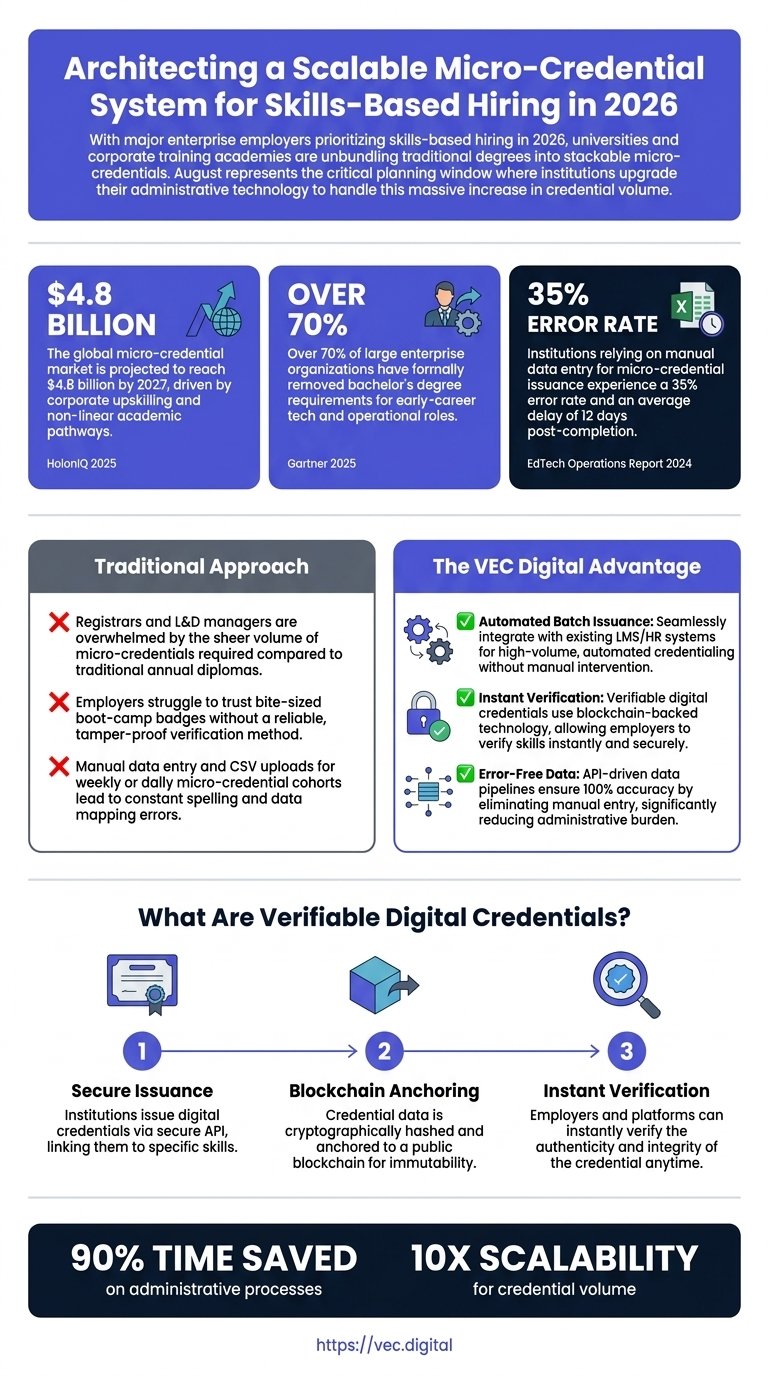
Over 70% of large enterprise organizations have formally removed bachelor's degree requirements for early-career tech and operational roles, according to Gartner (2025). This massive shift toward skills-based hiring has fundamentally fractured the traditional four-year degree model, replacing it with a demand for granular, stackable micro-credentials. However, as universities and corporate training academies rush to unbundle their curricula, they are colliding with a severe operational bottleneck: the sheer administrative disaster of issuing thousands of individual certificates manually. Without a modernized infrastructure, institutions are finding it impossible to scale their credentialing programs while maintaining the absolute trust required by global employers.
In this comprehensive guide, our team at VEC Digital provides a practical blueprint for managing the massive administrative overhead of modern education. You will learn how to leverage automated systems to deploy verifiable digital credentials at scale, eliminating manual data entry errors and issuance delays. By bridging the gap between innovative curriculum design and automated credential delivery, your institution can build a frictionless, globally recognized digital diploma platform that empowers learners and guarantees authenticity for hiring managers.
Key Takeaways
- Verifiable digital credentials provide cryptographically secure proof of granular skills, essential for modern skills-based hiring.
- Replacing manual data entry with a bulk certificate generator eliminates the 35% error rate commonly seen in high-volume cohort issuance.
- Integrating a digital diploma platform via REST API reduces the administrative cost of issuing certificates by up to 88% per academic year.
- Blockchain certificate verification ensures that stackable micro-credentials remain immutable, globally interoperable, and permanently owned by the learner.
- Automated credential engines align with international standards, supporting global frameworks like the European Approach to Micro-credentials.
The Rise of Skills-Based Hiring and Stackable Micro-Credentials
The transition from monolithic degrees to granular skill validation is reshaping the global educational landscape. As employers prioritize proven competencies over institutional pedigree, the demand for verifiable digital credentials has skyrocketed. The global micro-credential market is projected to reach $4.8 billion by 2027, driven by corporate upskilling and non-linear academic pathways, according to research by HolonIQ (2025). This explosive growth signifies a fundamental shift in how human capital is evaluated, requiring educational institutions to adapt their output models rapidly.
Traditional academic models were built around singular, high-stakes issuance events—such as an annual graduation ceremony where a single paper diploma was handed out. Today, a single learner might earn dozens of micro-credentials over a few months. This exponential increase in credential volume creates a mathematical nightmare for registrars and Learning & Development (L&D) managers who are still relying on legacy software and physical printing presses.
Shifting from Degrees to Granular Skill Validation
Skills-based hiring credentials allow employers to see exactly what a candidate can do, rather than guessing based on a broad degree title. A stackable micro-credential system breaks down a larger curriculum into bite-sized, achievable milestones. For example, instead of waiting two years for a Master's in Data Science, a professional can earn individual badges in Python Data Structures, Machine Learning Algorithms, and Data Visualization along the way.
While the pedagogical benefits of this approach are widely celebrated, the operational reality is often ignored. Most industry content focuses heavily on the curriculum design of micro-credentials, completely overlooking the operational disaster of issuing them manually. Registrars and L&D managers are suddenly overwhelmed by the sheer volume of micro-credentials required compared to traditional annual diplomas. The administrative burden multiplies with every new short-course launched.
The Operational Disaster of Manual Credentialing
When institutions attempt to handle this new volume using old methods, the system breaks down. According to the EdTech Operations Report (2024), institutions relying on manual data entry for micro-credential issuance experience a 35% error rate and an average delay of 12 days post-completion. These delays are not just administrative headaches; they actively harm the learner. If a student completes a coding bootcamp on a Friday, they need that credential immediately to apply for jobs on Monday. A 12-day delay nullifies the agility that micro-credentials are supposed to provide.
Furthermore, manual data entry and basic CSV uploads for weekly or daily micro-credential cohorts lead to constant spelling mistakes and data mapping errors. A misspelled name on a professional certification damages the credibility of both the issuer and the recipient. To survive this shift, institutions must bridge the gap between curriculum design and automated credential delivery systems, treating credential issuance as a continuous, automated digital process rather than a manual, batch-processed administrative chore.
What Are Verifiable Digital Credentials?
To understand how to fix the operational bottleneck, we must first address a fundamental question asked by many academic administrators: What are verifiable digital credentials? Unlike a standard PDF or a JPEG image of a certificate, a verifiable digital credential is a cryptographically secured data package. It contains authenticated metadata about the issuer, the recipient, the specific skills acquired, and the date of issuance, all anchored to a tamper-proof system.
This distinction is critical. A standard PDF can be easily altered using basic photo-editing software, rendering it useless as a reliable proof of skill. In contrast, a cryptographically verifiable credential provides absolute certainty. This is why 82% of hiring managers state they are more likely to trust a candidate's skills if backed by cryptographically verifiable digital credentials, according to HR Tech Trends (2025).
Defining the Modern Standard for Proof of Skill
A true digital diploma platform goes beyond generating a visually appealing document; it creates a mathematical proof of achievement. When an institution issues a certificate through a robust credentialing engine, the system hashes the certificate's data—creating a unique digital fingerprint. If even a single pixel or letter is altered on the certificate, the hash changes, immediately flagging the document as fraudulent.
This level of security is what allows employers to trust bite-sized bootcamp badges and short-course certificates. Historically, employers struggled to trust these smaller credentials without a reliable, tamper-proof verification method. By adopting cryptographically secure standards, institutions can elevate the perceived value of their micro-credentials, ensuring they carry the same—if not more—weight than traditional paper degrees in the modern job market.
How Do Employers Verify Digital Badges and Micro-Credentials?
The true power of a digital credential lies in its frictionless verification. So, how do employers verify digital badges and micro-credentials in practice? The most efficient systems utilize instant QR code verification. Every certificate generated includes a unique, embedded QR code.
When a hiring manager or auditor reviews a resume, they do not need to call a university registrar, pay a background check fee, or wait weeks for a transcript. They simply scan the QR code with their smartphone camera. This action instantly routes them to a secure, dedicated verification URL hosted by the digital diploma platform. Within seconds, the employer sees a "Verified" badge, alongside the immutable data confirming the candidate's achievements. This zero-friction process dramatically speeds up hiring timelines and eliminates the administrative burden on your institution's records department.
Overcoming Volume: How to Automate the Issuing of Student Certificates
Scaling a micro-credential program requires a fundamental shift in how institutions handle data. The most common question we hear from EdTech product managers and university deans is: How to automate the issuing of student certificates without losing personalization or security? The answer lies in replacing manual human intervention with a centralized verifiable digital credentials engine designed for high-volume throughput.
Automation is not just a convenience; it is an operational necessity. When dealing with thousands of learners completing various stackable modules at different times, human administrators simply cannot keep up. By implementing an automated credential delivery system, institutions can achieve zero-touch issuance, where the completion of a course automatically triggers the creation and delivery of the certificate.
Why Universities and EdTechs Need a Digital Diploma Platform
A comprehensive digital diploma platform serves as the centralized hub for all credentialing activities. Instead of using disjointed graphic design tools, email clients, and spreadsheet software, a unified platform handles the entire lifecycle. It provides visual drag-and-drop editors to maintain brand consistency, dynamic placeholders (like {{RecipientName}} and {{CourseTitle}}) to ensure personalization, and automated dispatch engines to handle delivery.
More importantly, a dedicated platform natively supports multi-signatory approval pipelines. For high-stakes compliance training or academic degrees, certificates can be held in a pending state until authorized personnel securely log in and digitally sign off. This ensures strict governance and prevents rogue or accidental issuance, maintaining the integrity of the institution while still operating at a massive scale.
Leveraging a Bulk Certificate Generator for High-Volume Cohorts
For organizations that process learners in distinct cohorts—such as post-event wrap-ups, hackathons, or end-of-semester graduations—a bulk certificate generator is the ultimate operational relief. How do universities issue micro-credentials at scale in these scenarios? They utilize smart CSV upload parsers.
Instead of typing out 5,000 names, an administrator simply exports a standard CSV file from their Student Information System (SIS) or Learning Management System (LMS) and uploads it into the credential engine. The system automatically maps the data columns to the dynamic placeholders on the certificate template. Within minutes, thousands of personalized, cryptographically secured certificates are generated and emailed directly to the recipients. This eliminates the 35% manual error rate and reduces a multi-week administrative nightmare into a five-minute automated process.
Securing Trust: Can Micro-Credentials Be Stored on the Blockchain?
As the volume of micro-credentials grows, so does the need for absolute, decentralized trust. A frequent inquiry from forward-thinking IT Directors is: Can micro-credentials be stored on the blockchain? The answer is a resounding yes, and it is rapidly becoming the global gold standard for verifiable digital credentials. By anchoring credentials to a public ledger, institutions can guarantee absolute immutability and protect their brand reputation from sophisticated AI-generated forgery.
Blockchain technology acts as a decentralized notary. When a certificate is issued, its unique cryptographic hash is recorded on the blockchain. This record is permanent, publicly verifiable, and completely independent of the issuing institution's internal servers. If a university's local database is compromised, or if an EdTech startup ceases operations, the learner's credentials remain secure and verifiable forever.
The Mechanics of Blockchain Certificate Verification
Blockchain certificate verification works silently in the background, providing a frictionless experience for both the issuer and the verifier. When an employer scans the QR code on a blockchain-secured diploma, the verification page queries the blockchain ledger in real-time. It compares the hash of the presented document against the hash stored on the chain.
If the hashes match perfectly, the system displays a "Blockchain Verified" security badge. This process completely eliminates the possibility of credential fraud. It is mathematically impossible for a bad actor to alter the certificate data without changing the hash, and it is equally impossible for them to alter the decentralized blockchain ledger. For further reading on the mechanics of decentralized trust, resources like Wikipedia's breakdown of Blockchain technology provide excellent foundational knowledge.
Ensuring Global Interoperability and Cross-Border Trust
The shift toward blockchain-backed credentials is not just a technological preference; it is becoming a regulatory mandate. Global regulatory frameworks are pushing for standardized, interoperable credential systems. For instance, the European Approach to Micro-credentials emphasizes the need for short-course certifications to be universally verifiable across borders.
Similarly, initiatives in the Middle East, such as the UAE's push for blockchain-based national skill registries, are mandating that academic and professional achievements be cryptographically secured. By adopting blockchain certificate verification now, institutions ensure their credentials hold recognizable weight in the international job market, proving compliance with the highest global standards of data integrity.
Architecting Your Automated Credential Delivery System
Understanding the value of verifiable digital credentials is only the first step; the true competitive advantage comes from implementation. To handle the administrative load of stackable micro-credentials, institutions must architect a seamless, automated delivery system. This involves connecting your existing educational infrastructure directly to a modern credentialing engine.
The goal is to create a "zero-touch" environment. In a fully optimized system, human administrators focus on curriculum development and student support, while the software handles the entirety of the credential generation, securing, and dispatching process.
Integrating API-Driven Certificate Automation
The most effective way to achieve zero-touch issuance is through a robust Developer API. Integrating API-driven credential automation reduces the administrative cost of issuing certificates by up to 88% per academic year, according to the University Tech Review (2026). An API (Application Programming Interface) allows your Learning Management System (such as Canvas, Moodle, or Blackboard) or corporate HRIS to communicate directly with the certificate generator.
When a learner passes a final assessment or completes a compliance module, your LMS sends a programmatic webhook to the credential platform. The API instantly triggers the generation of the certificate, anchors it to the blockchain, and dispatches the email to the learner. This happens in milliseconds, ensuring that the learner receives their reward the exact moment they earn it, dramatically boosting engagement and course completion rates.
Preventing Data Entry Errors and Eliminating Delays
By removing the human element from the data transfer process, API integrations completely eliminate spelling mistakes and data mapping errors. The name and email address are pulled directly from the user's authenticated profile in the LMS, ensuring 100% accuracy on the final credential.
Furthermore, this automated architecture scales infinitely. Whether your institution has 50 learners completing a course on a Tuesday, or 50,000 learners finishing a massive open online course (MOOC) on a Friday, the API handles the load without requiring additional administrative headcount. This operational efficiency is the cornerstone of a successful, modern skills-based educational program.
Empowering the Learner: Creating Immutable Digital Lockers
The ultimate beneficiary of a well-architected verifiable digital credentials system is the learner. In the era of skills-based hiring, candidates need immediate, organized access to their entire portfolio of achievements. A common pain point for students and corporate trainees is losing their individual course badges because they aren't centrally anchored to an immutable system.
When credentials are sent as standalone PDFs or disjointed emails, they are easily lost in spam folders or forgotten on old hard drives. A modern credentialing strategy must include a centralized, secure space for learners to manage their lifelong learning records.
Preventing the Loss of Individual Course Badges
A comprehensive digital diploma platform provides every recipient with access to a secure customer portal—a digital locker for their achievements. Whenever an institution issues a new stackable micro-credential, it is automatically deposited into the learner's portal.
This centralized repository empowers learners to view, manage, and download all credentials issued to them over their lifetime. More importantly, it allows them to easily share their verified achievements directly to professional networks like LinkedIn, turning your alumni network into a global, automated marketing engine for your institution's programs.
The Best Digital Diploma Platform for Stackable Certificates
What is the best digital diploma platform for stackable certificates? The ideal solution must combine visual design flexibility, high-volume automation, and unbreakable cryptographic security. It must offer frictionless QR code verification for employers, API endpoints for developers, and an intuitive dashboard for registrars.
At VEC Digital, we have built exactly this infrastructure. Our platform is designed specifically to solve the operational bottlenecks of the micro-credential boom. By offering automated CSV bulk uploads, seamless REST API integrations, and immutable blockchain anchoring, we provide the trust infrastructure that global institutions rely on to scale their credentialing without adding administrative overhead.
Secure Your Organization's Credentials Today
The shift toward skills-based hiring and stackable micro-credentials is not a temporary trend; it is the new global standard. As employers increasingly demand granular, cryptographically secure proof of competencies, institutions that rely on manual data entry and easily forged PDFs will quickly lose their competitive edge. The administrative cost and reputational risk of legacy systems are simply too high in 2026.
By upgrading to an automated, blockchain-anchored credentialing engine, you can eliminate data entry errors, reduce issuance delays to zero, and provide your learners with the internationally recognized, verifiable credentials they need to succeed in the modern job market. We empower organizations to make credential fraud impossible while scaling operations effortlessly.
Secure your organization’s credentials today — design your first template in minutes with no setup fees and experience the operational relief of true automation.
Ready to modernize your credentialing infrastructure?
Website: https://vec.digital
Email: support@vec.digital