
Automating Graduation Week With a Bulk Certificate Generator
Published on June 2, 2026

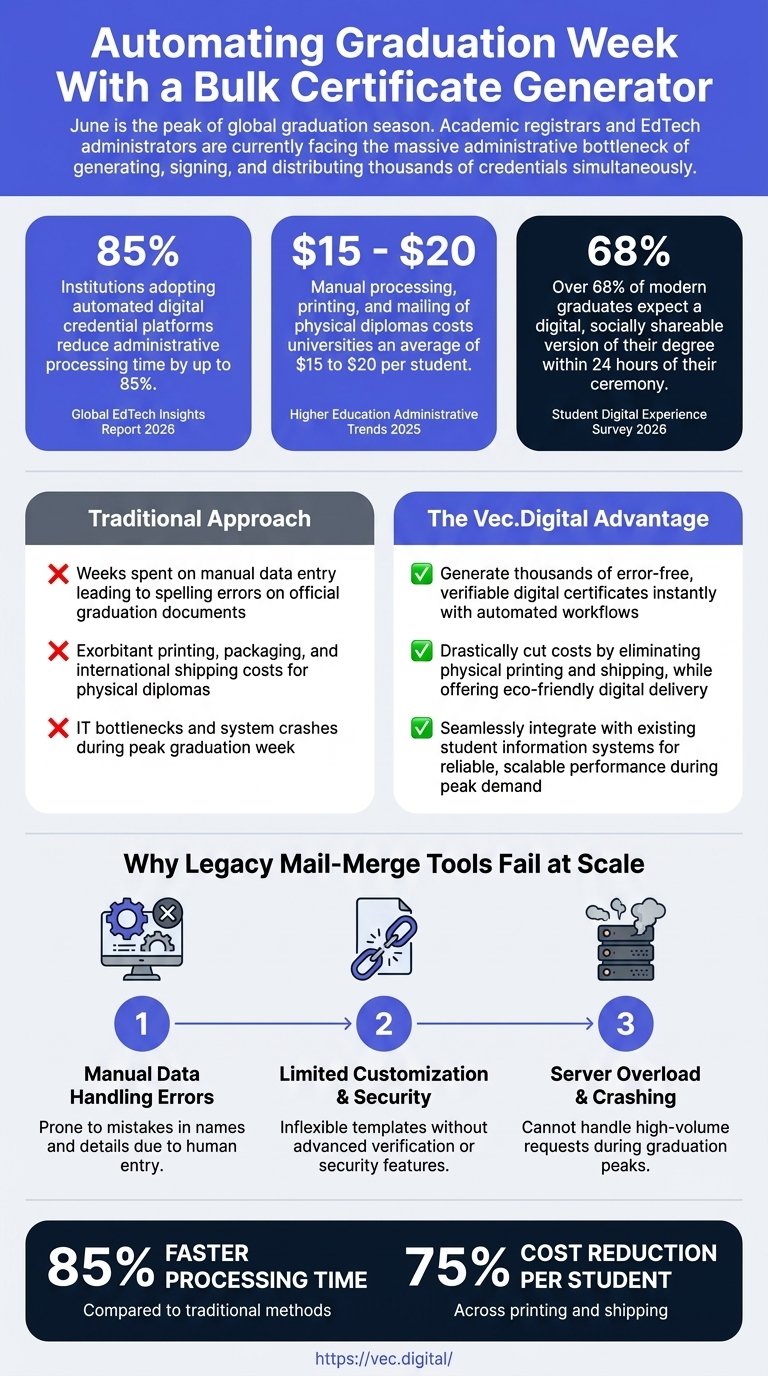
Manual processing, printing, and mailing of physical diplomas costs universities an average of $15 to $20 per student (Higher Education Administrative Trends, 2025). As the peak of global graduation season approaches, academic registrars and IT directors face an overwhelming logistical burden that drains institutional resources and delays student gratification. To eliminate this massive administrative bottleneck, leading educational organizations are adopting a bulk certificate generator to transform how they issue and authenticate academic awards at scale.
In this comprehensive guide, you will discover how to modernize your graduation processes using advanced automation. Leveraging our deep expertise in Technology at Vec.Digital, we will explore how to drastically reduce administrative overhead, eradicate costly data entry errors, and deliver highly secure credentials to a global student body. You will learn actionable strategies to issue thousands of uniquely verifiable digital diplomas in minutes, ensuring your institution remains at the forefront of educational innovation and operational efficiency.
Key Takeaways
- Implementing an automated certificate system reduces administrative processing time by up to 85%.
- Replacing physical mail with a bulk certificate generator saves institutions $15 to $20 per graduating student.
- Over 68% of modern graduates now demand instant, socially shareable verifiable digital credentials.
- Automated data mapping eliminates the manual typing errors that cause 30% of global diploma reprints.
- Modern QR code certificates provide instant, secure verification for thousands of documents without IT bottlenecks.
The Global Shift Toward Automated Digital Diplomas
Overcoming Graduation Week Logistics
The landscape of higher education has become inherently globalized. With the rise of remote learning, international branch campuses, and cross-border online programs, the traditional method of distributing graduation documents has completely broken down. Shipping physical degrees internationally has become a logistical nightmare fraught with customs delays, exorbitant courier fees, and lost mail. For an institution graduating 10,000 students across 50 different countries, relying on physical logistics is no longer sustainable.
During peak graduation week, this logistical strain often culminates in severe IT bottlenecks and system crashes. Legacy university databases struggle to export massive files, and administrative staff are forced to work overtime to manually process batches of student records. By transitioning to a cloud-based bulk certificate generator, universities can decouple their credentialing process from physical limitations. Automated systems utilize distributed cloud architecture to process tens of thousands of records simultaneously, ensuring that graduation week proceeds smoothly without overwhelming internal university servers.
Meeting the Expectations of Modern Graduates
Today's graduates enter a highly competitive, digital-first job market where speed and verifiable proof of skills are paramount. They do not want to wait six to eight weeks for a piece of parchment to arrive in the mail before they can apply for jobs. In fact, over 68% of modern graduates expect a digital, socially shareable version of their degree within 24 hours of their ceremony (Student Digital Experience Survey, 2026).
This demographic shift demands a technological response. Students want instant, LinkedIn-ready digital proof of their graduation that they can immediately share with their professional networks and prospective employers. When an institution fails to provide this, they inadvertently hinder their alumni's immediate career prospects and miss out on the organic marketing generated by thousands of proud students sharing their branded university credentials online.
How Do Modern Universities Issue Digital Diplomas?
When asking, How do modern universities issue digital diplomas?, the answer lies in robust API integrations and automated data pipelines. Instead of treating the diploma as a physical object to be printed, modern institutions treat it as a secure digital asset. They utilize a comprehensive educational technology platform that connects directly to their Student Information System (SIS).
Once a student's final grades are approved and their degree is officially conferred in the database, the SIS triggers an automated process. The data is securely transmitted to the credentialing engine, which instantly generates a beautifully designed, cryptographically secure digital diploma. This asset is then automatically emailed to the student and deposited into their secure digital locker, completely bypassing the need for manual human intervention.
Why Legacy Mail-Merge Tools Fail at Scale
The Hidden Costs of Manual Processing
For decades, universities relied on basic mail-merge features in word processors to generate certificates. While this method may suffice for a small classroom of twenty students, it is catastrophically inefficient for institutional scale. The financial burden is immense. Manual processing, printing, and mailing of physical diplomas costs universities an average of $15 to $20 per student (Higher Education Administrative Trends, 2025). For a university with 5,000 graduates, that equates to up to $100,000 spent purely on paper, ink, and postage.
Beyond the direct financial costs, there is a massive hidden cost in human capital. Academic registrars and their staff spend weeks on manual data entry, formatting text, adjusting layouts for long names, and organizing shipping labels. A modern bulk certificate generator reclaims these thousands of hours, allowing administrative staff to focus on higher-value tasks such as student advising and curriculum support.
Eradicating Data Entry Errors
When humans are tasked with manually processing thousands of records, fatigue inevitably leads to mistakes. Misspelled names, incorrect degree honors, and wrong graduation dates are incredibly common when relying on manual typing or rudimentary copy-pasting. These errors are not just minor inconveniences; they damage the institution's reputation and cause immense frustration for the graduate.
The statistics highlight the severity of this issue: administrative data entry errors account for over 30% of diploma reprints globally (International Registry Association, 2024). Reprints double the cost and labor associated with that specific credential. By utilizing an automated system that pulls data directly from the verified central database, institutions ensure 100% accuracy. The exact spelling the student verified during enrollment is the exact spelling injected dynamically into the final credential.
The Security Gap in Traditional PDFs
Most existing tutorials on bulk certificate creation rely on basic mail-merge techniques that generate standard PDF files. However, there is a massive knowledge gap regarding the security of these files. A standard PDF offers zero verification features. It can be easily altered using basic graphic design software, allowing malicious actors to change names, grades, or university seals, thereby committing credential fraud.
In contrast, a dedicated university credential platform embeds advanced cryptographic security into every generated document. When utilizing a true automated engine, the resulting file is not just an image; it is a mathematical proof of achievement that cannot be tampered with, fundamentally solving the security gap left by outdated mail-merge processes.
Mastering the Bulk Certificate Generator
What is the Best Bulk Certificate Generator for Universities?
When evaluating technology, IT directors frequently ask: What is the best bulk certificate generator for universities? The optimal solution must possess three core capabilities: effortless scalability, bank-grade security, and uncompromising design flexibility. It must be able to handle the simultaneous generation of tens of thousands of documents without crashing, ensuring zero IT bottlenecks during peak graduation week.
Furthermore, the best platforms act as a comprehensive digital certificate maker, offering drag-and-drop design editors that allow universities to perfectly replicate their traditional physical parchment in a digital format. This includes supporting custom fonts, high-resolution university seals, and dynamic text scaling that automatically adjusts font sizes to accommodate exceptionally long student names without breaking the layout.
How Do You Generate Certificates in Bulk Automatically?
To answer the common question, How do you generate certificates in bulk automatically?, we must look at the architecture of dynamic data mapping. The process begins with the creation of a master template. Within this template, the designer places dynamic variable tags—such as {{Student_First_Name}}, {{Degree_Title}}, and {{Graduation_Date}}.
When the automated engine is triggered, it ingests a structured data payload. The bulk certificate generator rapidly reads each line of data, matches the corresponding information to the variable tags on the template, renders the final high-resolution file, and dispatches the delivery email. Because this process is handled by distributed cloud servers, an institution can generate 10,000 unique certificates in the same amount of time it takes a human to manually type a single one.
Is it Possible to Automate Certificate Generation from a CSV File?
Absolutely. For institutions that do not wish to implement a full API integration, CSV uploads provide a powerful, no-code alternative. Is it possible to automate certificate generation from a CSV file? Yes, and it is the preferred method for many mid-sized colleges and event organizers.
The administrator simply exports a spreadsheet from their database containing the graduate roster. They upload this CSV file into the credentialing platform. The system's interface will then prompt the user to map the spreadsheet columns to the template's dynamic fields. Once mapped, the administrator clicks a single button to execute the batch. The system processes the CSV row by row, generating and delivering thousands of accurate, personalized credentials in a matter of minutes.
Integrating Cryptographic Security at Scale
How Can I Send 1000 Certificates at Once with Unique QR Codes?
One of the most complex challenges in digital credentialing is combining high-volume output with individualized security. Administrators frequently ask: How can I send 1000 certificates at once with unique QR codes? Standard mail-merge tools cannot accomplish this, as they cannot dynamically generate and embed unique cryptographic images on the fly.
A specialized bulk certificate generator solves this by integrating QR generation directly into the rendering pipeline. As the system processes each student's record, it first generates a unique UUID (Universally Unique Identifier) and a dedicated public verification URL for that specific credential. It then instantly generates a QR code pointing to that URL and embeds it into the designated layout block on the certificate template. This ensures that every single document out of the 1,000 generated receives its own unique, secure verification code without slowing down the overall system.
The Role of Verifiable Digital Credentials
The inclusion of these unique QR codes transforms a simple digital image into verifiable digital credentials. When an employer or auditor wants to verify a graduate's degree, they do not need to contact the university registrar and wait days for a manual background check. They simply scan the QR code using any standard smartphone camera.
The scan instantly routes them to a secure, university-branded verification page hosted on a platform with 99.98% guaranteed uptime. This page displays the immutable record of the credential, including the issuer details, recipient name, degree earned, and official signatory approvals. By providing this instant verification, universities drastically increase the value of their degrees in the job market, empowering their alumni to prove their qualifications effortlessly.
Ensuring Zero IT Bottlenecks During Peak Season
The technological backbone required to support this level of automation must be incredibly robust. Institutions adopting automated digital credential platforms reduce administrative processing time by up to 85% (Global EdTech Insights Report, 2026), but this efficiency is only realized if the platform remains stable under heavy load.
By utilizing modern cloud infrastructure and enterprise-grade technology, advanced credentialing systems isolate the intensive rendering processes from the institution's internal networks. This means that even if a university issues 50,000 diplomas simultaneously on graduation day, their internal student portals and websites remain completely unaffected, ensuring a seamless experience for both staff and students.
Accelerating EdTech and Online Course Recognition
What is the Fastest Way to Create Certificates for Online Course Graduates?
While traditional universities face the pressure of annual graduation seasons, EdTech platforms and online course creators deal with a continuous, daily stream of graduates. What is the fastest way to create certificates for online course graduates? The answer is a fully automated, API-driven bulk certificate generator.
For EdTech platforms, manual issuance is entirely unscalable. By integrating a digital certificate maker directly into their Learning Management System (LMS) via REST API, course creators can establish a "set it and forget it" system. The moment a learner passes their final assessment, the API payload is triggered, and the credential is generated and delivered instantly. This immediate reward mechanism significantly boosts learner satisfaction and encourages them to enroll in subsequent courses.
Centralized Team Management for High-Volume Issuers
Whether operating a global university or a massive open online course (MOOC) platform, credential issuance is rarely a solo endeavor. It requires collaboration between designers, instructors, data managers, and executive signatories (like a Dean or CEO). Managing this collaboration securely is critical to preventing unauthorized issuance.
A premium university credential platform includes unified team management features. Administrators can assign specific roles within the system dashboard. A designer can be granted access only to the template builder, an instructor can be restricted to uploading CSV grade files, and the Dean can be the sole authority capable of applying the final digital signature to approve the batch release. This coordinated, role-based approach ensures secure operations while maintaining the speed and efficiency of automated bulk issuance.
Scale Your Credentialing with Vec.Digital
The traditional methods of processing, printing, and shipping physical diplomas are obsolete. They are too slow, too expensive, and fundamentally misaligned with the expectations of modern, digital-native graduates. To thrive in the current educational landscape, institutions must embrace automation and cryptographic security to deliver instant, verifiable proof of achievement.
At Vec.Digital, we provide a comprehensive suite of tools designed to completely modernize your graduation workflows. Our powerful bulk certificate generator allows you to design stunning, on-brand templates and issue thousands of uniquely verifiable QR-code diplomas via CSV or API in mere minutes. With our 99.98% uptime SLA, centralized team management, and unwavering commitment to making credential fraud impossible, we empower universities and EdTech platforms to scale their operations effortlessly.
Stop wasting weeks on manual data entry and exorbitant shipping costs. Transition to a secure, automated system that delights your students and protects your institution's legacy.
Ready to automate your graduation season? Visit us at: https://vec.digital/ Contact our Happiness Centre: support@vec.digital