
Beyond the PDF: How to Create Online Certificates with QR Code Verification
Published on June 29, 2026
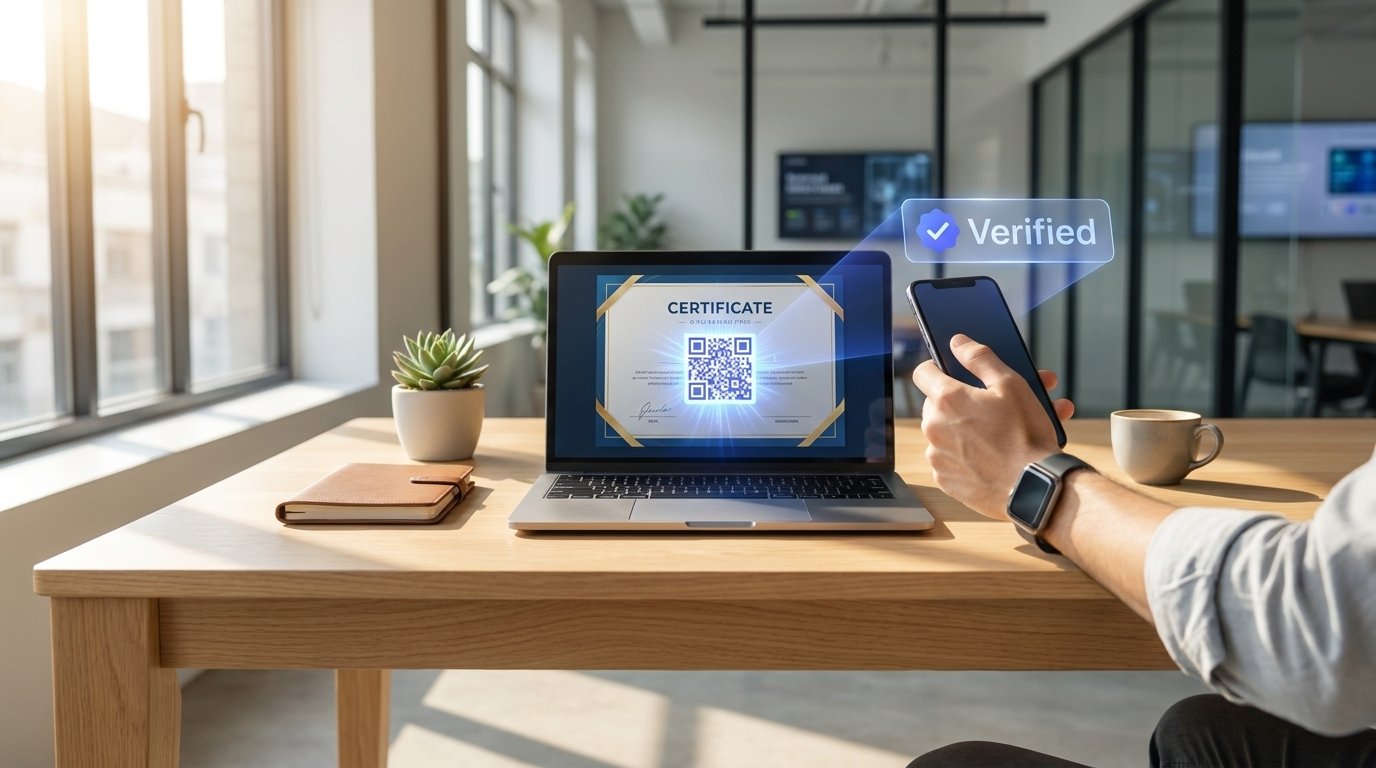
With the global e-learning market projected to surpass $400 billion by 2026, educational platforms face an unprecedented challenge in proving the authenticity of their graduates' achievements. When you create online certificates with QR code verification, you instantly transform a standard digital document into a secure, employer-trusted credential. Relying on easily forged static PDFs is no longer viable in a competitive digital economy where hiring managers demand immediate, irrefutable proof of skills.
In this comprehensive guide, our team at Vec.Digital leverages deep expertise in verifiable digital credentials and educational technology to show you how to modernize your issuance process. You will learn the critical differences between static and dynamic cryptographic QR codes, discover how to automate bulk generation directly from your learning management system, and explore strategies to boost your course completion rates. By implementing these enterprise-grade security measures, your organization will empower learners with instantly verifiable achievements that stand out in the global job market.
Key Takeaways
- Transitioning from static PDFs to QR code certificates eliminates credential fraud and protects institutional reputation globally.
- Understanding how to create online certificates with QR code technology dynamically ensures every document maps to a unique, immutable database record.
- Integrating a bulk certificate generator with existing LMS platforms automates credential delivery and eliminates administrative overhead.
- Providing verifiable digital credentials increases learner motivation and significantly boosts engagement on professional networks like LinkedIn.
- Utilizing the best certificate maker for online courses reduces employer background check times from days to mere seconds.
1. The Rising Demand for Secure Digital Credentials in EdTech
The Surge of Global E-Learning and Micro-Credentials
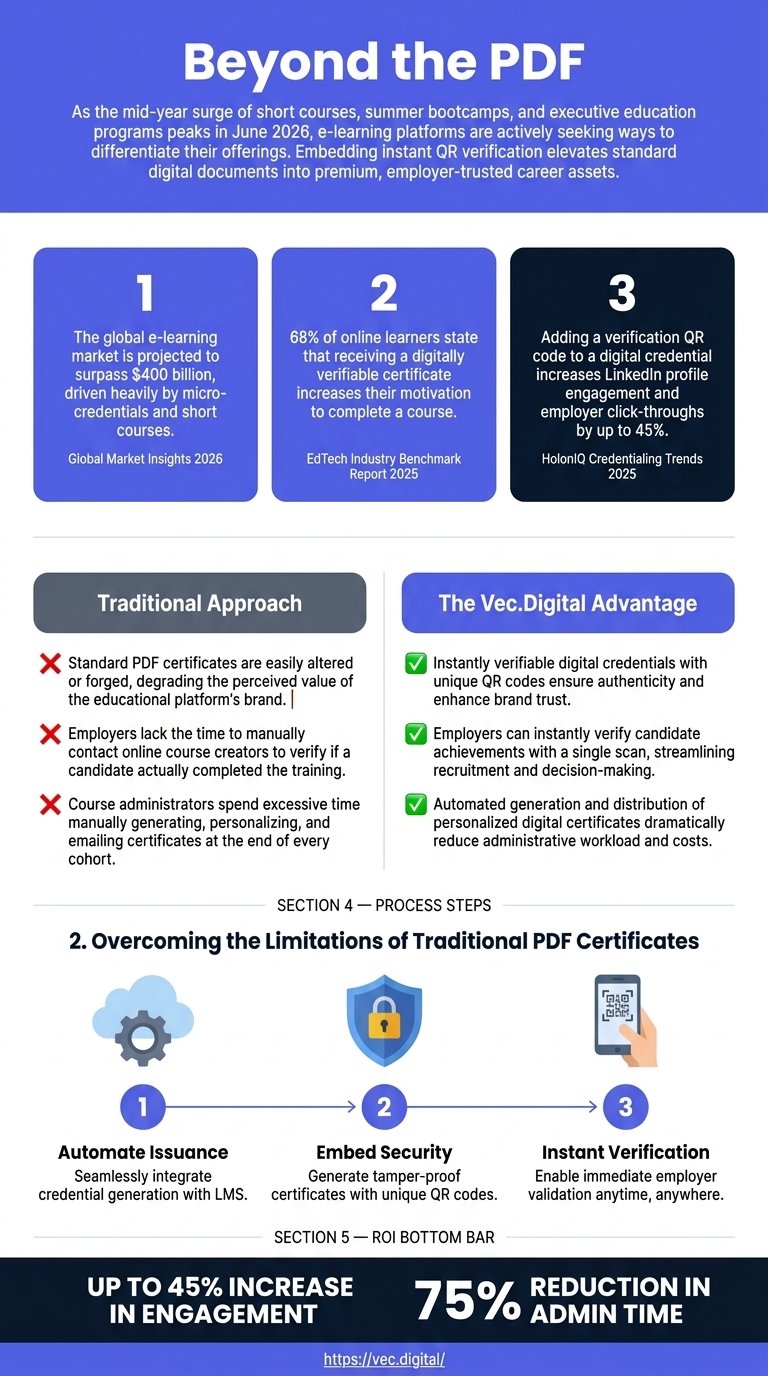
The landscape of education has fundamentally shifted from traditional, multi-year degree programs toward agile, skill-based learning. According to a 2026 report by Global Market Insights, the global e-learning market is projected to surpass $400 billion, driven heavily by the proliferation of micro-credentials, summer bootcamps, and executive education programs. As this surge reaches its peak, online course creators and EdTech founders are actively seeking ways to differentiate their offerings in an increasingly saturated market.
However, this rapid expansion has introduced a critical challenge: trust. With thousands of new academies and independent educators launching programs daily, employers are struggling to determine which credentials represent genuine skill acquisition and which are merely participation trophies. To stand out, modern educational platforms must provide credentials that carry inherent, verifiable weight. This is where the ability to create online certificates with QR code technology becomes a foundational business requirement rather than an optional add-on.
Why Verifiability Drives Learner Motivation
The value of an educational program is closely tied to the tangible outcomes it provides for the student. If a learner invests weeks or months into mastering a new skill, they expect a credential that will be recognized and respected by future employers. When educational institutions fail to provide secure, verifiable proof of these achievements, learner engagement inevitably drops.
The data strongly supports this correlation. According to the 2025 EdTech Industry Benchmark Report, 68% of online learners state that receiving a digitally verifiable certificate increases their motivation to complete a course. When students know that their final award will feature an instant verification mechanism—one that they can proudly display on digital portfolios and professional networks—their commitment to the curriculum strengthens. This increased completion rate not only benefits the learner but directly improves the reputation and profitability of the EdTech platform.
2. Overcoming the Limitations of Traditional PDF Certificates
The Vulnerability of Static Documents
For years, the standard operating procedure for online courses has been to issue a basic PDF document at the end of a program. Unfortunately, standard PDF certificates are easily altered or forged, degrading the perceived value of the educational platform's brand. With basic image editing software, anyone can manipulate a name, date, or course title on a static document. When an employer discovers a forged certificate tied to your institution's name, the reputational damage is immediate and severe.
This vulnerability creates a massive pain point for hiring managers. Employers lack the time to manually contact online course creators to verify if a candidate actually completed the training. If a credential cannot be verified quickly, it is often dismissed entirely, rendering the learner's hard work useless and reflecting poorly on the issuing academy. The modern solution requires moving away from static files and embracing verifiable digital credentials that protect both the issuer and the recipient.
The Administrative Burden of Manual Issuance
Beyond the security risks, traditional certificate issuance is an administrative nightmare. Course administrators spend excessive time manually generating, personalizing, and emailing certificates at the end of every cohort. This manual process is prone to human error—misspelled names, incorrect dates, and missing signatures are common occurrences that require additional time to rectify.
As an EdTech platform scales, this manual overhead becomes unsustainable. Issuing ten certificates by hand might take an hour, but issuing one thousand certificates requires dedicated administrative staff and days of repetitive data entry. Organizations must adopt automated systems that handle personalization and delivery simultaneously, freeing up valuable staff time for more strategic initiatives.
Can PDF certificates be verified without third-party software?
A frequently asked question among academic program directors is: Can PDF certificates be verified without third-party software? The definitive answer is no. A standard PDF is merely a digital piece of paper. While it is possible to apply basic digital signatures to a PDF, verifying those signatures often requires the employer to download specific software, understand cryptographic keys, and manually check the document's properties. This introduces too much friction into the hiring process. To achieve true verifiability, the credential must be hosted in a secure, cloud-based environment accessible via a simple, universal mechanism like a dynamic QR code.
3. Static vs. Dynamic: The Mechanics of QR Code Certificates
Understanding the Content Gap in Credential Generation
When researching how to upgrade their credentials, many educators encounter a significant informational gap. Many existing tutorials instruct users to generate free, static QR codes via generic websites and paste them onto a design template. They completely miss the enterprise security requirements of dynamic generation, where the QR code must automatically map to a unique, immutable database record for each specific student without manual linking.
A static QR code simply redirects a smartphone to a fixed URL—usually the homepage of the educational institution. It proves nothing about the specific learner. In contrast, dynamic QR code certificates utilize advanced cryptography. When scanned, a dynamic QR code routes the user to a dedicated, tamper-proof verification page detailing the specific learner's achievements, the exact date of issuance, and the cryptographic signatures of the approving authorities.
How do you create online certificates with QR code dynamically?
To answer the common question—How do you create online certificates with QR code dynamically?—you must utilize a specialized platform designed for credentialing. Instead of manually generating a code for each student, an enterprise-grade system automatically generates a unique Universally Unique Identifier (UUID) for every record at the moment of issuance. The system then dynamically renders a QR code containing that specific UUID and embeds it directly into the certificate's design. This automated process ensures zero risk of mismatched links or broken URLs.
The Role of Blockchain in Document Security
For high-stakes credentials, the ultimate layer of security is blockchain technology. By anchoring the dynamic QR code's destination record to an immutable blockchain, the issuing organization guarantees that the credential can never be altered or deleted, even by internal bad actors. When an employer scans the QR code, they are presented with a "verified badge" that confirms the data matches the blockchain ledger perfectly. This cryptographic certainty represents the future of global credentialing.
4. How to Create Online Certificates with QR Code Verification
Step 1: Select the Best Certificate Maker for Online Courses
The first step in modernizing your issuance process is choosing the right infrastructure. What is the best certificate maker for online courses? The ideal platform must combine intuitive design capabilities with robust backend security. You need a digital certificate maker that offers drag-and-drop functionality, supports custom branding, and inherently understands the technical requirements of dynamic QR generation and blockchain anchoring.
At Vec.Digital, we have engineered a comprehensive environment specifically for this purpose. A superior platform will not require you to use separate software for design, QR generation, and email delivery. It should provide a unified, secure dashboard where cross-functional teams can collaborate on credential management seamlessly.
Step 2: Design with Professional Templates and Dynamic Fields
Once you have selected your platform, the next step is design. Your certificate is a representation of your brand's authority. Utilize high-quality, professional templates or upload your organization's custom background designs. The critical component here is the use of dynamic fields. Instead of typing out "John Doe," you insert a variable like [Recipient_Name].
During the automated generation sequence, the system will replace these variables with the actual data from your student database. This ensures perfect accuracy across thousands of documents. You can also incorporate dynamic signatory blocks, ensuring that the certificate is only generated once the required academic directors have digitally approved the batch.
Step 3: How do I add a QR code to my certificate?
Educators often ask: How do I add a QR code to my certificate? With a modern system, this step is entirely frictionless. You do not need to generate codes externally. Within the drag-and-drop editor, you simply select the "Verification QR" element and place it on your canvas. The system's automation engine handles the rest. When you initiate the issuance process, the engine will dynamically generate a unique cryptographic code for every single recipient and embed it flawlessly into their personalized document.
5. Integrating Your LMS with a Bulk Certificate Generator
How do you connect a learning management system to a bulk certificate generator?
For EdTech platforms handling hundreds or thousands of students, manual data entry is obsolete. How do you connect a learning management system to a bulk certificate generator? The answer lies in robust API integrations and automated data pipelines. Enterprise-grade credential platforms offer REST API access, allowing your development team to connect your LMS (such as Canvas, Moodle, or Blackboard) directly to the certificate engine.
When a student achieves a 100% completion status in your LMS, a trigger is sent via the API to the credentialing platform. The system instantly processes the data, generates the dynamic QR code, renders the final document, and delivers it to the student's email—all without a single click from your administrative staff. For organizations without developer resources, secure CSV upload functions provide a similarly powerful way to issue thousands of credentials in mere minutes.
Automating the Issuance Process
By utilizing a bulk certificate generator, you eliminate the friction associated with end-of-course administration. This automated process ensures that learners receive their rewards instantly, capitalizing on their moment of highest enthusiasm. Furthermore, centralized team management dashboards allow compliance officers and academic registrars to track issuance logs, monitor delivery success rates, and revoke credentials if necessary, maintaining complete control over the organization's digital footprint.
6. Empowering Learners and Accelerating Global Hiring
Erasing Cross-Border Friction in Remote Hiring
With the continuous rise of digital nomadism and remote hiring in 2026, HR teams are assessing candidates from completely unfamiliar international EdTech platforms. A hiring manager in London may be reviewing a resume featuring a bootcamp certificate issued in Singapore. Historically, verifying this international credential would take weeks of phone calls and emails across time zones.
A globally standardized, app-free QR scan eliminates this cross-border friction. Learners experience immense friction when trying to prove the authenticity of their newly acquired skills to potential employers during interviews. By providing them with verifiable credentials, you empower them to present irrefutable proof of their abilities anywhere in the world, instantly bridging the trust gap between international educators and global corporations.
How do employers scan and verify QR codes on digital certificates?
To ensure maximum accessibility, the verification process must be frictionless for the end-user. How do employers scan and verify QR codes on digital certificates? The process requires absolutely no specialized software or registered accounts. A hiring manager simply opens the native camera app on any standard iOS or Android smartphone and points it at the certificate (whether printed on paper or displayed on a screen).
According to a 2026 study by the Society for Human Resource Management (SHRM), over 55% of global employers now rely on automated or direct-scan digital background checks rather than manual phone verifications. Furthermore, a 2025 Gartner HR Tech Analysis revealed that digital credentials utilizing QR or blockchain technology reduce employer verification time from an average of 4 days to under 5 seconds.
Maximizing Professional Network Engagement
The benefits of these modern credentials extend directly to the learner's professional visibility. The 2025 HolonIQ Credentialing Trends report noted that adding a verification QR code to a digital credential increases LinkedIn profile engagement and employer click-throughs by up to 45%. When a student shares their secure certificate, the embedded verification link allows recruiters to instantly validate the achievement, dramatically increasing the learner's chances of securing employment and, by extension, elevating the prestige of your educational platform.
7. Secure Your Organization's Credentials Today
The transition from vulnerable, static PDFs to dynamic, cryptographically secure credentials is no longer a futuristic concept—it is a present-day necessity. As the global e-learning market continues to expand, the institutions that prioritize trust, verifiability, and automated efficiency will emerge as the leaders in the education sector. By adopting systems that allow you to seamlessly create online certificates with QR code verification, you protect your brand's integrity, eliminate administrative bottlenecks, and provide your learners with the powerful career tools they deserve.
At Vec.Digital, we are committed to making credential fraud impossible. Our comprehensive platform provides the infrastructure you need to design, manage, and instantly authenticate credentials at scale, backed by a 99.98% guaranteed uptime SLA and immutable blockchain security.
Ready to modernize your certification process and empower your learners globally?
Website: https://vec.digital/
Email: support@vec.digital