
Beyond the Static Link: How to Choose a Secure QR Code Certificate Maker in 2026
Published on August 11, 2026

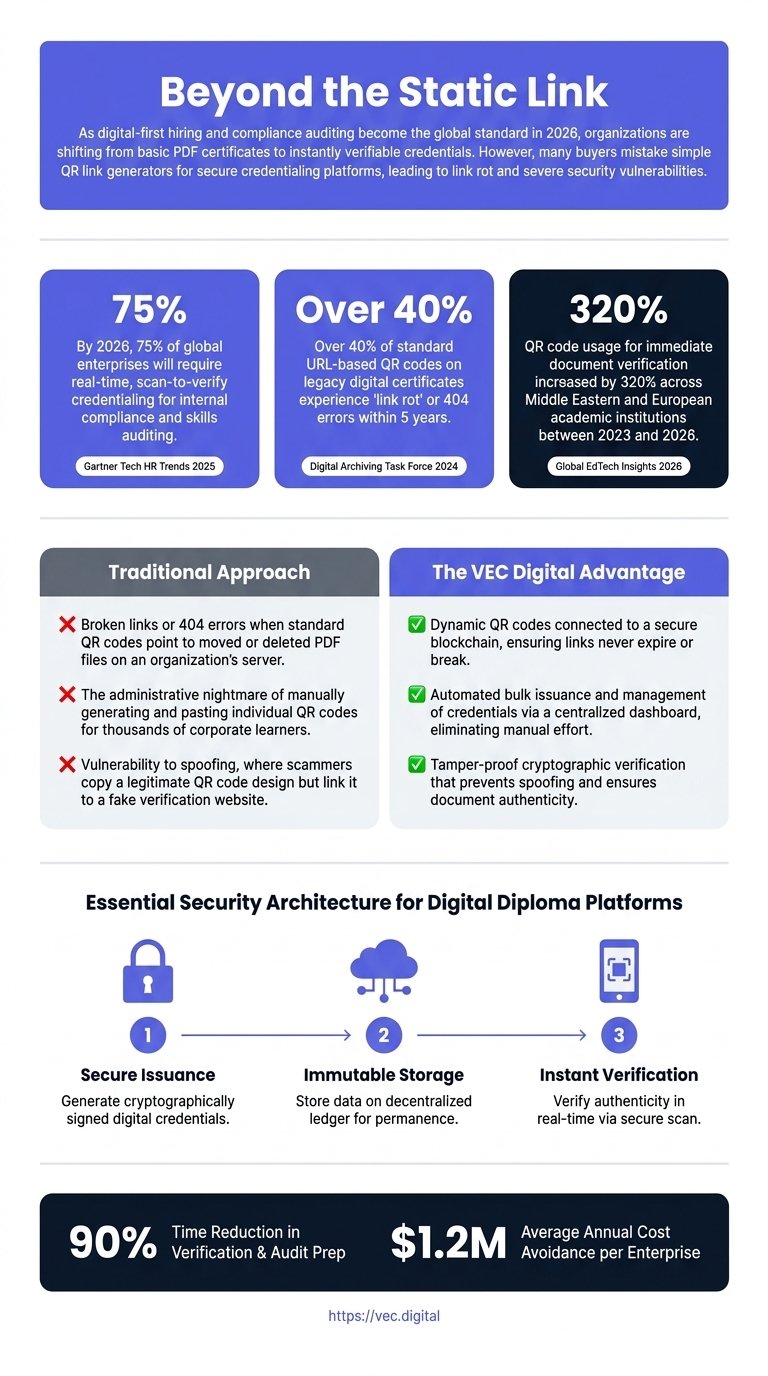
By 2026, 75% of global enterprises will require real-time, scan-to-verify credentialing for internal compliance and skills auditing, according to the Gartner Tech HR Trends report (2025). As organizations rapidly shift away from easily forged paper documents, the search for a reliable QR code certificate maker has become a top priority for academic registrars, corporate HR leaders, and learning platforms worldwide. However, treating these digital assets as mere graphic design projects rather than secure data architecture leaves institutions vulnerable to broken links, credential spoofing, and severe compliance failures.
In this comprehensive guide, our team at VEC Digital will walk you through the critical technological requirements necessary to evaluate and implement an enterprise-grade digital credentialing system. Leveraging our deep expertise in blockchain technology and automated issuance systems, you will learn how to distinguish between basic static link generators and cryptographically secured credential engines. By the end of this article, your business will have a clear blueprint for deploying verifiable digital credentials that eliminate fraud, automate bulk issuance, and ensure global regulatory compliance.
Key Takeaways
- Dynamic UUID routing is essential to prevent long-term "link rot" and ensure credentials remain accessible indefinitely.
- Blockchain certificate verification provides an immutable, tamper-proof layer of security that standard PDF documents cannot match.
- Implementing an automated bulk certificate generator via CSV or API drastically reduces administrative overhead for high-volume issuers.
- Modern scan-to-verify certificates allow employers and auditors to authenticate records instantly without requiring specialized apps or logins.
- True enterprise systems enable the ability to instantly update, suspend, or revoke a credential, effectively helping institutions prevent degree fraud at scale.
The Evolution of the QR Code Certificate Maker
The Shift from Static Documents to Verifiable Digital Credentials
The global landscape of credentialing is undergoing a massive transformation, driven by both technological advancement and stringent regulatory mandates. With the rollout of the European Union's eIDAS 2.0 framework and comprehensive digital trust initiatives across the UAE and broader Middle East set for 2026, organizations are globally mandated to move away from static document storage. Regulatory bodies now demand verifiable, cryptographically secured digital records. A simple graphic of a QR code linking to an unsecured cloud drive is no longer recognized as a legally sufficient proof of compliance.
Historically, institutions relied on physical paper or standard PDF documents to issue awards, diplomas, and training records. When QR codes were first introduced to this process, they were often treated as a novelty—a quick way to link a physical piece of paper to a digital file. However, this early iteration lacked underlying security architecture. The modern QR code certificate maker has evolved into a sophisticated digital trust engine. It is no longer just about generating a square barcode; it is about creating a secure bridge between a physical or digital document and an immutable, globally accessible source of truth.
For higher education institutions and corporate learning and development (L&D) departments, this evolution represents a critical upgrade. By adopting true verifiable digital credentials, organizations can protect their brand reputation, streamline the auditing process, and provide their learners with a portable, instantly authenticated proof of achievement that holds real weight in the international job market.
Overcoming the "Link Rot" Dilemma
One of the most pervasive pain points associated with legacy credentialing systems is the phenomenon known as "link rot." According to the Digital Archiving Task Force (2024), over 40% of standard URL-based QR codes on legacy digital certificates experience broken links or 404 errors within just five years of issuance. This occurs when basic QR codes are programmed to point directly to a specific file path on an organization's server (e.g., a PDF stored in a specific folder). When servers are migrated, websites are redesigned, or domain names change, those static links break permanently.
For an alumni relying on their digital diploma for a job application, or an employee presenting a compliance certificate during a sudden safety audit, a 404 error is catastrophic. It not only delays the verification process but also casts doubt on the legitimacy of the credential itself. An enterprise-grade platform solves this by utilizing dynamic Universal Unique Identifiers (UUIDs) rather than static file paths. When a QR code is scanned, it queries a centralized, highly stable database using that unique identifier, ensuring the credential resolves correctly regardless of underlying server changes.
This architectural shift is what separates a basic barcode generator from a professional digital diploma platform. By ensuring long-term link stability, institutions guarantee that the credentials they issue today will remain verifiable, accessible, and authoritative decades into the future, thereby preserving the lifelong value of the learner's achievement.
What is the Difference Between a Static and Dynamic Certificate QR Code?
A common question among IT directors and curriculum architects exploring this technology is: "What is the difference between a static and dynamic certificate QR code?" The distinction is foundational to the security and longevity of the credential.
A static QR code hardcodes the destination URL directly into the pattern of the barcode. Once generated and printed, the destination cannot be changed. If the web address hosting the certificate goes offline, the QR code becomes useless. Furthermore, static QR codes offer no analytics, no tracking, and no ability to update the underlying information if a typo is discovered post-issuance.
Conversely, a dynamic QR code embeds a short, redirecting URL. This intermediary link points to a secure database entry (like /certificate/[uuid]). Because the destination is managed server-side, the issuing organization retains full control over the credential's lifecycle. If a certificate needs to be updated, suspended, or revoked due to an expiration date or an identified error, the administrator can make the change in the system. The next time the dynamic QR code is scanned, it will immediately reflect the updated status, providing real-time accuracy that static codes simply cannot offer.
Essential Security Architecture for Digital Diploma Platforms
Blockchain Certificate Verification: The Gold Standard
As the adoption of digital credentials accelerates, so does the sophistication of credential fraud. To combat this, leading institutions are turning to decentralized technology. The Global EdTech Insights report (2026) highlights that QR code usage for immediate document verification increased by 320% across Middle Eastern and European academic institutions between 2023 and 2026. This surge is largely attributed to the integration of blockchain technology, which provides an unparalleled layer of security.
Blockchain certificate verification works by taking the data of a certificate (recipient name, issue date, qualification) and running it through a cryptographic algorithm to generate a unique digital fingerprint, known as a hash. This hash is then anchored to a public blockchain. Because blockchains are immutable—meaning data cannot be altered or deleted once recorded—the hash serves as a permanent, tamper-proof record of the credential's original state.
When an auditor or employer scans the QR code, the system recalculates the hash of the presented certificate and compares it to the hash stored on the blockchain. If even a single pixel or character has been altered, the hashes will not match, and the verification will fail instantly. This mechanism effectively allows universities and certification bodies to prevent degree fraud with absolute certainty, protecting the integrity of their programs without requiring manual intervention.
Can a QR Code on a Certificate Be Faked or Spoofed?
When discussing digital security, a frequent and valid concern arises: "Can a QR code on a certificate be faked or spoofed?" The short answer is yes, if the underlying system is poorly designed. A major vulnerability of rudimentary systems is that scammers can easily copy a legitimate QR code design, or generate their own, and link it to a fraudulent verification website designed to look exactly like the issuing institution's official portal.
This is known as a spoofing attack. If an employer scans the fake QR code, they are taken to a fake website that falsely confirms the candidate's credentials. To neutralize this threat, an enterprise digital diploma platform employs multiple layers of cryptographic security. First, the verification portal itself is secured with SSL/TLS encryption and hosted on the institution's verified domain (or a trusted third-party domain like VEC Digital). Second, the integration of blockchain anchoring ensures that the data being presented on the verification page matches the immutable on-chain record.
Educating verifiers to check the URL domain upon scanning is an important behavioral safeguard, but the technological safeguard relies entirely on cryptographic hashing. By utilizing a system that cross-references the credential data with a decentralized ledger, spoofed websites are immediately exposed as fraudulent because they cannot produce the correct on-chain cryptographic proof.
How Do I Make a Verifiable QR Code for a Certificate?
For operational leaders tasked with modernizing their systems, the practical question is: "How do I make a verifiable QR code for a certificate?" The process should be seamless and integrated directly into the design and issuance phase, rather than treated as a secondary, manual step.
Using a professional platform, the process begins in a visual drag-and-drop template editor. The administrator designs the certificate layout, placing dynamic text fields for variables like the recipient's name and the issuance date. A dedicated QR code placeholder is then dragged onto the canvas. Behind the scenes, the system's engine prepares to generate a unique UUID for every individual certificate that will be created from this template.
When the issuance command is triggered, the platform automatically generates the personalized certificate, creates the unique verification URL, encodes that URL into a high-resolution QR code, embeds the QR code into the document, and anchors the cryptographic hash to the blockchain. This entire sequence happens in milliseconds. The result is a fully verifiable, globally accessible digital asset created with zero manual coding required by the user.
Scaling Operations: Bulk Generation and Automation
The Administrative Challenge of Manual Issuance
While the security of a credential is paramount, the operational efficiency of issuing it is equally critical for B2B organizations. One of the most significant pain points for event organizers, university registrars, and corporate training managers is the administrative nightmare of manually generating and pasting individual QR codes for thousands of learners. Processing a graduating class of 5,000 students or wrapping up a global corporate compliance training initiative can consume hundreds of administrative hours if reliant on manual data entry.
Manual processes are not only slow but highly susceptible to human error. A misspelled name, an incorrect date, or a mismatched QR code can lead to severe compliance issues and require time-consuming remediation. As organizations scale, this manual bottleneck becomes unsustainable, leading to delayed issuance, frustrated learners, and inflated operational costs.
To solve this, organizations must leverage automated systems that eliminate manual touchpoints. By transitioning to an intelligent infrastructure, administrative teams can redirect their focus from tedious data entry to strategic educational initiatives, knowing that the credentialing engine is handling the heavy lifting with perfect accuracy.
What is the Best QR Code Certificate Maker for Bulk Issuing?
When evaluating solutions, operations directors frequently ask: "What is the best QR code certificate maker for bulk issuing?" The answer lies in the platform's ability to ingest data seamlessly and execute generation commands concurrently. A premier bulk certificate generator will offer multiple pathways for automated issuance, most notably CSV upload flows and robust Developer APIs.
The CSV upload flow is a lifesaver for non-technical administrators. By simply formatting a standard spreadsheet with columns for recipient names, emails, and custom variables, the user can upload the file into the platform. The system then parses the data, maps it to the dynamic placeholders on the chosen template, and batch-generates thousands of unique, QR-embedded certificates in a matter of minutes. Each certificate is automatically dispatched to the respective recipient via email, complete with access to a secure digital locker.
For organizations seeking zero-touch automation, a REST API is the ultimate solution. By programmatically connecting the credentialing platform with third-party software—such as a Learning Management System (LMS) like Canvas or Moodle, or a corporate HR intranet—certificates can be triggered instantly the moment a learner passes an assessment. This automated process ensures immediate recognition and completely removes the administrator from the issuance loop.
Compliance Training Certificate Automation
In the corporate sector, the stakes for credential management are uniquely high. Regulatory bodies require strict proof of compliance for safety standards (OSHA), data privacy (GDPR), and industry-specific certifications. The Compliance & Ethics Alliance (2025) reports that companies using automated, QR-integrated credential engines reduce audit preparation time by up to 60%.
Compliance training certificate automation transforms a chaotic, decentralized record-keeping system into a streamlined, audit-ready dashboard. When a global workforce completes mandatory training modules, an automated system instantly issues blockchain-secured certificates. These credentials are then stored in a centralized repository.
When external auditors request proof of compliance, HR directors no longer need to hunt through physical filing cabinets or disjointed legacy software. They can simply present the digital records, allowing auditors to scan the embedded QR codes to verify authenticity in real-time. Furthermore, implementing multi-signatory approval processes ensures that high-stakes certificates are reviewed and electronically signed by designated authorities before they are officially issued, maintaining strict internal governance.
The Verifier's Perspective: Scan-to-Verify in Action
How Do Employers Verify QR Code Certificates?
The ultimate value of a digital credential is realized at the moment of verification. If the verification process is cumbersome, employers will bypass it, diminishing the utility of the certificate. Fortunately, modern technology has drastically simplified this interaction. According to the SHRM Verification Report (2025), 88% of hiring managers prefer credentials that can be authenticated via mobile device instantly over traditional multi-day background checks.
So, "How do employers verify QR code certificates?" The process is designed to be entirely frictionless. When an employer or auditor is presented with a digital or printed certificate, they simply open the standard camera app on their smartphone and point it at the QR code. The camera instantly recognizes the embedded URL and prompts the user to open the link.
Upon clicking, the verifier is routed to a secure, dedicated public web page (e.g., /certificate/[uuid]). This page clearly displays the verified details: the issuing institution's verified identity, the recipient's name, the date of issuance, the specific qualifications achieved, and the cryptographic "Blockchain Verified" security badge. In less than three seconds, the employer has absolute, cryptographically backed certainty that the candidate possesses the claimed qualifications, completely bypassing the need to contact the university registrar or the previous employer's HR department.
Does a QR Code Certificate Require a Specific App to Scan?
A critical factor in the widespread adoption of scan-to-verify certificates is accessibility. A common question from end-users is: "Does a QR code certificate require a specific app to scan?" The answer is a definitive no. Requiring proprietary software or mandatory account creation introduces unnecessary friction that severely hampers the verification process.
Enterprise credentialing platforms utilize standard web protocols. The QR codes generated are universally readable by the native camera applications built into modern iOS and Android operating systems. There are no apps to download, no plugins to install, and no logins required for the verifier.
This universal interoperability is vital for international business and global hiring. Whether an employer is based in Dubai, London, or New York, they can authenticate a credential using the device already in their pocket. This seamless physical-to-digital bridge ensures that even if a graduate prints their digital diploma and frames it on their office wall, anyone visiting can scan the physical glass and instantly view the digital proof of authenticity.
Managing Credential Lifecycles
Finally, a robust system must account for the reality that credentials are not always permanent. Certifications expire, licenses require renewal, and occasionally, credentials must be revoked due to academic misconduct or compliance violations. A major pain point of static QR codes and printed PDFs is the inability to update, suspend, or revoke a credential instantly once it has been distributed.
Dynamic digital platforms solve this by offering comprehensive lifecycle management. Because the QR code points to a centralized database entry rather than a static file, administrators retain real-time control. If an employee's safety certification expires after two years, the system can automatically update the verification page to reflect an "Expired" status. If an employer scans the QR code on the old certificate, they will immediately see that the qualification is no longer valid.
This real-time status updating is a cornerstone of modern digital trust. It ensures that the information presented to the public is always accurate, current, and reflective of the issuing organization's highest standards, thereby safeguarding the institution's reputation against the circulation of outdated or revoked claims.
Secure Your Institutional Reputation with VEC Digital
As the global standard for hiring and compliance shifts toward instant, cryptographically secure authentication, relying on outdated PDFs and static links is a risk no modern organization can afford. Choosing the right QR code certificate maker is not just an IT decision; it is a strategic investment in your institution's operational efficiency, brand reputation, and the lifelong success of your learners.
At VEC Digital, we provide the trust infrastructure required to scale your credentialing seamlessly. Our blockchain-anchored platform combines frictionless drag-and-drop design with powerful API automation, multi-signatory governance, and instant scan-to-verify capabilities. We empower universities, enterprises, and event organizers to issue tamper-proof digital credentials that eliminate fraud and reduce administrative overhead by hundreds of hours.
Secure your organization’s credentials today and experience the new gold standard in digital trust. Design your first template in minutes with no complex technical setup required.
Ready to modernize your credentialing engine?
Visit our website: https://vec.digital
Contact our expert team: support@vec.digital