
Blockchain Certificate Verification in 2026: Ending Credential Fraud
Published on May 10, 2026

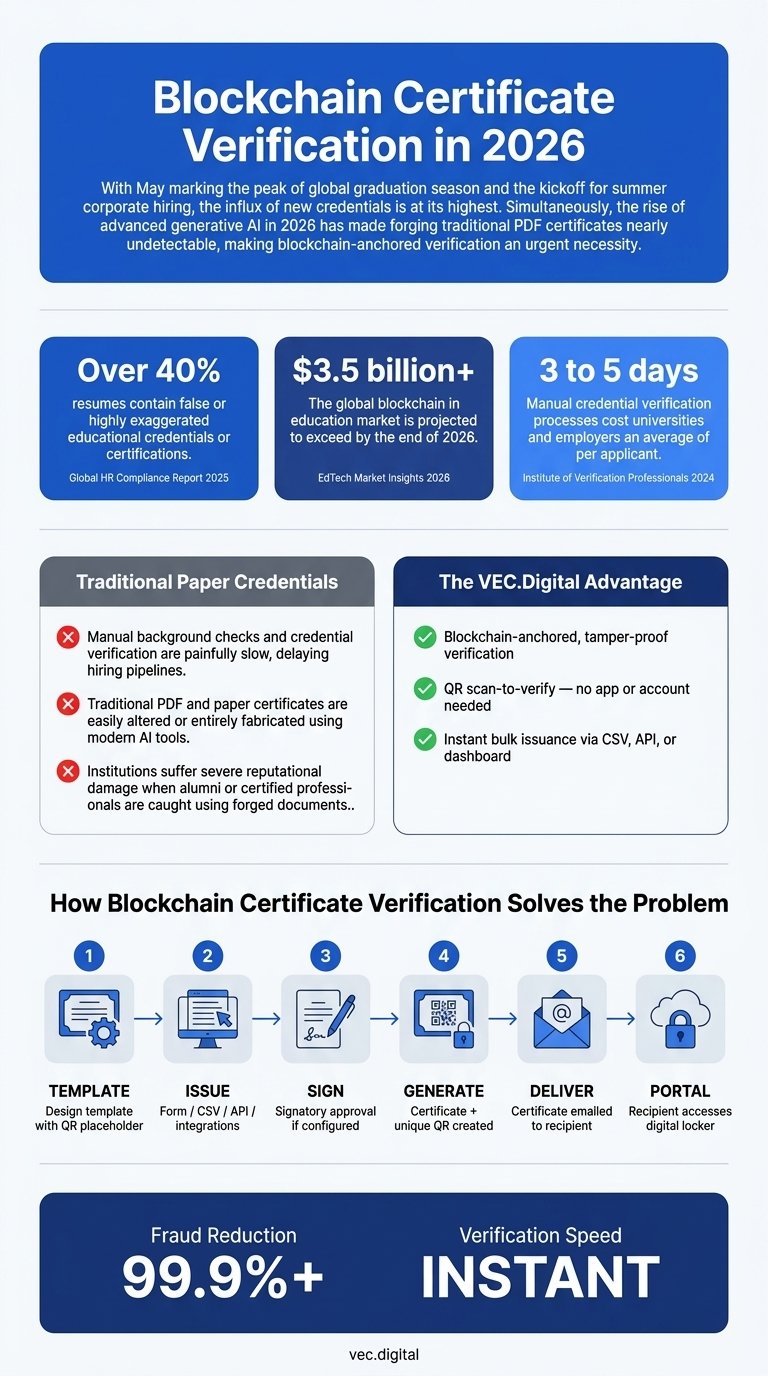
With over 40% of resumes containing false or highly exaggerated educational credentials according to the 2025 Global HR Compliance Report, the rise of advanced generative AI has made traditional PDF certificates virtually indistinguishable from authentic documents. Implementing blockchain certificate verification is no longer an optional upgrade, but an urgent necessity for institutions facing severe reputational damage and legal risks from fraudulent records. This escalating crisis demands an immediate shift away from easily manipulated paper trails toward immutable, globally accessible verification standards.
In this comprehensive guide, our team at VEC.Digital leverages our extensive expertise in blockchain-powered digital credentialing to show your organization how to seamlessly modernize its issuance pipelines. You will learn exactly how to completely eliminate credential fraud, drastically reduce administrative overhead by issuing bulk certificates in minutes, and empower your learners worldwide with instantly verifiable, eco-friendly digital credentials that accelerate their career mobility.
Key Takeaways
- Blockchain certificate verification completely eliminates forgery by anchoring academic and professional records to an immutable, decentralized ledger.
- Transitioning to verifiable digital credentials saves organizations an average of 3 to 5 days previously lost to manual background checks and institutional follow-ups.
- Modern secure digital certificate issuance pipelines allow administrators to bulk-create credentials via CSV and REST API without requiring any advanced technical expertise.
- QR code certificate verification enables instant, scan-to-verify authentication for employers with zero app downloads or login barriers required.
- Digital credentials support global sustainability goals by replacing paper issuance with a centralized, eco-friendly recipient digital locker.
The Escalating Crisis: AI-Assisted Credential Fraud
The Cost of Fake Certificate Detection
In recent years, the landscape of document forgery has undergone a terrifying technological evolution. Traditional PDF and paper certificates are now easily altered or entirely fabricated using modern AI tools, allowing bad actors to generate highly convincing academic degrees, corporate training certificates, and professional licenses in a matter of seconds. According to the 2025 Global HR Compliance Report, over 40% of resumes contain false or highly exaggerated educational credentials or certifications. This unprecedented volume of deceptive documentation has placed an enormous burden on HR departments and university registrars globally.
Institutions suffer severe reputational damage when alumni or certified professionals are caught using forged documents in the workforce. A single high-profile incident involving a fabricated degree can undermine decades of institutional prestige, causing prospective students, corporate partners, and accreditation bodies to question the integrity of the organization's entire credentialing system. Consequently, the focus must shift toward robust fake certificate detection strategies that do not rely on subjective human analysis, but rather on cryptographic certainty.
Delays in the Hiring Pipeline
Beyond the direct threat of fraud, the sheer inefficiency of traditional vetting methods is suffocating global talent acquisition. Manual background checks and credential verification are painfully slow, delaying hiring pipelines and causing organizations to lose top-tier candidates to faster-moving competitors. The Institute of Verification Professionals (2024) found that manual credential verification processes cost universities and employers an average of 3 to 5 days per applicant.
This delay is no longer acceptable in a fast-paced, digital-first global economy. As graduation seasons peak and corporate hiring surges, HR managers require immediate confirmation of an applicant's qualifications. In fact, according to Future of Work & Hiring Trends (2025), 82% of hiring managers consider instant, scan-to-verify digital credentials a critical factor in accelerating time-to-hire. The industry is demanding a solution that bridges the gap between absolute security and frictionless speed.
How Blockchain Certificate Verification Solves the Problem
What is the Difference Between a PDF Certificate and a Verifiable Credential?
To understand the solution, organizations must first understand the fundamental difference between legacy formats and modern standards. A standard PDF certificate is simply a visual representation of data—a digital picture of a document. It possesses no inherent security, and its metadata can be easily stripped or manipulated. A verifiable credential, on the other hand, is a cryptographically secure data packet. While it may still have a beautiful visual design, its true value lies in the underlying code that mathematically proves who issued the credential, who received it, and that it has not been altered since the moment of issuance.
Implementing blockchain certificate verification is what transforms a simple digital file into a verifiable credential. By anchoring the cryptographic hash of the certificate to a decentralized ledger, the document becomes tamper-proof. If even a single pixel or character of the certificate is altered by a fraudulent actor, the cryptographic hash will change, immediately breaking the verification link and exposing the forgery.
How Does Blockchain Verify Digital Certificates?
When an organization issues a certificate through a blockchain-powered platform, the system takes the unique data of that specific certificate—such as the recipient's name, the course completed, the date, and the issuing authority—and generates a unique digital fingerprint, known as a hash. This hash is then permanently recorded on the blockchain. Because blockchains are immutable and distributed across countless global nodes, this record cannot be deleted, altered, or hacked by any single entity.
When an employer or third party wants to verify the credential, the system simply compares the digital fingerprint of the presented certificate against the public record anchored on the blockchain. If they match perfectly, the document is authentic. The results of this technology are staggering: the Cybersecurity in Education Consortium (2026) reports that institutions utilizing blockchain for credentialing report a 99.9% reduction in successful certificate forgery.
Why Should Universities Use Blockchain for Academic Credentials?
Universities and higher education institutions are the bedrock of the global knowledge economy, making them primary targets for credential fraud. Adopting blockchain technology is crucial not only for protecting institutional integrity but also for complying with emerging global standards. Regulatory frameworks across the UAE, the European Union (via the eIDAS 2.0 framework), and North America are increasingly mandating zero-trust architectures and digital portability for educational and professional records.
Dubai's visionary paperless strategy and blockchain initiatives specifically position the MENA region as a global leader in adopting decentralized identity standards. By embracing these technologies, universities and higher education institutions can guarantee cross-border recognition of their degrees, ensuring that their alumni can seamlessly prove their qualifications to employers anywhere in the world, instantly and securely.
Bridging the Gap: Secure Digital Certificate Issuance Made Easy
Effortless Issuance Pipelines
A significant content gap in the current industry dialogue is the overemphasis on the complex cryptography behind blockchain, which often alienates non-technical administrators. The reality is that modern secure digital certificate issuance does not require an organization to employ blockchain developers or understand complex coding. Platforms like VEC.Digital have bridged this gap, translating high-tech security into everyday administrative usability.
Our platform empowers organizations with four distinct, user-friendly issuance methods tailored to any operational scale. Administrators can issue certificates one-by-one via an intuitive dashboard form, or utilize a CSV upload feature to execute bulk issuance for hundreds or thousands of graduates simultaneously. For enterprise environments requiring deep automation, our robust REST API and seamless third-party integrations allow for programmatic issuance directly from existing Learning Management Systems (LMS) or HR software. This flexibility ensures that creating tamper-proof digital credentials is as simple as sending an email.
The Power of Multi-Signatory Workflows
In academic and corporate environments, the authorization of a credential rarely falls to a single individual. Department heads, deans, and compliance officers must often review and approve certifications before they are released to the public. To accommodate this critical governance requirement, VEC.Digital features a sophisticated multi-signatory workflow.
Our system allows up to two distinct signatories per certificate template. When an issuance pipeline is triggered, the certificate is generated but strictly held in a pending state. It is only officially anchored to the blockchain and released to the recipient after all designated signatories have independently reviewed and signed off on the document. This workflow guarantees rigorous internal compliance and eliminates the risk of unauthorized or premature certificate distribution.
Designing with a Drag-and-Drop Template Editor
Security should never come at the expense of brand aesthetics. An organization's certificate is a powerful marketing tool and a proud representation of its brand identity. VEC.Digital provides a state-of-the-art drag-and-drop template editor that gives administrators complete creative control over their verifiable credentials.
Users can select from over 1,400 Google Fonts, adjust sizes seamlessly from A5 up to A2, and switch effortlessly between portrait and landscape orientations. Furthermore, our deep Canva integration allows designers to import stunning, custom backgrounds directly into the workflow. This ensures that every blockchain-anchored certificate not only provides cryptographic security but also visually reflects the prestige and professionalism of the issuing institution.
Empowering Learners with Verifiable Digital Credentials
How QR Code Certificates Work
The true power of a credential lies in its portability and ease of verification. This is where QR code certificate verification revolutionizes the user experience. Every certificate issued through VEC.Digital is automatically embedded with a unique, scannable QR code that links directly to a secure, public verification page via a unique UUID (Universally Unique Identifier).
When an employer or auditor scans the QR code with any standard smartphone camera, they are instantly directed to the live certificate record. There is no proprietary app to download, no account to create, and no login required to verify the document. This frictionless process respects the time of hiring managers while providing immediate, undeniable proof of the learner's achievements.
The Recipient Digital Locker
A major historical pain point for learners has been the lack of a centralized, secure digital locker, making it incredibly difficult for alumni to organize their achievements and share verifiable proofs on professional networking platforms like LinkedIn. Paper certificates are easily lost, damaged, or destroyed, leading to immense frustration for the professional and high administrative overhead for the institution tasked with re-issuing them.
VEC.Digital solves this by providing every learner with a permanent, secure recipient digital locker. Upon receiving their first verifiable digital credential, recipients gain access to a centralized portal where all their current and future certificates are safely stored. From this locker, they can effortlessly share their blockchain-verified achievements directly to their LinkedIn profiles, embed them in digital portfolios, or email them to prospective employers, ensuring their hard-earned qualifications are always accessible anywhere, anytime.
How Can Employers Detect Fake Digital Certificates?
For HR managers and recruitment professionals, detecting fake digital certificates no longer requires contacting university registrars or hiring expensive third-party background check agencies. When an employer clicks the link or scans the QR code of a VEC.Digital credential, they are taken directly to the public certificate verification page.
On this page, authentic documents proudly display a clear, unmistakable "blockchain verified" badge. This badge serves as a visual guarantee that the cryptographic hash of the document perfectly matches the immutable record on the blockchain. If a candidate attempts to present a forged or manipulated PDF, the QR code will either fail to resolve to our secure server, or the verification page will explicitly flag the document as invalid, instantly neutralizing the fraud attempt.
Sustainability and the Future of Global Credentialing
Eliminating Paper Waste and Administrative Overhead
The transition to blockchain-anchored digital credentials is not only a security imperative but also a critical step toward environmental responsibility. Traditional credentialing relies heavily on specialty paper, embossed seals, plastic sleeves, and international courier shipping—all of which contribute significantly to an organization's carbon footprint. Furthermore, the high administrative overhead and financial costs associated with printing, mailing, and re-issuing lost paper certificates drain institutional resources.
VEC.Digital is deeply committed to supporting the United Nations Sustainable Development Goals. By adopting our secure digital issuance pipelines, organizations completely eliminate paper waste and the associated carbon emissions of physical delivery. This eco-friendly approach to credential management demonstrates corporate social responsibility while simultaneously reducing operational budgets, allowing institutions to reallocate those funds toward core educational and training initiatives.
Global Adoption and Market Growth
The global shift toward decentralized, verifiable credentials is accelerating at an unprecedented pace. EdTech Market Insights (2026) projects that the global blockchain in education market will exceed $3.5 billion by the end of 2026. This massive influx of investment and adoption underscores a fundamental change in how the world views trust and verification.
From corporate training directors in North America to university administrators in the Middle East and HR managers across Europe, the expectation for instant, secure digital verification is becoming the universal standard. Organizations that fail to adopt these technologies risk falling behind, while those that proactively implement prevent credential fraud strategies will distinguish themselves as forward-thinking, trustworthy leaders in their respective industries.
What is the Best Digital Certificate Platform for Organizations?
As the threat of AI-assisted credential fraud continues to escalate, relying on static PDFs and manual background checks is a liability your organization can no longer afford. The future of credentialing demands absolute security, effortless issuance, and global accessibility. VEC.Digital provides the ultimate solution, combining the immutable trust of blockchain technology with an incredibly intuitive, user-friendly administrative experience.
With over 100,000 certificates issued, more than 500 universities onboarded, and trust established with over 10,000 corporations globally, our platform delivers a 99.98% uptime SLA reliability that enterprise organizations demand. Whether you are issuing a dozen certificates for an internal corporate workshop or thousands of diplomas for a graduating university class, our multi-signatory workflows, drag-and-drop template editor, and QR-verifiable technology ensure your credentials are both beautiful and bulletproof.
Best of all, transitioning your organization to the future of credentialing is risk-free. VEC.Digital offers a completely free plan to start, requiring no credit card and zero setup fees. For scaling organizations, our paid plans begin at just $29.99 per month, while individuals can secure their credentials for only $1.00 per certificate. Protect your institutional reputation, empower your learners, and eliminate credential fraud for good.
Ready to modernize your issuance pipeline? Visit us at vec.digital to get started in minutes. For personalized assistance, reach out to our global support team via email at support@vec.digital or connect with us on WhatsApp at +971521373078.