
Blockchain Certificate Verification in 2026: Preventing Fraud
Published on May 18, 2026

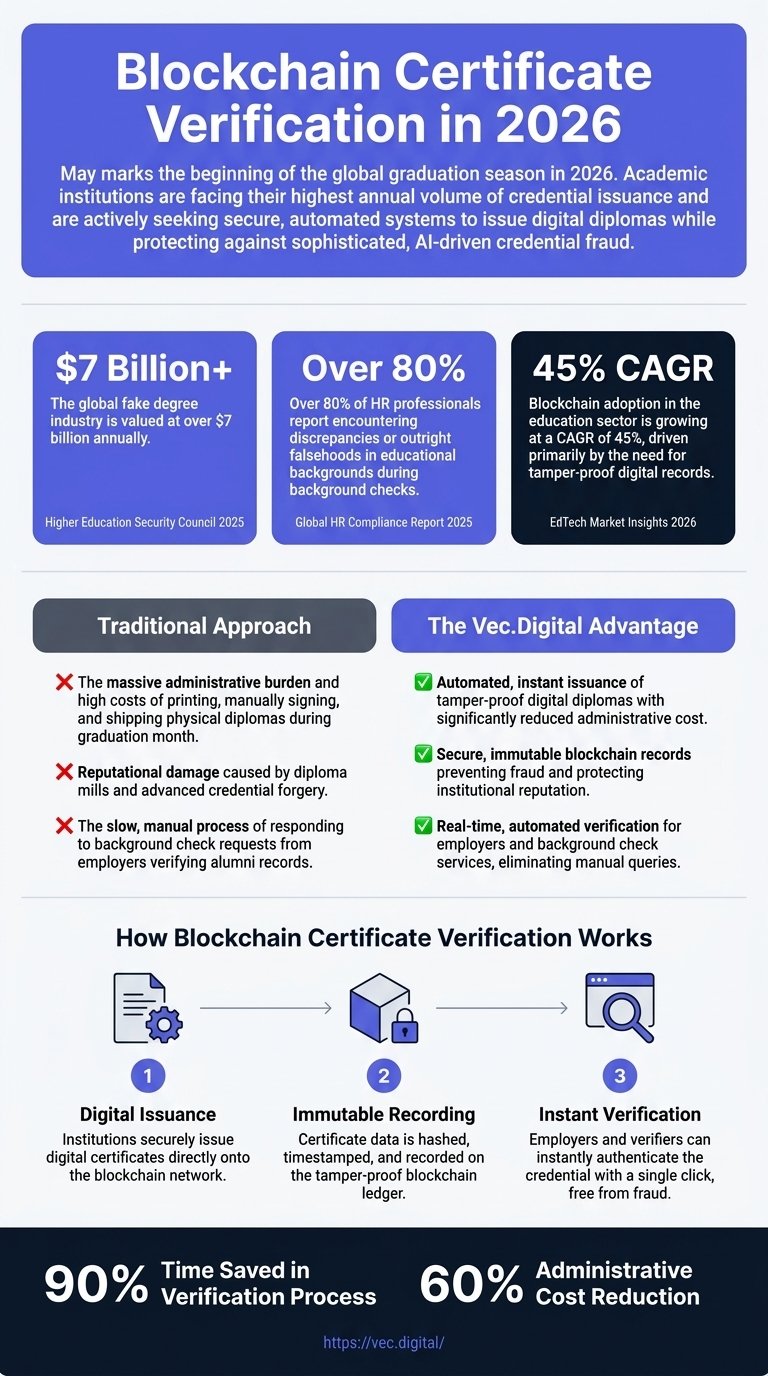
The global fake degree industry is valued at over $7 billion annually, leaving academic institutions highly vulnerable to sophisticated, AI-driven credential forgery. Adopting blockchain certificate verification is no longer a futuristic luxury, but a critical, immediate defense mechanism for universities worldwide. Modernizing this infrastructure protects institutional reputation while meeting the urgent demands of global student mobility.
By transitioning to secure, automated issuance systems, your institution can eradicate diploma mills while drastically reducing administrative overhead. Drawing on our extensive Technology expertise at Vec.Digital, this guide will show you how to seamlessly integrate automated credentialing, eliminate the costly burden of physical diplomas, and ensure instant, global authenticity for every graduate. You will learn how to deploy an automated bulk-issuance system, bridge the gap between aesthetic design and cryptographic security, and empower alumni with universally trusted records.
Key Takeaways
- Blockchain certificate verification completely neutralizes the threat of AI-driven credential forgery by creating immutable digital records.
- Replacing manual printing with a bulk certificate generator eliminates weeks of administrative delays during graduation season.
- Issuing secure digital diplomas for universities saves an average of $15 to $20 per student in printing and mailing costs.
- Embedding QR code certificates provides global employers and border agencies with instant, app-free authentication.
- Utilizing a professional digital certificate maker ensures that high-level cryptographic security does not compromise your institution's traditional branding.
The Escalating Global Threat of Credential Fraud
The True Cost of Diploma Mills and Forgery
In the modern academic landscape, the integrity of an institution is its most valuable asset. Unfortunately, this integrity is under constant attack. According to the Higher Education Security Council (2025), the global fake degree industry is valued at over $7 billion annually. Diploma mills and sophisticated forgery operations have leveraged advanced graphic design and artificial intelligence to produce counterfeit documents that are virtually indistinguishable from authentic paper diplomas.
This epidemic of fraud has profound consequences for the global workforce. The Global HR Compliance Report (2025) reveals that over 80% of HR professionals report encountering discrepancies or outright falsehoods in educational backgrounds during background checks. When employers cannot trust the documents presented to them, the value of a legitimate degree is diluted, directly harming the hard-working graduates who earned them.
The Administrative Burden of Manual Verification
When asking, "How do universities verify degrees online?" the traditional answer has often involved a convoluted, manual process. Registrars are routinely inundated with verification requests from employers, background check agencies, and foreign universities. Historically, administrators have had to cross-reference legacy databases, print official transcripts, apply physical seals, and mail documents across the globe.
This slow, manual process of responding to background check requests is a massive administrative burden. It creates friction for alumni seeking employment and consumes thousands of hours of administrative labor. The demand for a modernized, instant verification system has never been higher, setting the stage for the widespread adoption of decentralized ledger technology in higher education.
How Blockchain Certificate Verification Works
Demystifying the Technology for Administrators
A common question among academic leaders is, "What is blockchain certificate verification and how does it work?" While the underlying mathematics are complex, the practical application is remarkably straightforward. When a university issues a credential, the system generates a unique cryptographic hash—a digital fingerprint—of that document. This fingerprint is permanently recorded on a decentralized, public blockchain ledger.
Because the blockchain is immutable, the record cannot be altered, deleted, or manipulated by any party. EdTech Market Insights (2026) reports that blockchain adoption in the education sector is growing at a CAGR of 45%, driven primarily by this need for tamper-proof digital records. We provide the infrastructure that handles this complex cryptographic anchoring automatically in the background, allowing administrators to focus entirely on their students.
PDF vs. Verifiable Digital Credentials
To fully grasp this transformation, we must answer another frequent inquiry: "What is the difference between a PDF certificate and a verifiable digital credentials?" A standard PDF is merely a digital image. It can easily be opened in photo-editing software, where names, dates, and grades can be seamlessly altered. It offers zero inherent security.
Conversely, a verifiable digital credential is mathematically tethered to its blockchain record. If a bad actor attempts to alter even a single pixel or character on the credential, the cryptographic hash will change, immediately breaking the verification link. When an employer checks the altered document, the system will instantly flag it as invalid, making undetectable forgery mathematically impossible.
Are Digital Diplomas Tamper-Proof?
The short answer to "Can digital diplomas be forged or tampered with?" is no—provided they are anchored to the blockchain. Traditional digital files are vulnerable, but blockchain-anchored records are not. By removing the reliance on physical paper and vulnerable static files, universities can guarantee the absolute authenticity of every document they issue, safeguarding their institutional legacy for generations.
Bridging the Gap: From Design to Immutable Security
Using a Digital Certificate Maker for On-Brand Diplomas
A significant gap in the transition to digital records has been the disconnect between complex security protocols and practical administrative usability. Highly technical systems often ignore the aesthetic importance of a university diploma. A professional digital certificate maker solves this by pairing beautiful, traditional design capabilities with modern security.
Through intuitive design interfaces, universities can upload their official seals, custom typography, and traditional layouts. The digital credential looks exactly like the prestigious paper document graduates expect, but it is supercharged with hidden cryptographic security. This ensures that institutions do not have to sacrifice their historic branding to achieve modern compliance.
Scaling Operations with a Bulk Certificate Generator
May marks the beginning of the global graduation season, bringing the highest annual volume of credential issuance. The massive administrative burden and high costs of printing, manually signing, and shipping physical diplomas during graduation month are overwhelming. According to the University Administrators Association (2024), processing, printing, and mailing physical paper certificates costs universities an average of $15 to $20 per student.
This is where a bulk certificate generator becomes indispensable. Administrators often ask, "How can I bulk issue secure digital certificates to students?" By utilizing an automated system, universities can map student data via CSV or API integrations directly into their custom templates. Thousands of unique, blockchain-anchored diplomas can be generated, signed, and distributed via email in a matter of minutes, entirely eliminating the physical bottleneck of graduation season.
The Power of QR Code Certificates in Global Mobility
Instant Global Authentication for Employers
As international student mobility increases post-2025, border agencies, global employers, and postgraduate institutions are mandating instantly verifiable records to bypass the weeks-long delays associated with international postal verification and physical apostilles. QR code certificates serve as the perfect bridge between the physical and digital worlds.
Every credential generated through our system embeds a unique, dynamic QR code. When scanned by any smartphone camera, this code routes the user to a dedicated, public verification page. This page displays the issuer's details, the recipient's achievements, the digital signatures, and a prominent "blockchain verified" badge. It requires no specialized software, making global authentication frictionless.
Do Employers Accept QR Code Certificates?
A common question from students is, "Do employers accept QR code certificates?" The answer is a resounding yes. In fact, multinational corporations and global HR departments now prefer them. Instead of waiting weeks for a university registrar to reply to an email or mail a physical transcript, an employer can verify a candidate's qualifications in under three seconds during an interview.
This instant verification accelerates the hiring process, giving your alumni a distinct competitive advantage in the global job market. For more information on how global verification standards are evolving, you can explore resources from the World Economic Forum regarding digital identity and global workforce mobility.
Implementing Secure Digital Diplomas for Universities
Transitioning from Paper to Digital Systems
Deploying secure digital diplomas for universities does not require a massive overhaul of your existing IT infrastructure. The key is utilizing a centralized platform that handles the cryptographic heavy lifting. By adopting a cloud-based automated system, universities can seamlessly transition away from paper-heavy processes.
This transition also aligns perfectly with global sustainability initiatives. By eliminating the paper, ink, and carbon emissions associated with global shipping, universities can significantly reduce their environmental footprint while simultaneously upgrading their security posture. The shift to paperless operations is a critical step toward meeting modern ESG (Environmental, Social, and Governance) goals.
Enhancing Alumni Experience and Security
Beyond administrative efficiency, the transition to digital credentials dramatically improves the alumni experience. Graduates no longer face the risk of losing physical diplomas in a move or a natural disaster. Digital credentials can be stored securely in digital lockers and shared instantly to professional networks like LinkedIn.
The operational savings here are substantial. The Digital Credentialing Institute (2025) notes that institutions adopting verifiable digital credentials see a 60% reduction in alumni requests for replacement diplomas. By providing lifetime, secure access to their achievements, universities foster stronger, more positive relationships with their alumni networks.
Secure Your Institution’s Credentials Today
The academic landscape of 2026 demands a zero-tolerance approach to credential fraud. By leveraging blockchain technology, dynamic QR verification, and automated bulk issuance systems, your institution can protect its global reputation while delivering an unparalleled experience to your graduates. The transition from vulnerable paper to immutable digital records is the defining operational upgrade for modern universities.
At Vec.Digital, we provide the comprehensive infrastructure necessary to make credential fraud impossible. Our platform combines intuitive design tools with enterprise-grade cryptographic security, allowing you to issue thousands of universally trusted diplomas in minutes. To learn more about how blockchain technology is securing data globally, visit Wikipedia's overview of Blockchain, and discover how our specific implementations can serve your campus.
Ready to modernize your academic credentialing and eradicate diploma fraud? Start issuing verifiable certificates in minutes. Visit us at https://vec.digital/ or contact our Happiness Centre directly at support@vec.digital to secure your organization's credentials today.