
Blockchain Certificate Verification in 2026: Securing Higher Ed
Published on May 25, 2026

With over 2 million fake degrees sold worldwide every year fueling a billion-dollar diploma mill industry, academic institutions are facing an unprecedented crisis in credential authenticity. As AI and advanced photo editing tools make traditional paper diplomas and PDFs incredibly easy to forge, universities must adopt blockchain certificate verification to protect their reputations. For academic registrars and IT directors, finding a secure, scalable system to issue tamper-proof digital credentials instantly is no longer optional—it is a critical requirement for the modern educational landscape.
In this comprehensive guide, you will discover how to eliminate diploma fraud while drastically reducing the administrative overhead associated with graduation season. Drawing on our extensive expertise in global technology solutions at Vec.Digital, we will break down the operational steps required to automate credential generation at scale. By the end of this article, your organization will understand exactly how to implement secure, verifiable digital systems that empower graduates and provide absolute certainty to international employers.
Key Takeaways
- Blockchain certificate verification completely eliminates the risk of diploma forgery by anchoring records to an immutable ledger.
- Utilizing a bulk certificate generator allows universities to issue thousands of credentials instantly, saving significant administrative time.
- QR code certificates provide international employers with immediate, app-free authentication of a candidate's academic achievements.
- Deploying secure digital diplomas for universities reduces graduation-related operational costs by up to 60 percent.
- Modernizing your tech stack with a professional digital certificate maker helps institutions meet UN sustainability goals by going entirely paperless.
The Global Crisis of Diploma Forgery in Higher Education
The integrity of global academic institutions is under constant threat from sophisticated credential fraud. As the reliance on digital documentation grows, so does the need for robust blockchain certificate verification. Traditional methods of issuing and verifying degrees are breaking down under the weight of modern technological advancements, leaving universities vulnerable to reputational damage and employers exposed to unqualified candidates.
To combat this, educational leaders must understand the scale of the problem and the direct impact it has on the global workforce. By examining the data and recognizing the limitations of legacy systems, universities can begin the necessary transition toward modernized, cryptographically secure digital credentials.
The Rise of AI-Driven Credential Fraud
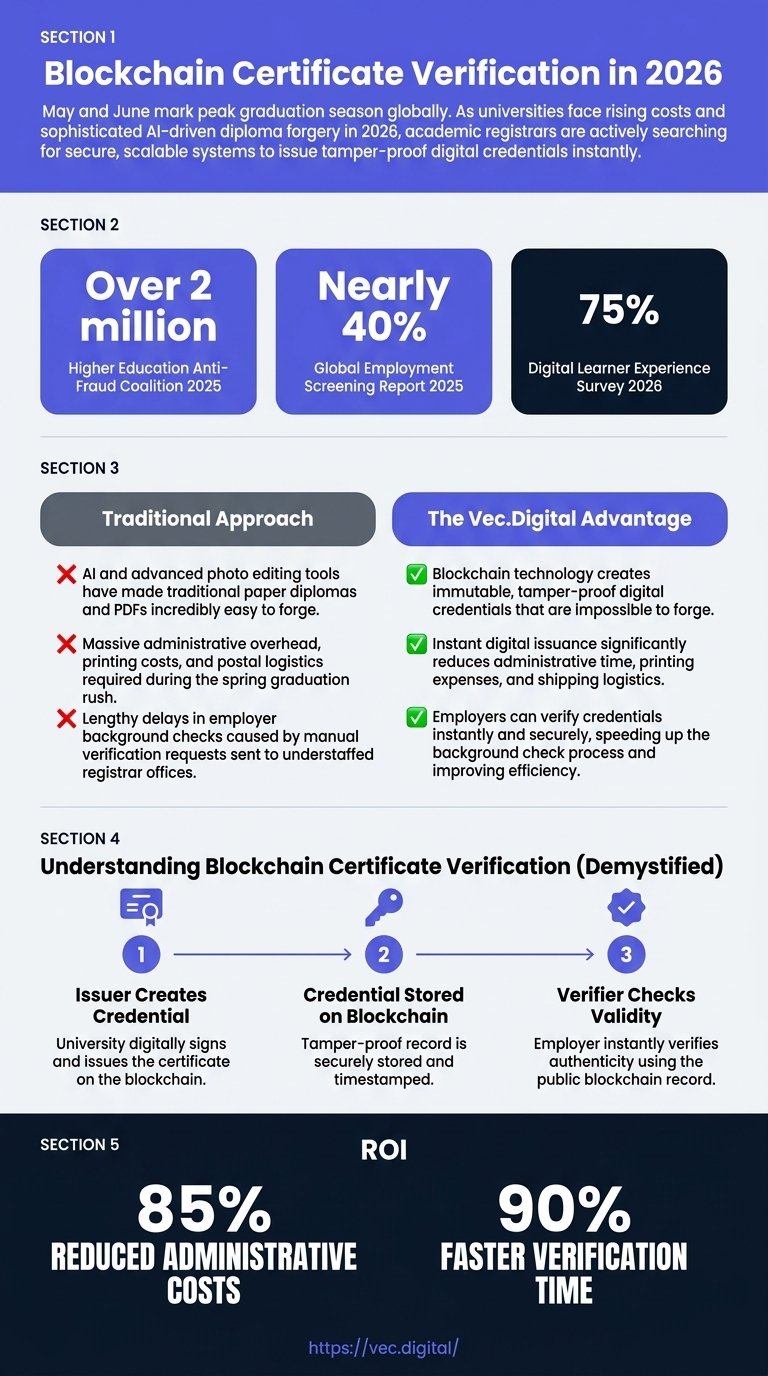
In recent years, AI and advanced photo editing tools have made traditional paper diplomas and standard PDFs incredibly easy to forge. Bad actors no longer need specialized printing equipment to create convincing fake degrees; high-quality digital alterations can bypass basic visual inspections with alarming success. According to the Higher Education Anti-Fraud Coalition (2025), over 2 million fake degrees are sold worldwide every year, fueling a billion-dollar diploma mill industry that undermines the value of legitimate academic achievements.
This proliferation of fabricated documents forces institutions to reconsider what constitutes a secure credential. A simple PDF emailed to a graduate is no longer sufficient, as it lacks any embedded, tamper-proof authentication mechanism. Consequently, universities must pivot toward systems that guarantee immutability, ensuring that once a degree is awarded, its data cannot be altered, copied, or falsely claimed by unauthorized individuals.
How Administrative Delays Impact Global Hiring
The consequences of diploma fraud extend far beyond the university campus, creating significant bottlenecks in the international job market. As remote work and cross-border hiring continue to dominate the global economy, international employers demand instantly verifiable credentials. However, navigating international university registrar protocols is notoriously slow. Manual verification requests sent to understaffed registrar offices result in lengthy delays in employer background checks, frustrating both candidates and hiring managers.
The Global Employment Screening Report (2025) highlights this systemic issue, revealing that nearly 40% of global organizations have encountered candidates with fabricated or highly exaggerated academic qualifications. When employers cannot quickly and reliably verify a degree, they are forced to either delay the hiring process or take on unacceptable risks. Implementing automated verification systems eliminates these delays, providing instant cryptographic proof of a candidate's qualifications to anyone, anywhere in the world.
Understanding Blockchain Certificate Verification (Demystified)
For many academic administrators, the concept of blockchain technology feels inextricably linked to complex cryptocurrency markets. However, the application of blockchain certificate verification in higher education is entirely focused on data security, immutability, and trust. By demystifying how this technology operates, universities can confidently adopt solutions that protect their credentials without requiring deep technical expertise from their staff.
At its core, blockchain acts as a decentralized, unchangeable digital ledger. When applied to academic credentials, it serves as an absolute source of truth that anyone can reference but no one can secretly alter. This section explores the mechanics of these systems and answers common questions regarding their security and functionality.
What is a Verifiable Digital Credential?
A common question among educational professionals is: What is the difference between a PDF certificate and a verifiable digital credential? While a standard PDF is merely a digital image of a document, a verifiable digital credential is a data-rich asset anchored to a secure network. It contains cryptographic signatures from the issuing institution, ensuring that the document's origin and integrity can be mathematically proven.
When you explore public-key cryptography, you understand that these credentials use digital signatures to bind the identity of the university to the specific details of the graduate's achievement. If even a single pixel or character of the credential is altered after issuance, the cryptographic signature breaks, immediately flagging the document as invalid. This binary state of verification—either mathematically authentic or demonstrably tampered with—provides a level of assurance that traditional documents simply cannot match.
How Does Blockchain Certificate Verification Work?
People also ask: How does blockchain certificate verification work in practice? The process is remarkably straightforward for both the issuer and the verifier. When a university issues a diploma, the certification platform generates a unique digital fingerprint (a hash) of the document's data. This hash is then permanently recorded on the blockchain. The blockchain does not store the student's personal data—ensuring compliance with global privacy regulations like GDPR—but rather stores the mathematical proof that the specific credential was issued by the institution on a specific date.
When an employer wishes to verify the diploma, the system compares the digital fingerprint of the presented document against the fingerprint stored on the blockchain. If they match perfectly, the document is authentic. According to the Institute for Digital Trust (2025), blockchain-backed credential verification processes 99% faster than traditional manual registrar background checks, transforming a process that used to take weeks into an interaction that takes milliseconds.
Can a Blockchain Degree Be Hacked or Altered?
Security is the paramount concern for any academic registrar. The question frequently arises: Can a blockchain degree be hacked or altered? The definitive answer is no. Because the blockchain is decentralized across thousands of global nodes, altering a record would require simultaneously hacking the majority of the network—a computational feat that is practically impossible. This immutability is what makes blockchain the ultimate solution for high-stakes credentials.
Furthermore, because the actual personal data of the student remains off-chain in secure, encrypted databases, the system protects against unauthorized data harvesting. The blockchain merely acts as the unassailable notary public, confirming that the credential exists and remains exactly as it was when the university authorized its creation.
Transitioning to Secure Digital Diplomas for Universities
The shift from physical paper to digital infrastructure requires a thoughtful approach that prioritizes both security and accessibility. Implementing blockchain certificate verification must be paired with user-friendly delivery methods that allow graduates to seamlessly share their achievements. Secure digital diplomas for universities represent the perfect intersection of cryptographic security and modern user experience.
By leveraging universally recognized technologies alongside advanced encryption, institutions can bridge the gap between their secure databases and the public verification needs of the global job market. This transition not only fortifies the institution's reputation but also modernizes the entire graduation experience.
How to Embed a Verification QR Code in University Diplomas
To make verification accessible to everyone—including employers who may not have specialized software—universities are increasingly utilizing QR code certificates. People often ask how to embed a verification QR code in university diplomas. Through a professional certification platform, this process is entirely automated. During the design phase, administrators simply drag and drop a dynamic QR code placeholder onto the diploma template.
Upon issuance, the system generates a unique, scannable QR code for every individual graduate. When scanned with any standard smartphone camera, this code routes the verifier to a dedicated, public authentication page hosted on a secure server. This page displays the issuer's details, the recipient's information, the signatory approvals, and a prominent "verified badge" indicating the blockchain anchor. This instant scan-to-verify functionality means that any employer can authenticate a degree in seconds, without needing to download an app or create a registered account.
Digital vs. Traditional PDF Certificates
Are digital diplomas secure? When engineered correctly, they are infinitely more secure than their physical or standard PDF counterparts. A traditional PDF can be opened in simple editing software, where names, dates, and grades can be manipulated. In contrast, verifiable digital credentials are interactive digital assets that actively communicate with a verification server to confirm their status.
If a student attempts to alter their secure digital diploma, the unique QR code and the underlying blockchain hash will immediately reveal the discrepancy to any verifier. Additionally, if an institution needs to revoke a credential due to academic misconduct, they can do so instantly through their centralized dashboard. The next time the QR code is scanned, the verification page will clearly state that the credential has been revoked, a dynamic capability that physical paper and static PDFs completely lack.
Automating Graduation with a Bulk Certificate Generator
One of the most significant pain points for university administrators is the massive administrative overhead, printing costs, and postal logistics required during the spring graduation rush. While blockchain certificate verification solves the security problem, institutions also need a solution for the logistical nightmare of credential distribution. This is where a robust bulk certificate generator becomes an indispensable tool for academic registrars.
By automating the issuance process, universities can eliminate manual data entry, reduce human error, and ensure that thousands of students receive their secure credentials simultaneously. This operational efficiency is a core component of modernizing higher education administration.
How Do Universities Issue Digital Certificates in Bulk?
A critical knowledge gap exists regarding the actual operational steps required to deploy these systems at scale. Administrators frequently ask: How do universities issue digital certificates in bulk? The process is designed to be intuitive and requires no specialized IT coding. Using a professional digital certificate maker, the registrar first designs the diploma template, placing dynamic fields for variables like the student's name, degree type, and honors designation.
Next, the administrative team exports a standard CSV file from their existing Student Information System (SIS). This file contains the data for all graduating students. The registrar uploads this CSV into the certification platform, mapping the columns to the dynamic fields on the template. With a single click, the system's issuance engine processes the data, generates the unique cryptographic hashes, anchors them to the blockchain, and automatically emails the secure digital diplomas to all 5,000 graduates simultaneously. This automated process takes minutes, replacing weeks of manual labor.
Reducing Administrative Costs and Overhead
The financial benefits of this automated system are profound. The traditional graduation cycle involves sourcing high-quality parchment, coordinating with specialized printing vendors, manually signing documents, and paying exorbitant international shipping fees for overseas alumni. Furthermore, alumni frequently lose physical diplomas, requiring a slow, costly manual reprint process that drains registrar resources year-round.
Transitioning to paperless credential issuance reduces administrative graduation costs by up to 60%, according to the University Administrative Review (2024). Once a digital credential is issued, it resides in a secure cloud environment. If a graduate loses access to their digital file, the registrar can simply resend the secure link with a single click, or the student can retrieve it from their digital locker. This efficiency allows university staff to refocus their time on student services rather than document logistics.
Meeting Gen Z Expectations and Global Sustainability Goals
The adoption of blockchain certificate verification is driven not only by security and efficiency but also by the evolving expectations of the student body and global regulatory frameworks. Today's graduates live in a digital-first world, and they expect their academic institutions to reflect that reality. Simultaneously, governments and international bodies are placing increasing pressure on large organizations to adopt sustainable, environmentally friendly practices.
By transitioning to digital credentialing systems, universities can satisfy the demands of their tech-savvy alumni while aligning their operations with critical global sustainability mandates.
Instant Sharing for the Modern Graduate
The modern professional landscape relies heavily on digital networking platforms. When a student graduates, their immediate goal is to showcase their achievement to potential employers. The Digital Learner Experience Survey (2026) reports that 75% of Gen Z graduates expect to receive a digital, instantly shareable version of their diploma for professional networking. Physical paper diplomas sitting in a frame on a wall do nothing to help a young professional secure a job in a globalized, remote-first economy.
With a comprehensive platform like Vec.Digital, graduates receive credentials that are optimized for platforms like LinkedIn. With a single click, they can add their verified degree to their digital profile. When recruiters view the profile, they can click the credential link and instantly view the blockchain-verified authentication page. This frictionless sharing empowers learners to own their achievements and seamlessly integrate them into their career progression, as supported by insights from the World Economic Forum regarding the future of digital skills and verifiable qualifications.
Aligning with UN Sustainability Mandates
Beyond student expectations, there is a pressing global imperative to reduce environmental impact. European and Middle Eastern universities, among others globally, are rapidly adopting digital-first administrative systems to comply with government mandates for paperless operations. These initiatives are closely aligned with the United Nations' sustainability goals, which encourage institutions to minimize waste and reduce their carbon footprint.
Printing tens of thousands of paper diplomas annually, encasing them in leather binders, and shipping them across the globe via air freight generates a massive, unnecessary carbon footprint. By utilizing an automated digital issuance system, universities eliminate the need for physical materials and global shipping logistics. This transition not only secures the institution's credentials but also publicly demonstrates a commitment to environmental stewardship and forward-thinking institutional governance.
Secure Your Organization's Credentials Today
The era of easily forged paper diplomas and inefficient manual verification is coming to an end. By embracing blockchain certificate verification, universities can eradicate credential fraud, protect their institutional prestige, and provide international employers with the absolute certainty they require. Through the intelligent use of automated issuance engines and dynamic QR codes, academic registrars can transform graduation season from a logistical burden into a streamlined, cost-effective success.
At Vec.Digital, we provide the comprehensive infrastructure required to make credential fraud impossible. Our platform combines an intuitive drag-and-drop design editor with powerful bulk issuance capabilities and immutable blockchain anchoring, empowering your team to issue globally recognized, verifiable digital credentials effortlessly.
Start issuing verifiable certificates in minutes and secure your organization's academic legacy. Discover how our technology can modernize your institution's credentialing processes today.
Website: https://vec.digital/
Email: support@vec.digital