
Blockchain Certificate Verification in 2026: Securing University Diplomas Against Fraud
Published on May 16, 2026
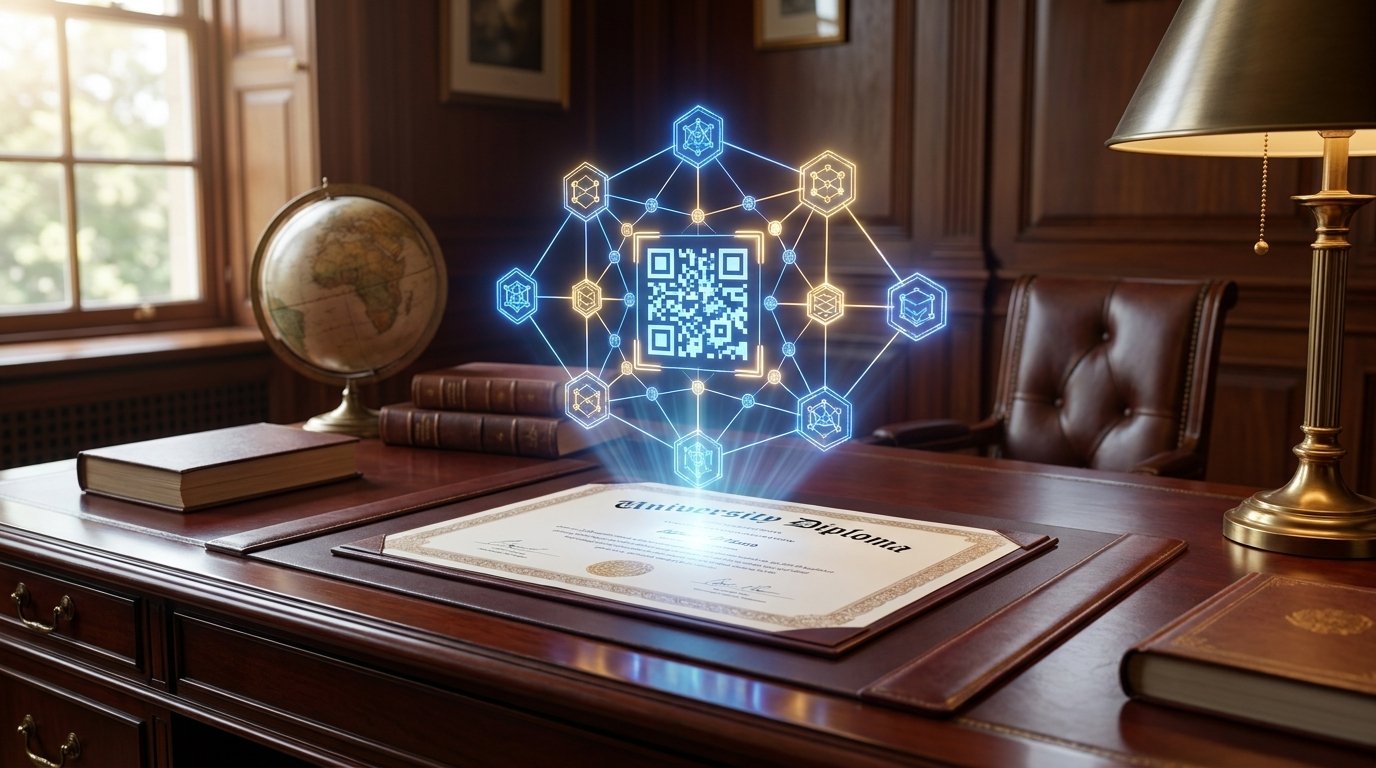
Every year, more than 2.5 million fake degrees are purchased globally, severely impacting university reputations and costing the global economy billions. As international student mobility reaches unprecedented highs, implementing blockchain certificate verification has become an urgent necessity for academic institutions preparing for graduation season. The proliferation of highly sophisticated, AI-generated forged diplomas means traditional paper credentials and standard PDFs are no longer sufficient to protect institutional integrity.
In this comprehensive guide, our team at Vec.Digital leverages our extensive expertise in technology and digital credentialing to help your institution transition to an impenetrable, automated system. Readers will discover how to seamlessly issue secure digital diplomas, permanently eliminate the administrative burden of manual verification, and integrate automated issuance engines directly into existing Student Information Systems (SIS).
Key Takeaways
- Implement blockchain certificate verification to completely eradicate credential fraud and safeguard your institution's global reputation.
- Transition to secure digital diplomas for universities to eliminate the heavy administrative and environmental costs of paper certificates.
- Utilize a bulk certificate generator to automate the issuance of thousands of credentials directly from your academic databases.
- Provide students with QR code certificates that employers can authenticate instantly, bypassing slow centralized verification agencies.
- Empower alumni with verifiable digital credentials that integrate seamlessly with professional networks to boost career opportunities.
The Escalating Crisis of Credential Fraud in Higher Education
The True Cost of Fake Degrees
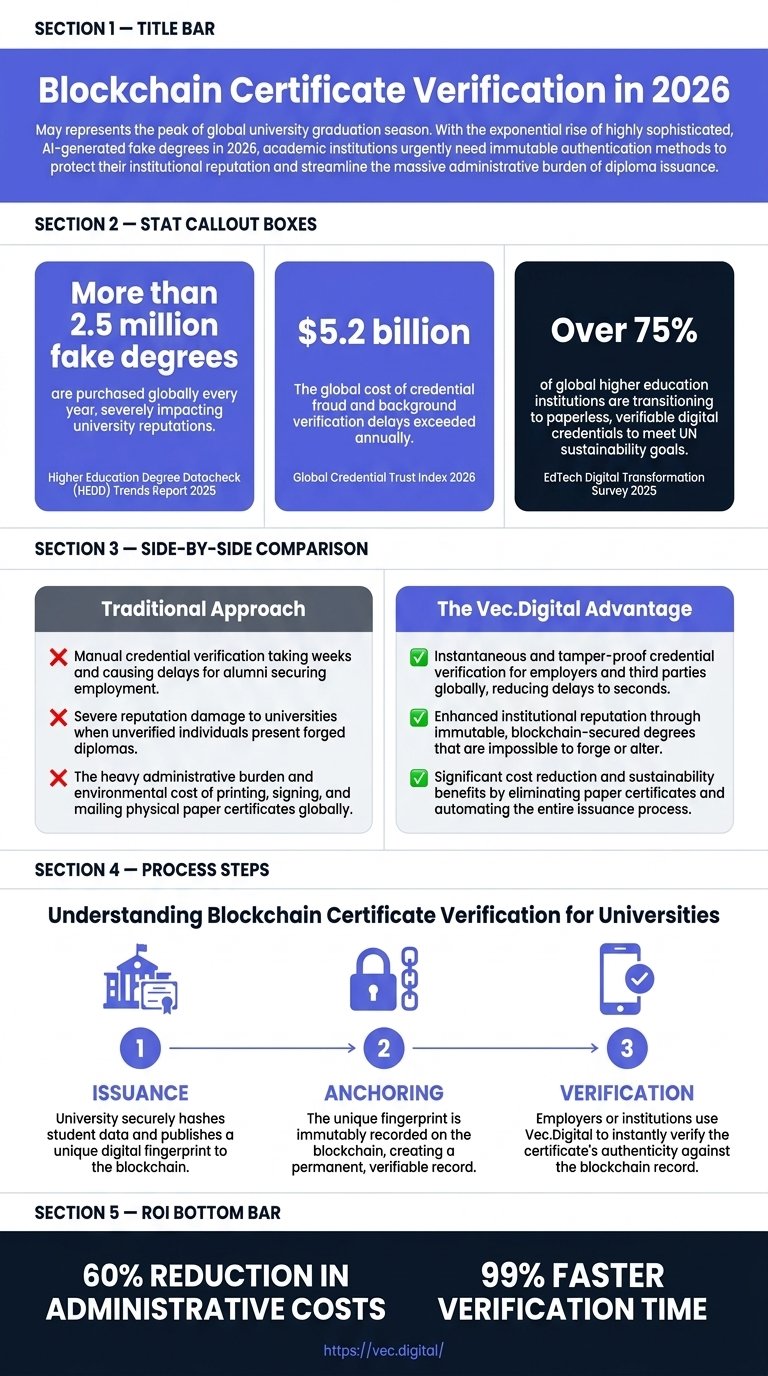
The academic world is currently facing a crisis of authenticity. According to the Higher Education Degree Datacheck (HEDD) Trends Report (2025), more than 2.5 million fake degrees are purchased globally every year. This is not merely a localized issue; it is a systemic global threat that undermines the fundamental value of higher education. When unverified individuals present forged diplomas to secure employment, the resulting fallout causes severe reputation damage to the universities they falsely claim to represent.
Furthermore, the financial implications of this fraud are staggering. The Global Credential Trust Index (2026) revealed that the global cost of credential fraud and background verification delays exceeded $5.2 billion annually. Employers are spending excessive resources trying to validate academic backgrounds, while universities are forced to dedicate entire departments to manually answering verification requests. This archaic process creates a bottleneck that harms both the institution's operational efficiency and the global economy.
Why Legacy Digital Signatures Are Failing
For years, universities attempted to solve the paper problem by issuing standard PDF diplomas equipped with basic digital signatures. However, these legacy methods are increasingly vulnerable. Modern editing tools and AI-driven software can easily bypass or manipulate traditional digital signatures, rendering them virtually useless against a determined bad actor. A PDF can be visually altered to change a name, a date, or a GPA, and without a centralized, immutable source of truth, employers have no immediate way to detect the forgery.
This vulnerability highlights exactly how blockchain certificate verification is changing the landscape. Unlike a static PDF, a blockchain-anchored credential relies on decentralized cryptographic proof. It shifts the paradigm from "trusting the document" to "trusting the mathematical proof" behind the document, ensuring that any alteration to the file immediately invalidates its verification status. Blockchain technology provides the immutable foundation necessary for modern academic integrity.
Understanding Blockchain Certificate Verification for Universities
Demystifying the Technology for Administrators
A common hurdle for academic registrars and Deans is the misconception that blockchain is purely a financial technology requiring deep technical expertise to implement. In reality, modern platforms have translated complex cryptography into a simple, automated process. So, how does blockchain certificate verification work for universities?
When a university issues a diploma through a specialized platform, the system takes the data from the certificate and generates a unique cryptographic hash—a digital fingerprint of that specific document. This hash is permanently recorded on a public blockchain. The university does not need to manage servers, understand coding, or deal with cryptocurrency. The automated engine handles the anchoring seamlessly in the background. If anyone attempts to alter the digital diploma, the hash changes, and the blockchain immediately flags the document as invalid.
Can Blockchain-Backed Digital Certificates Be Faked or Altered?
One of the most frequently asked questions by IT Directors is whether these next-generation credentials can be compromised. The definitive answer is no. Because the blockchain is an immutable, decentralized ledger, altering a record would require simultaneously hacking thousands of computers worldwide—a mathematical impossibility. This guarantees that secure digital diplomas for universities remain permanently tamper-proof.
Even if a fraudster attempts to copy the visual design of a diploma, they cannot replicate the cryptographic anchor. When an employer checks the credential against the blockchain, the system will instantly reveal that the issuer (the university) did not authorize that specific document. This provides absolute certainty to hiring managers and completely eradicates the possibility of successful credential forgery.
Instant Authentication with QR Code Certificates
To make this technology accessible to employers who may not understand blockchain, the verification process must be instantaneous and frictionless. This is achieved through the use of QR code certificates. Every digital diploma is embedded with a unique, dynamic QR code.
When an employer or auditor scans the code with any standard smartphone camera, they are instantly routed to a dedicated, secure public verification page. This page displays the issuer's details, the recipient's information, signatory approvals, and a prominent "blockchain verified" badge. No app downloads, account registrations, or waiting periods are required. This instant scan-to-verify system bypasses slow, centralized governmental verification agencies, drastically accelerating the hiring process for international alumni.
Overcoming the Administrative Burden of Graduation Season
The Hidden Costs of Paper Diplomas
May represents the peak of global university graduation season, bringing with it a massive administrative nightmare. The traditional process of issuing paper diplomas involves a heavy administrative burden: verifying student records, coordinating physical printing, securing wet signatures from busy Deans, and managing the environmental and financial costs of international postal logistics. Physical mail processes are not only slow and costly but are incredibly prone to loss or damage during transit.
When an international student loses their physical diploma, the reissue process can take weeks, causing immense frustration and potentially costing the student a job opportunity. Furthermore, the manual verification of these paper documents requires dedicated university staff to answer phone calls and emails from background check agencies, pulling resources away from core educational initiatives.
Automating Issuance with a Bulk Certificate Generator
To solve these operational bottlenecks, forward-thinking institutions are integrating automated issuance engines directly into their Student Information Systems (SIS). By utilizing a bulk certificate generator, universities can transform a process that once took months into one that takes minutes.
Administrators can simply export a CSV file of graduating students from their database or connect their systems via REST API. The automated system then populates dynamic fields on pre-designed, branded templates, applies digital signatory approvals, anchors the records to the blockchain, and securely emails the digital diplomas to thousands of students simultaneously. This level of operational efficiency allows universities to focus on celebrating student achievements rather than managing logistical nightmares.
The Global Shift Toward Verifiable Digital Credentials
Meeting UN Sustainability Goals
The transition away from paper is not solely about security and efficiency; it is also a vital component of global environmental responsibility. According to the EdTech Digital Transformation Survey (2025), over 75% of global higher education institutions are transitioning to paperless, verifiable digital credentials to meet UN sustainability goals. The carbon footprint associated with sourcing specialized paper, operating industrial printers, and flying documents across the globe is immense.
By adopting cloud-based certification systems, universities drastically reduce their environmental impact. This commitment to sustainability resonates strongly with modern students and faculty, positioning the institution as a forward-thinking, socially responsible leader in the global education sector.
Cross-Border Verification and International Mobility
As international student mobility reaches new highs in 2026, cross-border credential verification has become a significant bottleneck. A degree earned in the APAC region must be easily verifiable by an employer in the EU or the UAE. Standardized digital frameworks in these regions are pressuring universities to adopt globally interoperable credentials.
Blockchain provides a universal language of trust. It does not rely on the infrastructure of any single country's government. A blockchain-anchored credential can be verified instantly from anywhere in the world, ensuring that alumni face zero friction when applying for international visas, further education, or global employment opportunities. For more insights into how digital transformation is shaping global IT strategies, you can explore research from authorities like Gartner.
Are Digital Diplomas Legally Recognized by Employers?
A crucial question often raised by academic boards is: Are digital diplomas legally recognized by employers? The answer is a resounding yes. In fact, they are increasingly preferred. As long as the digital credential can be cryptographically proven to originate from the accredited institution, corporate HR departments and background check agencies accept them as primary source verification.
Because blockchain verification provides irrefutable proof of origin and integrity, employers view these credentials as far more reliable than a physical piece of paper, which could easily be a sophisticated counterfeit. The legal and corporate frameworks globally have adapted to recognize cryptographic anchoring as the highest standard of document authentication.
Empowering Alumni and Enhancing Employability
Accelerating the Hiring Process
The ultimate goal of a university is to prepare its students for successful careers. Manual credential verification taking weeks causes severe delays for alumni securing employment. In a competitive job market, a delay of two weeks can result in a lost job offer. By providing students with verifiable digital credentials, universities directly empower their graduates to prove their qualifications instantly.
The Digital Credentialing Impact Study (2026) demonstrated that job applicants sharing verifiable digital credentials on professional networks like LinkedIn receive 3x more interview requests. Employers appreciate the transparency and speed, allowing them to make faster, more confident hiring decisions.
How Do You Share a Verifiable Digital Credential on LinkedIn?
Modern digital credential platforms are designed with the user experience in mind. For a graduate, sharing their achievement is a seamless process. Upon receiving their secure digital diploma via email, the student accesses their credential in a digital environment. With a single click of a "Share to LinkedIn" button, the system automatically formats the credential as a verified certification on their profile.
This integration includes the credential name, the issuing university, the issue date, and a direct URL to the public verification page. When a recruiter views the profile, they can click the link and instantly see the blockchain-verified proof of the degree, significantly elevating the candidate's professional standing.
How to Implement the Most Secure Digital Certificate Maker
Choosing the Right Digital Certificate Maker
When evaluating solutions, academic IT Directors often ask: What is the most secure digital certificate maker? The ideal platform must balance military-grade cryptography with an intuitive, user-friendly interface. It should not require administrative staff to possess coding skills or graphic design expertise.
A comprehensive platform will offer a drag-and-drop design editor, allowing universities to upload their custom background designs, official seals, and specific typography to perfectly maintain brand identity. It must include dynamic fields for automated personalization and built-in signatory approval systems to ensure that no credential is issued without the proper authorization from Deans or Registrars.
Step-by-Step Integration Guide
Implementing a secure digital diploma system is a straightforward process when utilizing the right technology partner. The process generally follows these automated steps:
- Design the Template: Use the digital certificate maker to create a visually stunning, on-brand diploma template, complete with dynamic variable fields for student names and degree types.
- Configure Signatories: Assign specific university officials to review and digitally sign the credentials before issuance.
- Connect the Data: Utilize a bulk certificate generator by uploading a CSV file from your SIS or integrating directly via REST API for continuous, automated issuance.
- Issue and Anchor: The system generates the diplomas, embeds the QR code certificates, anchors the data to the blockchain, and dispatches the credentials to the students.
This streamlined approach completely modernizes the graduation experience, ensuring security, efficiency, and scale.
Secure Your Institution's Legacy with Vec.Digital
The transition to secure, immutable academic records is no longer a futuristic concept; it is an immediate requirement. By adopting blockchain certificate verification, universities can permanently eliminate the threat of credential fraud, drastically reduce administrative overhead, and empower their alumni with instantly verifiable proof of their hard work. Your institution's reputation is its most valuable asset—protect it with technology that guarantees absolute authenticity.
At Vec.Digital, we specialize in providing effortless digital certification and verification at scale. Our comprehensive suite of tools, including our intuitive template editor and automated bulk issuance engine, is designed specifically to meet the high-stakes demands of global higher education. We ensure 99.98% uptime, zero setup fees, and seamless integration with your existing systems.
Start issuing verifiable certificates in minutes and secure your university's credentials today. To learn more about our enterprise solutions and how we can support your digital transformation this graduation season, visit our website at https://vec.digital/ or contact our dedicated team at support@vec.digital.