
Blockchain Certificate Verification in 2026: Securing University Diplomas at Scale
Published on May 30, 2026
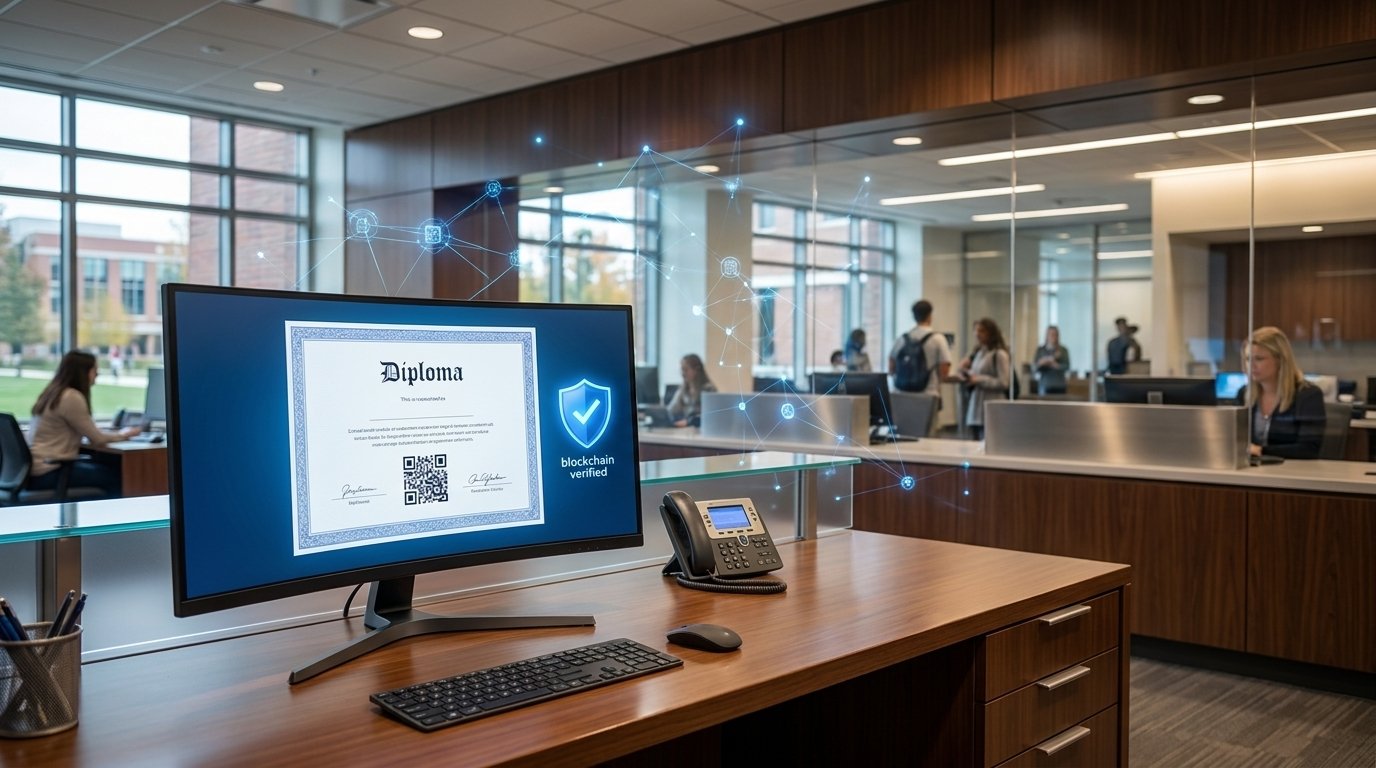
Diploma mills and credential forgery represent a staggering $7 billion global industry, fundamentally threatening the institutional integrity of academic organizations worldwide. As graduation season approaches, academic registrars face the immense pressure of issuing thousands of diplomas while combating highly sophisticated, AI-generated fake degrees. Implementing blockchain certificate verification has evolved from a futuristic concept into an urgent administrative necessity to protect institutional reputation and streamline operations.
In this comprehensive guide, our team at Vec.Digital will demonstrate how modern educational institutions can seamlessly transition to tamper-proof digital credentials without requiring extensive technical overhauls. Leveraging our deep expertise in educational technology and document authentication, you will discover actionable strategies to automate your issuance processes. By the end of this article, you will understand how to deploy a bulk certificate generator, eliminate manual verification bottlenecks, and provide your graduates with universally trusted, instantly verifiable achievements.
Key Takeaways
- Blockchain certificate verification ensures immutable, tamper-proof academic records that cannot be altered or forged.
- A modern bulk certificate generator automates mass issuance, saving registrars hundreds of administrative hours.
- Issuing secure digital diplomas for universities protects institutional reputation from the rising threat of AI-driven forgery.
- Implementing QR code certificates allows global employers to authenticate degrees instantly without specialized software.
- Transitioning to verifiable digital credentials reduces administrative overhead and physical printing costs by up to 80%.
The Global Crisis of Credential Fraud in Higher Education
The landscape of higher education is facing an unprecedented security crisis. As the value of specialized degrees and certifications continues to rise in the global job market, so does the incentive for malicious actors to fabricate these credentials. The traditional paper diploma, once a universally respected symbol of academic achievement, is no longer sufficient to guarantee authenticity in a digitally interconnected world. The need for robust blockchain certificate verification is more apparent than ever.
During the peak of global graduation season, universities are under immense pressure to issue thousands of diplomas efficiently. However, this administrative sprint is increasingly overshadowed by the looming threat of credential fraud. Academic Registrars, Deans, and IT Directors are recognizing that legacy systems simply cannot keep pace with modern forgery techniques.
The Rise of AI-Driven Forgery
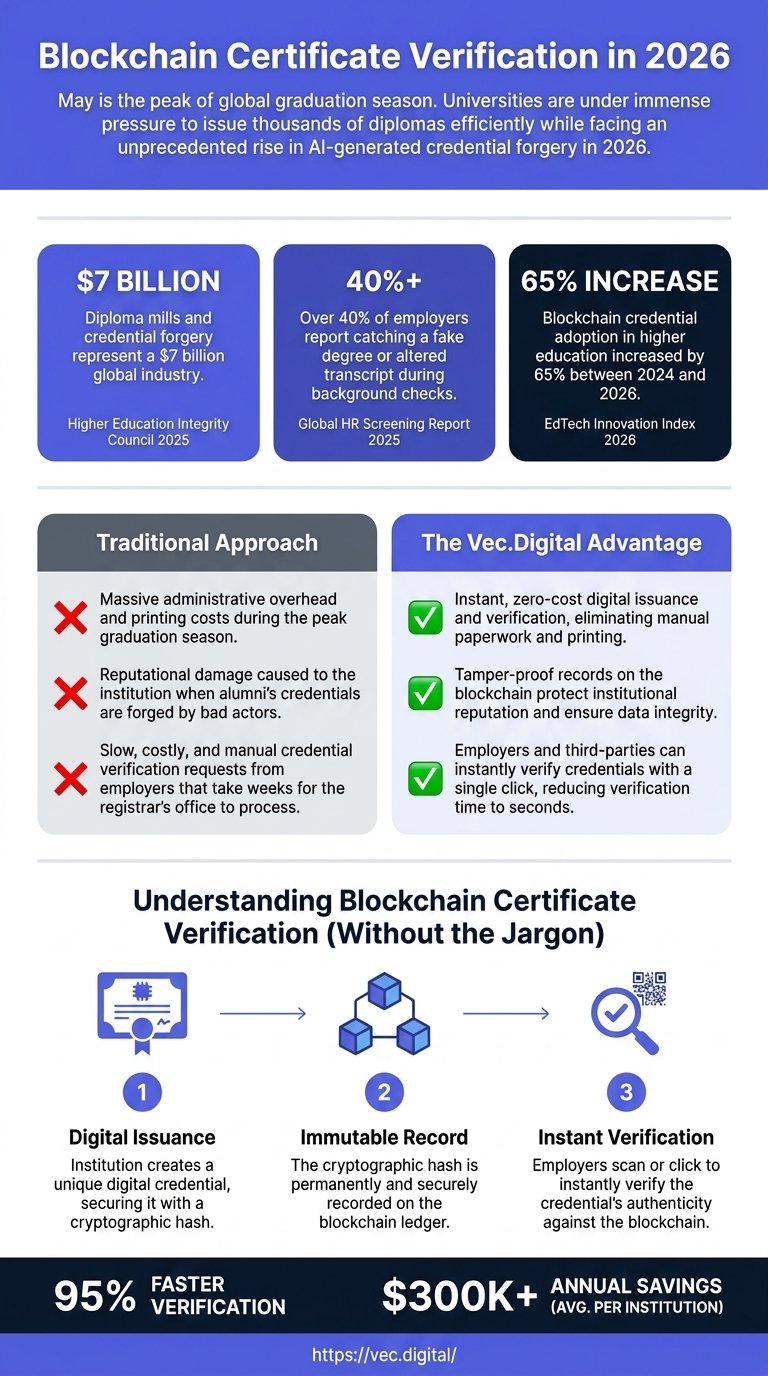
The technological democratization brought about by artificial intelligence has a dark side when applied to document security. According to the Cybersecurity Education Watch in 2026, AI-driven document forgery has reduced the time it takes to create a highly convincing fake diploma from days to mere minutes. Bad actors can now perfectly replicate university seals, localized typography, and even the specific signatures of university chancellors with alarming precision.
This rapid advancement in forgery technology means that a visual inspection of a physical document is no longer a reliable method of authentication. The reputational damage caused to an institution when alumni's credentials are forged by bad actors can be devastating, potentially devaluing the hard-earned degrees of legitimate graduates and deterring prospective students.
The Cost of Traditional Paper Diplomas
Beyond the security vulnerabilities, the operational reality of physical credentialing is highly inefficient. Universities suffer from massive administrative overhead and printing costs during the peak graduation season. The process involves sourcing specialized parchment, coordinating manual signatures from university officials, and navigating the complex, expensive logistics of global postal distribution.
The consequences of this outdated system spill over into the corporate world. The Global HR Screening Report in 2025 revealed a startling statistic: over 40% of employers report catching a fake degree or altered transcript during background checks. This high prevalence of fraud forces employers to rely on slow, manual verification requests, creating a frustrating bottleneck for everyone involved.
Why Are Colleges Switching to Secure Digital Diplomas?
Administrators frequently ask: Why are colleges switching to secure digital diplomas? The answer lies in the intersection of security, efficiency, and student experience. Traditional paper diplomas are easily lost, destroyed in natural disasters, or damaged during international relocations. When this happens, students face expensive, time-consuming bureaucratic hurdles to get replacements.
By transitioning to digital platforms, universities instantly resolve these pain points. Graduates receive a permanent, secure digital asset that they can access from anywhere in the world. Furthermore, the institution reclaims thousands of hours previously lost to manual administrative tasks, redirecting those resources toward enhancing the core educational experience.
Understanding Blockchain Certificate Verification (Without the Jargon)
While the administrative benefits of digitization are clear, true security requires more than just generating a standard PDF. This is where blockchain certificate verification becomes critical. However, many existing resources focus too heavily on the technical cryptography of blockchain, alienating the academic registrars and Deans who actually need to implement these systems. Our goal is to demystify this technology.
At its core, blockchain is simply a distributed, highly secure digital ledger. Instead of relying on a single, vulnerable university server to confirm a graduate's status, blockchain technology distributes the verification data across a global network, making it mathematically impossible to alter.
How Does Blockchain Certificate Verification Work?
A common question among academic IT directors is: How does blockchain certificate verification work? When a university issues a diploma using a blockchain-enabled platform, the system takes the unique data of that certificate (student name, degree, graduation date, and issuer details) and runs it through a cryptographic algorithm. This creates a unique digital fingerprint, known as a "hash."
This hash is then permanently anchored to a public blockchain. It does not store the student's private data on the public ledger; it only stores the mathematical proof that the specific document existed at a specific time and was issued by a specific, authorized institution. When an employer wants to verify the document, the system simply checks if the document's current hash matches the immutable hash stored on the blockchain. If even a single pixel or letter has been altered, the hashes will not match, and the verification will fail instantly.
Can a Digital Diploma be Forged?
This leads to another critical inquiry: Can a digital diploma be forged? If a digital diploma is merely a standard PDF or an image file, it can absolutely be forged using basic photo-editing software. However, if the diploma is anchored to the blockchain, forgery becomes virtually impossible.
Because the blockchain is immutable—meaning data cannot be changed or deleted once recorded—a bad actor cannot alter the official record. They might try to Photoshop the visual representation of the certificate, but the moment an employer runs that altered file through the verification engine, the cryptographic mismatch will immediately expose it as a fake. This provides absolute certainty to the hiring market.
What is the Safest Way to Issue University Certificates?
When institutions ask, What is the safest way to issue university certificates?, the global consensus points directly to blockchain anchoring combined with secure access controls. It removes the single point of failure inherent in legacy databases and completely neutralizes the threat of AI-generated visual forgery. By utilizing public-key cryptography, universities can mathematically prove their identity as the legitimate issuer, ensuring that every credential bearing their name is authentic.
Bridging the Gap: From Cryptography to Intuitive Administrative Systems
Understanding the theoretical security of blockchain certificate verification is only half the battle. The true challenge for universities lies in operationalizing this technology. Registrars and administrative staff require systems that bridge highly secure technology with intuitive, user-friendly administrative interfaces. They need tools that upgrade their legacy paper systems today, without requiring them to become blockchain developers.
The solution lies in platforms that abstract the complex cryptography behind a seamless, consumer-grade user interface. By utilizing automated systems, universities can process massive cohorts of graduating students with unprecedented speed and accuracy.
The Power of a Bulk Certificate Generator
During graduation season, manual data entry is the enemy of efficiency. A robust bulk certificate generator is the engine that drives modern credentialing. This system allows university administrators to upload a simple CSV file containing the details of thousands of graduates—names, degree types, honors, and dates.
The automated engine then maps this data to pre-approved design templates, automatically anchoring each unique record to the blockchain in the background. What used to take a team of administrators weeks of painstaking labor can now be accomplished in a matter of minutes. This automated process ensures zero data-entry errors and guarantees that every student receives their credential precisely on graduation day.
How Much Does a Bulk Certificate Generator Cost for Universities?
Budget constraints are always a reality in higher education. Therefore, administrators frequently ask: How much does a bulk certificate generator cost for universities? The transition to digital credentialing is surprisingly cost-effective, especially when compared to legacy methods.
While enterprise pricing varies based on the size of the institution and the volume of issuance, the return on investment is immediate. The Global Registrar Data Consortium reported in 2025 that switching to digital credentials reduces university administrative overhead related to printing, mailing, and manually verifying records by up to 80%. When you factor in the elimination of specialized parchment, secure international shipping, and the labor hours spent on manual verification, a modern digital system pays for itself rapidly.
Designing with a Digital Certificate Maker
While security is paramount, the aesthetic prestige of a university diploma cannot be sacrificed. A professional digital certificate maker allows institutions to maintain their strict brand guidelines and historical prestige in a digital format. Using intuitive drag-and-drop interfaces, design teams can upload high-resolution university seals, select precise brand colors, and incorporate authorized digital signatures from chancellors and deans.
This ensures that the digital representation of the credential commands the same respect and visual authority as its physical predecessor, providing graduates with a beautiful digital asset they are proud to share with their professional networks.
Empowering Employers and Alumni with Instant Authentication
The lifecycle of a diploma extends far beyond graduation day. The primary utility of an academic credential is its ability to prove a candidate's qualifications to prospective employers. Traditional verification processes are notoriously broken, causing friction for both the alumni and the hiring company. Blockchain certificate verification completely revolutionizes this dynamic.
When a university digitizes its credentials, it transforms a static piece of paper into an active, verifiable digital asset. This empowers alumni to seamlessly integrate their achievements into modern digital hiring pipelines, accelerating their career progression.
How Do Employers Instantly Verify Digital Credentials?
A critical question for the corporate sector is: How do employers instantly verify digital credentials? In the past, an employer had to contact the university registrar, submit a formal request, pay a verification fee, and wait days or weeks for a response. This slow, costly, and manual credential verification request system is a massive bottleneck in modern HR operations.
With verifiable digital credentials, the process is instantaneous. An employer simply clicks a secure link provided by the candidate, which directs them to a dedicated, university-branded public verification page. This page queries the blockchain in real-time, instantly displaying the verified status, the issuer details, and the immutable record of the achievement. No phone calls, no waiting periods, and no doubt.
The Role of QR Code Certificates in Modern Hiring
To bridge the gap between physical and digital environments, QR code certificates have become the global standard. Every secure digital diploma can be embedded with a unique, dynamically generated QR code. If an alumnus chooses to print their digital diploma for display, the security travels with the physical copy.
Anyone—such as an auditor, a recruiter at a job fair, or an immigration official—can simply scan the QR code with their standard smartphone camera. They are immediately routed to the blockchain-backed authentication page. This provides foolproof, easily shareable proof of authenticity that requires no specialized app or registered account to utilize.
Eliminating the Verification Bottleneck
By empowering employers with instant self-service verification, universities simultaneously eliminate their own administrative bottlenecks. Registrars no longer need to dedicate staff to answering verification emails or phone calls. The automated system handles thousands of verification queries globally, 24/7, with zero marginal cost to the university. This is the ultimate realization of operational efficiency in higher education.
Implementing Secure Digital Diplomas for Universities Globally
The transition toward secure digital diplomas for universities is not an isolated trend; it is a massive global shift driven by technological advancement and regulatory mandates. Educational institutions that fail to modernize their credentialing systems risk falling behind in an increasingly competitive, digital-first academic landscape.
Understanding the broader context of this digital transformation helps university leadership justify the investment and align their IT strategies with global best practices.
Meeting Global Compliance and Sustainability Goals
Governments and regulatory bodies globally are heavily encouraging or mandating verifiable digital credentials across public and private education sectors. Initiatives such as the European Blockchain Services Infrastructure (EBSI) in the EU and the Dubai Paperless Strategy in the UAE are making digital modernization a pressing compliance priority worldwide in 2026.
The data strongly reflects this shift. The EdTech Innovation Index in 2026 reported that blockchain credential adoption in higher education increased by an astounding 65% between 2024 and 2026. Furthermore, this transition aligns perfectly with the United Nations' sustainability goals. By eliminating the need to harvest materials, print, and globally ship thousands of physical documents, universities drastically reduce their carbon footprint, demonstrating a tangible commitment to environmental responsibility.
Seamless Integration with Existing Registrar Systems
A common hesitation among IT Directors is the fear of disrupting existing infrastructure. However, modern platforms are designed for seamless interoperability. Through secure APIs, a digital credentialing engine can connect directly to existing Student Information Systems (SIS) and Learning Management Systems (LMS).
This means that the moment a student's graduation status is approved in the university's primary database, the automated system can instantly trigger the generation, blockchain anchoring, and secure delivery of the digital diploma. It is a frictionless upgrade that enhances, rather than replaces, the institution's core data architecture.
Secure Your Institution's Legacy with Vec.Digital
The era of relying on vulnerable paper documents to represent years of rigorous academic achievement is rapidly coming to an end. As AI-driven forgery becomes more sophisticated and the global workforce demands instant, irrefutable proof of skills, universities must adopt proactive security measures. Implementing blockchain certificate verification is the only definitive way to protect your institution's reputation and empower your graduates.
At our core, we believe that trust should be built into the infrastructure of education. Our comprehensive platform at Vec.Digital provides everything your university needs to issue secure, beautifully designed, and globally verifiable digital diplomas at scale. From our intuitive bulk generation systems to our immutable blockchain anchoring, we make digital transformation effortless.
Do not let your institution's prestigious credentials become a target for fraud during this graduation season. Equip your registrar's office with the most advanced document security technology available today.
Ready to modernize your credentialing process?
Visit us at https://vec.digital/ to explore our enterprise solutions, or reach out to our team directly at support@vec.digital to schedule a consultation. Secure your organization's credentials today.