
Blockchain Certificate Verification in 2026: Stop Credential Fraud
Published on May 8, 2026

Fake degrees and professional credential fraud cost employers globally over $600 million annually in bad hires and compliance fines (Higher Education Degree Datacheck, 2024). As generative AI tools make forging traditional PDF certificates indistinguishable from the real thing, adopting blockchain certificate verification has become an urgent necessity for global institutions. This cryptographic approach provides an immutable layer of trust, ensuring that every issued credential is tamper-proof and instantly verifiable.
In this comprehensive guide, we will explore how your organization can seamlessly transition from vulnerable legacy systems to secure, blockchain-anchored digital credentials. Drawing on VEC.Digital's extensive expertise in credentialing technology, you will learn how to eliminate credential fraud, streamline your issuance pipeline to issue bulk certificates in minutes, and provide learners with globally accessible, instantly verifiable credentials that empower their career growth.
Key Takeaways
- Digital credential fraud is a multimillion-dollar global crisis that requires cryptographic solutions.
- Blockchain certificate verification provides immutable trust, ensuring credentials cannot be altered or forged.
- QR code certificate verification enables instant, zero-cost auditing for employers and HR teams.
- Verifiable credentials 2026 align with upcoming global regulatory standards and digital identity frameworks.
- Sustainable digital issuance eliminates paper waste and supports United Nations sustainability goals.
The Escalating Crisis of Digital Credential Fraud
The modern talent acquisition landscape is facing a profound crisis of trust. With the proliferation of advanced digital editing tools, fabricating a convincing academic or professional credential has never been easier. Blockchain certificate verification has emerged as the definitive response to this growing epidemic of misrepresentation.
The True Cost of Fake Degrees and Certifications
The financial and reputational implications of credential fraud are staggering. According to the Higher Education Degree Datacheck (2024), fake degrees and professional credential fraud cost employers globally over $600 million annually in bad hires and compliance fines. When an organization inadvertently hires an individual based on falsified qualifications, the fallout extends far beyond the initial recruitment costs. It compromises operational integrity, endangers workplace safety, and exposes the company to severe legal liabilities.
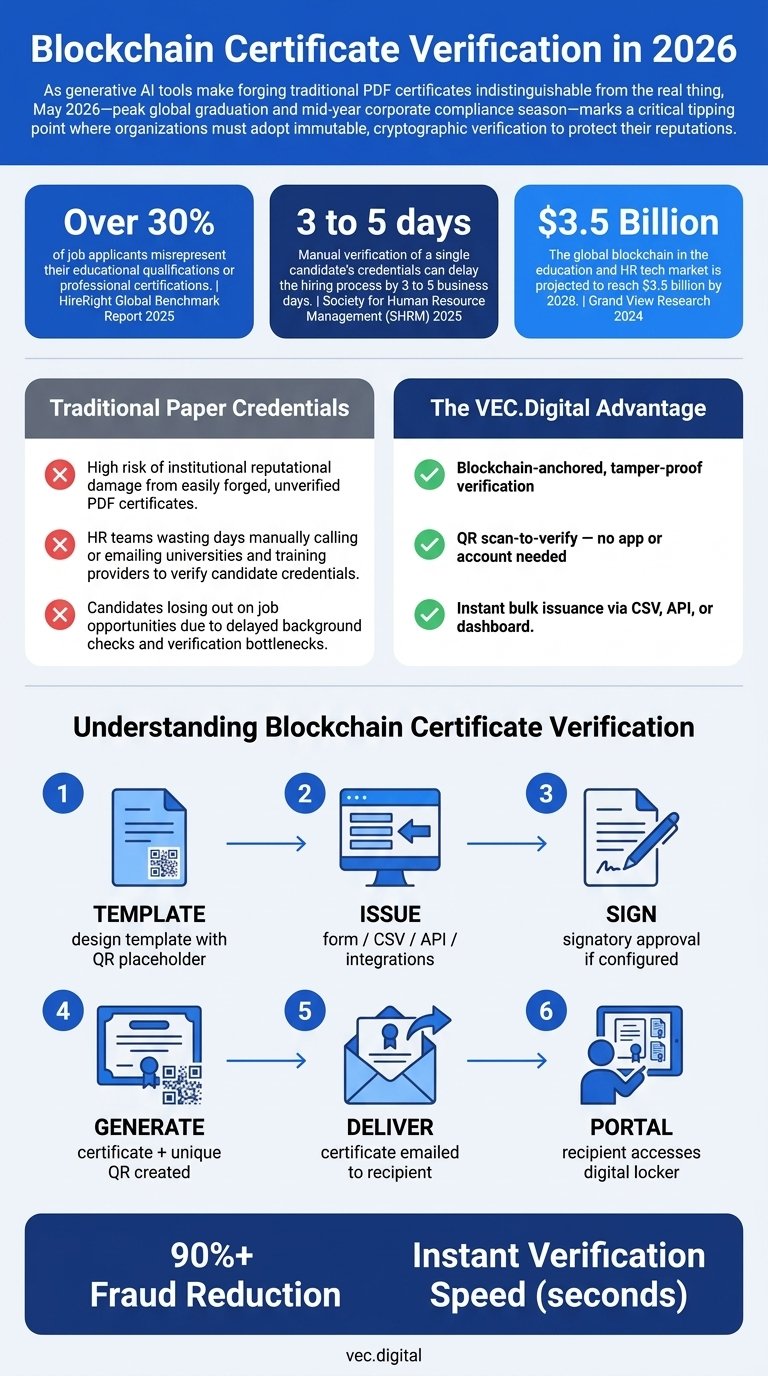
Furthermore, over 30% of job applicants misrepresent their educational qualifications or professional certifications (HireRight Global Benchmark Report, 2025). This alarming statistic underscores the reality that traditional background checks are no longer sufficient. Institutions and corporations require a more robust, technologically advanced method to guarantee the authenticity of the claims made by prospective employees and students.
Why Traditional PDF Certificates Are Failing Institutions
What is the difference between a standard PDF certificate and a verifiable credential? A standard PDF is merely a digital image or document. It lacks intrinsic security measures and can easily be manipulated using basic graphic design software. Once a standard PDF is downloaded, the issuing institution loses all control over how that document is presented, altered, or shared.
In contrast, a verifiable credential contains embedded cryptographic proofs. When an institution issues a certificate anchored to a blockchain, the data is secured immutably. If even a single pixel or character on the digital document is altered, the cryptographic signature breaks, immediately flagging the document as invalid. This fundamental difference is why legacy PDFs are rapidly becoming obsolete in high-stakes academic and professional environments.
The Administrative Bottleneck in Global Talent Acquisition
Beyond the risk of fraud, the sheer operational inefficiency of manual verification is stifling global hiring. Manual verification of a single candidate's credentials can delay the hiring process by 3 to 5 business days (Society for Human Resource Management, 2025). HR teams waste countless hours calling or emailing universities and training providers to confirm graduation dates and certification statuses.
This delay is highly detrimental. 85% of HR professionals report that credential verification remains a major administrative bottleneck in the talent acquisition pipeline (Global Talent Acquisition Trends, 2025). Candidates often lose out on job opportunities due to delayed background checks, while employers lose top talent to competitors with faster hiring processes. Automating this workflow through cryptographic verification is essential for modernizing global recruitment.
Understanding Blockchain Certificate Verification
As the global market recognizes the limitations of legacy systems, the adoption of cryptographic solutions is accelerating. The global blockchain in the education and HR tech market is projected to reach $3.5 billion by 2028 (Grand View Research, 2024). But how does this technology actually function in practice? Blockchain certificate verification abstracts complex cryptography into a seamless user experience.
How Does Blockchain Verify Digital Certificates?
How does blockchain verify digital certificates? At its core, the process relies on cryptographic hashing. When an organization issues a certificate through a platform like VEC.Digital, the system generates a unique mathematical representation (a hash) of the certificate's data. This hash is then permanently anchored to an immutable blockchain ledger.
When an employer or auditor wants to verify the credential, the system recalculates the hash of the presented document and compares it to the hash stored on the blockchain. If the two hashes match perfectly, the certificate is authentic. If they do not match, the document has been tampered with. This process occurs in milliseconds, entirely behind the scenes, ensuring 100% cryptographic trust without requiring the verifier to understand the underlying technology.
Moving from Theoretical Tech to Practical Application
Historically, much of the discourse surrounding blockchain has been highly technical and theoretical. There has been a significant informational gap in connecting this technology to the actual user experience. Organizations do not need to manage nodes, understand cryptographic algorithms, or handle cryptocurrency to benefit from blockchain anchoring.
Modern platforms handle the entire issuance pipeline seamlessly. Administrators simply use intuitive dashboards to design and issue credentials, while the platform automatically manages the complex blockchain anchoring in the background. This practical application allows institutions to reap the benefits of decentralized security while maintaining a familiar, user-friendly administrative workflow.
Are Blockchain Certificates Legally Recognized Globally?
Are blockchain certificates legally recognized? Yes, in a rapidly growing number of jurisdictions worldwide. As digital transformation accelerates, international bodies and governments are establishing frameworks to recognize cryptographic signatures and verifiable credentials as legally binding equivalents to physical documents.
Standards such as the W3C Verifiable Credentials Data Model provide a universally accepted framework for expressing credentials on the web in a way that is cryptographically secure, privacy-respecting, and machine-verifiable. By adhering to these global standards, blockchain-anchored certificates ensure compliance across borders, making them ideal for international universities, global corporations, and cross-border professional associations.
The Best Way to Prevent Digital Certificate Fraud
What is the best way to prevent digital certificate fraud? The answer lies in combining immutable ledger technology with frictionless accessibility. Blockchain certificate verification is most effective when it is incredibly easy for third parties to use.
QR Code Certificate Verification: The User Experience
How do employers verify a digital credential? The most efficient method is through QR code certificate verification. Every certificate issued by VEC.Digital features a unique QR code linking directly to a secure, public verification page (e.g., /certificate/[uuid]).
An employer or auditor simply scans the QR code with their smartphone camera or clicks the verification link. They are instantly directed to a page displaying the authentic credential data along with a prominent "blockchain verified" badge. There is no app to download, no account to create, and no login required. This frictionless process abstracts away the technical complexity, empowering anyone to instantly audit a credential at zero cost.
Empowering Learners with a Secure Digital Locker
A critical component of preventing fraud is ensuring that the rightful owner of the credential can securely store and share it. A common pain point for learners is the lack of a centralized, secure repository for their achievements. Physical paper certificates are easily lost or damaged, and scattered PDF files are difficult to manage.
Modern verifiable credential platforms provide recipients with a permanent digital locker. Through this secure portal, learners gain anytime, anywhere access to all their certificates. They can easily share secure verification links directly to their LinkedIn profiles, digital portfolios, or directly with prospective employers, ensuring that their hard-earned credentials are always accessible and verifiable.
How Universities and Corporations Can Issue Verifiable Credentials
How can universities issue verifiable digital diplomas? The process of issuing blockchain certificate verification documents is highly streamlined, designed to integrate smoothly into existing administrative operations.
Establishing a Secure Multi-Signatory Workflow
For high-stakes credentials like university degrees or corporate compliance certifications, authorization is critical. Advanced platforms offer a secure multi-signatory workflow. Organizations can configure templates to require up to two independent signatories.
When a certificate is generated, it is held in a pending state until all designated signatories have independently reviewed and signed off on the issuance. This robust signatory workflow ensures internal accountability and prevents unauthorized personnel from issuing official credentials, adding an essential layer of administrative security before the cryptographic anchoring even takes place.
Streamlining the Issuance Pipeline at Scale
Whether an organization needs to issue a single certificate or tens of thousands simultaneously, the issuance pipeline must be flexible. VEC.Digital supports four distinct issuance methods to accommodate any operational scale:
- Dashboard Form: Ideal for one-by-one issuance, allowing administrators to manually enter recipient details.
- CSV Upload: Perfect for bulk issuance, enabling the generation of thousands of certificates in minutes by uploading a simple spreadsheet.
- REST API: Allows for seamless programmatic issuance directly from an organization's existing LMS, HRIS, or CRM systems.
- Third-Party Integrations: Connects with popular platforms to automate the certificate workflow based on specific triggers and events.
Furthermore, the visual design is never compromised. Administrators have access to a powerful template editor featuring over 1,400 Google Fonts, intuitive drag-and-drop functionality, support for A2 through A5 sizes in both portrait and landscape, and seamless Canva integration for stunning background designs.
Aligning with Global Sustainability and Compliance Goals
Transitioning to digital credentials is not only a security upgrade; it is a vital step toward environmental responsibility. Traditional paper certificates require massive amounts of water and timber to produce, and their physical delivery generates significant carbon emissions.
By adopting digital verifiable credentials, organizations eliminate paper waste, reduce printing costs, and eliminate physical shipping fees. This sustainable approach directly supports United Nations sustainability goals, allowing universities and corporations to publicly demonstrate their commitment to eco-friendly practices while simultaneously enhancing their security posture.
Future-Proofing Credentials for 2026 and Beyond
As we look toward the future, the global regulatory landscape is shifting dramatically. Blockchain certificate verification is rapidly transitioning from a technological innovation to a strict operational requirement.
Preparing for EU Digital Identity Wallets and Global Standards
With the European Union's Digital Identity Wallet initiatives advancing significantly by 2026, citizens across Europe will soon have standardized digital wallets to securely store and present their verifiable credentials. Similar frameworks are being developed in regions across the globe.
Institutions that adopt blockchain-anchored credentials today are future-proofing their operations for 2026 and beyond. By issuing credentials that comply with global cryptographic standards, organizations ensure that their learners' achievements will seamlessly integrate into these upcoming national and international digital identity ecosystems.
The Role of Immutable Cryptographic Trust in Highly Regulated Sectors
Alongside digital identity initiatives, there is tightening global regulatory scrutiny on compliance training in sectors such as healthcare, finance, and aviation. In these high-stakes industries, the authenticity of a training certificate can be a matter of public safety or massive financial liability.
Cryptographically secure and instantly verifiable credentials provide the definitive proof required by auditors and regulators. By utilizing an immutable ledger, organizations can demonstrate an unbroken chain of trust, proving definitively when a credential was issued, to whom it was issued, and that it has remained completely unaltered since the moment of authorization.
Secure Your Organization's Reputation with VEC.Digital
The era of easily forged PDF certificates and slow, manual verification is coming to an end. To protect your institution's reputation, accelerate global hiring processes, and empower your learners, adopting blockchain-anchored credentials is the necessary next step.
At VEC.Digital, we provide the comprehensive infrastructure required to issue, manage, and verify trustworthy digital credentials at scale. Our platform combines immutable blockchain anchoring with effortless QR code verification, ensuring that your certificates are secure, beautiful, and globally accessible.
We believe that security should be accessible to all organizations. That is why we offer a completely free plan—no credit card required, and no setup fees. You can start designing and issuing secure credentials in minutes. For growing organizations, our paid plans start at just $29.99/month, while individuals can issue certificates for as little as $1.00 per credential. Explore our solutions for higher education or discover how it works today.
Ready to eliminate credential fraud and streamline your issuance pipeline?
Website: vec.digital
Email: support@vec.digital
WhatsApp: +971521373078