
Blockchain Certificate Verification in 2026: Stopping AI Diploma Fraud
Published on May 27, 2026

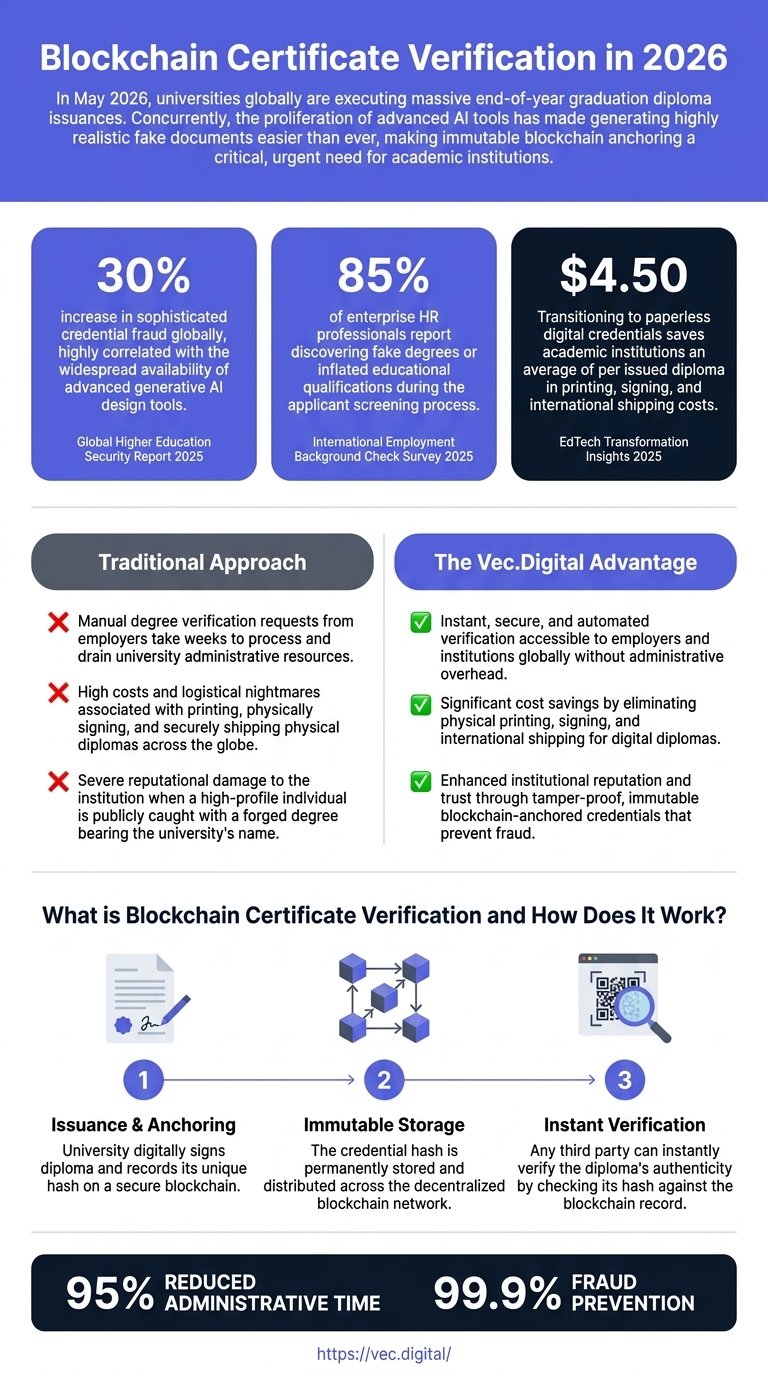
According to the Global Higher Education Security Report (2025), there has been a staggering 30% increase in sophisticated credential fraud globally, highly correlated with the widespread availability of advanced generative AI design tools. This surge in highly realistic forged documents has made blockchain certificate verification an urgent operational necessity for academic institutions facing massive end-of-year graduation issuances. Without immutable digital anchoring, universities risk catastrophic reputational damage as fake degrees infiltrate the global job market.
By reading this comprehensive guide, you will understand how modern academic institutions are leveraging our deep expertise in Technology to deploy automated systems that issue instant, QR-scannable diplomas at scale. We will explore the mechanics of decentralized verifiable credentials, demonstrate how to eliminate the manual overhead of traditional document verification, and provide actionable strategies to protect your institutional legacy. You will learn how to seamlessly integrate a bulk issuance engine, cut administrative costs, and empower your graduates with tamper-proof digital records.
Key Takeaways
- Advanced AI tools have accelerated diploma forgery, making blockchain certificate verification the only viable defense for academic integrity.
- Transitioning to paperless systems utilizing a digital certificate maker saves institutions significant printing and international shipping costs.
- QR code certificates allow global employers to instantly authenticate credentials, eliminating weeks of manual administrative delays.
- Implementing a bulk certificate generator streamlines massive graduation events through automated CSV and API integrations.
- Verifiable digital credentials are rapidly becoming a regulatory and corporate standard across global markets, including the EU and the Middle East.
The 2026 Landscape: Why AI-Driven Diploma Fraud is Surging
The Sophistication of Modern Generative AI Forgery
The academic landscape is currently facing a crisis of authenticity. As we navigate 2026, the barrier to entry for creating counterfeit documents has effectively vanished. Generative artificial intelligence and advanced graphic design software allow malicious actors to replicate university seals, complex typography, and official signatures with terrifying accuracy. This technological shift means traditional visual inspections of paper diplomas are no longer sufficient to prove a candidate's educational background.
The data paints a concerning picture for educational institutions. The Global Higher Education Security Report (2025) highlights a 30% increase in sophisticated credential fraud globally, highly correlated with the widespread availability of advanced generative AI design tools. When a bad actor can generate a pixel-perfect replica of a master's degree in minutes, universities must adopt cryptographic defenses. Blockchain certificate verification shifts the paradigm from trusting the visual appearance of a document to mathematically proving its origin.
This escalation in fraud is not isolated to any single region; it is a global phenomenon affecting legacy institutions and modern online academies alike. To combat this, academic leaders must recognize that the physical paper itself is obsolete as a security measure. The only way to outpace AI-driven forgery is to utilize immutable digital ledgers that cannot be retroactively altered or spoofed.
The Reputational and Financial Cost to Academic Institutions
For a university, trust is the foundational currency. When a high-profile individual is publicly caught with a forged degree bearing a university's name, the reputational damage is immediate and severe. Alumni feel the value of their hard-earned degrees diminish, and prospective students may question the institution's prestige. The fallout from credential scandals often takes years of public relations efforts to repair, costing millions in lost endowments and enrollment drops.
Beyond the abstract loss of reputation, there is a tangible financial drain associated with managing fraud. Academic Registrars and IT Directors are forced to dedicate extensive resources to fielding verification calls, conducting internal audits, and issuing legal cease-and-desist orders to diploma mills. By failing to implement modernized digital defenses, institutions inadvertently subsidize the operational costs of managing fake credentials.
Proactive institutions are realizing that investing in secure infrastructure is far more cost-effective than managing the fallout of a scandal. By anchoring academic records to a decentralized ledger, universities create a permanent, tamper-proof historical record that publicly defends their brand integrity without requiring constant human intervention.
The Burden on Enterprise HR and Global Employers
The downstream victims of diploma fraud are the corporations and organizations hiring these unverified candidates. Enterprise HR departments and Learning & Development (L&D) managers are overwhelmed by the sheer volume of background checks required in today's globalized remote workforce. Manual degree verification requests from employers often take weeks to process, draining university administrative resources and stalling corporate onboarding processes.
The scale of this issue is immense. According to the International Employment Background Check Survey (2025), 85% of enterprise HR professionals report discovering fake degrees or inflated educational qualifications during the applicant screening process. This high incidence rate forces employers to treat every paper resume with extreme skepticism, slowing down the velocity of global business.
When universities fail to provide instantly verifiable digital credentials, they inadvertently harm their own graduates' employment prospects. A candidate whose degree takes three weeks to verify may lose a competitive job offer to a candidate whose university provides instant, cryptographically secure proof of graduation. Bridging this gap between academic issuance and corporate verification is the primary driver behind the adoption of decentralized credentialing systems.
What is Blockchain Certificate Verification and How Does It Work?
Moving Beyond Theoretical Cryptography
Many discussions surrounding decentralized technology become bogged down in complex jargon, alienating the administrative professionals who need these solutions most. So, how does blockchain certificate verification actually work in a practical, academic setting? At its core, it is a method of taking a digital document, creating a unique mathematical fingerprint of that document, and storing that fingerprint on a public, unchangeable database.
When a university issues a diploma using a modern system, the platform compiles the student's data—name, graduation date, degree type, and institutional signatures. The system then processes this data through a cryptographic algorithm (such as SHA-256) to produce a unique string of characters called a hash. This hash is anchored to the blockchain. The actual personal data is not stored publicly, ensuring complete compliance with global data privacy regulations; only the mathematical proof of the document's existence is recorded.
For more detailed information on how cryptographic hashing secures data, you can review authoritative resources on cryptographic hash functions. In practice, this means the university retains total control over the issuance process, while the blockchain serves purely as a decentralized notary public, silently verifying that the document was issued by the authorized institution on a specific date.
The Mechanics of Immutable Ledger Anchoring
The power of this technology lies in the concept of immutability. A blockchain is a distributed ledger maintained by thousands of independent computer nodes globally. Once a record (the certificate's hash) is added to this ledger, it cannot be altered, deleted, or manipulated by any single party—not even the software provider or the university itself. This creates a permanent, objective truth.
If a fraudster attempts to take a legitimate digital diploma and alter the name using a PDF editor or AI tool, the underlying data changes. When this altered document is run through the verification engine, it produces a completely different hash. Because this new hash does not match the original hash anchored on the blockchain, the system instantly flags the document as a forgery. The math does not lie, and it does not require human interpretation.
This automated mathematical cross-referencing happens in milliseconds behind the scenes. For the end-user—whether that is an employer, a visa officer, or an academic auditor—the experience is seamless. They are simply presented with a clear "Verified" or "Invalid" badge, backed by the unassailable security of decentralized consensus.
Can a Blockchain Digital Degree Be Faked or Hacked?
A frequently asked question by Academic Deans and IT Directors is: "Can a blockchain digital degree be faked or hacked?" The definitive answer is no, provided the underlying infrastructure is built correctly. Because the blockchain relies on decentralized consensus mechanisms, a hacker would need to simultaneously compromise thousands of independent servers worldwide to alter a single record—a computational impossibility.
Furthermore, because the system relies on public-key cryptography, the digital signature tied to the university's issuing wallet cannot be forged. Even if a bad actor creates a fake certificate and anchors it to the blockchain themselves, the verification system will show that the credential was not signed by the university's official cryptographic key. The origin of the document is always transparent and undeniable.
This level of security is why major technological research firms, such as Gartner, continually highlight decentralized identity and verifiable credentials as critical infrastructure for the future of digital trust. By adopting these systems, universities insulate themselves against both current AI threats and future, unforeseen vectors of document fraud.
Transitioning to Secure Digital Diplomas for Universities
Overcoming the Limitations of Physical Paper Credentials
For centuries, the physical parchment has been the ultimate symbol of academic achievement. However, in a digitized, fast-paced global economy, paper is a liability. Physical diplomas are easily lost, damaged in transit, or destroyed in natural disasters. When graduates lose their physical diplomas, they face high friction, steep administrative costs, and long wait times to obtain replacement proof of their qualifications from their alma mater.
Moreover, the logistics of managing paper are a nightmare for university administrators. Printing high-quality secure paper, coordinating physical signatures from deans (who may be traveling), and securely shipping thousands of documents across the globe is an archaic process. It is prone to human error, delays, and lost mail, resulting in a frustrating experience for the newly graduated student.
Transitioning to secure digital diplomas for universities using a robust digital certificate maker eliminates these physical pain points entirely. Graduates receive their credentials instantly upon the conclusion of the academic year, regardless of their geographical location. They can store these documents in secure digital lockers, ensuring they have permanent, lifelong access to their achievements without ever needing to request a physical reprint.
Cost Reductions and Operational Efficiency
Beyond security and convenience, the financial argument for digital transformation is undeniable. The costs associated with legacy credentialing—specialty paper, embossed seals, manual labor, and international couriers—compound rapidly, especially for large state universities or global online academies issuing tens of thousands of degrees annually.
According to EdTech Transformation Insights (2025), transitioning to paperless digital credentials saves academic institutions an average of $4.50 per issued diploma in printing, signing, and international shipping costs. When extrapolated across a graduating class of 10,000 students, this represents a massive reallocation of budget back into core educational initiatives rather than administrative overhead.
This shift also aligns perfectly with global sustainability mandates. By eliminating paper waste, reducing the carbon footprint associated with global shipping, and moving to cloud-based issuance, universities can directly support UN sustainability goals. It is a rare operational upgrade that simultaneously improves security, enhances the student experience, saves money, and benefits the environment.
Are Verifiable Digital Credentials Legally Recognized by Global Employers?
Another common inquiry is: "Are verifiable digital credentials legally recognized by global employers?" The answer is a resounding yes, and the trend is accelerating rapidly. In regions like the European Union, driven by strict data privacy mandates (GDPR) and the eIDAS regulation, decentralized digital identities and verifiable credentials are rapidly becoming a regulatory standard for cross-border authentication.
Similarly, in the Middle East, initiatives like the UAE's Paperless Strategy have mandated that government and institutional transactions transition to secure digital formats. Global employers prefer these credentials because they shift the burden of proof away from the HR department and onto an immutable public ledger. A cryptographically verified digital diploma carries more legal and practical weight than a physical piece of paper that could easily have been printed in a basement.
Major multinational corporations, visa processing agencies, and postgraduate admissions offices now actively request digital links and verifiable badges over scanned PDFs. Universities that fail to provide these modern formats are inadvertently putting their alumni at a disadvantage in the competitive global job market.
The Role of QR Code Certificates in Instant Authentication
How Employers Verify Digital Credentials Instantly
While the underlying blockchain technology is complex, the user experience for verification must be incredibly simple. This is where QR code certificates bridge the gap between advanced cryptography and everyday usability. A common question is, "How do employers verify digital credentials instantly?" The solution requires no specialized software, no account creation, and no technical expertise.
Every certificate generated through a modern platform embeds a unique, dynamic QR code directly onto the visual design of the diploma. When an employer, auditor, or recruiter scans this code using any standard smartphone camera, they are instantly routed to a dedicated, public verification page. This page displays the issuer's details, the recipient's information, the date of issuance, and a prominent "blockchain-verified" badge confirming the document's authenticity.
This frictionless process means that a background check that traditionally took three to four weeks via email correspondence and physical mail can now be completed in three seconds. The employer gains immediate confidence in the hire, the candidate secures the job faster, and the university is entirely removed from the manual verification loop.
Eliminating Manual Administrative Bottlenecks
The impact of this instant verification on university administrative staff is transformative. Historically, the Registrar's office spends countless hours each week manually pulling student records, verifying graduation status, and responding to third-party verification requests from corporate HR departments. This is a tedious, low-value task that drains morale and resources.
The University IT Administration Index (2026) reports that institutions using instant QR-verification systems experience a 60% reduction in manual administrative hours spent verifying alumni degrees for third-party employers. By automating this process, universities can reassign their staff to higher-value academic support roles, drastically improving overall operational efficiency.
The QR code acts as a self-serve portal for truth. Because the data is anchored to the blockchain, the university does not need to maintain a vulnerable, centralized database that employers must query. The decentralized ledger handles the verification automatically, providing 99.98% uptime and ensuring that credentials can be checked 24/7, from anywhere in the world, without any institutional intervention.
Empowering Graduates with Portable Digital Lockers
Beyond the administrative benefits, QR code certificates fundamentally change how graduates interact with their own achievements. In the past, a diploma was framed and hung on a wall—visible only to those who entered the physical room. Today, professional networking happens online, primarily on platforms like LinkedIn.
Modern verifiable credentials are designed for digital portability. Graduates receive a secure link to their digital locker, from which they can share their verified achievements directly to their social media profiles with a single click. When a recruiter views their LinkedIn profile, they can click the credential, view the dedicated verification page, and see the immutable proof of the degree.
This portability empowers learners to take ownership of their academic records. They no longer rely on the university to act as a gatekeeper to their own data. This self-sovereign approach to identity and achievement is the future of the global workforce, ensuring that hard-earned skills can be proven instantly, anywhere, at any time.
Practical Deployment: Using a Bulk Certificate Generator at Scale
The Best Way for Universities to Issue Digital Diplomas
Understanding the value of blockchain verification is only half the battle; the other half is execution. "What is the best way for universities to issue digital diplomas?" The answer lies in utilizing a specialized bulk certificate generator designed for enterprise-scale operations. Academic institutions cannot afford to manually design and issue thousands of certificates one by one.
A comprehensive platform provides a drag-and-drop design editor, allowing universities to upload their custom background designs, official logos, and typography to maintain 100% brand consistency. Administrators can then map dynamic fields—such as Recipient Name, Degree Program, and Honors—directly onto the template. This ensures that the visual prestige of the university is maintained while transitioning to a digital format.
Once the template is perfected, the issuance process is entirely automated. Administrators can upload a simple CSV file containing the graduating class's data, and the engine generates, hashes, anchors, and emails thousands of unique, verifiable certificates in a matter of minutes. This turns a multi-month logistical nightmare into a streamlined, afternoon task.
Integrating Automated Systems for Massive Graduation Events
For large universities and global EdTech platforms, even CSV uploads might not be efficient enough. In these scenarios, deep technical integration is required. Modern certification platforms offer robust REST API access, allowing institutions to connect the issuance engine directly to their existing Learning Management Systems (LMS), Student Information Systems (SIS), or HR compliance software.
This API-driven approach enables true automation. When a student's status changes to "Graduated" in the university's internal database, the API triggers the certificate platform to instantly generate and deliver the blockchain-anchored diploma without any human input. According to Academic Tech Trends (2026), over 45% of top-tier global universities have fully adopted or are currently piloting decentralized digital credential engines to protect their institutional reputation.
This level of automation is critical for massive end-of-year graduation events, where thousands of credentials must be issued simultaneously. It ensures zero data entry errors, immediate delivery, and a flawless experience for the graduating class, all while maintaining the highest cryptographic security standards.
How Much Does It Cost to Issue Blockchain Certificates in Bulk?
Budget constraints are a reality for every academic institution. "How much does it cost to issue blockchain certificates in bulk?" Unlike legacy software providers that hide behind opaque pricing models and massive setup fees, modern platforms offer transparent, scalable pricing designed to accommodate institutions of all sizes.
For instance, specialized platforms often provide a free tier for small organizations to test the technology, with premium monthly subscriptions scaling based on user seats, template limits, and monthly issuance volumes. For massive universities requiring tens of thousands of credentials, custom enterprise pricing ensures the cost-per-certificate drops significantly, making it vastly more affordable than traditional paper issuance.
By eliminating setup fees and offering predictable monthly or annual billing, institutions can accurately forecast their IT budgets. When factoring in the $4.50 saved per physical diploma, the return on investment for deploying a bulk certificate generator is typically realized within the first major graduation cycle.
Secure Your Institution's Future with Vec.Digital
The threat of AI-driven diploma fraud is no longer a theoretical future; it is a present reality disrupting the global hiring market and threatening academic integrity. As we look toward the massive graduation events of 2026 and beyond, universities and enterprise organizations must adopt modern, cryptographic defenses. Relying on physical paper or easily manipulated PDFs is a risk your institution can no longer afford to take.
At Vec.Digital, we provide the ultimate solution for effortless digital certification and verification at scale. Our platform combines a highly customizable digital certificate maker with the immutable security of blockchain anchoring and the instant accessibility of QR code verification. With a 99.98% uptime guarantee, zero setup fees, and robust API capabilities, we empower your team to automate credential issuance while eradicating fraud entirely.
Do not let sophisticated forgery undermine your organization's legacy. Transition to a secure, paperless, and globally recognized credentialing system today. To learn how we can streamline your graduation processes and protect your reputation, visit us at https://vec.digital/ or contact our Happiness Centre directly at support@vec.digital.