
Blockchain Credential Verification in 2026: Combating AI Certificate Fraud
Published on May 3, 2026

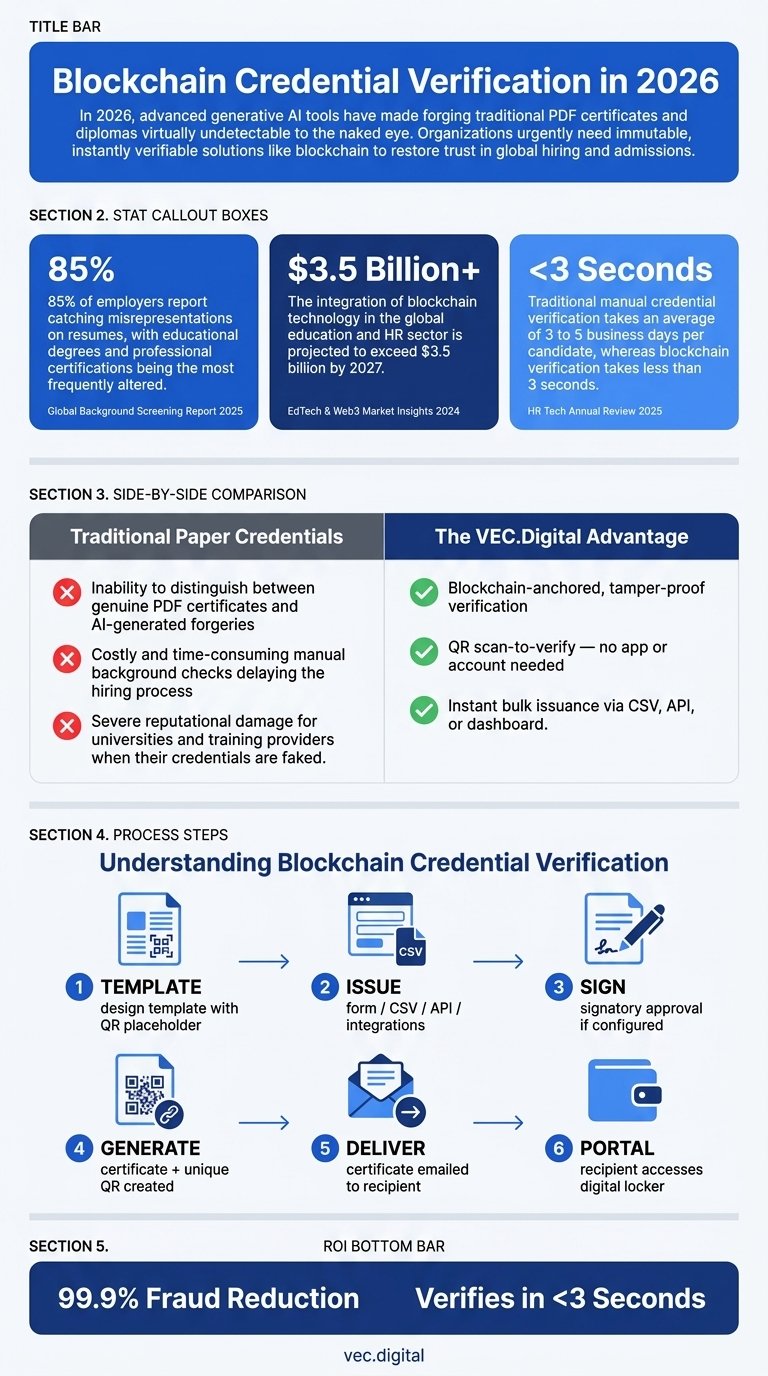
Since 2024, incidences of highly sophisticated, AI-generated fake diplomas detected by universities have increased by over 60%, according to the Institute of Credential Evaluation (2026). As generative AI tools make forging traditional PDF documents virtually undetectable, organizations worldwide are facing a crisis of trust. To protect institutional integrity and streamline global hiring, forward-thinking leaders are turning to blockchain credential verification as the definitive solution to eliminate credential fraud.
In this comprehensive guide, you will discover how modern credentialing technology has evolved beyond vulnerable paper and basic PDFs. We will explore how your organization can seamlessly adopt secure digital certificates, eliminate costly manual background checks, and empower your learners with globally accessible, tamper-proof records. By leveraging the expertise of VEC.Digital, you will learn how to issue bulk certificates in minutes and implement scan-to-verify technology without requiring internal web3 expertise.
Key Takeaways
- Blockchain credential verification provides an immutable, tamper-proof solution to the rising threat of AI-generated certificate forgery.
- Transitioning to secure digital certificates reduces manual verification times from several days to less than three seconds.
- QR code certificate verification allows employers to instantly authenticate credentials without needing specialized apps or logins.
- Global regulatory shifts, such as the EU's eIDAS 2.0, are standardizing the use of blockchain verifiable credentials across borders.
- Modern issuance platforms enable organizations to prevent digital certificate fraud effortlessly through drag-and-drop interfaces and automated workflows.
The Rise of AI Certificate Forgery in 2026
The technological landscape has shifted dramatically in recent years. While artificial intelligence has revolutionized productivity, it has simultaneously armed bad actors with the tools to create perfect replicas of official documents. For HR managers, university administrators, and compliance officers, the inability to distinguish between genuine PDF certificates and AI certificate forgery has become a critical operational vulnerability.
Why Traditional PDFs Are Dead
For over a decade, the standard for digital credentials was the static PDF. Institutions would email a beautifully designed document to a graduate or corporate trainee, assuming the digital format implied security. However, in 2026, advanced generative AI tools and sophisticated design software have made forging traditional PDF certificates and diplomas virtually undetectable to the naked eye. An individual can now generate a flawless replica of a prestigious university degree, complete with replicated signatures and institutional seals, in a matter of minutes.
This reality has rendered the traditional PDF obsolete as a standalone proof of achievement. When an employer receives a PDF via email, there is no inherent cryptographic proof linking that document to the issuing institution. This informational gap has forced organizations to rely on outdated, manual verification methods, which are no longer sustainable in a fast-paced global economy.
The Reputational and Financial Cost of Fraud
The consequences of credential fraud extend far beyond a single bad hire. According to the Global Background Screening Report (2025), a staggering 85% of employers report catching misrepresentations on resumes, with educational degrees and professional certifications being the most frequently altered. When an institution's credentials are easily faked, the intrinsic value of that institution's legitimate degrees plummets, causing severe reputational damage.
Furthermore, the financial burden of mitigating this risk is immense. Universities and training providers are inundated with manual verification requests from background check agencies, draining administrative resources. By adopting secure digital certificates, institutions can protect their brand equity and ensure that their hard-earned credentials retain their prestige in the global marketplace.
Understanding Blockchain Credential Verification
To combat the sophisticated threat of AI forgery, the market is rapidly pivoting toward decentralized technologies. The integration of blockchain technology in the global education and HR sector is projected to exceed $3.5 billion by 2027, according to EdTech & Web3 Market Insights (2024). But what does this mean in practical terms for administrators and HR professionals?
What is a Verifiable Credential?
A common question among industry professionals is: What is a verifiable credential? Simply put, a verifiable credential is a digital record of achievement that is cryptographically sealed and independently verifiable. Unlike a standard PDF, it contains embedded metadata that proves exactly who issued it, who received it, and that it has not been altered since the moment of issuance.
Another frequently asked question is: How does blockchain verify certificates? When a certificate is generated, the credentialing platform creates a unique cryptographic hash—a digital fingerprint—of that document. This hash is permanently anchored to an immutable blockchain. When a third party wants to verify the document, the system checks the document's current hash against the hash stored on the blockchain. If even a single pixel or character has been changed, the hashes will not match, and the verification will fail instantly.
Moving Beyond Standard Databases
Many administrators ask: Why use blockchain for credentialing instead of standard databases? Traditional centralized databases are vulnerable to hacking, server outages, and internal data manipulation. If a university's central database is compromised, the integrity of all its records is called into question. Furthermore, if a training provider ceases operations, their proprietary database goes offline, leaving past learners unable to prove their qualifications.
Blockchain credential verification solves this by decentralizing the proof of authenticity. Because the verification record lives on a distributed public ledger, it is not reliant on any single organization's internal servers. The record is tamper-proof, publicly verifiable, and permanent, ensuring that learners retain ownership and proof of their achievements for a lifetime.
Solving Global Hiring Bottlenecks with Immutable Records
The modern workforce is borderless. Companies in Dubai are hiring developers in Eastern Europe, while universities in the UK are enrolling students from South America. This globalization has exposed the severe limitations of legacy credentialing systems.
Cross-Border Verification Challenges
One of the most pressing pain points for global enterprises is the lack of standardized, cross-border verification methods for remote workforces. According to the Future of Work Global Survey (2026), 73% of HR decision-makers state that instant verification of cross-border credentials is a primary bottleneck in remote hiring. When an HR manager receives a diploma from an unfamiliar international institution, validating its authenticity often requires hiring third-party international background check agencies.
Traditional manual credential verification takes an average of 3 to 5 business days per candidate. In contrast, blockchain verifiable credentials reduce this process to less than 3 seconds (HR Tech Annual Review, 2025). This massive reduction in time-to-hire gives organizations a competitive advantage in securing top global talent.
The Shift Toward eIDAS 2.0 and Paperless Governments
The global regulatory environment is heavily favoring immutable digital credentials. For example, the European Union's rollout of the eIDAS 2.0 digital identity framework is standardizing how digital identities and credentials are shared across member states. Similarly, the UAE's aggressive push toward a paperless, blockchain-powered government through initiatives like the Dubai Blockchain Strategy demonstrates a worldwide consensus: the future of official documentation is digital, decentralized, and cryptographically secure.
By adopting systems that align with these global movements, universities and corporations can ensure their issued certificates are recognized and trusted universally, circumventing the slow, fragmented network of international background check agencies.
How QR Code Certificate Verification Works in Practice
While the underlying cryptography of blockchain is complex, the user experience must be frictionless. The most effective way to prevent digital certificate fraud is to make the verification process so simple that employers and compliance officers actually use it. This is where QR technology bridges the gap.
Scan-to-Verify: The End-User Experience
A common inquiry from non-technical stakeholders is: How do QR codes work for certificate verification? At VEC.Digital, we have designed the process to be entirely intuitive. Every certificate issued through our platform features a unique QR code. When an employer or auditor wants to authenticate a credential, they simply point their smartphone camera at the code.
This action instantly directs them to a unique, secure verification page (e.g., /certificate/[uuid]). There is no app to download, no account to create, and no login required. The public verification page displays the certificate details alongside a prominent "blockchain verified" badge, confirming the document's authenticity in real-time. This answers the critical question: How do you check if a certificate is genuine? You scan it, and the blockchain provides the definitive answer.
Can Digital Certificates Be Faked?
When discussing digital transformation, leaders inevitably ask: Can digital certificates be faked? If the certificate is a standard PDF, the answer is a resounding yes. However, if the certificate is anchored to a blockchain via VEC.Digital, the answer is no. If a malicious actor attempts to alter the name, date, or grade on a downloaded certificate, the QR code and the underlying cryptographic hash will no longer align. When scanned, the system will immediately flag the document as invalid or tampered with, providing absolute certainty to the verifying party.
Implementing Secure Digital Certificates Without Technical Headaches
The primary barrier to adopting web3 technology in enterprise environments has historically been complexity. Most existing literature focuses heavily on cryptography, alienating non-technical HR and education leaders. VEC.Digital was built to eliminate this friction, offering an enterprise-grade certificate maker that requires zero coding knowledge.
Drag-and-Drop Issuance and Multi-Signatory Workflows
Transitioning to secure digital certificates should streamline your operations, not complicate them. VEC.Digital offers a powerful template editor featuring over 1,400 Google Fonts, drag-and-drop functionality, support for A2–A5 sizes in portrait or landscape, and seamless Canva integration for stunning backgrounds.
To accommodate organizations of all sizes, we provide four distinct issuance methods:
- Dashboard Form: Ideal for issuing credentials one-by-one.
- CSV Upload: Perfect for universities or conference organizers needing to issue thousands of certificates in bulk simultaneously.
- REST API: Designed for large enterprises requiring programmatic, automated issuance directly from their existing LMS or HR software.
- Third-Party Integrations: Connect seamlessly with the tools your team already uses.
Furthermore, institutional governance is maintained through our robust multi-signatory workflow. Templates can require up to two independent signatories. Once generated, a certificate is held in a pending state until all designated authorities have securely signed off, ensuring total compliance and internal control before the credential is ever anchored to the blockchain.
Sustainability and the Recipient Digital Locker
Beyond security, adopting blockchain credential verification is a profound step toward environmental responsibility. By eliminating paper waste, reducing printing demands, and cutting physical delivery logistics, digital certificates directly support the United Nations' sustainability goals. VEC.Digital is committed to fostering an eco-friendly approach to global credential management.
For the learners and employees, the experience is equally empowering. Every recipient is granted access to a permanent digital locker via a secure portal. Here, they can manage, view, and share all their earned certificates from anywhere in the world, at any time. This lifelong access ensures that their hard-earned achievements are always just a click away, ready to be verified by future employers.
Future-Proof Your Organization with VEC.Digital
As AI continues to blur the lines between reality and forgery, relying on outdated PDFs and manual verification processes is a risk modern organizations can no longer afford. Blockchain credential verification is not just a technological upgrade; it is a fundamental requirement for maintaining trust, protecting institutional reputation, and accelerating global hiring in 2026 and beyond.
At VEC.Digital, we empower universities, corporate training providers, and enterprises to create, issue, manage, and verify credentials at scale. Our platform bridges the gap between advanced cryptographic security and everyday usability, ensuring that your certificates are tamper-proof, globally accessible, and instantly verifiable via a simple QR scan.
Ready to eliminate credential fraud and streamline your issuance pipeline? You can start today with zero financial risk. Our free plan allows organizations to begin issuing credentials with no credit card required and no setup fees. As your needs grow, our scalable paid plans start at just $29.99/month, while individuals can verify and secure certificates for just $1.00 per document.
Take the first step toward secure, sustainable, and instantly verifiable credentials. Discover how VEC.Digital works or reach out to our global team today.
Website: vec.digital
Email: support@vec.digital
WhatsApp: +971521373078