
Blockchain Credential Verification in 2026: Ending Certificate Fraud
Published on May 14, 2026

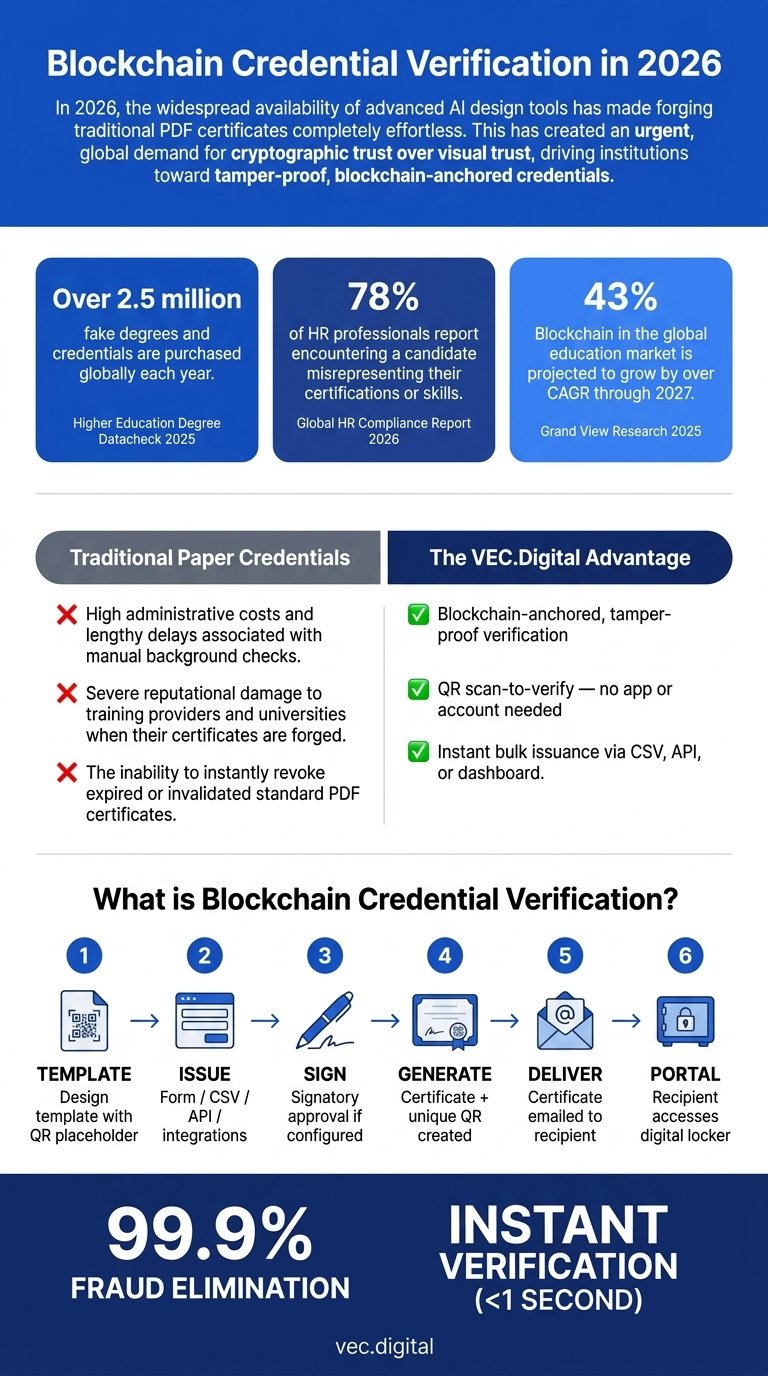
Over 2.5 million fake degrees and credentials are purchased globally each year, according to the Higher Education Degree Datacheck (2025), costing institutions millions in reputational damage and compliance failures. With advanced AI design tools making traditional PDFs effortless to forge, blockchain credential verification has become the essential defense against this escalating global crisis. Transitioning from visual trust to cryptographic trust is no longer optional; it is a mandatory requirement for academic institutions and global enterprises that need to issue trustworthy, verifiable digital credentials efficiently.
In this comprehensive guide, we leverage our team's deep expertise in blockchain-powered digital credentialing to show your organization exactly how to transition away from vulnerable legacy systems. You will learn how to eliminate credential fraud entirely, drastically reduce manual background check delays, and issue globally accessible, tamper-proof certificates that empower your learners and protect your institutional integrity.
Key Takeaways
- Cryptographic trust has replaced visual trust, making blockchain verification the only reliable defense against AI-driven document forgery.
- Implementing QR code certificate verification reduces manual HR background check processing times by up to 80%.
- Tamper-proof blockchain anchoring allows universities and training providers to instantly issue, manage, and revoke credentials globally.
- Modern automated issuance pipelines enable organizations to generate thousands of secure certificates via CSV or REST API in minutes.
- Digital credentialing supports UN sustainability goals by eliminating paper waste and reducing the carbon footprint of physical certificate delivery.
The Escalating Crisis of Digital Certificate Fraud in 2026
The landscape of professional and academic qualifications has fundamentally shifted. In previous decades, a physical stamp or a localized digital signature was enough to prove authenticity. Today, the sheer volume of global mobility and remote work has exposed the vulnerabilities of these legacy systems. As organizations scale their hiring and educational programs across borders, the reliance on easily manipulated document formats has created a massive security loophole.
This vulnerability is not just theoretical; it has quantifiable business impacts. The Global HR Compliance Report (2026) reveals that a staggering 78% of HR professionals report encountering a candidate misrepresenting their certifications or skills. This widespread misrepresentation forces organizations to spend excessive time and resources verifying claims, slowing down operations and increasing administrative overhead.
Can PDF Certificates Be Faked by AI?
One of the most pressing questions from administrators today is whether standard digital documents are still safe. The definitive answer is no. In 2026, the widespread availability of advanced AI design tools has made forging traditional PDF certificates completely effortless. Bad actors no longer need sophisticated graphic design skills to replicate watermarks, signatures, or institutional logos. This technological shift has caused a total loss of trust in standard digital documents, driving the urgent need for blockchain credential verification.
The Cost of Manual Verification
Beyond the risk of fraud, the operational cost of manual verification is staggering. High administrative costs and lengthy delays are the hallmark of legacy background checks. HR teams and university registrars spend countless hours calling institutions, emailing verification departments, and waiting days or weeks for confirmation. According to HR Tech Insights (2026), automated, verifiable credentials reduce background check processing times by up to 80%, highlighting the massive inefficiency of the status quo.
Reputational Damage and the Loss of Institutional Trust
For training providers, universities, and certification bodies, the primary asset is trust. When forged certificates bearing an institution's name enter the job market, it causes severe reputational damage. Employers begin to doubt the validity of all candidates from that institution, ultimately harming legitimate graduates. Protecting the brand requires a system where authenticity can be proven instantly and undeniably, safeguarding the value of the education provided.
What is Blockchain Credential Verification?
To understand how to solve this crisis, we must look at the underlying technology. Blockchain credential verification is the process of anchoring the unique data of a certificate to an immutable, decentralized ledger. Rather than relying on the visual appearance of a document, this method relies on cryptographic mathematics. Once a credential is anchored, its data cannot be altered, backdated, or manipulated without breaking the cryptographic seal.
This approach completely shifts the paradigm from visual trust to cryptographic trust. It ensures that the credential presented by a candidate is exactly the same as the credential issued by the authority, providing absolute certainty to employers and compliance officers.
Are Digital Certificates Tamper-Proof?
When anchored to a blockchain, digital certificates are entirely tamper-proof. Every VEC.Digital certificate is anchored on an immutable blockchain, generating a unique cryptographic hash. If a bad actor attempts to change even a single pixel or character—such as altering a grade or extending an expiration date—the hash changes, instantly invalidating the document. This mechanism guarantees the integrity of the credential over its entire lifecycle.
How Do You Verify a Blockchain Certificate?
The verification process has been streamlined to eliminate friction. You do not need technical knowledge, specialized software, or a cryptocurrency wallet to verify a credential. Every certificate issued through our platform features a unique QR code linking directly to a secure verification page (e.g., /certificate/[uuid]). Anyone can scan the QR code with a standard smartphone camera to instantly view the "blockchain verified" badge and confirm the document's authenticity. No app, no account, and no login are required to verify.
Why Cryptography Outperforms Traditional PDFs
A major pain point with legacy PDF certificates is the inability to instantly revoke expired or invalidated documents. Once a PDF is downloaded and emailed, the issuing institution loses all control over it. Blockchain-anchored credentials solve this by maintaining a live connection to the source of truth. If a certification is revoked due to compliance failures or expiration, the public verification page is instantly updated, ensuring that anyone who scans the QR code sees the current, accurate status.
Why Global Institutions Are Adopting Blockchain Academic Credentials
The transition to decentralized verification is accelerating globally. Grand View Research (2025) projects that blockchain in the global education market will grow by over 43% CAGR through 2027. This explosive growth is driven by the practical benefits that cryptographic trust delivers to administrators, learners, and employers across the globe.
Institutions are realizing that modernizing their credentialing infrastructure is a strategic advantage. By adopting blockchain credential verification, they not only protect their reputation but also provide a superior experience for their alumni, who can now share verifiable proof of their achievements instantly on platforms like LinkedIn.
Securing the Higher Education Landscape
Universities often ask: what is the best way to prevent academic certificate fraud? The answer lies in removing the opportunity for forgery entirely. By issuing blockchain academic credentials, universities empower their students with portable, lifelong records of their achievements. This protects the institution's prestige and ensures that their graduates stand out in a competitive global job market with credentials that employers can trust implicitly.
Streamlining Corporate Hiring and HR Compliance
How do verifiable credentials work for employers? For HR managers and corporate training directors, verifiable credentials transform the hiring and compliance landscape. Instead of initiating costly, multi-week background checks, an employer simply scans a QR code or clicks a link to verify a candidate's qualifications instantly. This efficiency is why Gartner (2026) reports that by 2028, nearly 90% of global enterprises plan to adopt verifiable digital credential systems.
Navigating Global Data Privacy Mandates
Operating on a global scale requires strict adherence to data privacy regulations. With stringent frameworks like GDPR in Europe and evolving digital mandates in the UAE and APAC regions, global organizations are rapidly adopting decentralized, cryptographic verification methods. This technology allows employers to verify candidate credentials across borders instantly without storing excessive, non-compliant personal data. For more information on global data standards, the W3C Verifiable Credentials Data Model provides foundational insights into how decentralized identifiers protect user privacy.
A Step-By-Step Guide to Transitioning Your Issuance Pipeline
Despite the clear benefits, a significant content gap exists in the industry: a lack of practical, step-by-step guides showing non-technical HR and education leaders exactly how to transition their legacy PDF issuance pipelines to secure, automated workflows. At VEC.Digital, we have engineered our platform to make this transition seamless, requiring zero blockchain coding experience.
By following these structured steps, your organization can modernize its credentialing process in a matter of days, completely eliminating the manual bottlenecks of the past.
Step 1: Designing Secure Digital Certificates
The first step is translating your visual brand into a secure digital format. Our intuitive template editor is designed for administrators, not graphic designers. You can choose from over 1,400 Google Fonts, utilize a simple drag-and-drop interface, and select from standard A2 to A5 sizes in both portrait and landscape orientations. Furthermore, our Canva integration allows you to seamlessly import custom background designs, ensuring your secure digital certificates perfectly match your institutional branding.
Step 2: Implementing a Multi-Signatory Workflow
Quality assurance is critical before any credential is anchored to the blockchain. We provide a robust multi-signatory workflow that accommodates complex institutional hierarchies. You can configure up to 2 signatories per template. Crucially, the certificate is held in a pending state until ALL signatories have independently reviewed and signed off. This ensures that no credential is ever issued prematurely or without proper authorization.
Step 3: Automating Bulk Issuance
Efficiency at scale is the true power of an automated issuance pipeline. We offer 4 distinct issuance methods to fit your operational needs:
- Dashboard form: Ideal for one-by-one issuance for ad-hoc awards or corrections.
- CSV upload: Perfect for bulk issuance, allowing you to generate thousands of certificates for a graduating class or conference attendees in minutes.
- REST API: Enables programmatic issuance, integrating directly with your existing LMS or HR software.
- Third-party integrations: Connect your credentialing engine seamlessly to the tools your organization already uses.
Step 4: Empowering Recipients with Digital Lockers
The final step is delivering the credential to the learner. Instead of sending a static email attachment that can be lost or deleted, recipients get permanent access to all their certificates via a secure portal—their personal digital locker. This portal is accessible anywhere, anytime, allowing learners to share their achievements securely. Furthermore, this digital-first approach directly supports UN sustainability goals. Digital certificates eliminate paper waste, reduce printing and physical delivery costs, and contribute to eco-friendly credential management globally.
The Future of Verifiable Credentials in 2026 and Beyond
As we look toward the future, the integration of blockchain credential verification into everyday administrative processes will become as standard as email. The technological infrastructure is now mature, user-friendly, and highly accessible, removing the barriers to entry that previously hindered widespread adoption. Organizations that embrace this shift now will position themselves as leaders in digital trust and operational efficiency.
The conversation is no longer about the underlying cryptography; it is about the practical business value of instant verification, reduced fraud, and enhanced learner experiences.
Embracing QR Code Certificate Verification
The universal adoption of smartphone technology has made QR code certificate verification the gold standard for credential sharing. Whether at a global industry conference, during a virtual job interview, or embedded within a digital resume, a simple QR scan bridges the gap between a candidate's claim and verified reality. This frictionless experience is what modern employers demand and what innovative institutions provide.
Achieving UN Sustainability Goals Through Paperless Operations
Beyond security and efficiency, the environmental impact of traditional credentialing cannot be ignored. The global education and corporate training sectors consume vast amounts of paper, ink, and carbon-heavy logistics to print and mail physical certificates. By transitioning to a fully digital, blockchain-anchored system, your organization takes a measurable step toward sustainability, aligning with global eco-friendly initiatives while simultaneously cutting operational costs.
Secure Your Organization's Future with VEC.Digital
Credential fraud is a complex, global problem, but the solution is clear, accessible, and ready to deploy. By shifting from vulnerable visual documents to immutable cryptographic trust, your organization can eliminate fraud, drastically reduce administrative overhead, and empower your learners with lifelong, globally verifiable credentials.
At VEC.Digital, we have built a platform that makes this transition effortless. Our blockchain-powered digital certificate platform enables organizations to create, issue, manage, and verify credentials at scale. Best of all, your organization can start completely free—with no credit card required and no setup fees. Our paid plans for organizations start at just $29.99/month, while individuals pay only $1.00 per certificate.
Ready to modernize your issuance pipeline and protect your institutional reputation? Explore how it works, or verify a sample credential on our verification page today.
Contact our team to get started:
Website: vec.digital
Email: support@vec.digital
WhatsApp: +971521373078