
Blockchain Credential Verification in 2026: The Ultimate Defense Against AI Certificate Fraud
Published on April 12, 2026

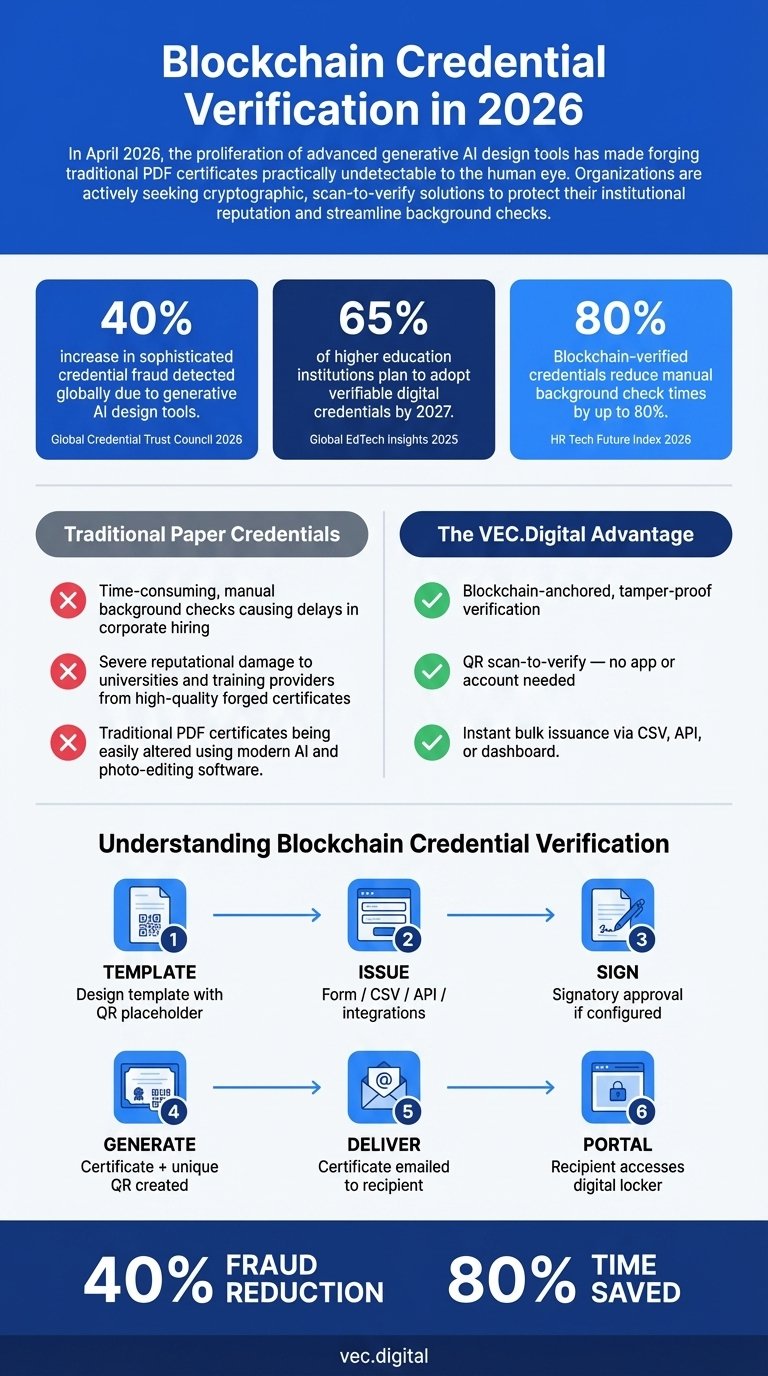
A staggering 40% increase in sophisticated credential fraud detected globally due to generative AI design tools has left institutions scrambling to secure their reputations in 2026, according to the Global Credential Trust Council. As high-quality forged documents become virtually indistinguishable from legitimate records, traditional PDF certificates are no longer sufficient to prove academic or professional achievement. Implementing robust blockchain credential verification is now the ultimate defense for global universities and corporate HR teams facing this unprecedented crisis of trust.
In this comprehensive guide, our team at VEC.Digital—experts in blockchain-powered digital credentialing—will demystify the technology behind immutable academic and professional records. By reading this article, you will learn how to eliminate certificate fraud entirely, issue bulk credentials across global borders in minutes, and empower learners with globally accessible, instantly verifiable digital certificates. We will bridge the gap between complex cryptography and practical daily use, showing you exactly how seamless secure credential management can be for both issuers and verifiers.
Key Takeaways
- Blockchain credential verification guarantees that digital certificates are tamper-proof and instantly verifiable on a global scale.
- Advanced AI-generated certificate fraud is rendering traditional PDF documents obsolete, demanding immediate cryptographic security upgrades.
- Seamless QR code verification allows global employers to validate credentials instantly without logins, accounts, or specialized apps.
- Adopting verifiable digital credentials drastically reduces manual background check times and accelerates the international hiring process.
- Digital credentialing supports UN goals by promoting sustainable digital credentialing, eliminating paper waste, and reducing carbon footprints.
The Escalating Crisis of AI-Generated Certificate Fraud
How Generative AI Has Weaponized Document Forgery
For decades, educational institutions and corporate training providers relied on physical paper certificates, complete with embossed seals and wet signatures, to signify achievement. As the world digitized, these transitioned into standard PDF documents. However, the landscape of document security has shifted dramatically. In 2026, traditional PDF certificates are being easily altered using modern AI and photo-editing software. Generative AI design tools can now flawlessly replicate university seals, mimic authorized signatures, and alter graduation dates without leaving a trace visible to the human eye. This technological leap has effectively weaponized document forgery, making it accessible to anyone with an internet connection.
The statistics surrounding this issue are alarming. According to the Global Credential Trust Council (2026), there has been a "40% increase in sophisticated credential fraud detected globally due to generative AI design tools." This surge in fraudulent activity demonstrates that legacy digital formats are fundamentally broken when it comes to proving authenticity. Organizations can no longer rely on visual inspections to verify a candidate's qualifications. The need for a cryptographic, mathematically verifiable solution—specifically blockchain credential verification—has never been more urgent.
The Cost of Reputational Damage in Higher Education
When an individual secures employment or academic admission using a forged certificate bearing an institution's name, the consequences extend far beyond a single fraudulent transaction. There is severe reputational damage to universities and training providers from high-quality forged certificates. If employers discover that candidates claiming to hold degrees from a specific university lack the fundamental skills associated with that qualification, the intrinsic value of that institution's genuine degrees plummets. Alumni who worked tirelessly to earn their credentials find their achievements devalued in the global marketplace.
Protecting institutional integrity requires moving away from easily manipulated formats. By anchoring credentials to an immutable ledger, universities ensure that their brand remains synonymous with trust and excellence. When a certificate is cryptographically secured, the institution maintains absolute control over its issuance, and third parties can trust the credential without second-guessing its origin.
The Global Impact on Corporate Hiring and Background Checks
The proliferation of fake credentials is creating massive bottlenecks in the corporate world. According to the International Higher Education Security Report (2025), "Over 10 million fake degrees and professional certificates are currently circulating in the global job market." This staggering volume of fraudulent documents leads directly to time-consuming, manual background checks causing severe delays in corporate hiring. HR professionals are forced to spend weeks contacting university registrars across different time zones, paying exorbitant fees for primary source verification, and navigating complex international privacy laws.
With cross-border remote hiring at an all-time high in 2026, organizations face massive challenges verifying international credentials where traditional national databases are disconnected. A recruiter in London trying to verify a degree from a university in Singapore or a training provider in Dubai cannot rely on a single, unified database. This lack of standardized, easy-to-use methods for third-party employers to verify international qualifications underscores the vital necessity for a decentralized, globally accessible verification framework.
Understanding Blockchain Credential Verification
How Does Blockchain Verify a Certificate?
A common question among administrators is: How does blockchain verify a certificate? To understand this, it is essential to look past the complex technical architecture of nodes and ledgers and focus on the fundamental principle of cryptographic hashing. When a certificate is created using a platform like VEC.Digital, the system generates a unique mathematical fingerprint—known as a hash—based on the exact data within that certificate. This includes the recipient's name, the course details, the date of issuance, and the issuer's identity.
This unique hash is then permanently anchored to a decentralized blockchain. The blockchain acts as a public, immutable digital notary. When an employer or verification agency wants to check the certificate, the system recalculates the hash of the presented document and compares it to the hash stored on the blockchain. If the two hashes match perfectly, the certificate is definitively proven to be authentic and issued by the claimed organization. The beauty of blockchain credential verification is that the actual personal data is not stored publicly on the blockchain; only the mathematical proof of the document's existence and integrity is recorded, ensuring complete data privacy.
Can a Blockchain Certificate Be Faked?
Another frequently asked question is: Can a blockchain certificate be faked? The definitive answer is no. Because the verification relies on the exact mathematical composition of the original data, altering even a single pixel, a single letter in a name, or a single digit in a date will completely change the document's hash. If a fraudster attempts to use AI to alter a legitimate blockchain-anchored certificate and presents it to an employer, the verification scan will instantly fail.
The system will recognize that the hash of the altered document does not match the immutable record anchored on the blockchain. Furthermore, because blockchains are decentralized networks secured by advanced cryptography, it is computationally impossible for a bad actor to hack the blockchain itself to alter the original anchored record. This immutability provides absolute certainty to verifiers and complete peace of mind to issuers.
Moving Beyond Cryptography: The User Experience
Most existing industry literature focuses heavily on the complex technical architecture of blockchain, which often alienates non-technical decision-makers. At VEC.Digital, we believe in shifting the focus from the complex cryptography of the blockchain to the seamless user experience. HR managers, compliance officers, and university administrators do not need to understand how consensus algorithms work to benefit from them.
We bridge the informational gap by showing non-technical users how easy it is to issue and verify immutable credentials. From the verifier's perspective, they simply look for the "blockchain verified" badge on the public certificate verification page. The underlying technology operates invisibly, providing military-grade security wrapped in an intuitive, user-friendly interface. This focus on accessibility is what drives true global adoption of secure digital trust systems.
The Mechanics of Verifiable Digital Credentials
How Do Verifiable Digital Credentials Work?
When asking "How do verifiable digital credentials work?", it helps to view them as a digital ecosystem consisting of three primary actors: the issuer (e.g., a university or training provider), the holder (the student or employee), and the verifier (the employer or HR manager). The issuer creates the credential, cryptographically signs it to prove its origin, and anchors it to the blockchain. The holder receives the credential and stores it securely. When applying for a job, the holder presents the credential to the verifier.
The verifier then uses the cryptographic proofs embedded in the credential to instantly confirm that it was indeed issued by the claimed institution, that it was issued specifically to the holder presenting it, and that it has not been altered or revoked since issuance. This streamlined process is highly valued in the modern job market. In fact, a Future of Work Survey (2026) revealed that "72% of employers strongly prefer candidates who provide instantly verifiable digital credentials." By utilizing advanced digital credentialing platforms, organizations can meet this growing demand effortlessly.
Why Use QR Codes for Certificate Verification?
One of the most powerful tools in bridging the gap between complex technology and everyday usability is the Quick Response (QR) code. So, why use QR codes for certificate verification? The answer lies in universal accessibility and speed. In the VEC.Digital ecosystem, every single certificate is generated with a unique QR code linking directly to a secure, dedicated URL (formatted as /certificate/[uuid]).
This means that a recruiter reviewing a digital resume or a physical printed copy of the certificate can simply point their smartphone camera at the QR code. Within milliseconds, they are taken to a secure verification page displaying the authentic certificate data and the "blockchain verified" badge. There is no need to download a proprietary app, no requirement to create a verifier account, and no login necessary. This frictionless experience empowers anyone, anywhere in the world, to perform a background check instantly, effectively neutralizing fake certificate detection challenges.
Standardizing Global Trust Across Borders
The shift toward verifiable credentials is not happening in isolation; it is part of a massive global movement. Driven by forward-thinking governmental initiatives like Dubai's Paperless Strategy and the European Digital Identity Framework, there is a massive global push toward decentralized, immutable digital trust systems. These initiatives recognize that in a highly mobile, globalized workforce, relying on siloed, national databases is inefficient and prone to error.
By adopting standardized blockchain credential verification, institutions ensure their certificates are universally recognized and trusted. Whether a graduate is applying for a visa in the UAE, a corporate role in London, or an academic program in Tokyo, their VEC.Digital anchored credential speaks a universal language of cryptographic truth, completely bypassing the traditional friction of cross-border credential validation.
Best Methods for Certificate Fraud Prevention in 2026
What Are the Best Methods for Certificate Fraud Prevention?
When institutions ask, "What are the best methods for certificate fraud prevention?", the answer in 2026 is unequivocally the transition from static documents to dynamic, cryptographic assets. Relying on watermarks, complex background patterns, or holographic stickers on physical paper is obsolete in the face of advanced AI forgery. The best method is to remove the burden of proof from the visual appearance of the document and place it entirely on mathematical verification.
This means adopting a platform that automatically anchors every issued credential to a blockchain, provides a public verification portal, and allows issuers to instantly revoke credentials if necessary. Furthermore, true fraud prevention starts at the source: the issuance process itself. Ensuring that only authorized personnel can generate and sign certificates is a critical component of a holistic security strategy.
Implementing a Multi-Signatory Workflow
Internal fraud or accidental issuance can be just as damaging as external forgery. To combat this, VEC.Digital incorporates a robust multi-signatory workflow. Within our platform, organizations can mandate up to 2 signatories per certificate template. When a certificate is generated, it does not immediately go live. Instead, the certificate is held pending until ALL designated signatories have independently reviewed and signed off on the document.
This internal governance mechanism ensures that no single individual can unilaterally issue a credential, providing an essential layer of internal compliance and quality assurance. This feature is particularly crucial for higher education institutions and strict regulatory compliance managers who require absolute oversight over their credentialing pipelines.
Streamlining the Issuance Pipeline
While security is paramount, it must not come at the expense of operational efficiency. VEC.Digital has engineered an issuance pipeline that caters to organizations of all sizes, offering 4 distinct issuance methods to suit any operational requirement. For ad-hoc credentialing, administrators can use the intuitive dashboard form to issue certificates one-by-one. For large cohorts, such as graduating university classes or massive corporate training programs, the CSV upload feature allows for bulk issuance of thousands of certificates in minutes.
For organizations looking for deep automation, VEC offers a powerful REST API for programmatic issuance, as well as robust third-party integrations. This flexibility ensures that whether you are a boutique training provider or a massive multinational corporation, integrating blockchain credential verification into your existing workflows is seamless and highly efficient.
How Institutions Issue Blockchain Education Credentials
How Do Universities Issue Blockchain Credentials?
The transition to next-generation credentials is accelerating rapidly. According to Global EdTech Insights (2025), "65% of higher education institutions plan to adopt verifiable digital credentials by 2027." So, how do universities issue blockchain credentials? With VEC.Digital, the process is designed to be as creative as it is secure. Institutions do not have to sacrifice their branding or aesthetic standards to achieve cryptographic security.
Our platform features an advanced template editor equipped with over 1400 Google Fonts, an intuitive drag-and-drop interface, and support for multiple sizes (A2–A5) in both portrait and landscape orientations. Furthermore, seamless Canva integration allows design teams to import stunning, custom-branded backgrounds directly into the workflow. Once the design is perfected, the data is merged, the blockchain anchoring happens automatically in the background, and the secure credentials are dispatched to the learners.
Empowering Learners with a Digital Locker
The value of a credential is directly tied to its accessibility. Traditional paper certificates are frequently lost, damaged, or destroyed, requiring alumni to pay hefty fees and wait weeks for replacements. VEC.Digital solves this by providing every recipient with a secure digital locker. This portal gives learners permanent access to all their earned certificates in one centralized, globally accessible location.
Whether they are updating their LinkedIn profile, attaching proof of certification to a digital job application, or presenting a QR code during an in-person interview, learners can access their credentials anywhere, anytime. This empowerment not only enhances the student experience but also turns alumni into lifelong brand ambassadors for the issuing institution.
Sustainability and the Elimination of Paper Waste
Beyond security and efficiency, the shift to digital credentials represents a vital step toward global environmental responsibility. Traditional credentialing is incredibly resource-intensive, requiring specialized paper, chemical inks, plastic protective sleeves, and carbon-heavy global shipping networks. By transitioning to VEC.Digital, organizations actively support the UN sustainability goals.
Digital certificates completely eliminate paper waste, drastically reduce printing and physical delivery costs, and contribute to an eco-friendly credential management ecosystem. For modern organizations, demonstrating a commitment to sustainability is no longer optional; it is a core expectation of stakeholders, students, and corporate partners alike. Blockchain credential verification allows you to secure your legacy while protecting the planet.
The Future of Global HR and Automated Background Checks
Accelerating the Hiring Process
The ultimate beneficiary of verifiable credentials is the global labor market. The traditional background check process is notoriously slow, often taking weeks to complete and risking the loss of top-tier talent to faster-moving competitors. However, the paradigm is shifting. According to the HR Tech Future Index (2026), "Blockchain-verified credentials reduce manual background check times by up to 80%."
By leveraging QR code certificate verification, HR managers can instantly validate a candidate's entire educational and professional history during the initial interview phase. This unprecedented speed reduces time-to-hire, lowers administrative overhead, and allows recruitment teams to focus on evaluating a candidate's cultural fit and soft skills rather than acting as document investigators.
Empowering the Modern Workforce
As the concept of lifelong learning becomes the standard, professionals are continually acquiring micro-credentials, attending specialized corporate training, and updating their skill sets. A unified, blockchain-anchored digital ecosystem ensures that every achievement, no matter how granular, is securely recorded and instantly provable. This fosters a more dynamic, transparent, and meritocratic global workforce where skills can be verified without friction, enabling true talent mobility.
Secure Your Organization's Legacy with VEC.Digital
The threat of AI-generated certificate fraud is real, growing, and increasingly sophisticated. In 2026, relying on visual verification of static documents is a risk no reputable organization can afford to take. By adopting blockchain credential verification, you not only protect your institution's hard-earned reputation but also provide unparalleled value to your learners and the global employers who seek to hire them.
VEC.Digital is the premier solution for effortless, trustworthy digital credential issuance. We have engineered a platform that combines military-grade cryptographic security with an intuitive, user-friendly experience. Whether you need to issue a single certificate or automate the credentialing for thousands of global learners, our tailored solutions provide the infrastructure you need to succeed.
Transform your credentialing process today. Organizations can start completely free—with no credit card required and no setup fees—and begin issuing secure certificates in minutes. For growing institutions, our paid plans start at just $29.99/month, while individuals pay a simple, flat rate of $1.00 per certificate. Secure your legacy, eliminate fraud, and embrace the future of digital trust.
Ready to eliminate certificate fraud and streamline your issuance? Contact us today:
Website: vec.digital
Email: support@vec.digital
WhatsApp: +971521373078