
Boost EdTech Course Completions With a Digital Certificate Maker
Published on June 3, 2026

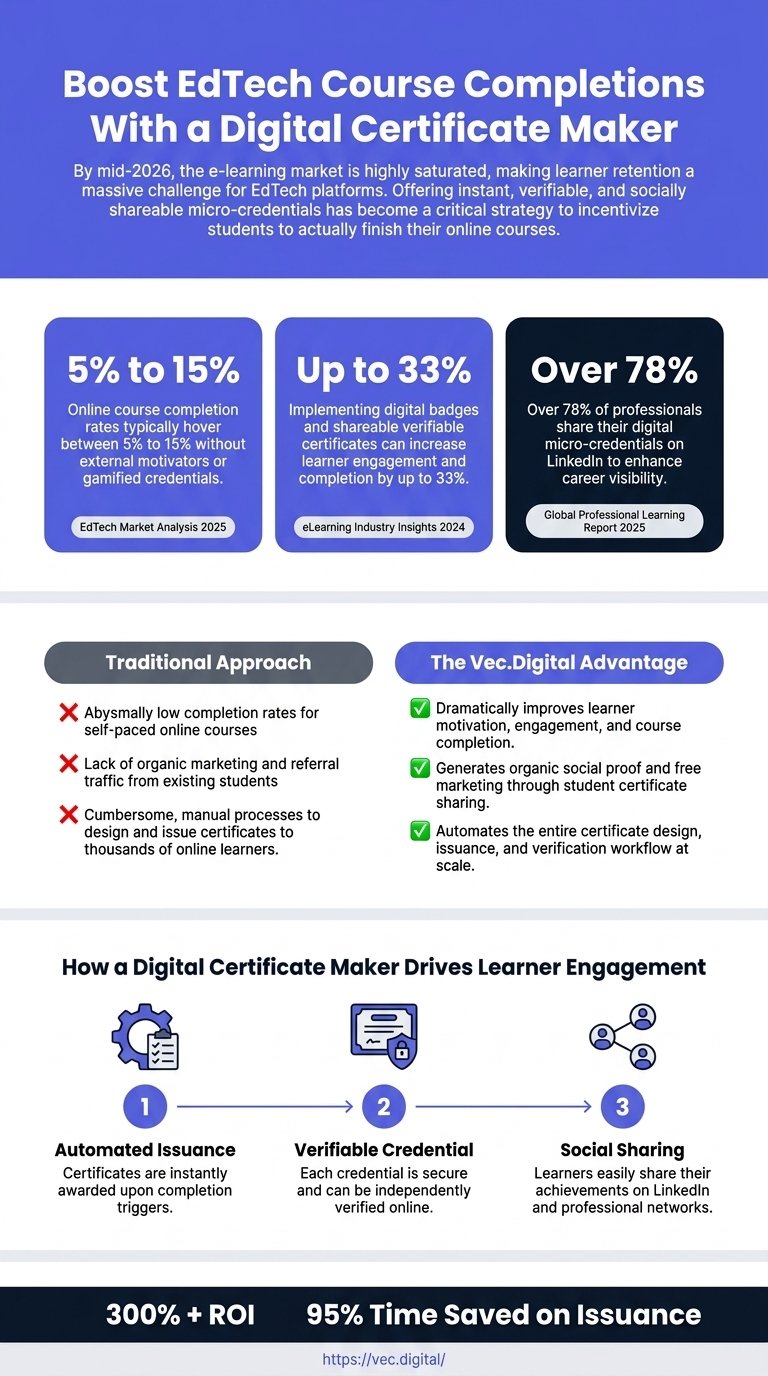
Online course completion rates typically hover between a staggering 5% to 15% without external motivators or gamified credentials. To combat this massive learner drop-off, forward-thinking e-learning platforms are leveraging a modern digital certificate maker to transform static achievements into verifiable, shareable assets. Bridging the gap between continuous online learning and corporate employability requires more than just excellent curriculum design; it demands robust, instantaneous credentialing.
In this comprehensive guide, our technology experts at Vec.Digital explore how implementing automated, secure certification systems can dramatically lower student churn and drive organic referral traffic. You will learn how to integrate QR verification systems to authenticate achievements, discover strategies to turn learner milestones into powerful marketing engines, and understand the global shift toward verifiable micro-credentials.
Key Takeaways
- Implementing a **digital certificate maker** can increase course completion rates by up to 33%.
- Creating **QR code certificates** provides instant, foolproof verification for employers worldwide.
- Sharing **verifiable digital credentials** on professional networks generates organic referral traffic for EdTech platforms.
- Automating the issuance process with a **bulk certificate generator** saves significant administrative time and reduces costs.
- Transitioning to paperless systems supports global sustainability goals while meeting the rising demand for **EdTech digital badges**.
The Hidden Crisis in EdTech: Why Learners Abandon Online Courses
As global venture capital funding in the educational technology sector normalizes in 2026, platforms worldwide are under immense pressure to demonstrate tangible ROI, lower student churn, and deliver measurable learning outcomes. However, a persistent challenge plagues the industry: abysmally low completion rates for self-paced online courses. When learners are isolated behind screens without the social pressure of a physical classroom, their initial enthusiasm often wanes.
According to the EdTech Market Analysis (2025), online course completion rates typically hover between 5% to 15% without external motivators or gamified credentials. This drop-off is not necessarily a reflection of poor content quality, but rather a disconnect in the psychological reward system. Students invest hours of their time, yet frequently feel they have nothing tangible to show for their efforts at the end of the journey.
To solve this, leading institutions are turning to a robust digital certificate maker to provide immediate, tangible rewards. By offering a professionally designed, globally recognized credential the moment a final module is completed, platforms tap into the intrinsic human desire for recognition and achievement.
Analyzing the Drop-Off Rates
The journey of an online learner is fraught with distractions. Unlike traditional university settings where degree progression is heavily monitored, e-learning requires immense self-discipline. When students realize that completing a rigorous technical course will only result in a generic, easily forgeable PDF—or worse, an email confirmation—their motivation plummets. They lack the verifiable proof needed to showcase their new skills to prospective employers.
This lack of authentic recognition directly fuels the abandonment crisis. In highly competitive job markets across Asia, Europe, and North America, professionals are seeking courses that offer immediate employability boosts. If an EdTech platform cannot provide a secure, authenticated record of achievement, learners will migrate to platforms that can.
The Disconnect Between Effort and Recognition
Another significant pain point is students losing static PDF certificates or being unable to prove the authenticity of their course completion. When a learner downloads a standard PDF, it sits idly on a hard drive. If an employer asks for proof of the skill, the student must email the file, and the employer has no reliable way to verify its legitimacy without engaging in a lengthy manual background check.
This friction devalues the online course itself. By integrating advanced credentialing systems, platforms bridge the gap between academic effort and professional recognition, ensuring that every hour a student studies translates into a secure, verifiable asset that holds weight in the global corporate arena.
How a Digital Certificate Maker Drives Learner Engagement
Transitioning from static documents to dynamic, interactive awards fundamentally changes how students interact with course material. A modern digital certificate maker is not just a design tool; it is a vital component of the learner retention strategy. When students know that a highly secure, beautifully designed credential awaits them, they are significantly more likely to push through difficult course modules.
The data supports this behavioral shift. Research from eLearning Industry Insights (2024) reveals that implementing digital badges and shareable verifiable certificates can increase learner engagement and completion by up to 33%. This remarkable increase demonstrates that when the end goal is a verifiable asset that enhances a professional portfolio, the perceived value of the course skyrockets.
Furthermore, these systems allow educators to implement milestone-based rewards. Instead of waiting months for a final diploma, students can earn micro-credentials for completing specific modules, creating a continuous loop of positive reinforcement.
Transforming Milestones into EdTech Digital Badges
The concept of gamification is well-documented in educational psychology. By breaking down extensive curriculums into manageable phases and rewarding each phase with EdTech digital badges, platforms maintain high levels of student motivation. These badges act as digital stepping stones.
With an intuitive platform, organizations can easily design these badges to align perfectly with their brand identity. Using drag-and-drop interfaces, custom dynamic fields, and over 1,400 Google Fonts, course creators can generate hundreds of unique templates that automatically populate with the learner's specific achievements, ensuring that the visual quality of the credential matches the rigor of the education provided.
Solving the Administrative Bottleneck
Beyond student engagement, there is a massive operational benefit for the institutions themselves. One of the most prevalent pain points for event organizers and online course creators is the cumbersome, manual process required to design and issue certificates to thousands of online learners. Manually typing names, exporting PDFs, and sending individual emails is an unsustainable administrative nightmare.
By utilizing a bulk certificate generator, platforms can automate this entire sequence. Whether through a simple CSV upload or a direct API integration with a Learning Management System (LMS), thousands of credentials can be generated and distributed in seconds. Furthermore, the Green Education Initiative (2025) reports that transitioning to paperless digital certificates saves educational organizations an average of $3.50 per issued credential by eliminating printing, physical signatures, and global postal logistics.
Turning Verifiable Digital Credentials Into a Marketing Engine
A critical content gap in the e-learning industry is the misconception that certificates are purely an administrative task. In reality, a strategically deployed digital certificate maker serves as an active marketing and retention engine. When students share their achievements online, they inadvertently become brand ambassadors for the educational platform.
Most existing guides focus heavily on the visual design of certificates but completely miss the strategic business value. There is a profound lack of understanding regarding how dedicated verification pages and QR codes actually drive organic referral traffic. When a credential is built correctly, it does not just sit in a digital wallet; it actively funnels prospective new students back to the course enrollment page.
By treating verifiable digital credentials as marketing assets, EdTech founders can significantly lower their Customer Acquisition Cost (CAC) while simultaneously increasing the lifetime value of their existing student base.
The Power of Social Sharing on Professional Networks
Today's professionals live on networks like LinkedIn, where visibility directly correlates with career advancement. According to the Global Professional Learning Report (2025), over 78% of professionals share their digital micro-credentials on LinkedIn to enhance career visibility. Every time a student clicks "Share to LinkedIn," they broadcast the EdTech platform's brand to their entire professional network.
This creates a powerful network effect. Peers see the credential, recognize the skill, and click through to see where the certification was earned. Because the credential is hosted on a dedicated, public verification page, the viewer is immediately introduced to the issuing organization's branding, course offerings, and enrollment options. It is a highly targeted, zero-cost advertisement driven entirely by student success.
Creating Online Certificates with QR Codes for Instant Proof
To maximize this marketing effect and ensure absolute trust, platforms must create online certificates with QR code technology. A QR code bridges the physical and digital worlds. Whether the credential is viewed on a screen or printed for a physical portfolio, anyone—such as a hiring manager or an auditor—can instantly scan the code using their smartphone camera.
This scan routes the verifier to a secure, dynamically generated webpage containing the issuer's details, the recipient's name, the date of completion, and signatory approvals. This foolproof verification mechanism removes any doubt about the credential's authenticity, building immense trust not only in the student's abilities but in the rigorous standards of the EdTech platform itself.
Answering the Global Demand for Modern Micro-Credentials
The landscape of global education is shifting rapidly. Traditional four-year degrees are no longer the sole pathway to career success. Instead, the market is embracing continuous, lifelong learning powered by specialized, short-term courses. This evolution requires an equally modern approach to credentialing, one that is agile, secure, and globally recognized.
The HolonIQ EdTech Trends (2026) report highlights that the global demand for short-course micro-credentials has grown by 40% year-over-year in the continuing education sector. As Asian and European markets rapidly adopt verifiable micro-credentials to bridge the gap between continuous online learning and corporate employability, platforms that fail to offer secure digital proofs will be left behind.
To meet this demand, organizations must deploy a digital certificate maker that goes beyond mere aesthetics. The underlying technology must be resilient, capable of handling high-volume issuance, and fortified with cryptographic security to prevent fraud.
The Global Shift Toward Short-Course Learning
In the fast-paced technology and business sectors, skills become obsolete rapidly. Professionals are constantly upskilling through online bootcamps, corporate L&D programs, and specialized masterclasses. These short-course formats require immediate credentialing. A student completing a weekend data science bootcamp needs their credential by Monday morning to present to their employer.
Automated systems facilitate this instant gratification. By removing the manual delays associated with traditional credentialing, EdTech platforms provide a seamless, modern user experience that aligns with the expectations of today's digital-native workforce. For a broader perspective on the evolution of educational technology, resources like Wikipedia's overview of Educational Technology offer valuable historical context.
Why Blockchain Certificate Verification is the Gold Standard
For high-stakes credentials—such as medical compliance training, financial certifications, or university diplomas—standard digital verification may not be enough. This is where blockchain certificate verification becomes essential. By anchoring issued certificates to an immutable, publicly verifiable blockchain, organizations render credential fraud mathematically impossible.
When stored on the blockchain, the public verification page prominently displays a "blockchain verified" badge. This provides unparalleled security, assuring global employers that the record has not been tampered with since its issuance. It represents the pinnacle of digital trust, giving institutions the power to issue with confidence and employers the certainty to hire without doubt. Industry analysts at Gartner frequently highlight blockchain as a transformative technology for securing digital identities and records.
Frequently Asked Questions About E-Learning Certification
As educational institutions and corporate training departments transition to modern credentialing systems, several common questions arise regarding implementation, security, and overall business impact.
What is the best digital certificate maker for online courses?
The ideal solution for an online course is a platform that combines intuitive design capabilities with robust backend security. The best digital certificate maker will offer a drag-and-drop editor, hundreds of professional templates, custom dynamic fields, and most importantly, automated issuance features. It should allow organizations to retain 100% of their brand identity while providing instant QR verification for recipients.
How do I create an online certificate with a QR code?
Creating a QR-enabled credential is straightforward with a modern platform. During the design phase within the template builder, administrators simply drag a dynamic QR code block onto the certificate layout. When the certificate is issued—either manually, via CSV, or through an API—the system automatically generates a unique code for that specific learner. This code is permanently linked to a dedicated, public verification page hosted securely in the cloud.
Do digital certificates actually increase online course completion rates?
Yes, significantly. As noted earlier, providing gamified milestones and shareable end-of-course awards can boost completion rates by up to 33%. When learners know they will receive a verifiable asset that can directly impact their career trajectory, their motivation to finish challenging coursework increases dramatically.
How can students verify their online course certificates?
Verification is designed to be frictionless. Neither the student nor the verifying employer needs to download an app or create a registered account. Anyone can instantly verify the authenticity of the document simply by scanning the embedded QR code with a standard smartphone camera, or by clicking the unique URL provided in the digital delivery email.
How do I automate certificate generation for my LMS?
Automation is achieved by connecting your Learning Management System (LMS) directly to the credentialing platform's REST API. Once configured, this automated process listens for specific triggers—such as a student passing a final exam or completing a specific module. Upon receiving the trigger, the system instantly generates the personalized credential and delivers it to the student's email, requiring zero manual intervention from administrative staff.
Why are verifiable digital credentials important for EdTech?
Verifiable credentials solve two massive problems simultaneously: they eradicate the risk of diploma fraud, protecting the institution's reputation, and they provide organic marketing. Every verified credential shared on a platform like LinkedIn acts as a beacon, driving highly qualified, referral-based traffic back to the EdTech platform's course catalog.
Secure Your EdTech Platform's Future with Vec.Digital
In an increasingly saturated e-learning market, relying on static PDFs and manual administrative processes is no longer viable. To improve student retention, lower operational costs, and drive organic marketing, organizations must embrace modern, automated credentialing systems. By utilizing a comprehensive digital certificate maker, EdTech platforms can transform routine administrative tasks into powerful engines for growth and engagement.
At Vec.Digital, we provide the ultimate infrastructure for effortless digital certification and verification at scale. Our platform features an intuitive drag-and-drop builder, instant QR scan-to-verify technology, and immutable blockchain anchoring to ensure absolute security. With a 99.98% uptime SLA and seamless API integration capabilities, we empower universities, corporations, and online course creators to issue credentials with absolute confidence.
Stop losing students to engagement drop-offs and start turning your course milestones into verifiable, globally recognized achievements. Support global sustainability goals by going paperless, and secure your organization's credentials today.
Ready to transform your certification process? Visit our website at https://vec.digital/ to explore our platform, or reach out to our technology experts directly at support@vec.digital. Let us help you build trust as infrastructure and make credential fraud impossible.