
Bridging the Trust Gap: Verifiable Digital Credentials for EdTech
Published on October 12, 2026

With the global EdTech market projected to reach over $420 billion by 2027, the explosion of unaccredited online courses has left 87% of employers struggling to verify the authenticity of bootcamp certificates. To survive in this saturated landscape, platforms must equip their graduates with verifiable digital credentials that completely eliminate employer skepticism. The era of static, easily forged PDF certificates is over, replaced by cryptographically secure digital assets that prove legitimacy in seconds.
In this comprehensive guide, our team at VEC Digital leverages deep technology expertise to show you how to transform your credentialing system into a powerful growth engine. You will learn how to automate LMS issuance, implement tamper-proof blockchain security to prevent degree fraud, and utilize digital badges to significantly boost course completion rates and graduate employability on a global scale.
Key Takeaways
- Verifiable digital credentials provide cryptographically secure proof of learning, eliminating employer doubts.
- Integrating the best bulk certificate generator with API reduces post-course administrative processing by up to 92%.
- Using blockchain certificate verification reduces resume and portfolio fraud incidents by 99%.
- A modern digital diploma platform turns alumni achievements into a global marketing engine for your academy.
- Implementing instant QR scanning answers the critical question of how do employers verify digital certificates without friction.
The EdTech Trust Deficit: Why Traditional Certificates Are Failing
The Rise of the $420 Billion Market and "Degree Mills"
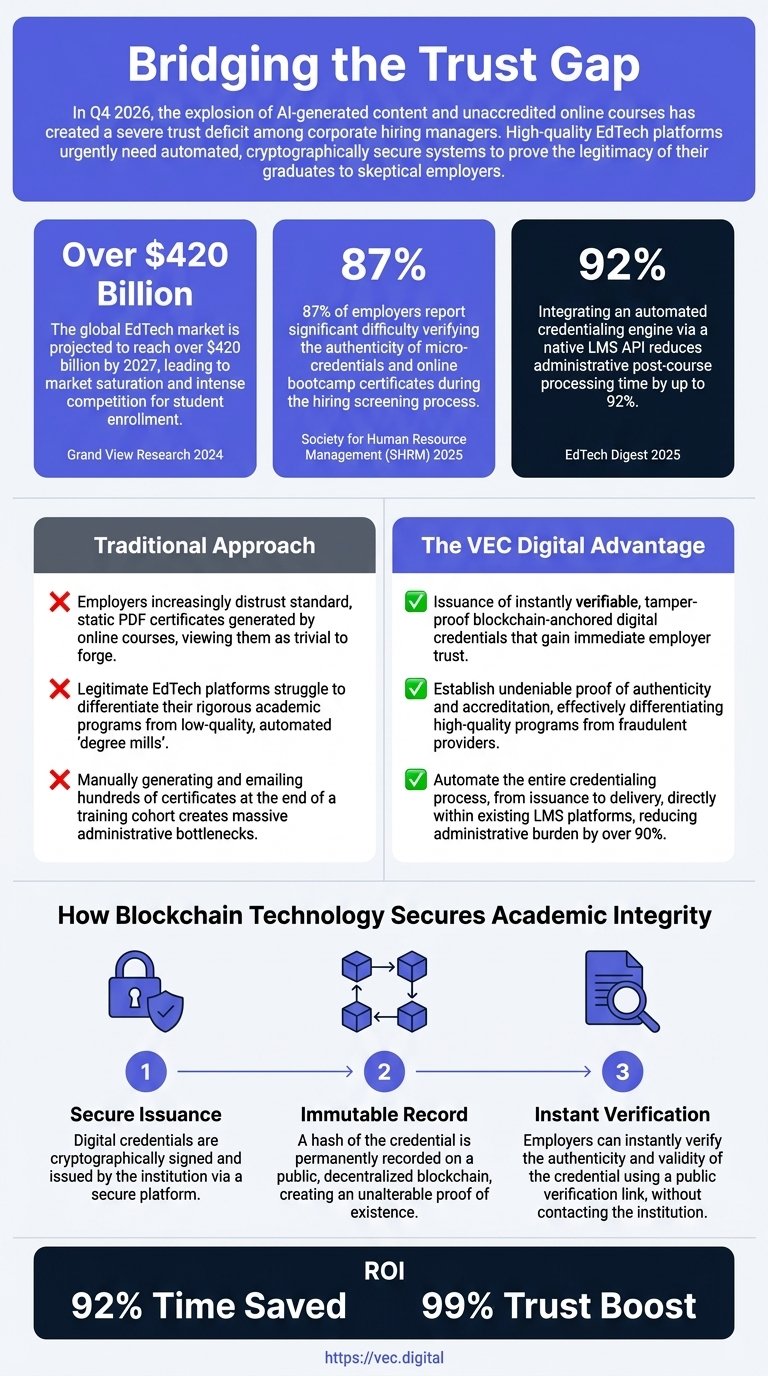
The global EdTech market is experiencing unprecedented growth. According to Grand View Research (2024), the sector is projected to reach over $420 billion by 2027. While this expansion democratizes access to education, it has simultaneously led to severe market saturation and intense competition for student enrollment. Legitimate EdTech platforms and rigorous coding bootcamps now find themselves struggling to differentiate their high-quality academic programs from low-effort, automated "degree mills" that issue meaningless qualifications.
This saturation has created a profound trust deficit among corporate hiring managers. According to the Society for Human Resource Management (SHRM, 2025), 87% of employers report significant difficulty verifying the authenticity of micro-credentials and online bootcamp certificates during the hiring screening process. When an employer cannot easily distinguish between a graduate of a rigorous 12-week software engineering bootcamp and someone who simply paid for a downloaded certificate, the value of the credential plummets. To maintain their reputation and enrollment numbers, premier academies must adopt verifiable digital credentials that offer undeniable proof of learning.
Are Verifiable Digital Credentials Better Than PDF Certificates?
A common question among curriculum architects is: Are verifiable digital credentials better than PDF certificates? The answer is an unequivocal yes. Employers increasingly distrust standard, static PDF certificates generated by online courses, viewing them as trivial to forge. A PDF can be easily manipulated using basic photo-editing software; names can be swapped, dates altered, and institutional logos copied without any technical expertise.
Furthermore, PDFs lack an embedded mechanism for authentication. When a candidate submits a PDF diploma, the hiring manager must either take it at face value or engage in a time-consuming manual background checkâ-often involving phone calls and emails to the issuing institution. Verifiable credentials, on the other hand, contain embedded cryptographic proofs. They are dynamic, securely hosted, and instantly auditable, ensuring that the document presented exactly matches the record issued by the institution.
The Global Push for Digital Skills Passports
The transition away from static documents is not just a technological preference; it is becoming a global regulatory and standardizing movement. Regions including the European Union (via the European Digital Credentials for Learning initiative) and the UAE are actively standardizing digital skills passports. Governments and international corporate consortiums are demanding that educational achievements be portable, secure, and universally recognized.
EdTech platforms operating internationally must adopt universally verifiable formats to ensure their graduates' skills are recognized across borders without administrative friction. By aligning your credentialing strategy with these global standards, you position your academy as a forward-thinking institution that prepares students for a borderless digital economy. Implementing a modern VEC Digital credentialing system ensures you remain ahead of these international compliance curves.
How Blockchain Technology Secures Academic Integrity
How Does Blockchain Prevent Degree Fraud in Online Education?
As the threat of AI-generated content and sophisticated forgery escalates, institutions must ask: How does blockchain prevent degree fraud in online education? The answer lies in the fundamental architecture of distributed ledger technology. When an academy issues a certificate, the credentialing platform generates a unique cryptographic hashâ-a digital fingerprintâ-of that specific document. This hash is then permanently anchored to a public blockchain.
Because blockchains are immutable, this record can never be altered, deleted, or overwritten, even by the issuing institution or the software provider. If a fraudulent actor attempts to change a single pixel or letter on the certificate, the cryptographic hash changes entirely, immediately flagging the document as invalid. This mathematical certainty is why organizations leveraging blockchain for credential verification report a 99% reduction in resume and portfolio fraud incidents, according to Gartner (2026).
The Mechanics of Blockchain Certificate Verification
Implementing blockchain certificate verification does not require your students or hiring managers to understand complex cryptography. The genius of a well-designed system is that the complexity remains entirely beneath the surface. When an employer views a blockchain-anchored certificate, they simply see a clean, professional web page displaying the student's achievements, accompanied by a "Blockchain Verified" security badge.
Behind the scenes, the system automatically checks the document's current hash against the immutable record stored on the blockchain. If they match, the badge illuminates, guaranteeing absolute authenticity. This decentralized approach means the verification is independent of any single server's uptime. It provides a permanent, tamper-proof source of truth that completely eliminates the possibility of credential fraud, safeguarding the integrity of your educational programs.
Protecting Your Academy's Brand Reputation
For EdTech founders and product managers, protecting brand reputation is paramount. Every time a fraudulent certificate bearing your academy's logo is submitted to an employer, it dilutes the perceived rigor of your courses. Over time, hiring managers may begin to systematically discount candidates from your programs, directly impacting your alumni's success and your future enrollment rates.
By issuing cryptographically secured records, you send a powerful signal to the corporate world: your academy operates with the highest standards of academic integrity. You transform your certificates from vulnerable pieces of paper into fortified digital assets. This proactive stance on security not only protects your brand but actively enhances its prestige in a crowded marketplace.
Accelerating Graduate Employability with Instant Authentication
How Do Employers Verify Online Bootcamp Certificates?
A critical pain point for both graduates and hiring managers is the verification process itself. How do employers verify online bootcamp certificates efficiently? Historically, this involved a disjointed process of emailing registrars, waiting days for a response, or paying third-party background screening services to track down educational records. Graduates suffer from prolonged background check delays because corporate employers lack a way to instantly authenticate non-traditional educational records.
Modern solutions answer the question of how do employers verify digital certificates by removing the intermediary entirely. Through embedded QR code technology, a hiring manager reviewing a resume or a printed portfolio can simply scan the code using their smartphone camera. In under two seconds, without downloading any apps or creating an account, they are routed to a secure, dedicated certificate URL verifying the exact details of the graduate's achievement.
Eliminating Background Check Delays for Graduates
The speed of hiring is a competitive advantage for employers and a critical stressor for job seekers. When a graduate is offered a position contingent on a background check, delays in verifying their bootcamp or EdTech credentials can stall the onboarding process, sometimes leading to rescinded offers. By providing instantly verifiable credentials, EdTech platforms directly intervene to solve this problem.
This zero-friction verification acts as a physical-to-digital link. Whether the graduate shares their credential on a digital platform or hands over a physical copy at an in-person interview, the embedded QR code ensures that the proof of their skills is always one scan away. This seamless experience delights employers and significantly accelerates the hiring timeline for your alumni.
The Marketing Power of a Digital Diploma Platform
While most industry content focuses on verifiable credentials from a traditional higher-education compliance perspective, EdTech leaders must recognize them as a core marketing engine. A robust digital diploma platform does more than just issue secure documents; it turns every successful graduate into a verifiable brand ambassador.
When a student shares their secure, aesthetically pleasing certificate on LinkedIn, it acts as a beacon to prospective students and employers alike. The frictionless verification process means that when an employer clicks the link, they are introduced to your academy's brand in a highly professional, secure context. This visibility directly increases graduate employability and platform enrollment, proving the ROI of your courses to the broader market.
Scaling Operations: Automating Issuance Without the Friction
How Can EdTech Platforms Automate Certificate Issuance?
As online academies scale from hundreds to thousands of concurrent learners, administrative processes often break down. Manually generating and emailing hundreds of certificates at the end of a training cohort creates massive administrative bottlenecks. Operations directors frequently ask: How can EdTech platforms automate certificate issuance to eliminate this manual overhead?
The solution lies in adopting a centralized automation engine. By utilizing a visual drag-and-drop template editor, design teams can create professional layouts with dynamic placeholders (e.g., {{RecipientName}}, {{CourseTitle}}). From there, the platform can ingest data automatically, either through scheduled CSV bulk uploads for cohort-based learning or via real-time API triggers for self-paced modules. This completely removes the human error associated with manual data entry and ensures immediate delivery.
What is the Best Bulk Certificate Generator with API for an LMS?
To achieve true zero-touch operations, platforms must integrate their credentialing system directly with their Learning Management System (LMS). When evaluating software, technical teams often search for the best bulk certificate generator with API. The ideal solution must offer robust REST API endpoints, OAuth 2.0 authentication, and real-time status callbacks.
According to EdTech Digest (2025), integrating an automated credentialing engine via a native LMS API reduces administrative post-course processing time by up to 92%. The second a learner passes a final assessment or completes a module in Canvas, Moodle, or a custom-built platform, the API triggers the bulk certificate generator. The credential is mathematically hashed, securely hosted, and emailed to the student instantly, allowing your operations team to focus on curriculum development rather than administrative paperwork.
Structuring Dynamic Templates for Zero-Touch Delivery
For platforms that also cater to B2B corporate training, compliance training certificate automation is a massive selling point. Corporate HR departments require precise, error-free records for compliance audits. By structuring dynamic templates properly, EdTech platforms can ensure that unique IDs, expiration dates, and specific continuing education units (CEUs) are populated flawlessly every single time.
This automated process can also incorporate multi-signatory review pipelines if human oversight is required for high-stakes certifications. Certificates can be held in a draft status until designated instructors securely log in to approve them. Once signed, the automation sequence resumes, dispatching the secure credentials to the corporate learners. This blend of automated generation and secure governance is what separates enterprise-grade EdTech platforms from basic course providers.
Driving Student Engagement and Course Completion Rates
How to Increase Online Course Completion Rates Using Digital Badges?
A persistent challenge in the online education sector is the notoriously low completion rate of asynchronous courses. Product managers are constantly seeking strategies to motivate learners to cross the finish line. This raises an important strategic question: How to increase online course completion rates using digital badges?
The psychological impact of verifiable, shareable recognition cannot be overstated. According to E-Learning Industry (2024), 73% of adult learners state that receiving a highly secure, instantly shareable digital badge significantly increases their likelihood of completing an online module. When students know they will receive a credential that holds recognizable weight in the job marketâ-one that they can proudly display on professional networksâ-their intrinsic motivation spikes. The credential becomes a tangible milestone rather than just an automated congratulatory email.
Turning Alumni into Global Brand Ambassadors
By providing prevent degree fraud measures natively within your credentials, you empower learners to take real ownership of their achievements. When a student successfully completes a rigorous coding bootcamp or a specialized marketing course, their first instinct is to share that success with their network. A modern credentialing platform facilitates this by offering one-click sharing to platforms like LinkedIn, Twitter, and Facebook.
This creates a powerful, organic marketing loop. As alumni share their verified achievements, their peers, colleagues, and prospective employers are exposed to your academy's brand. Because the credential is cryptographically secure, it carries a high perceived value, effectively utilizing your successful students as global brand ambassadors who validate the ROI of your educational offerings to the market.
Creating a Seamless Recipient Experience
The final piece of the engagement puzzle is the recipient experience. If claiming a certificate requires jumping through administrative hoops, creating complex software wallets, or paying hidden fees, the learner's final impression of your academy will be negative. The best systems ensure that the credential is emailed directly to the student's inbox, beautifully presented and ready to use.
Providing access to a dedicated recipient portal where students can permanently view, manage, and download all credentials issued to them further enhances this experience. By treating the credential not just as an administrative byproduct, but as a premium digital asset, EdTech platforms can foster long-term alumni loyalty and encourage repeat enrollments for advanced courses.
Secure Your Academy's Future with VEC Digital
In a global marketplace where trust is the most valuable currency, relying on outdated, easily forged PDF certificates is a risk modern EdTech platforms can no longer afford to take. By adopting a cryptographically secure credentialing system, you completely eliminate employer skepticism, protect your institutional reputation, and provide your graduates with the undeniable proof of skills they need to succeed in a competitive job market.
At VEC Digital, we provide the comprehensive trust infrastructure required to scale your operations without friction. Our platform combines intuitive drag-and-drop design, seamless API integrations for zero-touch automation, and immutable blockchain anchoring to ensure your certificates are permanently verifiable in seconds via a simple QR scan. We empower you to turn your administrative bottlenecks into a powerful marketing engine.
Secure your organizationâ's credentials today and differentiate your academy from the competition. Design your first template in minutes with no setup fees and discover how effortless verifiable credentialing can be.
Ready to modernize your issuance process? Visit our website: https://vec.digital Contact our team: support@vec.digital