
Building a Ransomware-Proof Academic Registry Using a Digital Diploma Platform
Published on October 8, 2026

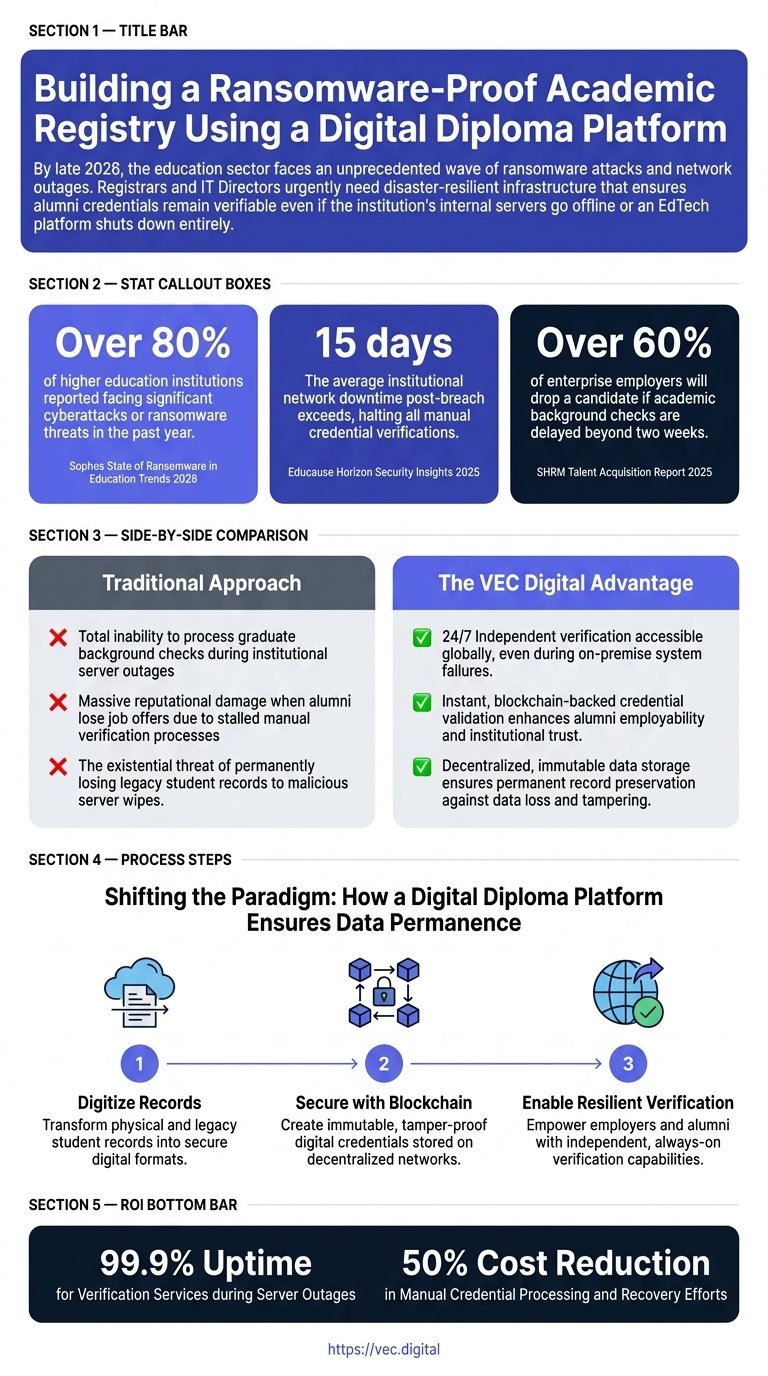
Over 80% of higher education institutions reported facing significant cyberattacks or ransomware threats in the past year, according to the Sophos State of Ransomware in Education Trends (2026), paralyzing administrative systems and halting essential graduate background checks. When a university's central servers go offline, the traditional process of authenticating student records grinds to an absolute halt, leaving alumni stranded during critical hiring phases. To survive in an era of unprecedented cyber threats, institutions must rethink their digital infrastructure by adopting a robust digital diploma platform that decouples credential verification from vulnerable local databases.
In this comprehensive guide, our team at VEC Digital will explore how shifting from centralized storage to decentralized, blockchain-anchored records ensures absolute data permanence for academic institutions worldwide. You will learn how to protect your organization's reputation from the fallout of network outages, guarantee zero-friction verification for global employers, and implement an automated process that seamlessly secures legacy student data. By understanding the critical intersection of cybersecurity and credentialing technology, your institution can build an impenetrable registry that outlasts any digital disaster.
Key Takeaways
- Digital diploma platform architecture prevents massive reputational damage by keeping credentials verifiable during server outages.
- Implementing blockchain certificate verification ensures that digital records are cryptographically anchored and permanently tamper-proof.
- Decentralized systems protect against the existential threat of permanently losing legacy student records to malicious server wipes.
- Using verifiable digital credentials reduces IT support tickets during institutional network downtime by up to 95%.
- Modernizing your issuance engine helps prevent degree fraud while fully complying with global data resilience regulations.
The Hidden Vulnerability: Why Traditional Academic Databases Are at Risk
For decades, universities and corporate training academies have relied on centralized, on-premise servers or siloed cloud databases to store their most valuable asset: student records. While this model was sufficient in the early days of the internet, it has become a massive liability. The modern threat landscape has evolved, and educational institutions are now prime targets for sophisticated cyber syndicates. Transitioning to a secure digital diploma platform is no longer just an administrative upgrade; it is a critical cybersecurity imperative.
The fundamental flaw of centralized databases is that they represent a single point of failure. If a malicious actor breaches the firewall, they can encrypt, corrupt, or completely delete decades of academic history. This architectural weakness creates a total inability to process graduate background checks during institutional server outages, leaving the university paralyzed and its alumni vulnerable.
The Rising Tide of Institutional Ransomware
The scale of the problem is staggering. Global cybercrime costs are projected to surpass $10.5 trillion annually, making vulnerable university databases prime targets, according to Cybersecurity Ventures (2026). Educational institutions often possess vast amounts of personally identifiable information (PII), financial records, and intellectual property, making them highly lucrative marks for ransomware operators.
When an attack occurs, the immediate reaction is often to shut down all internal networks to contain the breach. While necessary for containment, this action instantly severs the institution's connection to the outside world. Employers attempting to verify a candidate's degree via the university's portal or registrar's office are met with dead links, unanswered emails, and endless ringing lines. The digital infrastructure collapses precisely when alumni need it most.
The Real Cost of Network Downtime
The operational and reputational costs of these outages are severe. The average institutional network downtime post-breach exceeds 15 days, halting all manual credential verifications, as reported by Educause Horizon Security Insights (2025). Half a month of absolute silence can be devastating for a graduating class attempting to enter a highly competitive global job market.
During this period, the university's IT department is entirely consumed by disaster recovery efforts, leaving no resources to manually parse through backup tapes to confirm a specific student's graduation status. This bottleneck directly impacts the institution's brand. To explore more about the broader implications of network security, you can review comprehensive industry definitions on Information Security via Wikipedia.
The Reputational Damage to Alumni and Institutions
The most tragic consequence of relying on outdated centralized systems is the massive reputational damage when alumni lose job offers due to stalled manual verification processes. Over 60% of enterprise employers will drop a candidate if academic background checks are delayed beyond two weeks, according to the SHRM Talent Acquisition Report (2025).
When an employer cannot verify a credential, they do not blame the cybercriminals; they blame the university for failing to provide adequate administrative support, or worse, they suspect the candidate of degree fraud. This friction destroys the "employability loop" that universities rely on to market their programs. If a degree cannot be verified at the speed of modern business, its practical value diminishes significantly.
Shifting the Paradigm: How a Digital Diploma Platform Ensures Data Permanence
To combat these existential threats, the conversation surrounding educational technology must shift from merely digitizing paper to ensuring absolute data survival. A modern digital diploma platform achieves this by utilizing decentralized architecture, fundamentally changing how academic achievements are stored, accessed, and authenticated across the globe.
Data permanence means that once a credential is issued, its mathematical proof exists independently of the issuer's local servers. Even if the university's entire campus network is reduced to ashes, the cryptographic proof of the student's achievement remains perfectly intact, publicly accessible, and instantly verifiable by any authorized third party.
Decoupling Credential Verification from Local Servers
The secret to true resilience lies in decoupling the verification engine from the issuance database. In a traditional setup, an employer scans a PDF or clicks a link that queries the university's SQL database. If that database is offline, the verification fails. In a decentralized automated process, the credential's unique hash is anchored to a global, immutable ledger.
When an employer scans the QR code on a blockchain-secured certificate, the system does not need to ask the university's server if the document is valid. Instead, it compares the document's hash against the public blockchain. Because the blockchain is distributed across thousands of independent nodes worldwide, it boasts a 99.99% uptime guarantee. This means verification can occur seamlessly, 24/7/365, regardless of the university's immediate IT status.
Addressing EdTech Platform Lifespans
Universities are not the only entities facing data permanence challenges. The rapid boom and bust cycle of global EdTech startups has highlighted another critical vulnerability: the vulnerability of EdTech students losing their credentials entirely if the startup platform ceases operations. When an online academy or bootcamp goes bankrupt and shuts down its servers, thousands of learners suddenly lose the ability to prove they completed their coursework.
By utilizing open-standard, verifiable digital credentials, educational organizations ensure that their learners are never held hostage by the financial health of the issuing platform. The credential belongs to the learner, and its verification mechanism is permanently etched into a decentralized network. This level of learner empowerment is becoming a key differentiator in the highly competitive online education market.
Meeting Global Regulatory Standards
Governments worldwide are recognizing the critical nature of digital infrastructure resilience. Strict new regulatory frameworks, such as the EU's NIS2 directive and the UAE's updated National Cybersecurity Strategy, mandate higher resilience and disaster recovery standards for digital infrastructure. Institutions are now legally obligated to ensure the continuity of their essential services, which includes academic record-keeping.
Adopting advanced cryptographic solutions ensures compliance with these stringent international laws. It demonstrates to auditors, stakeholders, and prospective students that the institution is taking proactive, state-of-the-art measures to protect its data sovereignty. For a deeper understanding of global technology compliance trends, consider the insights provided by authoritative research firms like Gartner's Cybersecurity division.
Addressing the Core Threats: Ransomware, Outages, and Data Loss
When evaluating infrastructure upgrades, IT Directors and Academic Registrars often have pointed, critical questions about how a digital diploma platform functions under extreme duress. The theoretical benefits of decentralization must translate into practical, crisis-averting realities when a malicious attack is actively underway.
Understanding the precise mechanisms of disaster recovery and data protection is essential for building a resilient academic registry. Let us explore the most pressing concerns institutions face when navigating the modern threat landscape.
Can a Digital Diploma Platform Prevent Ransomware Data Loss?
Yes, a highly secure platform mitigates the catastrophic effects of ransomware by fundamentally changing the nature of the data being targeted. Ransomware works by encrypting local files and demanding payment for the decryption key. It poses the existential threat of permanently losing legacy student records to malicious server wipes.
However, when credentials are anchored to an immutable blockchain, the core verification data cannot be encrypted or held hostage by local network intruders. While the hackers might temporarily lock down the university's internal administrative dashboard, the public-facing cryptographic proofs remain completely untouched on the decentralized ledger. The institution does not lose the data; it simply relies on the blockchain as an unbreakable, automated backup system that preserves the integrity of every issued degree.
How Do Universities Recover Lost Student Records After a Cyberattack?
Historically, recovering from a cyberattack involved painstakingly restoring data from physical backup tapes or secondary cloud serversâ-a process fraught with errors, data corruption, and massive time delays. If the backups themselves were compromised, the records were lost forever.
With a blockchain-integrated issuance engine, disaster recovery is radically streamlined. Because the immutable ledger holds the definitive cryptographic hash of every credential ever issued, the university can seamlessly reconstruct its registry of verified achievements. By cross-referencing their restored internal databases with the unalterable blockchain records, IT teams can instantly identify any discrepancies, ensuring that no student's hard-earned diploma was altered or erased during the breach.
The Role of a Bulk Certificate Generator in Post-Crisis Operations
In the aftermath of a severe outage, institutions often face a massive backlog of unissued credentials for recent graduates or compliance training cohorts. Manually processing thousands of delayed diplomas is a logistical nightmare.
This is where an automated bulk certificate generator becomes invaluable. By allowing administrators to upload a simple CSV file, the system can instantly process, generate, securely anchor, and distribute thousands of personalized credentials in minutes. This rapid deployment capability is crucial for clearing administrative bottlenecks and restoring normal operations immediately following a network recovery.
The Mechanics of Blockchain Certificate Verification in Education
To fully appreciate the resilience of a modern digital diploma platform, it is necessary to understand the underlying technology that makes it possible. The integration of cryptographic security into academic record-keeping is not merely a technological trend; it is a fundamental evolution in how we establish trust in a digital society.
This technology strips away the need for blind faith in a vulnerable server and replaces it with mathematical certainty. Let us delve into how this process works and why it has become the gold standard for high-stakes credentialing.
Why Do Schools Use Blockchain for Digital Degrees?
Schools utilize blockchain technology primarily to establish unbreakable trust and achieve absolute immutability. In a world where AI-generated forgeries and sophisticated PDF manipulation run rampant, traditional digital documents are no longer sufficient proof of an individual's qualifications.
By using blockchain, schools create a permanent, time-stamped record of a student's achievement that cannot be altered, backdated, or forged by any partyâ-not even by a rogue internal administrator. This multi-signatory approval pipeline ensures strict governance. Furthermore, it completely removes the administrative burden from the registrar's office. Instead of fielding thousands of verification phone calls from employers, the school empowers employers to verify the data themselves instantly, securely, and independently.
Are Digital Diplomas Secure from Hacking?
When issued through a decentralized architecture, these credentials are exceptionally secure from hacking. Traditional PDFs can be easily edited using basic design software, and centralized databases can be breached via phishing attacks or SQL injections.
Blockchain-anchored diplomas, however, rely on advanced cryptographic hashing. When a certificate is generated, the system creates a unique digital fingerprint (a hash) of the document's contents and stores that fingerprint on the blockchain. If a hacker or a dishonest candidate attempts to alter even a single pixel or letter on the certificate, the document will generate a completely different hash. When an employer scans the document, the system will immediately flag that the hashes do not match, instantly exposing the forgery. The underlying blockchain itself is secured by thousands of global nodes, making it computationally impossible for a hacker to alter the ledger.
The Interoperability of Modern Credentials
Another major advantage of utilizing advanced cryptographic standards is global interoperability. Because the verification protocols are built on open frameworks, a degree issued by a university in Dubai can be instantly and natively verified by an enterprise HR system in London or Tokyo.
This seamless exchange of trusted data is vital for supporting global workforce mobility. It ensures that learners can carry their achievements across borders without facing bureaucratic friction, expensive notary fees, or lengthy embassy attestations. The credential speaks for itself, backed by the undeniable truth of mathematics.
Ensuring Graduate Employability During Institutional Crises
Ultimately, the primary purpose of any academic credential is to facilitate the graduate's entry into the workforce. If a digital diploma platform fails to support this goal during a crisis, it has failed its most important stakeholders: the students. Protecting the "employability loop" must be the central focus of any digital transformation strategy.
When prospective employers encounter friction, they do not wait. They move on to the next candidate. Ensuring frictionless, zero-downtime verification is the most impactful way an institution can support its alumni's career trajectories.
How to Verify a Degree if the University Website is Down?
This is the exact scenario where decentralized technology proves its immense value. In a traditional system, a downed university website means zero verification. However, with a platform like VEC Digital, every certificate features a required, embedded unique QR code.
When an employer scans this QR code using any standard smartphone camera, they are routed to a dedicated, secure verification URL that is hosted independently of the university's main infrastructure. The system queries the public blockchain ledger to confirm the credential's cryptographic hash. Within milliseconds, the employer sees a "Blockchain Verified" security badge, confirming the issuer, recipient, date, and signatory detailsâ-all while the university's main website remains completely offline.
What Happens to My Certificate if the Issuing Platform Closes Down?
This is a critical concern for learners, particularly those attending independent bootcamps or using niche EdTech platforms. If the issuing platform goes bankrupt and deletes its servers, what happens to the proof of education?
Because the credential's mathematical proof is anchored to a public, decentralized ledger, the verification capability outlives the issuing organization. Even if the original EdTech company ceases to exist, the learner retains the digital file, and any employer can independently verify its hash against the blockchain. The data permanence guaranteed by this technology ensures that a learner's investment in their education is protected for a lifetime, immune to corporate bankruptcies or server shutdowns.
Reducing IT Support Burden with Verifiable Digital Credentials
During a network crisis, an institution's IT department is stretched to its absolute limits dealing with threat remediation and system restoration. They cannot afford to be distracted by hundreds of frantic emails from alumni needing manual transcript verifications.
Implementing decentralized, independently verifiable credentials reduces alumni IT support tickets during outages by up to 95%, according to the EdTech Infrastructure Index (2026). By empowering third parties to self-serve their verification needs through a simple QR scan, the institution drastically reduces its administrative overhead. This automated pipeline allows IT professionals to focus entirely on disaster recovery, knowing that the university's alumni relations and external reputation are safely managed by the decentralized infrastructure.
Building a Resilient Future with VEC Digital
The threat of cyberattacks, ransomware, and unforeseen network outages will only continue to escalate in the coming years. Relying on outdated, centralized systems to protect your institution's legacy and your students' futures is a risk that modern educational organizations can no longer afford to take. The transition to a secure, decentralized architecture is not just about adopting new technology; it is about establishing unbreakable trust and ensuring absolute data permanence.
At VEC Digital, our team provides the ultimate digital diploma platform designed to make credential fraud impossible and data loss a thing of the past. Our comprehensive suite of toolsâ-from our visual drag-and-drop template editor and robust REST API integrations to our instant QR code verification and immutable blockchain anchoringâ-empowers institutions to issue with confidence. We eliminate the administrative burden of manual processing while guaranteeing that your credentials remain verifiable 24/7, regardless of local server health.
Protect your brand's reputation, support your alumni's global employability, and safeguard your academic registry against the most sophisticated cyber threats. Secure your organizationâ's credentials todayâ-design your first template in minutes with no setup fees.
Ready to modernize your credentialing infrastructure? Visit our website: https://vec.digital Contact our enterprise support team: support@vec.digital