
Certificate Fraud in 2026: Fast Blockchain Certificate Verification
Published on May 4, 2026

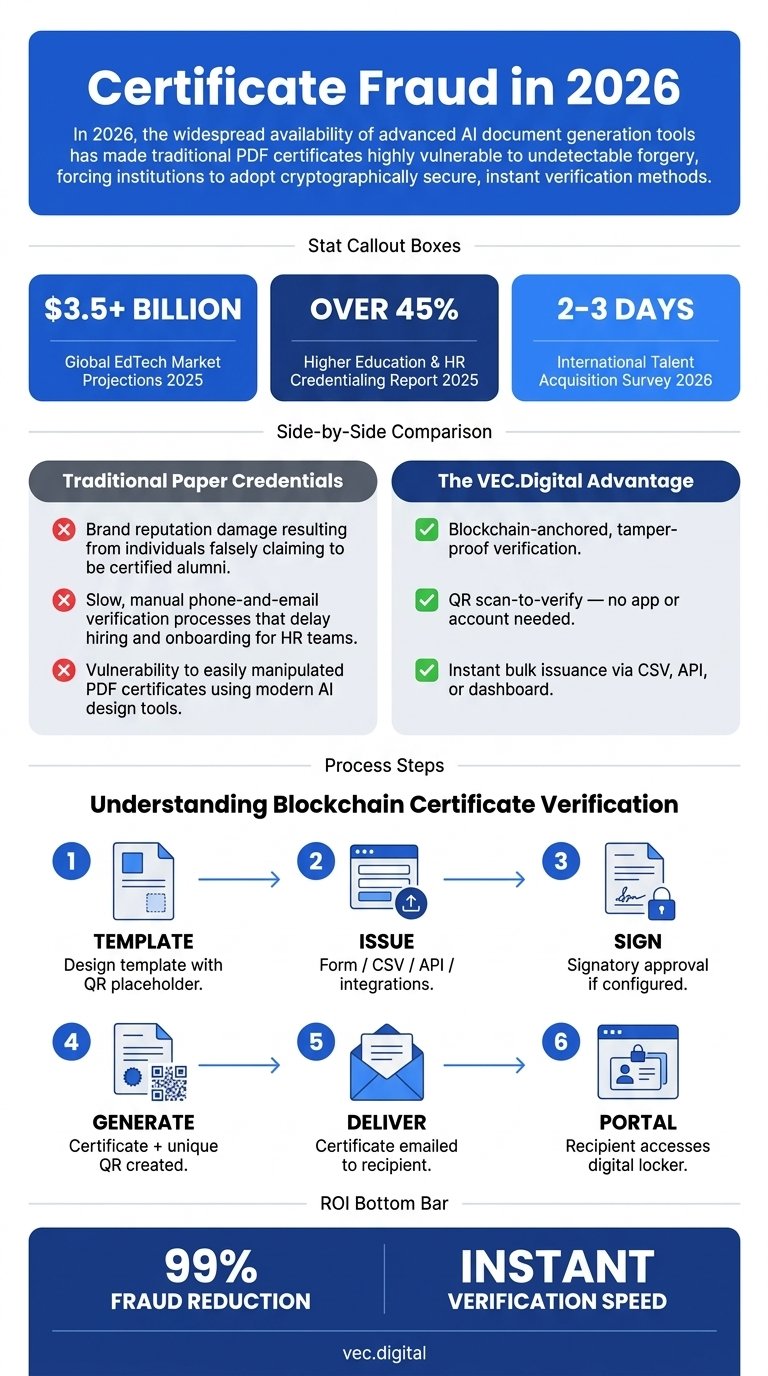
Over 45% of universities and large corporate training providers report dealing with sophisticated digital certificate forgery attempts as of recent industry data (Higher Education & HR Credentialing Report, 2025). As advanced AI document generation tools make fake credentials virtually indistinguishable from legitimate ones, organizations must adopt blockchain certificate verification to protect their institutional integrity. This technological shift transforms a vulnerable, manual procedure into an instant, cryptographically secure guarantee of authenticity.
In this comprehensive guide, our team at VEC.Digital will demystify how decentralized technology secures modern credentialing without overwhelming your team with technical complexity. You will learn how to eliminate credential fraud using scan-to-verify QR codes, drastically reduce the administrative burden of background checks, and issue globally accessible, tamper-proof certificates. By modernizing your certificate workflow, your organization can seamlessly safeguard its reputation while supporting global sustainability initiatives through the elimination of paper waste.
Key Takeaways
- AI-assisted forgery is rendering traditional PDF certificates obsolete and highly vulnerable to manipulation.
- Blockchain certificate verification reduces HR verification times by up to 90% by eliminating manual background checks.
- Scan-to-verify QR codes provide instant proof of authenticity without requiring third-party apps or user logins.
- Cryptographic hashing ensures absolute data privacy while maintaining global trust and strict regulatory compliance.
- Digital credentials directly support UN sustainability goals by entirely removing paper waste from the issuance pipeline.
The Escalating Threat of AI-Assisted Certificate Fraud
In 2026, the widespread availability of advanced AI document generation tools has fundamentally altered the landscape of digital credentialing. What once required specialized graphic design skills can now be accomplished in seconds using simple text prompts. This technological leap has made traditional PDF certificates highly vulnerable to undetectable forgery, forcing institutions globally to rethink how they issue and validate achievements.
To combat this, leading institutions are turning to blockchain certificate verification. This technology provides an immutable layer of security that artificial intelligence cannot replicate or bypass. When an organization issues a credential anchored to a decentralized ledger, it creates a permanent mathematical proof of that document's existence and authenticity at a specific moment in time.
The Vulnerability of Traditional PDFs
A common question among administrators is: What is the difference between a verifiable credential and a PDF certificate? The answer lies in the underlying architecture of trust. A standard PDF is merely a visual representation of data—a collection of pixels that can be easily edited, duplicated, or entirely fabricated using modern software. Even digitally signed PDFs can be stripped of their signatures or manipulated by sophisticated actors.
Conversely, a verifiable credential relies on cryptographic proof. When an organization issues a blockchain-anchored credential, the system generates a unique digital fingerprint (a hash) of the certificate's data. This fingerprint is recorded permanently. If a bad actor alters even a single pixel or letter on the certificate, the digital fingerprint changes entirely, instantly flagging the document as fraudulent during the verification process.
Brand Reputation on the Line
The consequences of credential fraud extend far beyond a single unqualified hire. For universities, training providers, and certification bodies, brand reputation is their most valuable asset. Brand reputation damage resulting from individuals falsely claiming to be certified alumni dilutes the value of the credential for legitimate graduates. When employers can no longer trust a certificate bearing an institution's logo, the perceived quality of that institution plummets.
Implementing a robust higher education credentialing solution ensures that an institution's name remains synonymous with excellence and integrity. By shifting to cryptographically secure methods, organizations proactively defend their brand equity in an increasingly digital and AI-driven world.
Understanding Blockchain Certificate Verification
Despite its growing adoption, there is a clear informational gap regarding the practical implementation of decentralized technologies. Most existing industry literature focuses heavily on the complex technical architecture of decentralized ledgers, which can alienate business decision-makers. However, understanding blockchain certificate verification does not require a degree in computer science; it simply requires understanding a new paradigm of digital trust.
At its core, this technology acts as a globally accessible, tamper-proof digital notary. It seamlessly integrates into existing issuance workflows, providing a frictionless experience for both the issuer and the recipient while ensuring absolute data integrity.
How Do Blockchain Certificates Work?
Many professionals ask: How do blockchain certificates work? The process is surprisingly straightforward when viewed through the lens of a user-friendly issuance pipeline. When your organization creates a certificate, the platform extracts the core data—such as the recipient's name, the course completed, and the date of issuance. This data is run through a cryptographic algorithm to create a unique hash.
This hash is then anchored to an immutable ledger. The actual certificate (the visual design and personal data) is stored securely off-chain, while the ledger only holds the mathematical proof. When an employer or verification agency wants to check the certificate, the system compares the hash of the presented document against the hash stored on the ledger. If they match perfectly, the certificate is authentic. This approach aligns with global standards, such as the W3C Verifiable Credentials Data Model, ensuring interoperability and universal trust.
Can Blockchain Certificates Be Faked or Hacked?
A critical concern for any compliance manager is security: Can blockchain certificates be faked or hacked? Because the underlying technology relies on decentralized consensus and advanced cryptography, altering a record after it has been anchored is computationally unfeasible. To "hack" a single certificate, a bad actor would need to simultaneously compromise thousands of independent servers worldwide.
Furthermore, VEC.Digital ensures that every blockchain-verified certificate displays a distinct "blockchain verified" badge on the public certificate verification page. This visual indicator provides immediate confidence to anyone reviewing the document, confirming that the credential's cryptographic proof remains entirely intact and untampered.
The Financial and Operational Costs of Manual Verification
The transition to modern credentialing is driven not only by security concerns but also by immense operational inefficiencies. Traditional verification methods are fundamentally broken, relying on slow, manual phone-and-email processes that delay hiring and onboarding for HR teams globally. By adopting blockchain certificate verification, organizations can drastically reduce these hidden costs.
Every hour spent verifying a candidate's background is an hour diverted from strategic talent acquisition and organizational growth. The financial impact of these administrative bottlenecks is staggering, prompting a rapid shift toward automated, cryptographically secure alternatives.
The Hidden Drain on HR Departments
Recent global research highlights the severity of this issue. HR professionals spend an average of 2 to 3 days manually verifying candidate credentials and compliance certificates during the hiring process (International Talent Acquisition Survey, 2026). This involves contacting university registrars, waiting for email confirmations, and paying for expensive third-party background check services.
These delays not only frustrate top-tier candidates who may accept competing offers but also incur high administrative costs associated with responding to third-party background check requests. For the issuing institutions, maintaining dedicated staff to answer verification phone calls and emails represents a significant, ongoing financial burden that scales poorly as the alumni network grows.
Why Universities Are Moving to Blockchain Credentials
Given these operational hurdles, it is no surprise that educational leaders frequently ask: Why are universities moving to blockchain credentials? The answer is a dramatic improvement in efficiency. Organizations utilizing blockchain-anchored credentials see a 90% reduction in credential verification times (Digital Trust & Identity Institute, 2024).
By providing a self-serve, instant verification mechanism, universities eliminate the need for manual registrar intervention. This allows educational institutions to reallocate administrative resources while simultaneously offering their graduates a premium, modernized credentialing experience that empowers them in the global job market.
How Scan-to-Verify QR Codes Transform the User Experience
The true power of blockchain certificate verification lies in its accessibility. Complex security infrastructure is only effective if it is easy for end-users to utilize. This is where the integration of scan-to-verify technology bridges the gap between advanced cryptography and everyday business utility.
By shifting the conversation away from the technical complexity of decentralized ledgers, organizations can focus on the practical, business-level user experience: how simple QR codes instantly eliminate credential fraud and save HR departments thousands of manual verification hours.
How Can You Verify If a Digital Certificate Is Genuine?
When an employer receives a resume, they often wonder: How can you verify if a digital certificate is genuine? With VEC.Digital, the process is frictionless. Every certificate generated through our platform includes a unique QR code linking directly to a dedicated verification page (e.g., /certificate/[uuid]).
There is no app to download, no account to create, and no login required to verify. An HR manager simply points their smartphone camera at the QR code—whether on a printed copy or a digital screen—and is instantly directed to the official certificate verification portal. The page displays the credential's status, the issuer's details, and the "blockchain verified" badge, providing absolute certainty in seconds.
How Do I Add a QR Code to a Digital Certificate?
For training providers and administrators, the issuance process must be equally seamless. A common logistical question is: How do I add a QR code to a digital certificate? With legacy systems, this often required complex mail-merge software or manual graphic design work.
Our platform automates this entirely. Using our intuitive template editor, the unique QR code is automatically generated and embedded into the design for every individual recipient. The editor features drag-and-drop functionality, supports A2–A5 sizes in both portrait and landscape orientations, and includes access to over 1400+ Google Fonts. Additionally, our Canva integration allows your design team to import stunning backgrounds effortlessly, ensuring that security never compromises aesthetics.
Global Compliance: Balancing Trust With Data Privacy
As digital credentialing expands internationally, organizations must navigate a complex web of data protection regulations. Implementing blockchain certificate verification must be done with a deep understanding of privacy laws to ensure that global trust does not come at the expense of individual data rights.
With increasing regulatory scrutiny around data privacy globally, organizations require secure credentialing methods that verify authenticity without unnecessarily exposing sensitive information. The architecture of modern verifiable credentials is specifically designed to meet these stringent requirements.
Navigating GDPR, PDPL, and Global Data Laws
Whether your organization operates under the General Data Protection Regulation (GDPR) in Europe, the Personal Data Protection Law (PDPL) in the UAE, or other international frameworks, compliance is non-negotiable. Storing personally identifiable information (PII)—such as a learner's name, email, or grades—directly on a public, immutable ledger would constitute a severe privacy violation, as that data could never be deleted.
To understand the depth of these requirements, organizations can consult resources like the Official GDPR Portal. Modern credentialing platforms solve this challenge by keeping all PII strictly off-chain in secure, compliant databases. The recipient retains control over who sees their actual certificate, ensuring full compliance with the "right to be forgotten" and other global privacy mandates.
The Role of Cryptographic Hashing in Privacy
Cryptographic hashing provides the exact balance needed between global trust and strict privacy compliance. Because a hash is a one-way mathematical function, it is impossible to reverse-engineer the original data (like a student's name) from the hash stored on the ledger.
This means the ledger only contains anonymous mathematical proofs. When a certificate is verified, the system simply checks if the hash of the provided document matches the anonymous proof on the ledger. This elegant solution guarantees absolute authenticity while ensuring that no personal data is ever exposed to the public domain.
Building a Future-Proof Credentialing Workflow
The global blockchain in education and credentialing market is projected to surpass $3.5 billion by the end of 2026 (Global EdTech Market Projections, 2025). To capitalize on this technological advancement, organizations need a credentialing platform that is not only secure but also highly adaptable to their specific operational needs.
Adopting blockchain certificate verification should enhance, rather than disrupt, your daily operations. A future-proof workflow requires flexible issuance methods, rigorous approval processes, and a commitment to long-term sustainability.
Seamless Integration With Existing Systems
Every organization operates differently, which is why VEC.Digital offers four distinct issuance methods to fit any operational scale. Administrators can issue certificates one-by-one via a simple dashboard form, upload a CSV for rapid bulk issuance, utilize our REST API for programmatic generation, or leverage third-party integrations to connect directly with existing Learning Management Systems (LMS).
Furthermore, we understand that issuing official credentials often requires oversight. Our multi-signatory workflow supports up to two signatories per template. Crucially, the certificate is held in a pending state until all signatories have independently reviewed and signed off, ensuring rigorous quality control. Once issued, learners gain permanent access to a recipient digital locker—a centralized portal where they can view, download, and share all their credentials anytime, anywhere.
Championing Sustainability Through Digital Issuance
Beyond security and efficiency, transitioning to digital credentials is a powerful step toward environmental responsibility. Traditional certificate issuance involves significant paper waste, chemical inks, plastic protective covers, and the carbon footprint associated with global physical shipping.
VEC.Digital actively supports UN sustainability goals by providing a completely paperless issuance pipeline. Digital certificates eliminate paper waste entirely, drastically reduce printing and physical delivery costs, and contribute to eco-friendly credential management globally. By upgrading your corporate training certificate workflows, your organization demonstrates a tangible commitment to both technological innovation and environmental stewardship.
Secure Your Organization's Reputation With VEC.Digital
As we navigate 2026, the threat of AI-generated certificate fraud is a reality that no institution can afford to ignore. Relying on outdated PDF certificates exposes your brand to reputational damage and bogs down global HR departments in endless manual verification cycles. The solution is clear: adopting blockchain certificate verification combined with intuitive scan-to-verify QR technology provides the ultimate safeguard for your credentials.
At VEC.Digital, we empower universities, corporate training providers, and conference organizers to issue trustworthy, verifiable digital credentials efficiently and sustainably. Our platform is designed for the modern world—requiring no technical expertise from your staff while delivering uncompromising cryptographic security and a frictionless experience for your learners.
Modernizing your certificate workflow has never been easier or more accessible. We believe in removing barriers to entry, which is why organizations can start completely free—with no credit card required and zero setup fees. For scaling institutions, our robust paid plans begin at just $29.99/month, while independent educators can issue credentials for a simple flat rate of $1.00 per certificate. Discover how effortless secure credentialing can be by exploring our organization pricing and features.
Ready to eliminate credential fraud and save your team countless administrative hours? Connect with our global team today to secure your digital issuance pipeline.
Website: vec.digital
Email: support@vec.digital
WhatsApp: +971521373078