
Certificate Fraud Prevention 2026: Blockchain Verification Defense
Published on May 12, 2026

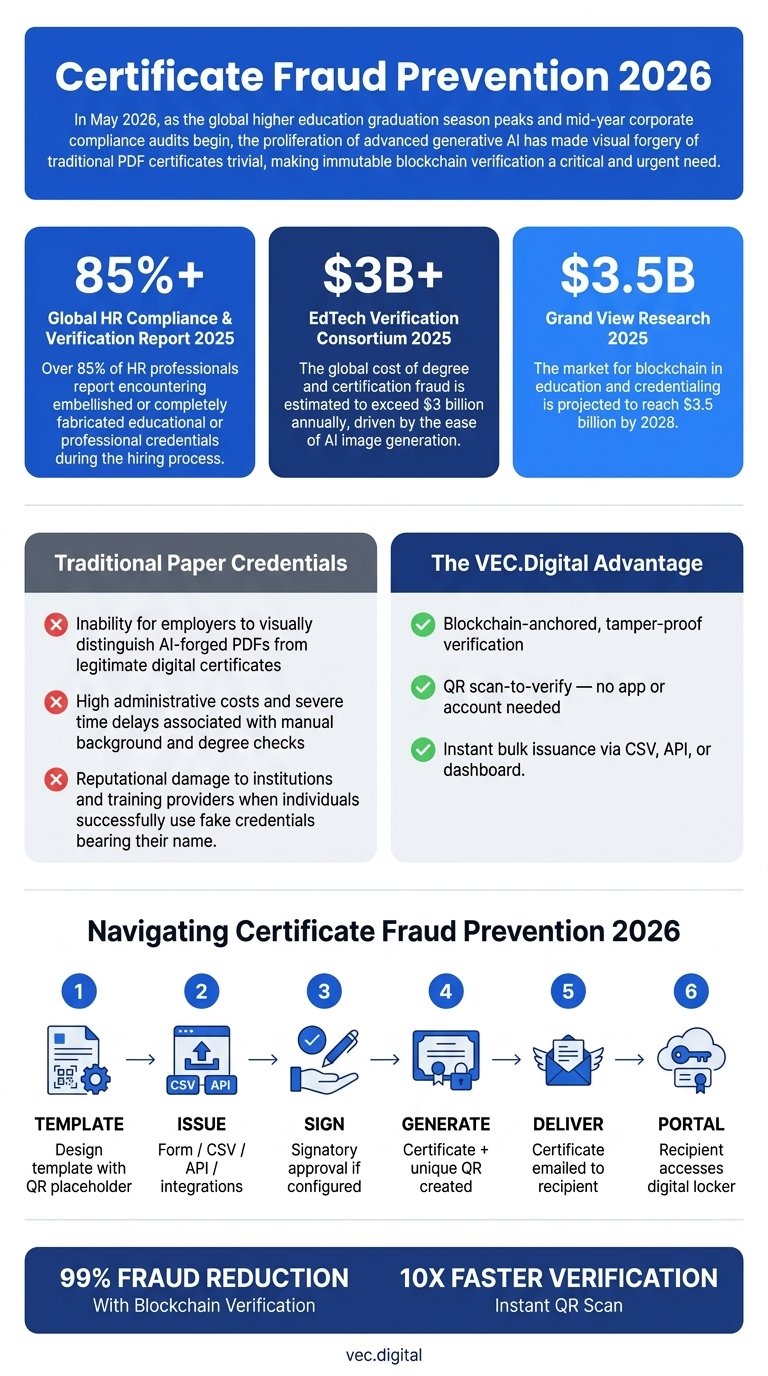
Over 85% of HR professionals report encountering embellished or completely fabricated educational or professional credentials during the hiring process, according to the Global HR Compliance & Verification Report (2025). As generative AI makes visual forgery trivial, prioritizing robust certificate fraud prevention 2026 is no longer optional for universities, training providers, and corporate compliance teams. The global cost of degree and certification fraud is now estimated to exceed $3 billion annually, according to the EdTech Verification Consortium (2025), severely impacting institutional reputation and trust globally.
In this comprehensive guide, our team at VEC.Digital leverages our expertise in blockchain-powered digital credentialing to help your organization navigate this rapidly evolving threat landscape. You will learn how to eliminate credential fraud using immutable blockchain technology, discover how to issue bulk certificates in minutes via automated workflows, and understand how to provide learners worldwide with instantly accessible, verifiable credentials that support global compliance and sustainability goals.
Key Takeaways
- AI-generated forgeries have rendered traditional secure PDFs and visual watermarks obsolete in the modern hiring landscape.
- Blockchain credential verification provides an immutable, publicly verifiable defense against fake degrees and unauthorized credential tampering.
- Scan-to-verify QR certificates bridge the physical-to-digital trust gap, reducing manual background check times and administrative costs by up to 90%.
- Automated issuance pipelines via REST API allow organizations to anchor credentials effortlessly at scale without manual intervention.
- Verifiable digital credentials support global compliance mandates, including eIDAS 2.0, and align with the UN's sustainability goals by eliminating paper waste.
The Rise of AI Forgeries and the Cost of Inaction
The landscape of credentialing is undergoing a seismic shift. In recent years, the rapid advancement of generative artificial intelligence has fundamentally altered how organizations must approach certificate fraud prevention 2026. Previously, institutions relied on intricate visual designs, complex borders, and standardized fonts to deter counterfeiters. Today, AI image generators and advanced PDF manipulation tools can recreate these visual elements flawlessly in seconds.
This technological democratization of forgery has created a critical vulnerability for institutions worldwide. When a fraudulent credential is visually indistinguishable from a legitimate one, visual inspection—the traditional cornerstone of document verification—becomes entirely obsolete. Organizations must now look beyond the surface of a document to cryptographic proofs to establish trust.
Why are secure PDF certificates no longer safe from forgery?
For over a decade, secure PDFs equipped with password protection and visual watermarks were considered the gold standard for digital credentialing. However, these methods rely on superficial security layers that modern software can easily bypass. Password protections can be stripped using widely available online tools, and visual watermarks can be cloned or digitally erased by AI-powered image editing software.
The inability for employers to visually distinguish AI-forged PDFs from legitimate digital certificates means that a bad actor can easily generate a fake degree, alter the name on a legitimate certificate, or invent a completely fictitious qualification. Because PDFs are fundamentally static documents, they lack a dynamic, independent verification mechanism. Once a PDF leaves the issuer's server, the issuer loses control over how that document is presented or altered.
The Hidden Costs: Reputational Damage and Liability Risks
The consequences of relying on outdated credential formats extend far beyond individual instances of resume fraud. There is severe reputational damage to institutions and training providers when individuals successfully use fake credentials bearing their name. If an employer discovers that a candidate was hired based on a forged certificate from a specific university, the perceived value of all legitimate degrees from that university diminishes.
Furthermore, there are massive compliance and liability risks in heavily regulated industries such as healthcare, finance, and aviation due to unverified training records. If an employee in a safety-critical role operates without the necessary, legitimately acquired qualifications, the issuing organization and the hiring company may face devastating legal and financial repercussions. Transitioning to modern credentialing solutions for higher education and corporate training is a critical step in mitigating these global risks.
Navigating Certificate Fraud Prevention 2026
As we look toward the future, certificate fraud prevention 2026 requires a fundamental paradigm shift from document-centric security to data-centric, cryptographic security. This shift is not just driven by technological necessity, but also by sweeping regulatory changes across the globe.
Institutions must adopt frameworks that guarantee data integrity, protect user privacy, and provide instantaneous, cross-border verification capabilities. This requires moving away from proprietary, siloed verification databases and embracing decentralized, immutable ledgers that act as a single source of truth.
Global Compliance Mandates and Cross-Border Trust
With the European Union's updated digital identity frameworks (eIDAS 2.0) taking full effect, and varying global compliance mandates such as the UAE's comprehensive paperless government and digital trust initiatives maturing in 2026, institutions worldwide are under immense regulatory pressure. These frameworks demand the adoption of immutable, cross-border verifiable credentials that protect consumer data while ensuring absolute authenticity.
Global mobility is at an all-time high. A professional trained in Dubai may seek employment in Berlin, requiring the German employer to instantly verify credentials issued in the UAE. Traditional manual background checks are ill-equipped for this reality, often taking weeks and incurring high administrative costs. Verifiable digital credentials solve this by standardizing the proof of authenticity, ensuring that a certificate is recognized and trusted globally without the need for manual, cross-border phone calls or emails.
How to check if a digital certificate is genuine?
To determine if a digital certificate is genuinely authentic in the modern era, the verification process must be entirely decoupled from human visual assessment. Instead of looking at the document, the verifier must look at the cryptographic signature anchoring the document to a public ledger.
When an organization utilizes a platform like VEC.Digital, checking a certificate's authenticity is frictionless. The verifier simply scans the embedded QR code or clicks the unique verification link (e.g., /certificate/[uuid]). This action queries the blockchain to confirm three vital data points: who issued the credential, who received it, and whether the credential has been altered or revoked since its issuance. If all data points match the immutable ledger, the system displays a definitive "blockchain verified" badge, providing absolute cryptographic certainty without requiring any app, account, or login.
Can Blockchain Prevent Fake Degrees?
The short answer is a definitive yes. When discussing certificate fraud prevention 2026, blockchain technology emerges as the only viable defense against sophisticated AI forgeries. The market has recognized this reality; according to Grand View Research (2025), the market for blockchain in education and credentialing is projected to reach $3.5 billion by 2028. Furthermore, Higher Ed Tech Trends (2026) reports that 70% of leading universities globally plan to issue digitally verifiable, blockchain-anchored credentials to graduates by the end of 2027.
Blockchain prevents fake degrees by fundamentally changing how trust is established. Instead of trusting the physical or digital document presented by the candidate, the employer trusts the decentralized, tamper-proof ledger where the original credential data was permanently recorded by the issuing institution.
The Mechanics of Immutable Blockchain Anchoring
Every VEC certificate is anchored on an immutable blockchain. This process involves taking the digital certificate's data and generating a unique cryptographic hash—a digital fingerprint. This hash is then permanently recorded on the blockchain. Because blockchains are decentralized and append-only, it is computationally impossible for any malicious actor, including the original recipient, to alter the recorded data.
If a candidate uses AI to change a "B" grade to an "A" on their digital certificate, the cryptographic hash of the altered document will no longer match the hash stored on the blockchain. When an employer attempts to verify the altered certificate, the system will immediately flag it as invalid. This mathematical certainty is why blockchain verification is the ultimate safeguard against credential fraud.
REST API Integration for Effortless Issuance
A common informational gap in the credentialing industry is the assumption that blockchain technology is too complex for standard administrative teams to implement. However, modern platforms abstract this complexity entirely. For instance, utilizing a REST API allows organizations to automatically anchor credentials on the blockchain without any manual data entry.
Through our robust REST API, a university's Learning Management System (LMS) or a corporation's HR software can automatically trigger the issuance pipeline the moment a student graduates or an employee completes a compliance module. This programmatic issuance method ensures that thousands of certificates can be generated, cryptographically signed, and securely anchored in minutes, creating a seamless administrative experience that scales infinitely.
Scan-to-Verify QR Certificates: Bridging the Trust Gap
One of the most significant pain points for HR departments is the high administrative costs and severe time delays associated with manual background and degree checks. In the pursuit of certificate fraud prevention 2026, efficiency is just as important as security. This is where the integration of QR technology with blockchain verification revolutionizes the industry.
According to HR Tech Weekly (2025), implementing QR-code based instant verification reduces manual background check times and associated administrative costs by up to 90%. By eliminating the need to contact university registrars or third-party background check agencies, organizations can streamline their hiring pipelines and secure top talent faster.
What is a scan-to-verify certificate?
A scan-to-verify certificate is a digital or printed credential that features a unique, mathematically generated QR code embedded directly into the design. This QR code acts as a direct bridge between the physical document and its digital, cryptographic proof.
Every certificate issued through VEC.Digital includes this unique QR code linking directly to a dedicated verification page. This completely bridges the physical-to-digital trust gap. Even if a recipient prints their digital certificate and hands a physical copy to an employer, the employer can simply scan the QR code with any standard smartphone camera. They are instantly routed to the public verification page, proving the document's authenticity in real-time.
How do verifiable credentials work for employers?
For employers, verifiable credentials remove the burden of trust from the hiring process. When a candidate submits a digital certificate, the employer does not need to possess specialized software, create an account, or pay a verification fee. They simply click the link or scan the QR code provided on the document.
Upon scanning, the employer is presented with a secure, VEC-hosted verification page displaying the "blockchain verified" badge. This page shows the exact details of the credential as originally issued by the institution. By comparing the data on the verification page with the data on the candidate's resume, the employer can confirm with 100% certainty that the credential is legitimate, unaltered, and actively valid. Learn more about this seamless process on our verification page.
Choosing the Best Platform to Issue Blockchain Digital Certificates
When evaluating solutions for certificate fraud prevention 2026, organizations frequently ask: What is the best platform to issue blockchain digital certificates? The ideal solution must combine immutable security with an intuitive, user-friendly experience for both the issuer and the recipient. It must accommodate diverse organizational workflows and provide extensive design flexibility without compromising cryptographic integrity.
VEC.Digital provides a comprehensive suite of features designed to meet the complex needs of modern global institutions. Our platform offers four distinct issuance methods: a dashboard form for one-by-one issuance, CSV upload for bulk processing, REST API for programmatic automation, and seamless third-party integrations. Furthermore, our advanced template editor features over 1,400 Google Fonts, drag-and-drop functionality, support for A2 to A5 sizes in both portrait and landscape, and direct Canva integration for stunning background designs.
Multi-Signatory Workflows and Recipient Digital Lockers
In many academic and corporate environments, a certificate requires authorization from multiple stakeholders, such as a department head and a university dean. VEC.Digital accommodates this through a robust multi-signatory workflow. Issuers can assign up to two signatories per template. Crucially, the certificate is held in a pending state until all signatories have independently reviewed and signed the document, ensuring strict internal compliance before the credential is ever anchored to the blockchain.
For the learner, the experience is equally refined. Recipients are granted access to a secure digital locker—a permanent portal where all their earned certificates are stored. This digital locker is accessible anywhere, anytime, empowering learners to manage, share, and prove their achievements globally without the fear of losing a physical document.
Supporting Sustainability Through Paperless Credentialing
Beyond security and efficiency, transitioning to digital credentials is a vital step toward environmental responsibility. Traditional paper certificates require massive amounts of water and timber to produce, and their physical delivery via global shipping networks contributes significantly to carbon emissions.
VEC.Digital is deeply committed to supporting the UN sustainability goals. By adopting our blockchain-verified digital certificates, organizations eliminate paper waste, drastically reduce printing and physical delivery costs, and contribute to an eco-friendly credential management ecosystem globally. Digital credentials are not just a technological upgrade; they are a sustainable imperative for the modern enterprise.
Secure Your Organization's Future with VEC.Digital
The threat of AI-generated credential fraud is real, accelerating, and costly. Relying on outdated PDFs and manual verification processes leaves your organization vulnerable to reputational damage and severe compliance risks. However, by adopting blockchain-anchored, scan-to-verify credentials, you can protect your institution's integrity, save thousands of hours in administrative overhead, and provide your learners with globally trusted proof of their achievements.
At VEC.Digital, we make issuing trustworthy, verifiable digital credentials effortless. Whether you are a university administrator managing thousands of graduates, an HR manager streamlining corporate compliance, or a conference organizer issuing attendance records, our platform is designed to scale with your needs. Discover how it works and see the difference cryptographic security makes.
We believe that absolute security should be accessible to organizations of all sizes. That is why we offer a completely free plan to help you get started—no credit card required and no setup fees. For scaling organizations, our paid plans start at just $29.99/month, while individuals pay only $1.00 per certificate.
Take the definitive step toward robust certificate fraud prevention today. Contact our team to secure your credentials for 2026 and beyond.
- Website: vec.digital
- Email: support@vec.digital
- WhatsApp: +971521373078