
Certificate Fraud Prevention in 2026: Securing Credentials Against AI Forgeries
Published on April 15, 2026

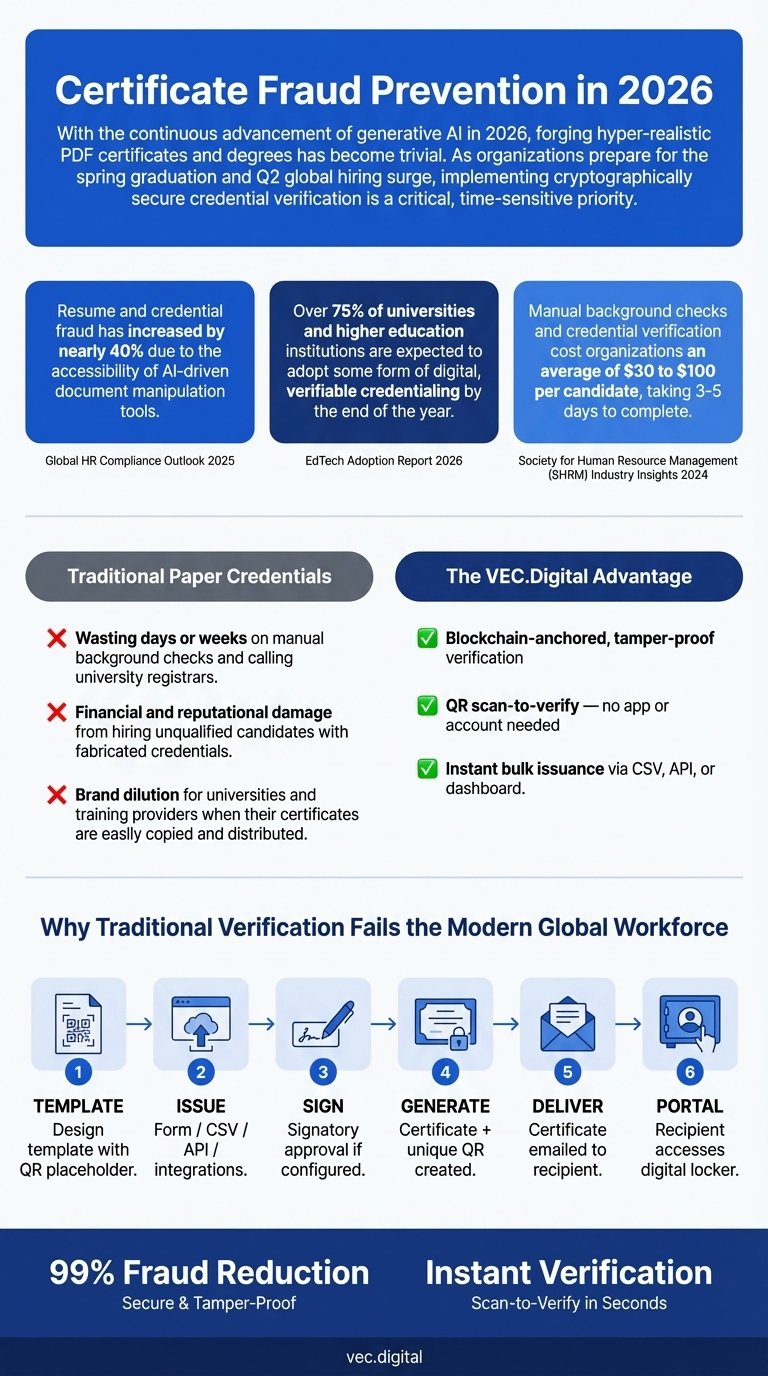
Resume and credential fraud has increased by nearly 40% globally, fueled by the widespread accessibility of advanced AI-driven document manipulation tools, according to the Global HR Compliance Outlook (2025). For HR managers, university administrators, and compliance officers, mastering certificate fraud prevention 2026 is no longer optional but a critical mandate to protect organizational integrity. Relying on outdated manual checks leaves institutions vulnerable to sophisticated forgeries that easily bypass traditional scrutiny.
In this comprehensive guide, we will explore how your organization can completely eliminate credential fraud using VEC.Digital’s blockchain-powered verification technology. You will learn how to transition from slow, manual background checks to instant, mathematically unforgeable proof of achievement, enabling you to issue bulk certificates in minutes while providing learners globally with secure, universally accessible credentials.
Key Takeaways
- Blockchain credential verification provides mathematical proof of authenticity, making AI-generated forgeries impossible to pass off as legitimate.
- Manual background checks cost organizations $30 to $100 per candidate, a financial drain eliminated by QR code certificate verification.
- Universities and enterprises are protecting their brand equity by adopting verifiable credentials for organizations that are anchored to an immutable ledger.
- The shift to digital certificate authenticity supports global sustainability goals by completely eliminating paper waste and shipping emissions.
- Implementing robust certificate fraud prevention 2026 requires zero technical friction when utilizing platforms with scan-to-verify technology and digital recipient lockers.
The Escalating Threat of AI-Generated Fake Credentials
As we navigate the complexities of the modern digital economy, the strategies surrounding certificate fraud prevention 2026 must evolve to counter unprecedented technological threats. The continuous advancement of generative AI has fundamentally altered the landscape of document security. What once required specialized graphic design skills and expensive software can now be accomplished in seconds with a simple text prompt or an automated document editing tool.
This democratization of forgery has led to a startling reality: the Global HR Compliance Outlook (2025) reports that resume and credential fraud has increased by nearly 40% due to the accessibility of AI-driven document manipulation tools. As organizations prepare for spring graduations and massive Q2 global hiring surges, the sheer volume of potentially fraudulent documents entering the talent pipeline is staggering.
Can PDF Certificates Be Easily Faked?
One of the most common questions asked by institutional leaders today is whether standard PDF certificates can be easily faked. The unequivocal answer is yes. Traditional digital certificates, which are essentially just static image or PDF files, offer zero inherent security. An individual can easily download a legitimate certificate, use AI-powered image editing software to seamlessly erase the original recipient's name, and insert their own using the exact same typography and formatting.
Because these alterations happen at the pixel level, visually spotting a fake PDF has become virtually impossible. Previous methods of fraud detection—such as checking for typos, looking for misaligned text, or searching for low-resolution watermarks—are entirely obsolete. AI tools perfectly replicate fonts, kerning, and institutional signatures, rendering visual inspection a dangerously inadequate method of verification.
The Hidden Costs of Fraudulent Hires and Lapsed Compliance
The consequences of accepting fake digital certificates extend far beyond the embarrassment of a bad hire. Organizations face severe financial and reputational damage from hiring unqualified candidates with fabricated credentials. When an employee lacks the skills they claimed to possess, productivity plummets, and the cost of replacing that employee compounds.
Furthermore, in highly regulated industries such as healthcare, finance, aviation, and engineering, the stakes are exponentially higher. A lapsed or forged compliance certification can lead to catastrophic operational failures, massive regulatory fines, and devastating legal liabilities. A hospital cannot afford to employ a nurse with a fabricated advanced life support certification; an aviation firm cannot risk a technician with a forged safety credential. The imperative for cryptographically secure credential verification is a critical, time-sensitive priority for risk mitigation across all sectors.
Why Traditional Verification Fails the Modern Global Workforce
To truly master certificate fraud prevention 2026, organizations must understand why the legacy systems they have relied on for decades are fundamentally broken. The traditional method of verifying a candidate's educational or professional background involves a highly manual, labor-intensive process. HR professionals must contact university registrars, email training providers, or navigate clunky third-party background check portals.
This process is fundamentally incompatible with the speed and agility required by today's enterprises. As remote work and cross-border hiring remain permanent fixtures, HR teams can no longer rely on localized education databases or regional accreditation bodies. A universal, borderless standard of verification is required so a company in Dubai can instantly verify a training certificate issued in London, Singapore, or New York without friction.
The Financial and Temporal Drain of Manual Background Checks
The operational burden of manual verification is staggering. According to the Society for Human Resource Management (SHRM) Industry Insights (2024), manual background checks and credential verification cost organizations an average of $30 to $100 per candidate, taking 3-5 days to complete. In a competitive global talent market, a delay of five days can easily result in losing a top-tier candidate to a faster-moving competitor.
Beyond the direct financial cost, wasting days or weeks on manual background checks drains the productivity of HR and administrative teams. Instead of focusing on strategic talent acquisition or employee development, highly paid professionals are reduced to playing phone tag with academic institutions, waiting for email replies that may never arrive. This inefficiency scales poorly; as an organization grows, the bottleneck of manual verification chokes the entire hiring pipeline.
The Need for a Borderless Standard in Remote Hiring
The modern workforce is inherently global. A hiring manager in Toronto might be evaluating a software engineer from Bangalore who completed a specialized bootcamp based in Berlin. In this scenario, traditional verification breaks down completely. Time zone differences, language barriers, and varying international privacy laws make manual verification a logistical nightmare.
This is where the paradigm must shift. Instead of treating verification as an investigative task performed by the employer, the burden of proof must be embedded within the credential itself. By adopting globally recognized standards, such as those outlined by the W3C Verifiable Credentials Data Model, organizations can ensure that credentials carry their own mathematical proof of authenticity, universally readable by anyone, anywhere, at any time.
Understanding Blockchain Credential Verification
At the heart of effective certificate fraud prevention 2026 is a technology that completely removes human error and visual guesswork from the equation. The global blockchain in education market is projected to reach over $3.5 billion, driven heavily by credential verification and identity management, according to Market Research Future (2026). But what exactly does this mean for your organization?
Many existing articles focus on outdated methods of fraud detection or get bogged down in overly technical jargon. At VEC.Digital, we believe in making this technology accessible and understandable. Blockchain credential verification is simply a method of creating an immutable, tamper-proof digital fingerprint for every certificate issued.
What is Blockchain Credential Verification?
When a university or corporate training provider issues a certificate through a platform like VEC.Digital, the system takes all the data on that certificate—the recipient's name, the course title, the date of issuance, and the issuer's identity—and runs it through a mathematical algorithm. This generates a unique string of characters known as a cryptographic hash. This hash is then anchored to a public blockchain.
The blockchain acts as a decentralized, unchangeable public ledger. Once that digital fingerprint is recorded, it can never be altered, deleted, or manipulated. When an employer wants to verify the certificate, the system recalculates the hash of the document presented and compares it to the hash stored on the blockchain. If they match perfectly, the certificate is 100% authentic. If even a single pixel or character has been altered by an AI tool, the hashes will not match, and the certificate is instantly flagged as a forgery.
Moving Beyond Watermarks: The Simplicity of Cryptographic Hashing
The beauty of this system is its absolute binary nature. There is no "maybe" in cryptographic hashing. Unlike checking a physical watermark or analyzing the font kerning on a PDF, blockchain verification provides a definitive "yes" or "no" regarding the document's authenticity.
This shifts the industry conversation from "how to visually spot a fake PDF" to "why manual verification is obsolete." By anchoring every VEC certificate on an immutable blockchain, organizations can issue credentials with absolute confidence. Furthermore, blockchain-verified certificates display a prominent "blockchain verified" badge on the public certificate verification page, providing immediate visual reassurance to any stakeholder reviewing the credential, backed by mathematical certainty.
How Global Institutions Are Stopping Fake Degrees
The academic sector is undergoing a massive transformation in its approach to certificate fraud prevention 2026. Over 75% of universities and higher education institutions are expected to adopt some form of digital, verifiable credentialing by the end of the year, according to the EdTech Adoption Report (2026). This rapid adoption is driven by the urgent need to protect institutional reputations and modernize the student experience.
Universities are realizing that their brand equity is inextricably linked to the integrity of their degrees. When a prestigious institution's certificates are easily copied and distributed by diploma mills, the value of that degree diminishes for every legitimate graduate who worked hard to earn it.
How Are Universities Stopping Fake Degrees in 2026?
Leading educational institutions are stopping fake degrees by completely abandoning paper-only issuance and static PDFs. Instead, they are integrating platforms like VEC.Digital into their graduation workflows. By doing so, they provide every graduate with a digital credential that is inherently verifiable.
This proactive approach eliminates brand dilution for universities and training providers. When an employer receives a verifiable credential, they instantly recognize the issuing institution as a forward-thinking, secure entity. This not only protects the university's reputation but also significantly enhances the employability of its graduates, as employers can trust the qualifications presented to them without hesitation.
Protecting Brand Equity and Eliminating Paper Waste
Beyond security, the shift to digital credentialing aligns perfectly with global sustainability initiatives. Traditional paper certificates require massive amounts of physical resources: specialized paper, custom printing, embossed seals, and global shipping. This process is not only expensive but environmentally detrimental.
VEC.Digital is deeply committed to supporting UN sustainability goals. By transitioning to digital certificates, your organization can eliminate paper waste, reduce printing and physical delivery costs, and contribute to eco-friendly credential management globally. A digital-first approach ensures that your institution is recognized not only for its uncompromising security but also for its commitment to environmental responsibility.
The Mechanics of Instant QR Code Verification
The true power of certificate fraud prevention 2026 lies in its accessibility. The most secure cryptographic system in the world is useless if it is too difficult for an HR manager or recruiter to use. This is where the seamless user experience of modern verifiable credentials becomes the defining factor in widespread adoption.
According to the Future of Work Global Survey (2025), a massive 82% of employers value instantly verifiable digital certificates over traditional paper counterparts during the remote hiring process. Employers do not want to download specialized software, create new accounts, or navigate complex portals just to verify a candidate's degree.
How Do QR Code Verifiable Credentials Work?
The solution is elegant and universally understood: the QR code. Every certificate issued through VEC.Digital features a unique, embedded QR code. This code links directly to a secure, public verification page hosted at a specific URL (e.g., /certificate/[uuid]).
The workflow is incredibly simple. Imagine a recruiter at a global job fair or an HR manager reviewing a digital resume. They simply point their standard smartphone camera at the QR code on the certificate. Instantly, their browser opens the official verification page displaying the "blockchain verified" badge, the recipient's details, the issuer's information, and the exact date of issuance.
How Can You Verify a Digital Certificate is Authentic Instantly?
With VEC.Digital, there is no app to download, no account to create, and no login required to verify a credential. This frictionless experience is critical for global adoption. Whether the verifier is a government compliance officer in Tokyo or a hiring manager in San Francisco, the process takes less than three seconds.
This instant verification completely eliminates the $30 to $100 cost of manual background checks and reduces the 3-5 day waiting period to mere seconds. By providing scan-to-verify certificates, organizations empower their learners to prove their achievements effortlessly, while simultaneously providing employers with the mathematical certainty they require.
Implementing a Secure Issuance Strategy with VEC.Digital
Understanding the technology behind certificate fraud prevention 2026 is only the first step; implementing it efficiently across your organization is where true transformation occurs. What is the best digital certificate platform for organizations? The answer lies in finding a solution that balances uncompromised blockchain security with unparalleled administrative ease.
VEC.Digital has been engineered from the ground up to serve the complex needs of modern institutions, having successfully issued over 100,000 certificates, onboarded over 500 universities, and earned the trust of more than 10,000 corporations globally.
Streamlining the Multi-Signatory and Issuance Pipeline
One of the most significant bottlenecks in traditional certificate issuance is the physical signing process. Chasing down a Dean, a CEO, or a Department Head for physical signatures is a logistical nightmare. VEC.Digital solves this with a robust multi-signatory workflow. Administrators can assign up to 2 signatories per template. The certificate is held securely in a pending state until ALL signatories have independently reviewed and digitally signed the batch, ensuring strict internal compliance and quality control.
Once approved, VEC offers four distinct issuance methods to suit any organizational scale:
- Dashboard Form: Perfect for issuing credentials one-by-one for bespoke achievements.
- CSV Upload: The ideal solution for bulk issuance following a massive graduation or corporate training seminar.
- REST API: Enables programmatic, automated issuance directly from your internal HR or student management systems.
- Third-Party Integrations: Seamlessly connect with your existing Learning Management Systems (LMS) or event platforms.
Empowering Learners with the Recipient Digital Locker
Issuing the certificate is only half the journey; managing it is the other. VEC.Digital provides every earner with a recipient digital locker. Recipients gain permanent, secure access to all their certificates via a centralized portal. They can access their credentials anywhere, anytime, completely free of charge, and easily share their verified achievements on professional networks like LinkedIn.
Furthermore, our advanced template editor ensures that your credentials look as prestigious as the achievements they represent. With access to over 1,400 Google Fonts, an intuitive drag-and-drop interface, support for A2–A5 sizes in both portrait and landscape, and a direct Canva integration for stunning backgrounds, your organization can design beautiful certificates that perfectly align with your brand identity.
Secure Your Organization’s Future with VEC.Digital
The landscape of credentialing has permanently changed. As AI tools make document forgery trivial, organizations that fail to adapt their certificate fraud prevention 2026 strategies will inevitably fall victim to fraudulent hires, compliance violations, and severe reputational damage. The era of manual background checks and static PDF certificates is over.
By partnering with VEC.Digital, your organization can instantly transition to a secure, sustainable, and globally recognized standard of credentialing. Our blockchain-anchored verification and seamless QR code technology provide mathematical certainty, eliminating fraud while saving your administrative teams countless hours and thousands of dollars.
We believe that secure credentialing should be accessible to organizations of all sizes. That is why VEC.Digital offers a completely free plan for organizations to start immediately—no credit card required, and no setup fees. As your needs grow, our paid plans start at just $29.99/month, with individual issuance available at $1.00 per certificate.
Don't let outdated verification methods compromise your institution's integrity. Upgrade your credential issuance pipeline today and join the thousands of universities and corporations that trust VEC.Digital.
Ready to eliminate credential fraud? Contact us today:
Website: vec.digital
Email: support@vec.digital
WhatsApp: +971521373078